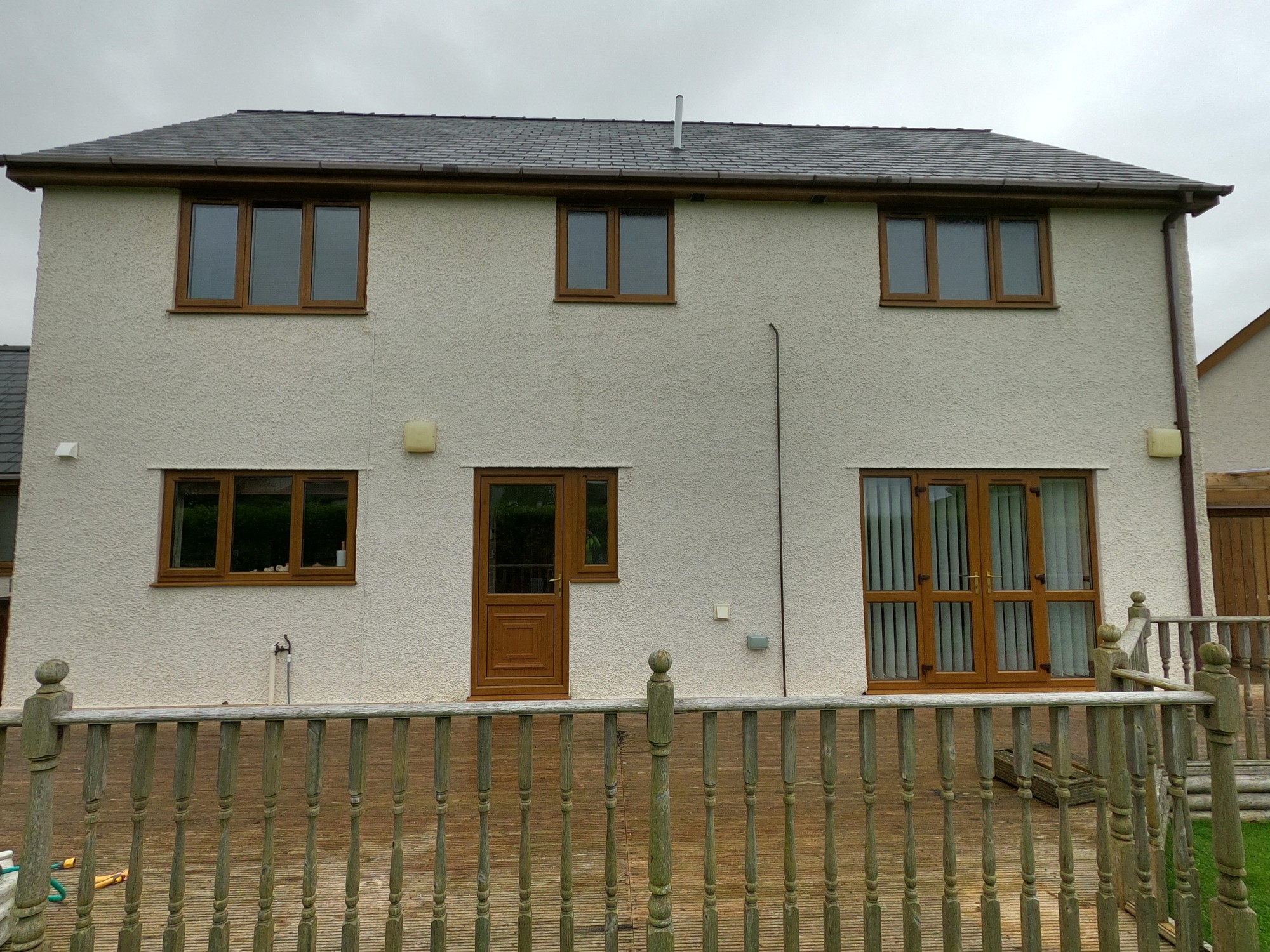
Almost every enquiry begins with the front of a house, and almost every assessment finds the real problem somewhere else. The elevation people look at is usually the one that dries best, because it faces a road, catches light and has nothing growing against it. The faces that need attention are the ones nobody stands in front of. A rear elevation shaded by the building itself, a side wall down a narrow passage, a gable rising above an extension roof, a return behind a garage — these are where colonisation is heaviest and where our render cleaning services spend most of the day. They are also the hardest to quote from a description, which is why an assessment walks the full perimeter rather than stopping at the frontage. A property can look entirely reasonable from the pavement and carry twenty years of growth on the far side. The treatment itself is unchanged wherever it is applied: a biocidal solution at low pressure, a long dwell so render algae removal happens at root level, then a gentle rinse. Render moss removal on the horizontal details of a shaded return is nearly always the slowest element, since those deposits have had the most consistent moisture and the least sun. Professional render cleaning of a house in Cerne Abbas is quoted on all of it or on none of it, and house render cleaning that covers only the visible faces leaves the worst of the problem untouched. Exterior render cleaning is worth doing where nobody looks quite as much as where everybody does.
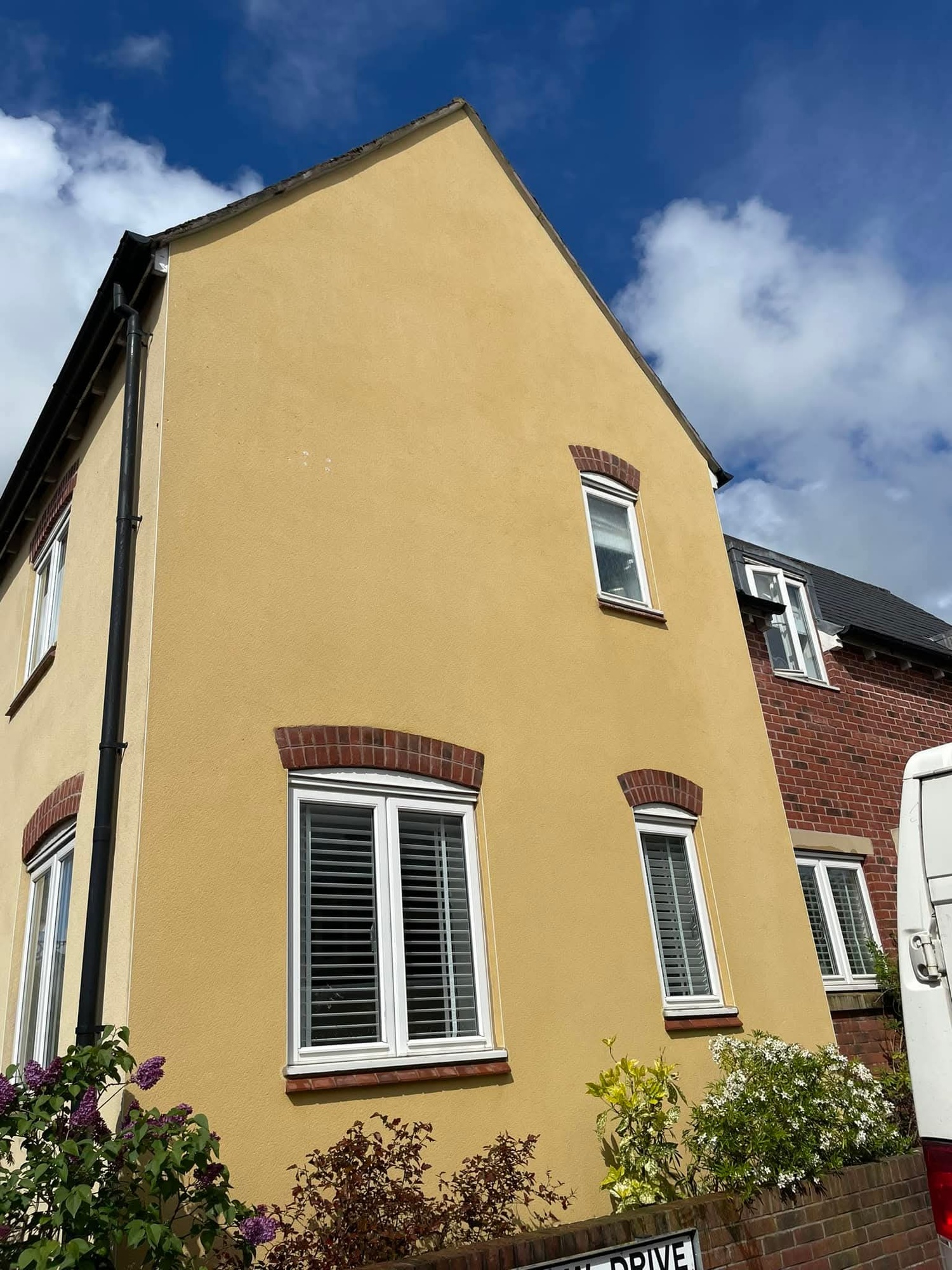
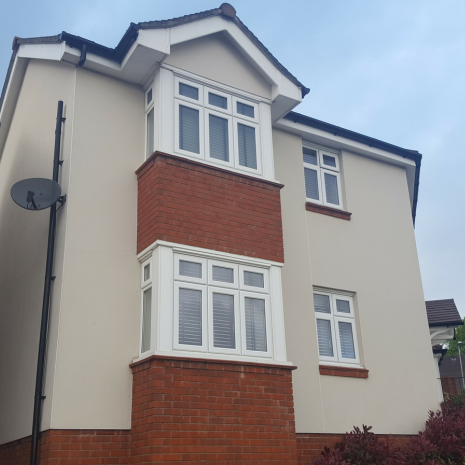

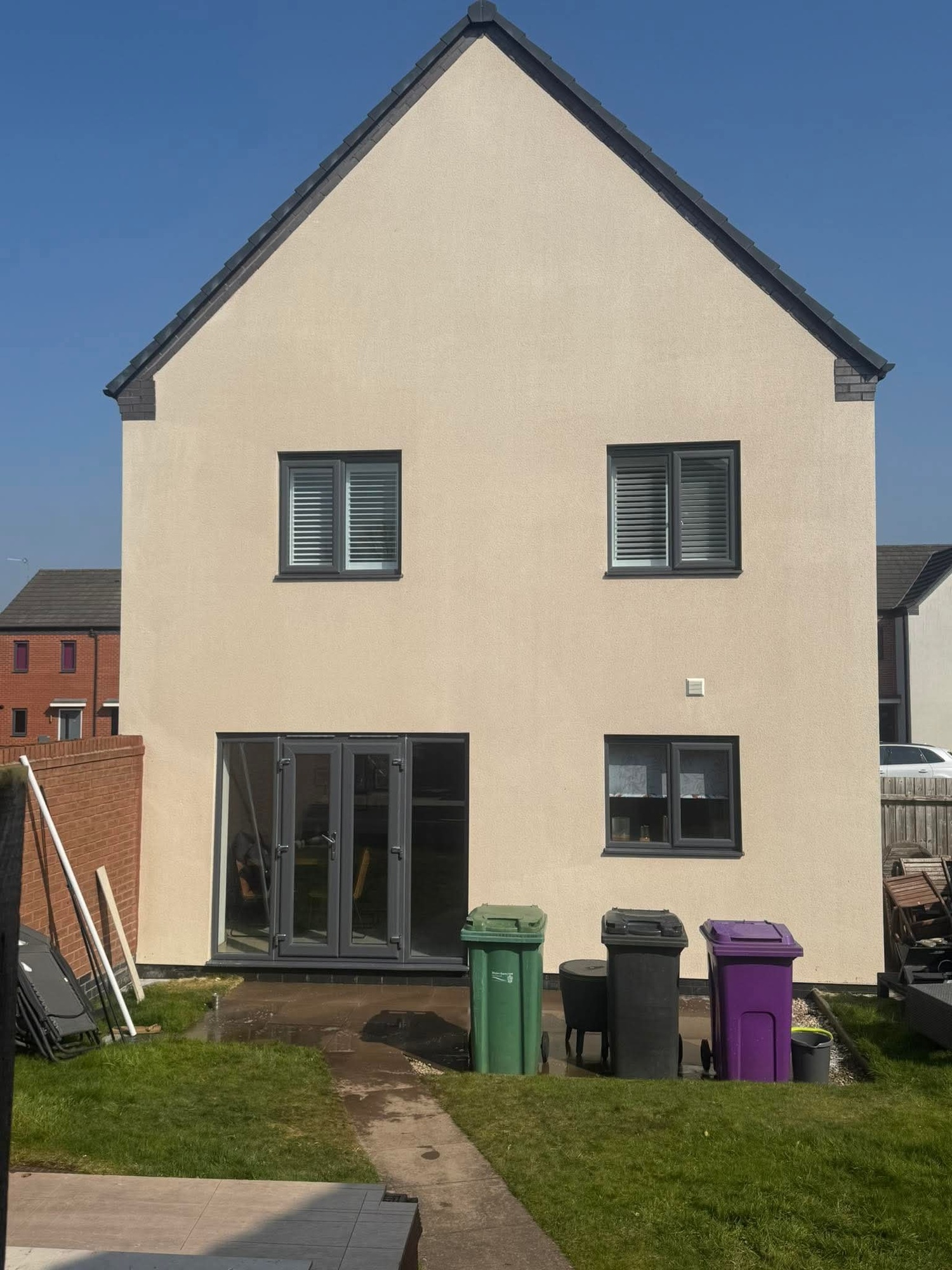
On modern housing the forgotten elevation is usually the narrow one between properties. Softwashing UK finds more heavily colonised K Rend down a side passage than anywhere else on a typical estate house: no sun reaches it, air barely moves, and the wall opposite keeps everything damp. K Rend cleaning there is frequently a bigger job than the whole of the front. It also takes the longest, because the wall never dries between applications. Working in that space is a matter of equipment rather than difficulty. Pole systems reach the full height from a position at either end, and soft wash render cleaning at a pressure barely above hose flow produces almost no drift, which matters where a boundary and another property sit a metre away. The method is otherwise standard: a biocidal solution given a long dwell to destroy algae and lichen at root level, then a gentle rinse, with no mechanical contact anywhere because pigment runs through the material and abrasion removes it permanently. Silicone render cleaning needs generous volume to keep a hydrophobic face wet, and a shaded passage usually takes the largest share of it. Volume rather than pressure is what does the work in a confined space. Render stain removal is common in those positions too, since the same walls carry outlets, brackets and boundary fixings. Iron bleed from ties and brackets, cement residue at fixing points and dark runs beneath a leaking joint each need a specific product and a test patch first. On a Cerne Abbas property those marks are set out separately from the general treatment. Boundary fixings are a common source and easy to miss.
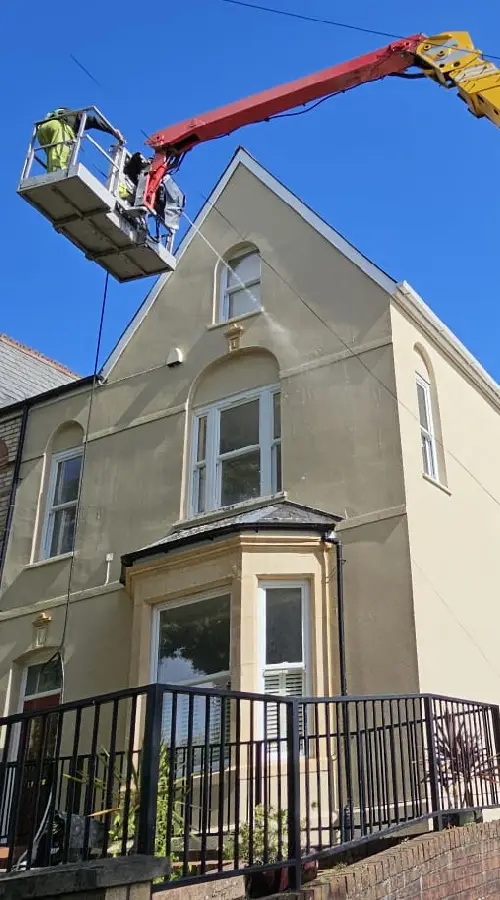
A gable rising above an extension roof is the most commonly overlooked area of monocouche on any house. It is difficult to see from the ground, difficult to reach without planning, and almost always in worse condition than anything at eye level, because water running off the roof below keeps the base of it damp. Monocouche render cleaning has to include it or the job is not finished. Leaving it produces a dark band that draws the eye to the whole building. Reaching it is settled at the assessment. Working over a roof is not something to improvise, and the quotation states how it will be done rather than leaving it to the day. Roof access is agreed in advance or the gable is reached from poles instead. The treatment is unchanged. Solution applied at low pressure in enough volume to soak through the scraped texture, a long dwell to kill growth at root level, a repeat application on the heaviest deposits along the base of the gable and any projecting band, then a soft even rinse. Render pressure washing is excluded absolutely, since it flattens the scrape, exposes the aggregate beneath and leaves permanent tracking, and coloured render cleaning offers no top coat to renew over that. Treated properly, render wall cleaning of monocouche leaves the whole building reading as one colour from every approach rather than showing a dark band above a roofline. On properties around Cerne Abbas where those upper areas had been left untouched for years, bringing them back to the specified tone is the part of a render restoration people notice most. It is also the part most other quotations quietly leave out.
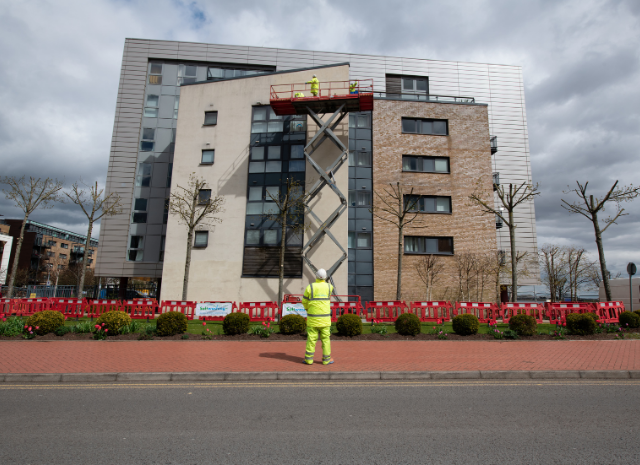

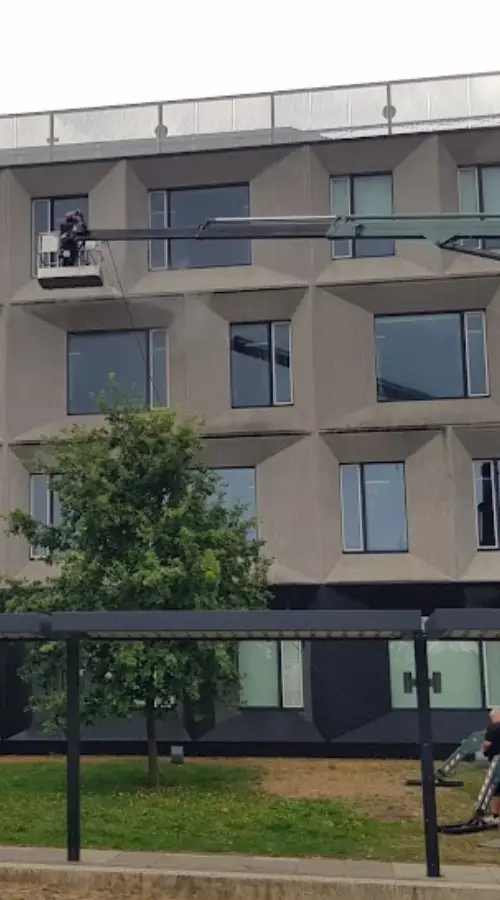
On commercial property the forgotten elevations are the ones facing a service yard, a boundary, or an adjoining building. They carry no visitors, generate no complaints and are therefore quoted last if at all, which is precisely why they end up in the worst condition on the site. Commercial render cleaning scoped only from the approach road misses most of the actual work. The elevations nobody sees are usually where the growth is. There is a practical argument for including them beyond appearance. Those faces are usually the most shaded, hold moisture longest, and are where a coating is most likely to suffer from prolonged saturation, so treating them protects the fabric rather than the frontage. That argument tends to carry more weight than appearance alone. Access is established across the whole building — powered platforms, tower scaffold or extended pole systems according to height and standing ground — with the programme written around trading hours, deliveries and staff movement, and method statements and risk assessments issued in advance. Rear elevations are often the easiest part of a programme to deliver, since the constraints around public routes and entrances do not apply. Render soft washing is used throughout, giving even coverage along a full flank, very low water volumes, run-off directable clear of entrances and parking, and negligible drift near occupied doorways. Render facade cleaning that stops at the corner of a building leaves the elevation most in need of it untreated. Render mould removal on those shaded faces sets the render maintenance interval for premises in Cerne Abbas. Everything else on the site can then be scheduled around it.
It is entirely reasonable to want only the front of a building treated, and we will quote for that. What is worth understanding first is that it rarely costs much less. Set-up, protection, travel and mobilisation are the same whether one elevation is treated or four, so the saving on a partial job is smaller than most people expect. Frequently it is a matter of a few per cent rather than half. Render cleaning prices are built element by element at an assessment from elevation count, working height, access arrangements and the extent of the growth, and the breakdown is shown so the difference between one face and the whole property is visible rather than assumed. The written render cleaning cost holds. Affordable render cleaning is very often the whole building rather than part of it, simply because the fixed costs are already being paid. The crews are render cleaning specialists rather than general exterior cleaners, and the neglected faces are where that experience matters most. A shaded return may carry lichen dense enough to need two applications while the frontage needs one, and recognising that before quoting is what keeps a job on schedule. It also prevents the awkward conversation about a return visit nobody costed. Everything used is an eco friendly render cleaning product chosen because it breaks down safely once its work is complete. Anyone comparing firms in search of the best render cleaning service should ask whether the quotation covers every elevation. A figure that only mentions the front has been produced from the pavement. It will also change once somebody walks round the back.
What prompts a call across this patch varies by the shape of the property more than by the address. Residential render cleaning at Minterne Magna and Minterne Parva is frequently triggered by a gable — the tall face that catches the eye from a distance and is usually the last part of a building anybody can reach. Gables are also where growth is heaviest, since nothing shelters them. Duntish brings more properties where the rear elevation is the problem. Those are often the ones people live with for years without registering, because they are seen from a garden rather than from a road and the change happens slowly enough to go unnoticed. A photograph from five years earlier usually settles it. Up Cerne and the more scattered addresses tend to produce enquiries about whole buildings rather than single faces, usually where a property has never been treated and every elevation has arrived at the same point together. Those are quoted as complete jobs, with any second application included in the original figure. Whole-building jobs are also the most efficient to deliver. Whatever prompts the call, the assessment covers the full perimeter rather than the elevation that was mentioned. It is common to arrive about a gable and find a shaded return in considerably worse condition, and it is better to know that before a figure is agreed. There is no travel charge, no minimum job size and no charge for the assessment. Anyone searching render cleaning near me should expect a local render cleaning company to walk the whole building before quoting for any part of it. Twenty minutes at the outset avoids most later surprises.
Most properties in Cerne Abbas benefit from professional render cleaning every 3 to 5 years, although this depends on the surrounding environment. Properties near trees, woodland, busy roads or coastal areas may require more frequent cleaning due to algae, mould and airborne contaminants. Our soft washing process removes existing growth and helps keep your render cleaner for longer.
Yes. Soft washing is specifically designed for delicate surfaces such as K-Rend, silicone render, monocouche render and painted render. Unlike high-pressure washing, it cleans at low pressure while treating biological growth at its source, reducing the risk of damage to the render finish.
We clean virtually all external render finishes, including K-Rend, Monocouche, Weber, Sto, silicone render, acrylic render, painted render, roughcast and pebble dash. Every cleaning method is tailored to the specific render type to achieve the best possible results.
Yes. Our specialist soft washing treatments are highly effective at removing green algae, red algae, black mould, mildew, lichen and other organic staining. We also apply professional biocide treatments to kill spores and slow down regrowth.
Because our process targets the biological growth rather than simply washing the surface, results typically last much longer than pressure washing alone. The exact lifespan depends on weather conditions, surrounding vegetation and the property’s location.
No. Our soft washing process is specifically designed to clean render safely. We use low-pressure application methods and specialist cleaning solutions that remove contamination without damaging the render surface when carried out by trained professionals.
The UK’s damp climate provides ideal conditions for algae, mould and other biological growth to develop on rendered surfaces. Areas with limited sunlight, nearby trees or persistent moisture are especially susceptible. Professional soft washing safely removes these contaminants and restores your property’s appearance.








































WhatsApp us