A growing number of the walls we treat are not solid at all. External wall insulation systems put a thick insulation board against the structure and finish it with a thin-coat render carried on a reinforcing mesh, and the result looks identical to any other modern elevation from the pavement. It behaves very differently under treatment, and identifying it before quoting is essential. The giveaway is usually a hollow sound when the surface is tapped, along with unusually deep window reveals and a render that finishes well proud of the original brickwork at a corner or a boundary. Our render cleaning services are specified differently once that is established, because the finish is only a few millimetres thick over a compressible board rather than over a hard substrate. The practical consequence is that pressure is out of the question entirely. There is nothing solid behind the coating to resist it, so anything forced at the surface dents, cracks or breaks the mesh line beneath. Render algae removal on these systems is achieved purely chemically, applied at low pressure and left to work. The joints between boards are the other consideration. Water driven into a mesh lap or a movement bead can travel behind the render and cause staining that appears months later, so rinsing is directed down the face rather than into any junction. Render moss removal along copings and window heads is handled with the same restraint. Professional render cleaning of a house in Charlton Marshall begins with establishing what is behind the surface, and house render cleaning on an insulated wall is a gentler job than on a traditional one. Exterior render cleaning has to suit the construction, not merely the finish.
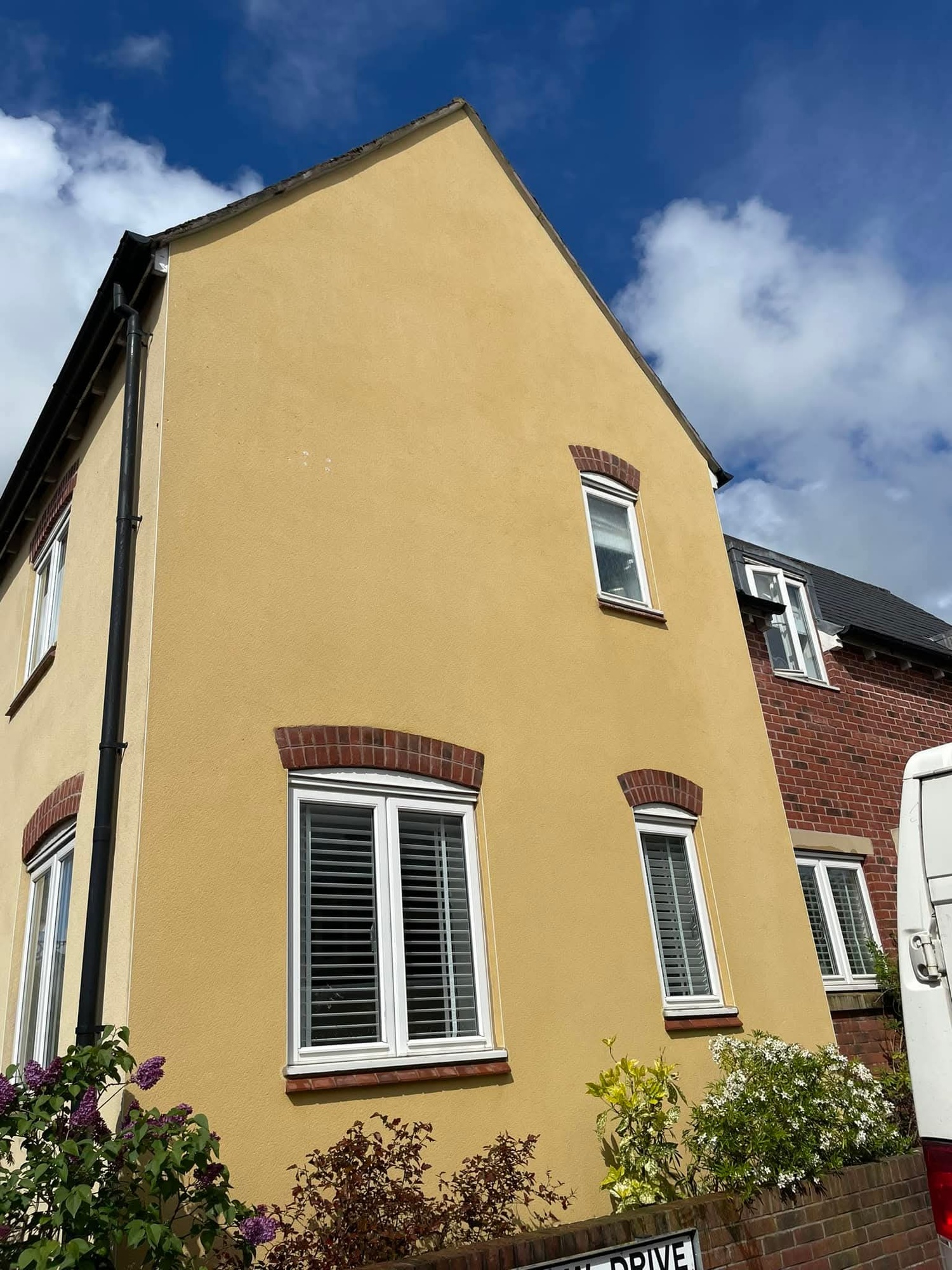
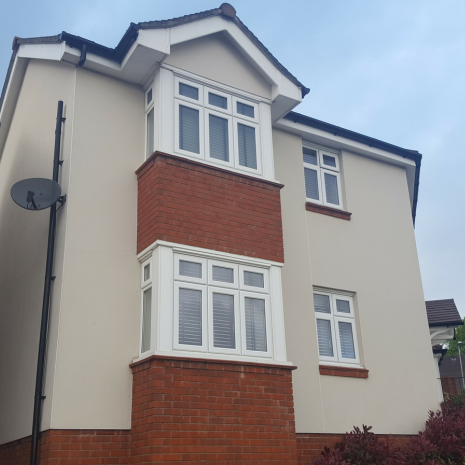

Silicone thin-coat finishes are commonly used as the top layer of an insulated system, which puts two separate constraints on the same wall. The colour runs through the material, so abrasion removes pigment permanently; and there is compressible board a few millimetres behind it, so pressure has nothing to push against. K Rend cleaning on that build-up has to be completely contact-free and completely low pressure. Soft wash render cleaning is exactly that. A biocidal solution is applied at a pressure barely above hose flow, dwells long enough to destroy algae and lichen at root level, and is then rinsed with a gentle controlled flow directed down the face. Nothing is brushed or scraped, and nothing is aimed into a joint. Every part of the sequence is chosen to keep water on the face and off the junctions. Silicone render cleaning also needs generous volume to keep a hydrophobic surface wet through the dwell, and that volume is applied evenly across a full elevation rather than concentrated wherever the growth looks worst. Render stain removal requires the most care on these systems, because a mark around a fixing very often indicates that something has penetrated the insulation behind. Iron bleed from a bracket, cement residue at an installation point and dark runs beneath a leaking joint each need a specific product and a test patch first, and where a stain appears to be coming from behind the render we will say so rather than treating the surface repeatedly. On a Charlton Marshall property that distinction is worth having before any money is spent. Repeated cleaning of a stain fed from behind achieves nothing except a recurring invoice.
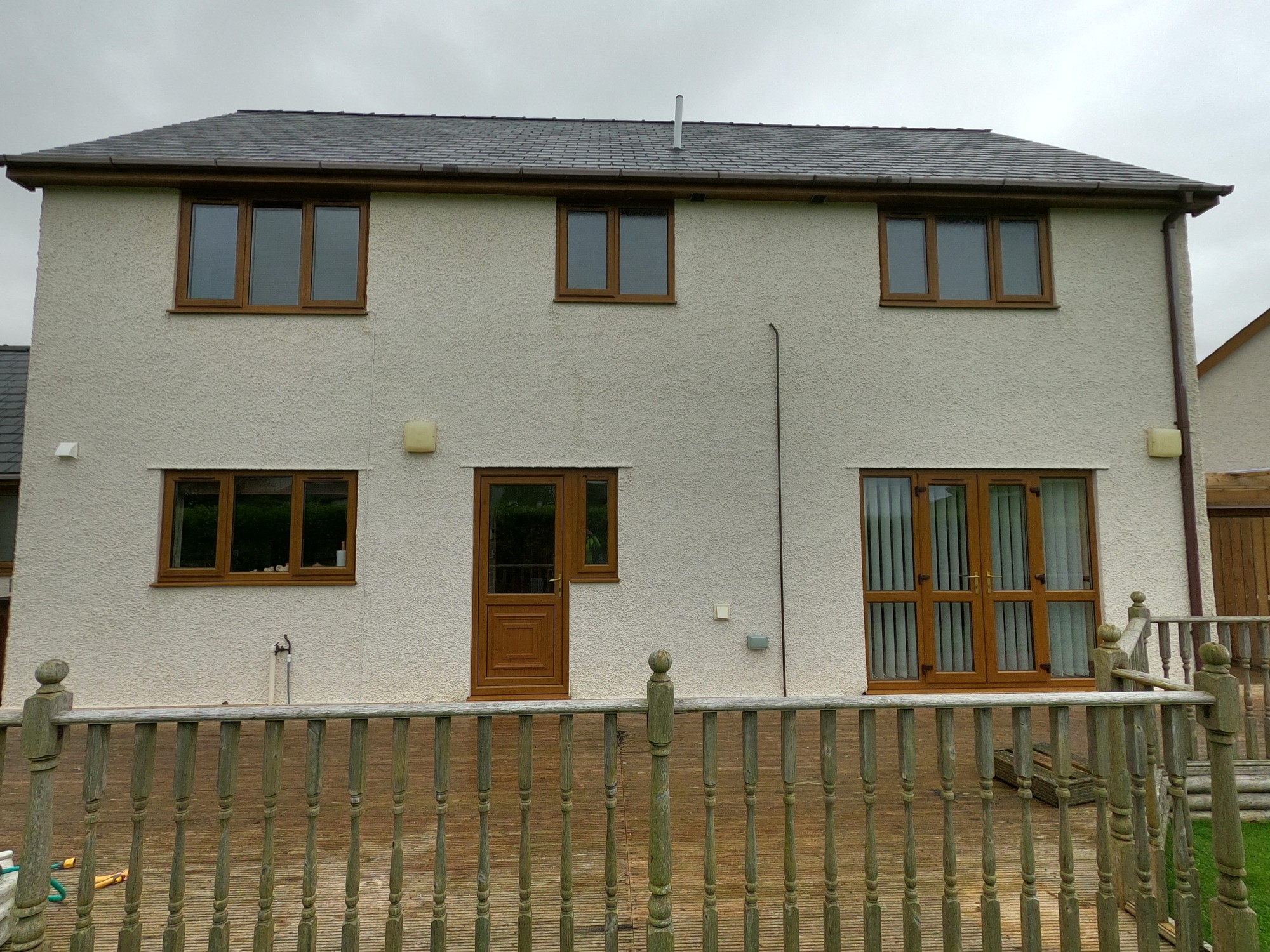
Monocouche is a solid mineral finish applied to a substrate rather than a thin coat over insulation, and telling the two apart before starting is the first thing Softwashing UK does on any scraped elevation. They look similar from a few metres away and behave differently under treatment, monocouche being thicker, harder and more absorbent while an insulated system is thinner, hollower and far more easily dented. For monocouche itself the method is well established, and Monocouche render cleaning follows the same sequence on every solid elevation. Solution goes on at low pressure in enough volume to soak through the depth of the scraped texture rather than glaze the peaks, dwells long enough to kill growth at root level, is repeated on the heaviest deposits along copings and projecting bands, and is rinsed softly and evenly across each full face. Render pressure washing is excluded on both constructions and for slightly different reasons. On monocouche it flattens the scrape, exposes the aggregate beneath and leaves permanent tracking, and coloured render cleaning offers no top coat to renew over the damage. On an insulated wall it can damage the substrate as well as the surface. Neither construction gives anything back in exchange for the speed. Where the wall is genuinely solid monocouche, render wall cleaning returns a uniform face with the texture completely unaltered. On buildings around Charlton Marshall where growth had obscured the specified colour for years, the tone recovered over the following weeks is the original one, and render restoration is a fair description of what has been achieved without adding anything to the surface. The texture is left exactly as the applicator formed it.
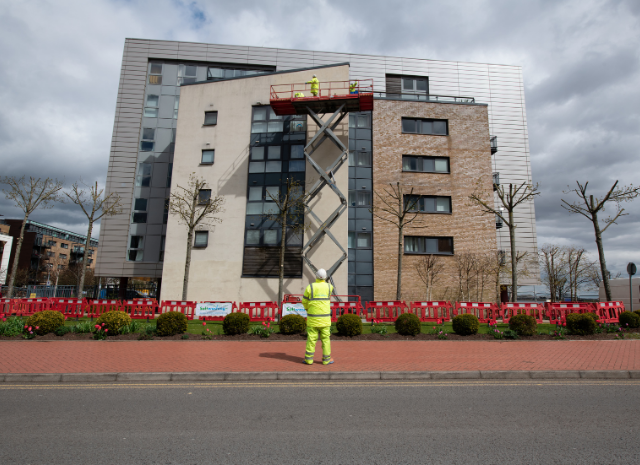

Insulated render systems are now widespread on larger buildings, from refurbished blocks to schools and offices upgraded for thermal performance, and they change how commercial render cleaning has to be specified. A thin coat over insulation board across several storeys is a large area of relatively delicate surface, and the method statement has to reflect that rather than describing a generic exterior clean. The construction is confirmed at survey and recorded, along with the location of movement joints, mesh laps and any areas where the finish has already been repaired. Access is then established — powered platforms, tower scaffold or extended pole systems according to height and standing ground — with the programme written around trading hours, deliveries and staff movement, and risk assessments issued in advance. Render soft washing is the only appropriate method on these systems. Low pressure means nothing is driven into a joint or against the board behind, very low water volumes mean minimal run-off across walkways and parking, coverage stays even along a full flank, and drift near occupied doorways is negligible. Render facade cleaning attempted with pressure equipment on an insulated elevation risks the thermal performance of the building as well as its appearance. Render mould removal on shaded and north-facing elevations remains the recurring item, and on insulated systems it tends to establish quickly because the outer surface runs cooler than a solid wall. Putting premises in Charlton Marshall onto a render maintenance cycle keeps the interval short enough that the treatment never needs to be aggressive. Short intervals and gentle work are the two things these systems most reward.
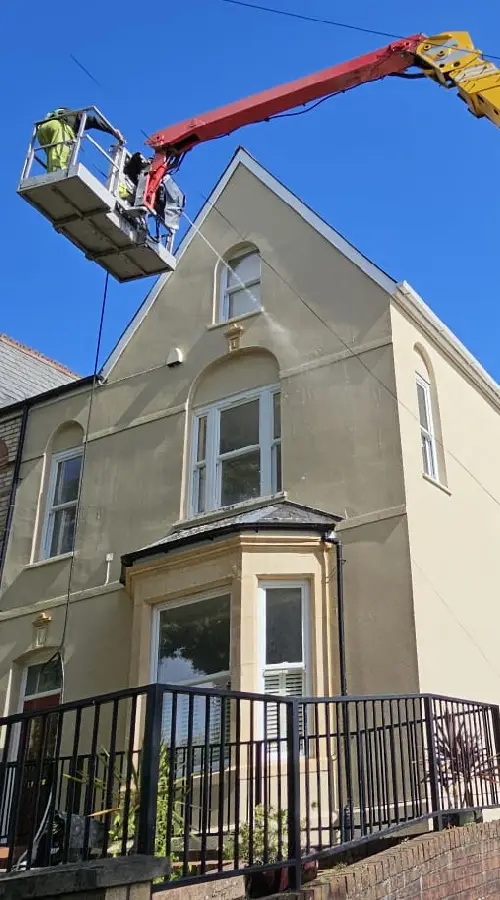
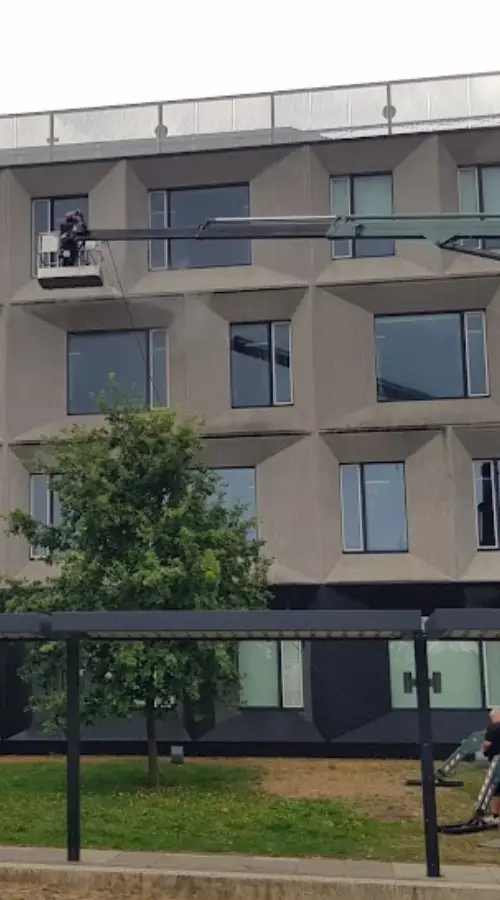
Owners of insulated render frequently do not know that is what they have, particularly where a system was fitted before they bought the property or installed under a scheme rather than chosen. It matters, because these systems usually carry a warranty and because damage to the render exposes the insulation behind it to water. The assessment establishes it before any figure is issued. Render cleaning prices are then calculated from elevation count, working height, access arrangements and the extent of the growth, with the construction recorded so the method is fixed in writing rather than decided on the day. The written render cleaning cost holds. Affordable render cleaning on this kind of wall is not about doing less; it is about not needing to put right anything damaged during the job. Remedial work on an insulated system is considerably more involved than on a solid wall. The crews are render cleaning specialists rather than general exterior cleaners, and recognising an insulated system on sight is exactly the sort of judgement that prevents an expensive mistake. So is spotting a bead that will not take handling, an overpainted section behaving unpredictably, or cracking that would carry solution behind a coating. Everything used is an eco friendly render cleaning product chosen because it breaks down safely once its work is complete. Anyone comparing firms in search of the best render cleaning service on an insulated wall should ask whether the contractor has identified the construction. A firm that has not asked the question is planning to treat it like any other elevation, which is precisely the problem. Asking it costs nothing and rules out the one mistake that cannot be undone.
Charlton Marshall sits within our regular working patch, and residential render cleaning here starts with the same question asked everywhere else: what is actually behind the finish? A great deal of housing has been upgraded with insulated render at some point, and where that has happened the method changes even though the wall looks entirely conventional. Establishing it takes a couple of minutes at the assessment. A tap along the elevation tells you most of it, deep window reveals confirm it, and the way the render finishes at a corner or against a boundary usually settles the question. Where paperwork from an installation exists it is worth having to hand, though it is by no means essential. The wall itself answers the question well enough in almost every case. Once known, the specification is written accordingly and stated in the quotation, so there is no possibility of a crew arriving and treating an insulated wall as though it were solid. That single step prevents the most expensive mistake available on this type of construction. It also means the quotation describes a job that can actually be delivered as written. There is no travel charge, no minimum job size and no charge for the assessment itself, and a single elevation is quoted on exactly the same basis as a full property. Anyone searching render cleaning near me should expect the construction to be identified before a figure is given, and a local render cleaning company that has not asked what is behind your render has not yet quoted for the job in front of it. The question takes seconds and changes everything that follows.
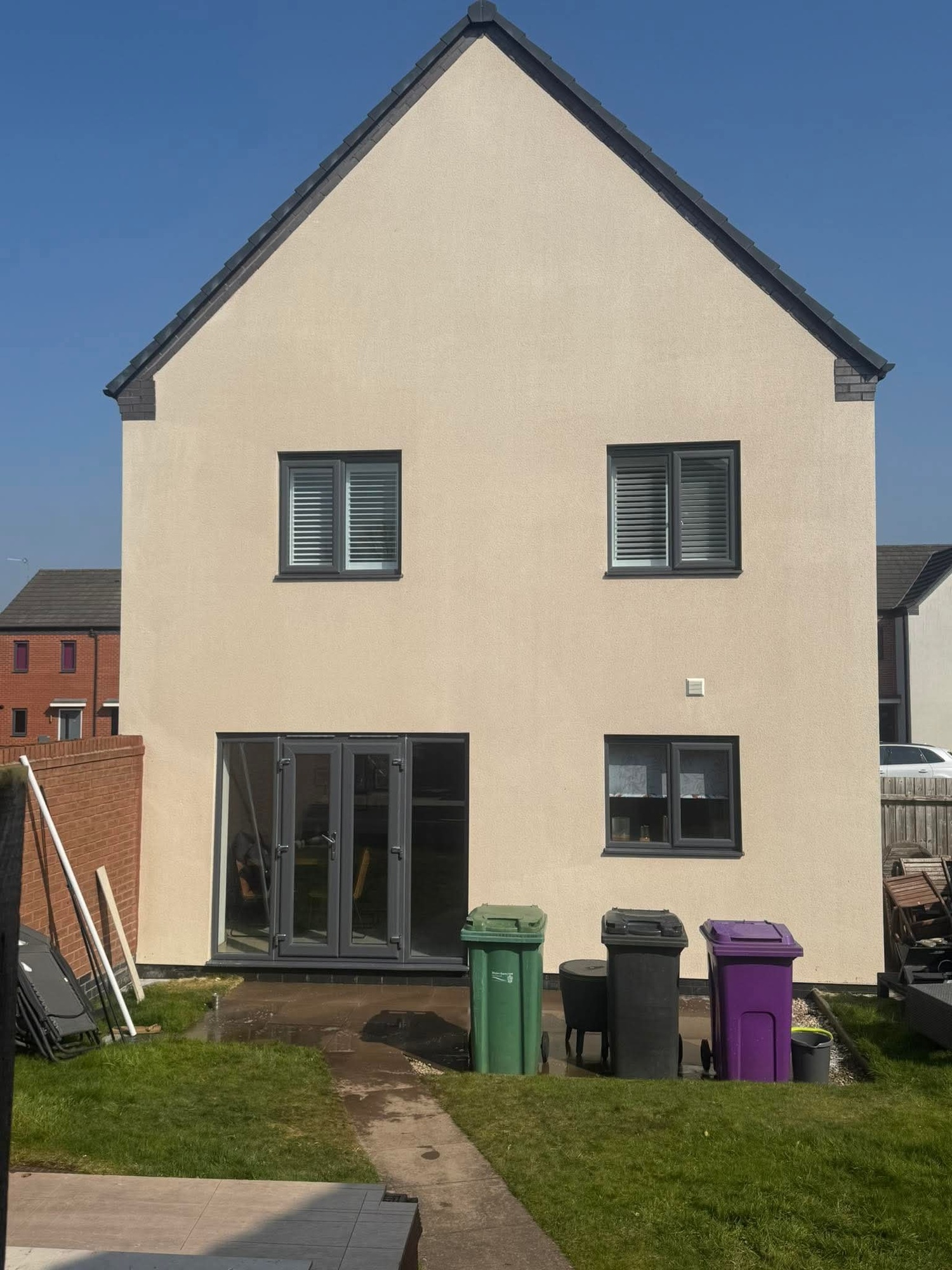
Most properties in Charlton Marshall benefit from professional render cleaning every 3 to 5 years, although this depends on the surrounding environment. Properties near trees, woodland, busy roads or coastal areas may require more frequent cleaning due to algae, mould and airborne contaminants. Our soft washing process removes existing growth and helps keep your render cleaner for longer.
Yes. Soft washing is specifically designed for delicate surfaces such as K-Rend, silicone render, monocouche render and painted render. Unlike high-pressure washing, it cleans at low pressure while treating biological growth at its source, reducing the risk of damage to the render finish.
We clean virtually all external render finishes, including K-Rend, Monocouche, Weber, Sto, silicone render, acrylic render, painted render, roughcast and pebble dash. Every cleaning method is tailored to the specific render type to achieve the best possible results.
Yes. Our specialist soft washing treatments are highly effective at removing green algae, red algae, black mould, mildew, lichen and other organic staining. We also apply professional biocide treatments to kill spores and slow down regrowth.
Because our process targets the biological growth rather than simply washing the surface, results typically last much longer than pressure washing alone. The exact lifespan depends on weather conditions, surrounding vegetation and the property’s location.
No. Our soft washing process is specifically designed to clean render safely. We use low-pressure application methods and specialist cleaning solutions that remove contamination without damaging the render surface when carried out by trained professionals.
The UK’s damp climate provides ideal conditions for algae, mould and other biological growth to develop on rendered surfaces. Areas with limited sunlight, nearby trees or persistent moisture are especially susceptible. Professional soft washing safely removes these contaminants and restores your property’s appearance.





































WhatsApp us