


Render has become one of the most popular exterior finishes on residential and commercial properties throughout the UK. Its clean appearance, modern aesthetics and weather-resistant properties make it a preferred choice for homeowners, developers and property managers alike. However, one of the biggest challenges facing rendered surfaces is algae growth.
Over time, render can become stained by biological contamination, leaving walls covered in unsightly green, red, black or orange discolouration. These stains not only affect kerb appeal but can also create the impression that a property is poorly maintained.
Soft washing has emerged as the leading solution for tackling algae contamination on render because it addresses the root cause of the problem rather than simply removing surface staining. By understanding how soft washing works and why it is so effective, property owners can make informed decisions about maintaining and protecting their rendered surfaces.
For specialist render cleaning services, Soft Washing UK provides professional soft washing treatments designed specifically to remove algae and restore render safely and effectively.
Understanding Algae Growth on Render
Algae are microscopic organisms that thrive in damp environments. Although they are often associated with ponds and waterways, algae can also grow on exterior building surfaces where moisture is present.
Render provides an ideal environment for algae because:
- It can retain moisture.
- It often contains microscopic pores.
- Shaded elevations remain damp for longer periods.
- Airborne spores settle easily on the surface.
- Rainwater provides a regular source of moisture.
Once algae become established, they begin reproducing and spreading across the render surface.
Types of Algae Found on Render
Several types of algae can affect rendered properties throughout the UK.
The most common include:
| Algae Type | Appearance |
|---|---|
| Green algae | Green streaks and patches |
| Red algae | Red, pink or orange staining |
| Black algae | Dark surface discolouration |
| Surface biofilm algae | Slimy staining and deposits |
Green algae and red algae are particularly common on modern render systems.
Both can spread rapidly if left untreated.
Why Green Algae and Red Algae Are a Growing Problem
Many homeowners first notice algae as small patches of discolouration.
Initially, the problem may appear minor.
However, algae reproduce quickly under suitable conditions.
Green Algae
Green algae commonly develop on:
- North-facing walls
- Garden-facing elevations
- Shaded render
- Damp surfaces
They often appear as:
- Green staining
- Dark streaking
- Patchy discolouration
Red Algae
Red algae are becoming increasingly common on rendered properties across the UK. This distinctive red or orange staining is typically caused by algae from the genus Trentepohlia, which thrives on damp exterior surfaces. Areas exposed to moisture, shade, and airborne contamination are particularly susceptible, making professional cleaning and preventative treatments important for maintaining the appearance of rendered walls.
They frequently appear as:
- Pink streaks
- Red patches
- Orange discolouration
- Rust-coloured staining
Unlike ordinary dirt, both green algae and red algae are living organisms that continue growing unless properly treated.
Why Algae Grow Faster on Modern Render
Modern render systems are designed to improve weather resistance and aesthetics.
Popular render types include:
- Silicone render
- Monocouche render
- Acrylic render
- Mineral render
- Cement render
Although highly durable, these surfaces can still support algae growth.
Factors contributing to contamination include:
| Growth Factor | Effect |
|---|---|
| Moisture | Encourages reproduction |
| Shade | Reduces drying time |
| Organic debris | Provides nutrients |
| Humidity | Supports colony growth |
| Airborne spores | Introduces contamination |
Understanding these factors helps explain why algae continue returning when not properly treated.
What Happens When Algae Colonise Render?
Algae do more than create visible staining.
As colonies expand, they form protective layers known as biofilms.
These biofilms:
- Retain moisture
- Trap dirt particles
- Protect algae cells
- Encourage further growth
- Increase staining
The longer algae remain on the surface, the more established the contamination becomes.
This is why early intervention is beneficial.
Why Traditional Cleaning Often Fails
Many property owners attempt to remove algae using basic cleaning techniques.
Common approaches include:
- Pressure washing
- Scrubbing
- Domestic detergents
- Garden hose rinsing
While these methods may temporarily improve appearance, they often fail to eliminate the underlying biological contamination.
The result is frequently:
- Rapid regrowth
- Recurring staining
- Ongoing maintenance
This occurs because visible staining is only part of the problem.
The algae cells responsible for the contamination often remain alive beneath the surface.
What Is Soft Washing?
Soft washing is a specialist exterior cleaning method that uses low-pressure application combined with professional cleaning treatments.
Unlike high-pressure cleaning, soft washing focuses on destroying biological contamination rather than relying on force.
The process is designed to:
- Remove algae
- Eliminate mould
- Treat mildew
- Reduce regrowth
- Restore appearance
This scientific approach makes soft washing particularly effective for render cleaning.
How Soft Washing Removes Algae
The success of soft washing comes from its ability to attack algae at a cellular level.
Instead of simply washing away visible growth, the treatment targets the organism itself.
The process typically involves:
- Inspection
- Preparation
- Treatment application
- Biological breakdown
- Surface restoration
Each stage contributes to long-lasting results.
Stage One: Inspection and Assessment
Every render cleaning project begins with a detailed assessment.
The inspection identifies:
- Render type
- Algae species
- Contamination severity
- Access requirements
- Surface condition
This information helps determine the most appropriate treatment strategy.
Stage Two: Surface Preparation
Before treatment begins, loose contamination may be removed.
This can include:
- Organic debris
- Surface dirt
- Moss deposits
- Vegetation build-up
Preparation ensures maximum contact between the treatment and the algae colonies.
Stage Three: Application of Soft Washing Treatment
Specialist solutions are applied using low-pressure equipment.
Low pressure is important because it protects delicate render finishes.
Benefits include:
| Low Pressure Advantage | Benefit |
|---|---|
| Reduced abrasion | Protects render |
| Lower water penetration risk | Preserves integrity |
| Even coverage | Better treatment performance |
| Improved safety | Minimises damage risk |
The cleaning solution performs the work rather than mechanical force.
Stage Four: Penetrating the Biofilm
One of the most important scientific aspects of soft washing is biofilm disruption.
Biofilms act as protective barriers around algae colonies.
They help algae:
- Retain moisture
- Resist environmental stress
- Collect nutrients
- Continue spreading
Soft washing treatments penetrate these protective layers.
Once disrupted, the algae become vulnerable.
Stage Five: Destroying Algae Cells
After penetrating the biofilm, the treatment begins attacking the algae itself.
The cleaning solution works by:
- Damaging cell walls
- Interrupting cellular processes
- Preventing reproduction
- Breaking down contamination
This process affects both green algae and red algae.
Because the organisms are destroyed rather than merely displaced, regrowth is significantly reduced.
The Science of Oxidation
A key scientific principle involved in soft washing is oxidation.
Oxidation occurs when molecules undergo chemical reactions that alter their structure.
In algae removal, oxidation helps:
- Destroy organic matter
- Break down staining
- Eliminate microorganisms
- Restore surface appearance
The oxidation process continues working after application, providing ongoing treatment benefits.
Why Soft Washing Lasts Longer
One reason soft washing has become so popular is its longevity.
Traditional cleaning methods often focus only on removing visible contamination.
Soft washing goes further by:
- Killing algae
- Destroying spores
- Treating biofilms
- Reducing future colonisation
This comprehensive approach generally produces longer-lasting results.
Why Pressure Washing Alone Is Not Enough
Pressure washing can remove visible algae.
However, appearance and elimination are not the same thing.
Pressure washing frequently:
- Leaves microscopic contamination behind
- Fails to kill algae cells
- Allows rapid recolonisation
- Creates uneven cleaning results
Soft washing addresses these shortcomings by targeting the biological source.
Protecting Delicate Render Surfaces
Modern render systems can be costly to repair.
Repair costs may include:
| Repair Type | Typical Cost Range |
|---|---|
| Local render repair | £250–£1,000 VAT |
| Large area repairs | £1,000–£5,000+ VAT |
| Re-rendering sections | £2,000–£10,000+ VAT |
| Full property rendering | £8,000–£25,000+ VAT |
Soft washing helps minimise unnecessary wear by avoiding excessive cleaning pressures.
Environmental Conditions That Encourage Algae
The UK climate provides ideal conditions for algae growth.
Common contributing factors include:
- Frequent rainfall
- High humidity
- Mild temperatures
- Limited sunlight
- Poor airflow
Properties located near:
- Trees
- Rivers
- Woodland
- Coastal areas
often experience more significant algae contamination.
Why North-Facing Walls Suffer Most
North-facing elevations frequently show the first signs of algae growth.
This occurs because they receive less direct sunlight.
As a result:
- Moisture remains longer.
- Drying times increase.
- Algae reproduce more easily.
Both green algae and red algae commonly establish colonies on these elevations.
Can Algae Damage Render?
While algae are often considered primarily cosmetic, long-term contamination can contribute to deterioration.
Potential issues include:
- Persistent moisture retention
- Increased staining
- Surface discolouration
- Reduced visual appeal
Keeping algae under control forms an important part of preventative property maintenance.
Soft Washing Different Types of Render
Professional soft washing can be adapted to suit various render systems.
| Render Type | Suitable for Soft Washing |
|---|---|
| Silicone Render | Yes |
| Monocouche Render | Yes |
| Acrylic Render | Yes |
| Mineral Render | Yes |
| Cement Render | Yes |
| Lime Render | Yes |
Each surface requires an appropriate treatment approach.
Why Professional Application Matters
Successful algae removal requires more than simply applying a cleaning solution.
Professionals must consider:
- Surface porosity
- Contamination levels
- Environmental conditions
- Dwell times
- Treatment compatibility
These factors influence the effectiveness of the cleaning process.
How Soft Washing Helps Prevent Regrowth
Algae spores are naturally present in the environment.
Complete elimination is impossible.
However, soft washing helps reduce regrowth by:
- Destroying active colonies
- Removing established contamination
- Treating biological residues
- Limiting reproduction
This creates a cleaner surface for a longer period.
The Importance of Routine Maintenance
Regular maintenance can prevent severe contamination.
Benefits include:
- Improved appearance
- Lower cleaning costs
- Easier maintenance
- Reduced staining
- Longer-lasting render finishes
Many property owners choose periodic soft washing treatments as part of a preventative maintenance programme.
Commercial Benefits of Algae Removal
For businesses, building appearance can influence customer perceptions.
Clean render can help create:
- Professional presentation
- Positive first impressions
- Improved brand image
- Better property aesthetics
Commercial properties commonly benefiting from soft washing include:
- Offices
- Schools
- Retail units
- Hotels
- Care facilities
- Apartment developments
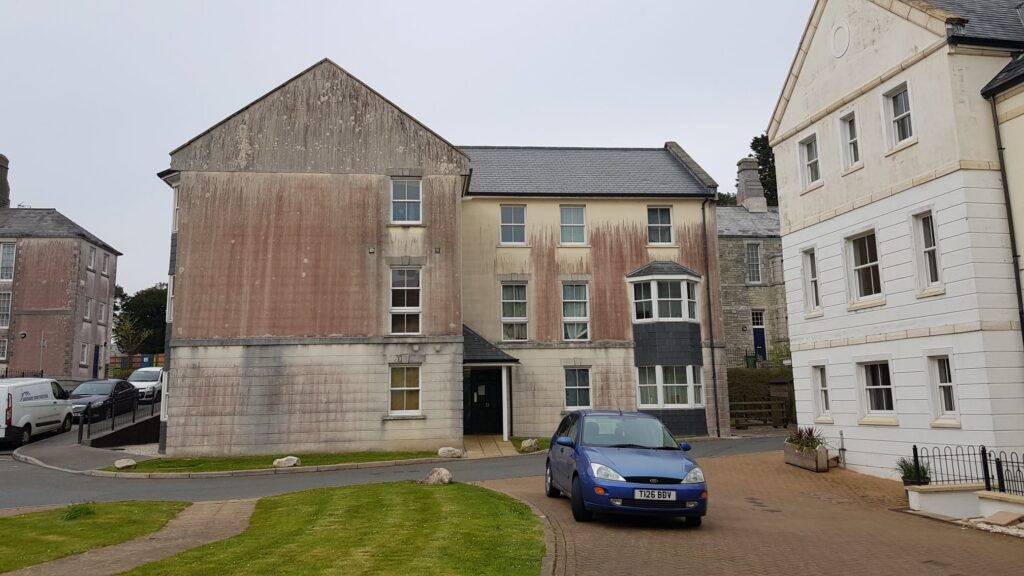
Signs Your Render Needs Soft Washing
Indicators that algae treatment may be required include:
- Green streaks
- Red staining
- Orange patches
- Dark discolouration
- Uneven colouring
- Persistent damp appearance
Early treatment often produces the best outcomes.
Why Soft Washing Is Suitable for Modern Render Systems
Modern render systems are designed for longevity and appearance.
Soft washing complements these objectives because it:
- Cleans effectively
- Protects finishes
- Reduces biological growth
- Minimises surface stress
Its combination of science-based treatment and low-pressure application makes it one of the safest methods available for algae removal.
Frequently Asked Questions About Algae Removal from Render
Does soft washing remove green algae and red algae?
Yes. Professional soft washing treatments are specifically designed to target both green algae and red algae, helping restore render surfaces and reduce future growth.
How long does algae removal last?
Results vary depending on environmental conditions, surrounding vegetation and moisture levels. However, because soft washing addresses the biological source of contamination, results often last significantly longer than cleaning methods focused solely on surface appearance.
Is soft washing safe for coloured render?
Yes. Soft washing is widely used on coloured render systems because it relies on low-pressure application rather than aggressive mechanical cleaning.
Will algae return after treatment?
Algae spores are naturally present in the environment. While no treatment can permanently prevent future contamination, soft washing helps reduce regrowth by eliminating active colonies and treating biological residues.
Why is professional treatment recommended?
Professional assessment ensures the correct treatment is selected for the render type, contamination level and environmental conditions, helping achieve optimal results while protecting the surface.
Seasonal Factors That Influence Algae Growth on Render
Algae activity on render is heavily influenced by seasonal weather patterns. Understanding how different times of year affect contamination can help property owners identify the most appropriate time to arrange professional soft washing treatments.
During autumn and winter, increased rainfall and reduced daylight hours create ideal conditions for both green algae and red algae to develop. Surfaces remain damp for longer periods, allowing biological colonies to expand and spread across rendered elevations.
Spring often reveals the full extent of contamination that has developed during the colder months. Many homeowners first notice green streaking, red staining and patchy discolouration as weather conditions improve and natural light highlights affected areas.
| Season | Impact on Algae Growth |
|---|---|
| Spring | Existing contamination becomes more visible |
| Summer | Growth may slow on sunlit elevations |
| Autumn | Increased moisture encourages development |
| Winter | Damp conditions support colony expansion |
Properties surrounded by trees can experience additional challenges because falling leaves and organic debris provide nutrients that support algae growth. Combined with persistent moisture, this creates an environment where contamination can become established more quickly.
Soft washing helps address these seasonal influences by removing active algae colonies and treating the biological contamination responsible for staining. By targeting the source of the problem rather than simply cleaning the surface, the treatment helps maintain a cleaner appearance throughout changing weather conditions.
Regular inspections following periods of prolonged rainfall can also help identify early signs of green algae and red algae before widespread staining develops across the render surface.