


For many homeowners, one of the first questions about soft washing is not whether it will get the house clean. It is whether the cleaning process could affect the dog, cat, lawn, flower beds or carefully maintained garden surrounding the property.
It is a sensible question.
Professional soft washing can involve specialist cleaning solutions designed to remove organic contamination from render, roofs and other exterior surfaces. These products need to be handled correctly, and some can potentially harm vegetation or irritate animals if they are allowed to come into direct contact with concentrated or freshly applied cleaning solutions.
However, that does not mean homeowners with pets or gardens need to avoid soft washing.
When carried out professionally, the process includes planning how cleaning solutions will be applied, controlling overspray and run-off, protecting sensitive vegetation and keeping pets away from the active working area.
Softwashing UK provides professional exterior cleaning services where the cleaning process can be planned around the property and its surroundings rather than simply concentrating on the wall or roof being cleaned.

Is Soft Washing Safe Around Pets?
Pets should not be allowed into an area while softwashing chemicals are actively being applied.
This is one of the simplest precautions homeowners can take.
Dogs and cats are naturally curious. A dog could walk through a freshly treated area before licking its paws, while an outdoor cat could move through vegetation close to the building.
Keeping animals indoors or securely away from the working zone prevents unnecessary exposure.
| Pet consideration | Sensible precaution |
|---|---|
| Dogs | Keep indoors or away from the treatment area |
| Cats | Keep inside where practical during active treatment |
| Rabbits | Move runs away from potential spray and run-off |
| Guinea pigs | Relocate outdoor enclosures during work |
| Chickens | Prevent access to treatment and run-off areas |
| Fish | Protect ponds from chemicals and run-off |
| Other outdoor pets | Discuss them with the contractor beforehand |
Professional exterior cleaning should include identifying areas where animals could potentially come into contact with cleaning products.
Tell Your Softwashing Company About Your Pets
Homeowners should tell their cleaning contractor about animals before work begins.
This is particularly important where pets have access to gardens or other external areas surrounding the building.
Do not assume the contractor knows there is a rabbit run behind the shed or a tortoise living in an enclosure beside the house.
The more information available before the work starts, the easier it is to plan appropriate precautions.
If your pet has unusual access requirements, discuss these when arranging your professional softwashing service.
What About Dogs Walking on the Lawn Afterwards?
The relevant consideration is whether cleaning solution or run-off is still present.
A professionally managed softwashing job should include appropriate rinsing and control measures based on the products being used.
Customers should follow the contractor’s instructions about when animals can safely return to treated or surrounding areas.
Rather than assuming a fixed period applies to every softwashing job, ask the contractor. Different products, concentrations, surfaces and site conditions can affect the appropriate precautions.
Can Softwashing Chemicals Harm Plants?
Some cleaning chemicals can damage plants if they are exposed to inappropriate concentrations.
This is why vegetation protection is an important part of professional soft washing.
Plants surrounding a house can include everything from hardy established shrubs to delicate flowers and expensive ornamental trees.
They should not simply be ignored while the building is treated.
Potential problems can arise from:
- direct overspray;
- concentrated chemical run-off;
- chemicals collecting around roots;
- insufficient rinsing;
- treatment being applied during strong winds;
- sensitive plants sitting immediately against the building.
Professional cleaning involves recognising these risks and managing them.
Pre-Wetting Plants Can Help Protect Them
One technique used when appropriate is wetting vegetation with clean water before chemical application.
The objective is to ensure plants are already wet before there is any possibility of incidental exposure.
Vegetation can also be rinsed during and following treatment where necessary.
This sounds like a small detail, but it demonstrates the difference between controlled softwashing and someone simply spraying cleaning chemicals around a property.
| Stage | Plant protection consideration |
|---|---|
| Before treatment | Identify vulnerable vegetation |
| Preparation | Move pots where practical |
| Pre-treatment | Wet appropriate plants and surrounding areas |
| Application | Control spray and overspray |
| During treatment | Monitor run-off |
| After treatment | Rinse vegetation where appropriate |
| Completion | Check surrounding areas |
The exact procedure will depend on the property, product and plants involved.
What About Delicate Plants?
Some gardens require considerably more care than others.
A property surrounded by established hedges and lawn is different from a house with delicate ornamental planting immediately underneath every rendered wall.
Where particularly valuable, unusual or sensitive plants are present, tell the contractor.
Some plants may need additional protection.
Potted plants can often simply be moved temporarily away from the building.
Other vegetation may require controlled covering or additional rinsing.
However, covering plants is not automatically appropriate in every situation. Leaving vegetation underneath plastic sheeting during hot weather can itself cause damage.
Professional judgement is therefore important.
Lawns Need Protection Too
It is easy to concentrate on flowers and shrubs while forgetting the lawn.
Cleaning solution repeatedly running onto the same patch of grass can potentially cause discolouration or damage.
A professional contractor should therefore consider where water and cleaning products will travel.
This becomes particularly important when cleaning large elevations or roofs where significant quantities of liquid may eventually reach ground level.
The objective is to avoid concentrated chemical exposure.
What About Artificial Grass?
Artificial grass does not have living roots or leaves, but that does not mean it should automatically be treated as chemically resistant.
Products vary in their materials, backing and colour stability.
Cleaning chemicals should therefore not simply be allowed to accumulate on artificial lawns.
Where artificial grass sits directly beside the property, it should be identified as part of the site assessment and protected or rinsed as appropriate.
Fish Ponds Need Particular Care
A fish pond is one of the most important features to tell a softwashing contractor about.
Cleaning chemicals must not be allowed to enter ponds or watercourses.
A pond close to a house may be vulnerable to direct overspray, wind-carried droplets or run-off from treated surfaces.
Additional precautions may therefore be necessary.
This is particularly important because simply diluting a chemical does not mean it is appropriate to allow it to enter an aquatic environment.
If you have a pond, make it clear when requesting your quotation rather than waiting until the team arrives.
What About Vegetable Gardens?
Vegetable beds, herb gardens and fruit-growing areas should also be identified before treatment.
Where edible crops are close to the building, avoiding unnecessary chemical contact is particularly important.
Depending on their location, it may be possible to protect the area, control application or modify the working method.
Portable pots and containers can also be relocated temporarily.
Professional exterior cleaning is about adapting the process to the property rather than expecting every homeowner to redesign their garden around the cleaning company.
Why Does Soft Washing Need Chemicals?
If cleaning solutions require precautions around plants and animals, homeowners may reasonably wonder why they are used at all.
The answer lies in what soft washing is designed to remove.
Exterior surfaces can become affected by biological contamination, including mould, lichen, black staining, green algae and red algae.
Rather than relying primarily on extremely high water pressure to physically blast this contamination from a surface, softwashing uses suitable treatments to address organic contamination at much lower pressure.
This can be particularly valuable on surfaces such as render where unnecessarily aggressive pressure may be inappropriate.
Softwashing UK specialises in professional low-pressure exterior cleaning designed around the surface and contamination being treated.
Low Pressure Does Not Mean Zero Precautions
The word “soft” describes the cleaning approach, but homeowners should not interpret it as meaning no safety controls are necessary.
Professional softwashing chemicals still require responsible handling.
The contractor should understand:
| Consideration | Why it matters |
|---|---|
| Chemical concentration | Excessively strong solutions can increase risks |
| Surface compatibility | Not every product suits every material |
| Vegetation | Overspray and run-off need controlling |
| Pets | Animals should remain outside active work areas |
| Ponds | Chemical entry must be prevented |
| Weather | Wind can increase spray drift |
| Drainage | Run-off needs consideration |
| PPE | Operators need appropriate protection |
The cleaning process is “soft” because it reduces reliance on aggressive mechanical pressure, not because the products can be handled carelessly.
Wind Is Particularly Important Around Gardens
Wind can turn an otherwise controlled application into a much more difficult situation.
Spray intended for a rendered wall can be carried towards nearby vegetation.
That may include neighbouring gardens as well as the customer’s own plants.
Professional contractors therefore need to monitor wind conditions and adjust their working method accordingly.
There may be occasions where postponing work is preferable to attempting to continue in unsuitable conditions.
Protecting the surrounding property should take priority over finishing the job as quickly as possible.
Run-Off Is Just as Important as Overspray
People often imagine plant damage occurring because a contractor directly sprays a flower with cleaning solution.
Run-off can be equally important.
Treatment applied several metres above ground eventually has to go somewhere.
Architectural features, gutters, roofs and walls can concentrate liquid into particular areas.
If that liquid repeatedly collects in one flower bed, additional protection or dilution may be required.
Experienced contractors consider where liquids are travelling throughout the job rather than only where the spray nozzle is pointing.
What if Plants Grow Directly Against the Wall?
Climbing plants and vegetation growing directly against a property can make exterior cleaning considerably more complicated.
Examples include:
- roses;
- wisteria;
- ivy;
- clematis;
- climbing hydrangea;
- established shrubs;
- trained fruit trees.
These plants cannot necessarily be moved.
The contractor therefore needs to assess whether they can be protected adequately while still accessing the surface requiring treatment.
Customers should mention particularly valuable or established plants when requesting a quotation.
Why DIY Soft Washing Can Be Riskier for Gardens
One of the biggest dangers of DIY exterior chemical cleaning is assuming that dilution and application can simply be guessed.
Someone might buy a concentrated cleaning product online, estimate the mixture and begin spraying.
If the result is not immediate, the natural temptation can be to make the next batch stronger.
That is not how professional chemical cleaning should be approached.
Too much product, uncontrolled application and inadequate rinsing can unnecessarily increase risks to vegetation and surrounding materials.
Professional softwashing from Softwashing UK removes the need for homeowners to experiment with chemical concentrations around their property.
Is Soft Washing More Expensive When Gardens Need Protection?
Potentially, because complicated sites can require more preparation and labour.
A straightforward property surrounded by paving may be quicker to prepare than a building surrounded by extensive landscaped gardens, ponds and sensitive vegetation.
The overall quotation can therefore reflect more than the number of square metres being cleaned.
| Property feature | Potential effect on job |
|---|---|
| Open paved surroundings | Relatively straightforward access |
| Large lawn | Run-off management required |
| Extensive flower beds | Additional protection and rinsing |
| Numerous potted plants | Preparation time may increase |
| Fish pond | Significant additional protection |
| Dense climbing plants | Access may become more complicated |
| Difficult rear garden | Equipment access may affect pricing |
Softwashing UK should be considered a specialist professional service rather than the cheapest possible exterior cleaning option.
A higher quotation can reflect the equipment, experience, insurance, preparation and care required to clean the building while protecting its surroundings.
Should You Move Garden Furniture and Pet Equipment?
Where practical, yes.
Moveable objects are generally easier to relocate than protect.
Items worth moving can include pet bowls, toys, children’s outdoor equipment, garden cushions, barbecues and lightweight furniture.
Dog water bowls should certainly not be left in areas where cleaning spray or run-off could potentially reach them.
Your contractor can advise what needs moving before work starts.
What Should You Do Before the Softwashing Team Arrives?
A little preparation can make the process considerably easier.
Secure pets indoors or in an unaffected area, remove food and water bowls, identify ponds and sensitive planting, move portable pots where requested and make sure the contractor knows about any animals living outside.
Windows and doors may also need to remain closed during treatment.
Do not worry about trying to protect the entire property yourself.
A professional contractor should be responsible for determining the precautions required for the cleaning process.
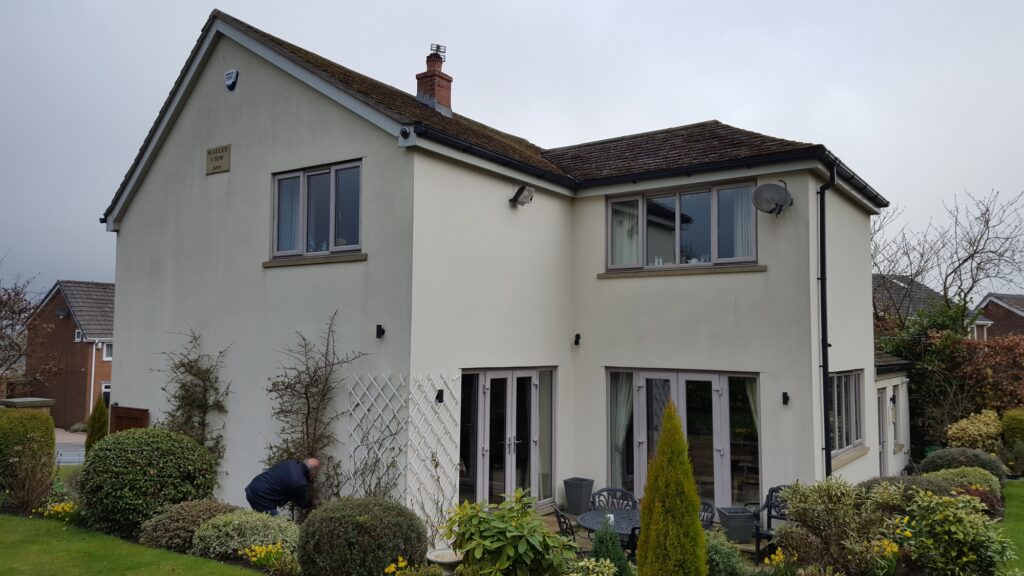
Professional Soft Washing Is About Control
The question “Is soft washing safe for pets and plants?” cannot sensibly be answered by pretending that professional cleaning chemicals are completely harmless.
Some cleaning products can damage vegetation or cause irritation if exposure is not properly controlled.
The important point is that those risks can be managed.
Correct chemical selection, appropriate concentration, controlled application, plant protection, clean-water rinsing, run-off management and keeping animals away from the working area all form part of responsible exterior cleaning.
For homeowners with extensive gardens, pets, ponds or valuable planting, discussing these features before work begins allows Softwashing UK to take them into account when assessing the property.
A good softwash should leave you looking at a cleaner property — not wondering what happened to the garden surrounding it.
What Happens if Softwashing Solution Gets on a Plant?
Accidental contact does not automatically mean a plant will die.
The outcome can depend on the cleaning solution, its concentration, the type of plant, the amount involved and how quickly appropriate action is taken.
This is one reason clean water is so important during professional exterior cleaning.
Where appropriate, vegetation can be thoroughly rinsed to reduce the potential for cleaning solution to remain concentrated on leaves and surrounding soil.
Professional operators should also be monitoring the garden throughout the cleaning process rather than waiting until the entire property has been treated before checking what has happened at ground level.
If a homeowner has particularly valuable or delicate plants, these should be pointed out before work begins.
Plant Protection Starts Before the First Spray
Good exterior cleaning should involve preparation.
The contractor should look at what surrounds the property and identify potential areas requiring additional attention.
That could include a large flower bed immediately beneath the render, a greenhouse beside the property, hanging baskets, a pond or established climbing plants.
| Before softwashing | Why it matters |
|---|---|
| Identify sensitive plants | Allows additional precautions to be planned |
| Locate ponds | Helps prevent contamination of water |
| Move portable pots | Removes them from the working area |
| Check wind conditions | Reduces risk of uncontrolled spray drift |
| Identify drainage routes | Helps anticipate where run-off may travel |
| Move pet bowls and toys | Prevents unnecessary contamination |
| Close windows and doors | Helps keep spray outside |
| Secure pets | Prevents animals entering the working area |
These precautions are relatively straightforward but can make an important difference.
Do Plants Need to Be Covered?
Sometimes customers assume the safest solution is to wrap every plant in plastic.
That is not necessarily the best approach.
Covering vegetation can create other problems, particularly during warm weather.
Plants underneath plastic sheeting can become extremely hot, especially if exposed to direct sunlight.
Protection therefore needs to be appropriate to the circumstances.
In some situations, temporarily moving plants is preferable. In others, controlled application combined with clean-water rinsing may be more appropriate.
Professional softwashing from Softwashing UK allows these decisions to be based on the individual property rather than using the same approach for every garden.
Established Gardens Need Extra Planning
Some properties have gardens that have taken decades to establish.
Mature roses, ornamental shrubs, hedging and climbing plants can represent considerable financial and sentimental value.
A homeowner may reasonably be more concerned about protecting a 20-year-old climbing rose than they are about the render itself.
Tell the cleaning company.
A professional contractor cannot properly plan around a particularly valuable plant if nobody explains its importance.
Where vegetation is especially sensitive or irreplaceable, additional precautions or alterations to the cleaning process may be appropriate.
What About Newly Planted Gardens?
Recently planted vegetation can require particular attention because plants may not yet have established strong root systems.
Young plants can already be under environmental stress from transplantation, hot weather or limited rainfall.
Adding unnecessary chemical exposure is clearly undesirable.
If significant landscaping has recently been completed around the property, mention this when arranging the cleaning.
It may influence preparation or even the timing of the work.
Can You Have Soft Washing if You Have a Dog?
Absolutely having a dog does not automatically prevent a property from being professionally softwashed.
The important factor is managing access.
During active treatment, the simplest solution will usually be to keep the dog indoors or somewhere completely separate from the working area.
Dogs present some additional considerations because they explore environments using their noses and mouths.
They may also lick their paws after walking across surfaces.
A dog should therefore not be allowed to wander through areas where cleaning chemicals are actively being handled or where potentially relevant residues remain.
Follow the contractor’s advice about when normal access can resume.
Don’t Forget Outdoor Water Bowls
Water bowls are easily overlooked.
Many dogs and cats have bowls permanently positioned outside during warmer months.
These should be removed before exterior cleaning begins.
The same applies to feeding bowls and outdoor pet fountains.
Even when the cleaning team is carefully controlling application, removing an exposed water bowl is such a simple precaution that there is little reason to leave it in place.
Pet Toys Should Be Moved Too
Balls, chew toys and other pet equipment can be scattered throughout a garden.
Because animals subsequently put these objects in their mouths, they should be moved away from the cleaning area.
A quick garden check before the contractor arrives can identify:
- water bowls;
- food bowls;
- dog toys;
- balls;
- leads;
- pet bedding;
- outdoor beds;
- feeding stations.
Children’s toys can also be moved at the same time.
What if You Keep Chickens?
Properties with chickens, ducks or other poultry require additional consideration.
Birds can roam across surprisingly large areas and may drink from puddles or investigate wet ground.
They should therefore be securely separated from the active cleaning area.
Drinkers and feeders should also be moved or protected where necessary.
The contractor should be told where birds are kept before treatment begins, particularly where a free-range area extends around the property.
Rabbits and Guinea Pigs Need Consideration
Outdoor hutches and runs can sometimes sit directly beside a house.
If so, simply leaving the animals there while the wall above them is treated would clearly be inappropriate.
Where practical, animals and portable runs should be relocated to an unaffected area.
Remember that hay, bedding, food and drinking water also need protection.
Discuss the situation with Softwashing UK beforehand so the working area can be assessed properly.
Ponds Are Not the Only Water Features to Consider
Modern gardens can contain several different types of water feature.
These might include fountains, wildlife ponds, decorative pools and natural swimming ponds.
Any feature containing aquatic plants or animals should be identified.
| Garden water feature | Main consideration |
|---|---|
| Fish pond | Prevent chemical entry |
| Wildlife pond | Protect aquatic ecosystem |
| Fountain | Prevent contamination where appropriate |
| Natural swimming pond | Careful run-off management |
| Bird bath | Empty or move during treatment |
| Pet drinking fountain | Remove from treatment area |
Bird baths are particularly easy to overlook.
Emptying and moving a small bird bath before cleaning is preferable to leaving it exposed unnecessarily.
What About Bees and Other Wildlife?
Gardens are not occupied only by domestic animals.
Birds, bees, hedgehogs and other wildlife may also be present.
It is impossible to control every insect or wild animal entering a garden, but responsible chemical application can minimise unnecessary environmental exposure.
Known nests, habitats or particularly wildlife-sensitive areas should be mentioned before work starts.
If a customer knows that hedgehogs regularly shelter beneath a particular area beside the house, for example, sharing that information allows the contractor to consider it during preparation.
Rain Can Change Where Cleaning Solution Travels
Run-off patterns can change dramatically if rain begins during exterior cleaning.
A relatively small amount of treatment that would otherwise have been controlled may become diluted and travel across a larger area.
Gutters and downpipes can also concentrate water into specific parts of a garden.
This is why weather monitoring is part of responsible softwashing.
A professional cleaner should understand how changing conditions could affect application and run-off rather than continuing regardless.
Strong Wind Can Affect Neighbouring Gardens
Your own plants are not the only vegetation that matters.
On properties close to neighbouring homes, a boundary hedge or flower bed could be only a short distance from the wall being cleaned.
Strong wind can potentially carry fine droplets beyond the intended application area.
The correct response is not simply to spray more carefully while fighting against unsuitable weather.
There can be situations where waiting for calmer conditions is the more professional choice.
Softwashing Can Help Restore Garden-Facing Elevations
Ironically, the parts of a property surrounded by the most vegetation can also be among those most likely to require exterior cleaning.
Trees, hedges and dense planting can create shade and reduce airflow around walls.
Surfaces may consequently remain damp for longer.
These conditions can encourage biological contamination, including mould, lichen, black staining, green algae and red algae.
The garden homeowners want to protect can therefore be part of the reason certain elevations become heavily contaminated.
Professional cleaning needs to balance both priorities: treating the building effectively while protecting the landscaping surrounding it.
Ask About Plant Protection When Comparing Quotes
If you are obtaining a quotation for softwashing, do not compare companies purely according to the figure at the bottom of the quote.
Ask what preparation is included.
A very low price is less attractive if the contractor intends to arrive, spray the building as quickly as possible and leave without properly considering the surrounding garden.
Professional exterior cleaning involves time before, during and after chemical application.
That preparation contributes to the cost.
Softwashing UK provides specialist softwashing for properties where the surface, contamination, access requirements and surrounding environment can all be considered as part of the cleaning process.
Homeowners with pets or substantial landscaping should make these requirements clear when requesting a quotation.
The objective is not merely to remove staining from a wall. It is to clean the property in a controlled way while respecting everything surrounding it.