


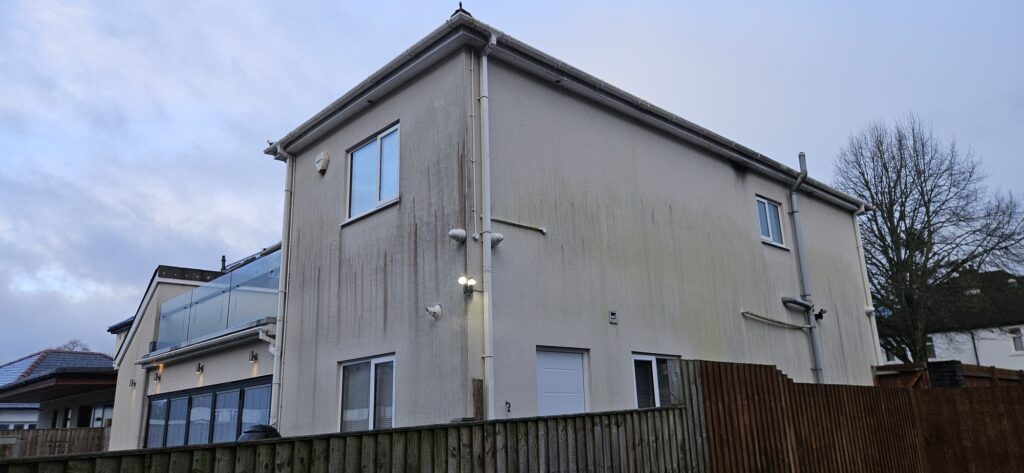
If you’ve started noticing green staining, black streaks or patches of biological growth on your rendered home, you’ve probably come across the term biocide treatment. Many professional render cleaning companies include biocide as part of their soft washing process, but many homeowners still ask the same question:
Do biocide treatments actually work, or are they simply an unnecessary extra?
The short answer is yes—when used correctly, professional biocide treatments are one of the most effective ways of controlling biological growth on render. Unlike simple washing, they target the organisms causing the staining rather than just removing what is visible on the surface.
If your render has become affected by algae or other biological contamination, the specialists at Softwashing UK can assess your property and recommend the most suitable treatment.
What Is a Biocide Treatment?
A biocide is a specially formulated cleaning solution designed to eliminate biological organisms living on exterior surfaces.
Rather than simply washing dirt away, it works by treating living contamination such as:
- Green algae
- Red algae
- Moss
- Lichen
- Mould
- Mildew
These organisms often root themselves into microscopic pores within the render. Without treating them properly, they can quickly return after ordinary cleaning.
What Does a Biocide Do?
| Function | Benefit |
|---|---|
| Kills biological growth | Removes living organisms |
| Targets spores | Slows future regrowth |
| Helps remove staining | Restores appearance |
| Works after application | Continues treating contamination |
| Suitable for soft washing | Protects delicate render finishes |
Why Washing Alone Isn’t Enough
Many homeowners assume that once the render looks clean, the problem has been solved.
Unfortunately, this isn’t always the case.
Pressure washing or rinsing may remove:
- Loose dirt
- Surface algae
- Dust
- Mud
However, microscopic spores often remain inside the render.
Over time these spores begin growing again, causing:
- Green algae
- Red algae
- Moss
- Lichen
This is why untreated render often becomes dirty again surprisingly quickly.
Understanding Biological Growth
Exterior walls provide the perfect environment for biological contamination.
Render naturally absorbs small amounts of moisture.
Combined with:
- Rain
- Shade
- Airborne spores
- Organic debris
this creates ideal growing conditions.
The organisms feed from moisture rather than the render itself, but their presence significantly affects the appearance of the property.
Common Biological Growth Found on Render
| Growth | Appearance |
|---|---|
| Green algae | Green staining |
| Red algae | Red, orange or pink patches |
| Moss | Thick green cushions |
| Lichen | Grey or white crusts |
| Mould | Dark patches |
| Mildew | Black spotting |
Green algae and red algae are increasingly found together on UK rendered homes, particularly in damp or shaded locations.
Why Red Algae Needs Special Attention
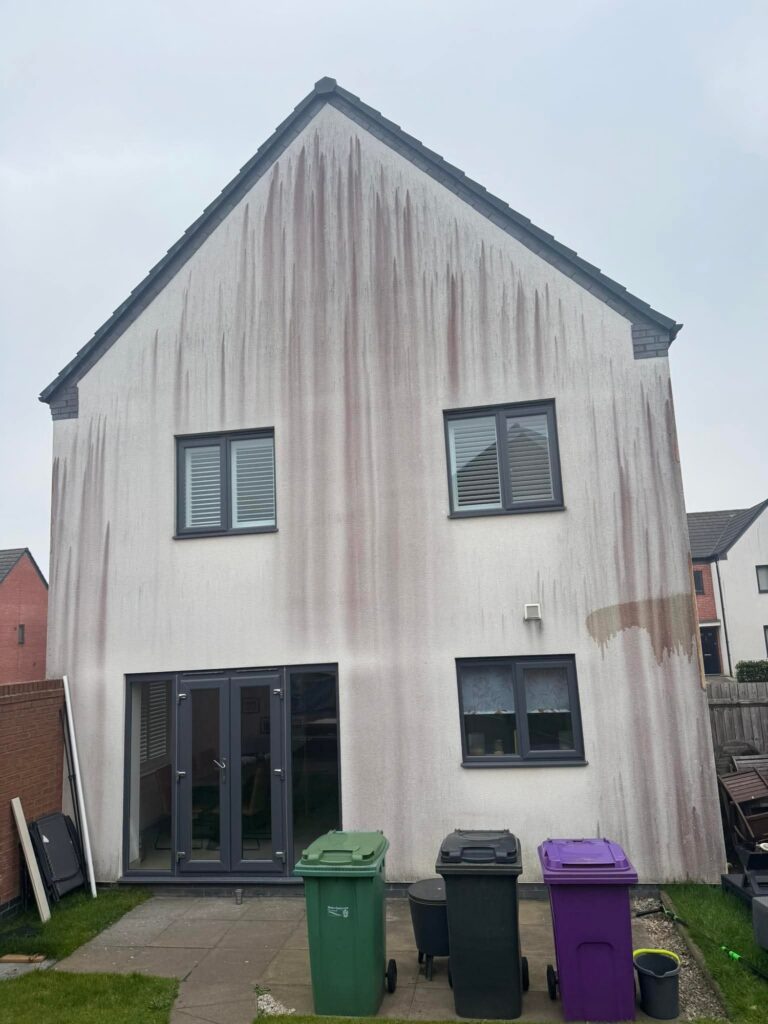
Red algae has become one of the biggest challenges facing modern rendered properties.
Unlike green algae, it often:
- Penetrates deeper into the surface.
- Produces stubborn staining.
- Returns quickly if untreated.
- Requires specialist soft washing methods.
Many homeowners mistake it for rust or paint staining when it is actually biological growth.
A professional biocide treatment helps target the underlying organism rather than simply cleaning the visible marks.
How Biocide Works
After cleaning the render, the biocide is applied evenly across the surface.
Rather than producing instant dramatic changes, the treatment continues working over time.
It:
- Eliminates remaining biological growth.
- Kills spores.
- Helps break down staining.
- Reduces future regrowth.
Some improvements continue developing over the days and weeks following application.
Does It Damage Render?
When professionally selected and applied, biocide treatments are designed to work safely alongside modern render systems.
Professional soft washing uses:
- Low pressure
- Controlled application
- Appropriate dilution
- Suitable contact time
This avoids the risks associated with aggressive pressure washing.
Professional Soft Washing vs High Pressure Cleaning
| Soft Washing | High Pressure Washing |
|---|---|
| Low pressure | High pressure |
| Treats biological growth | Mainly removes surface dirt |
| Helps kill spores | Spores often remain |
| Suitable for render | May damage finishes |
| Longer-lasting results | Growth often returns sooner |
Why Professional Application Matters
Biocide isn’t simply sprayed onto every surface in the same way.
Professionals consider:
- Type of render
- Level of contamination
- Amount of biological growth
- Weather conditions
- Drying time
- Safe application methods
This helps maximise effectiveness while protecting surrounding areas.
How Long Does It Take to Work?
Homeowners sometimes expect instant results.
In reality, biocide works differently from ordinary cleaning.
Immediately after treatment:
- Living organisms begin to die.
- Spores are treated.
- Remaining contamination gradually breaks down.
Some stubborn staining, particularly from red algae or lichen, may continue fading over several weeks.
Does Biocide Prevent Future Algae?
No treatment can permanently stop nature.
Eventually every property becomes exposed again to:
- Rain
- Wind
- Airborne spores
- Pollution
- Moisture
However, professional biocide treatments help delay regrowth by treating the biological organisms responsible for the contamination.
This is one reason professionally cleaned render often stays cleaner for much longer than render cleaned with water alone.
Factors Affecting How Long Results Last
| Factor | Effect |
|---|---|
| Tree cover | Faster regrowth |
| Shade | Encourages algae |
| Good sunlight | Slower regrowth |
| Airflow | Faster drying |
| Local pollution | More staining |
| Regular maintenance | Longer-lasting appearance |
Is Biocide Better Than Bleach?
Some DIY guides recommend household bleach.
This is generally not the same as professional exterior cleaning products.
Professional treatments are selected specifically for exterior surfaces and biological contamination.
Household chemicals may:
- Produce patchy results.
- Damage surrounding plants.
- Fail to kill deeper biological growth.
- Affect coloured render.
Professional assessment helps ensure the correct products are used.
Which Properties Benefit Most?
Biocide treatments are particularly effective for homes experiencing persistent biological growth.
Examples include:
- North-facing properties.
- Homes beneath mature trees.
- Woodland locations.
- Coastal properties.
- Damp garden walls.
- Properties near rivers.
These environments create ideal conditions for both green algae and red algae.
Can New Render Need Biocide?
Yes.
Many homeowners believe only older render becomes contaminated.
In reality, modern render can develop algae surprisingly quickly if conditions are favourable.
Even homes only a few years old may experience:
- Green staining.
- Red algae.
- Black marks.
- Organic contamination.
The age of the render is often less important than its surroundings.
Signs a Biocide Treatment May Be Appropriate
| Symptom | Biocide Recommended? |
|---|---|
| Green algae | Yes |
| Red algae | Yes |
| Moss | Yes |
| Lichen | Usually yes |
| Black biological staining | Yes |
| Light dust only | Usually not |
Can It Help Avoid Repainting?
One of the biggest advantages of professional cleaning is that it often restores the original appearance without repainting.
Many homeowners assume dirty render automatically needs decorating.
Often the issue is simply biological contamination.
Cleaning and treating the surface first may eliminate the need for much more expensive repainting.
Common Myths About Biocide Treatments
There are several misconceptions surrounding professional soft washing.
| Myth | Reality |
|---|---|
| It only cleans the surface | It treats biological growth |
| It works instantly | Results continue developing over time |
| Rain washes it away immediately | Proper application allows it to work effectively |
| Every property needs repeated treatments every year | Maintenance depends on local conditions |
| Pressure washing alone achieves the same result | Pressure washing doesn’t normally treat spores |
The Importance of Timing
Applying a biocide treatment before contamination becomes severe often produces the best long-term results.
Waiting until render is heavily covered in algae can mean:
- More intensive cleaning.
- Longer treatment times.
- Greater staining.
- More established biological growth.
Routine inspections help identify the best time to clean before problems become widespread.
Why Professional Assessment Makes a Difference
Every rendered property is different.
Factors such as sunlight, surrounding trees, drainage and previous maintenance all influence the level of contamination.
Rather than applying the same treatment to every home, professional assessment identifies:
- The type of biological growth present.
- Whether green algae, red algae or both are affecting the render.
- The safest cleaning method.
- The most appropriate biocide application.
- Whether additional treatment is required.
Using the correct soft washing process ensures the render is cleaned safely while targeting the organisms responsible for the staining. For homeowners looking to restore the appearance of their property and slow the return of biological growth, a professionally applied biocide treatment from Softwashing UK offers an effective solution tailored to the specific condition of the render, helping maintain a cleaner exterior for longer without relying on harsh pressure washing or unnecessary repainting.
Why Weather Conditions Matter During Treatment
Professional biocide treatments are most effective when applied under suitable weather conditions.
Heavy rain immediately after application can reduce the amount of time the treatment remains on the surface, while extremely hot weather may cause products to dry too quickly before they’ve had sufficient contact time.
This is why experienced professionals carefully consider the forecast before carrying out render cleaning.
Ideal conditions generally include:
- Dry weather during application.
- Moderate temperatures.
- Limited wind.
- Enough time for the treatment to work before rainfall.
Planning the work correctly helps maximise the effectiveness of the treatment.
Why Soft Washing Is More Than Just Applying Biocide
Some homeowners believe soft washing simply means spraying biocide onto dirty walls.
In reality, professional soft washing is a complete cleaning process.
It may include:
- Inspection of the render.
- Identification of contamination.
- Gentle removal of loose dirt.
- Treatment of algae and biological growth.
- Controlled application of biocide.
- Final assessment of the cleaned surface.
Each stage contributes to achieving a more consistent, longer-lasting result.
Areas of the Property That May Also Benefit
Although render is often the main focus, biological growth rarely affects just one surface.
Other areas commonly exposed to similar contamination include:
| Surface | Common Biological Growth |
|---|---|
| Garden walls | Green algae and red algae |
| Boundary walls | Moss and lichen |
| Rendered garages | Green staining |
| Outbuildings | Black mould and algae |
| Decorative pillars | Organic staining |
Treating multiple rendered surfaces at the same time can help maintain a more uniform appearance across the property.
Can Biocide Remove Black Streaks?
The answer depends on what is causing the staining.
Black streaks may result from:
- Air pollution.
- Biological growth.
- Mould.
- Water runoff.
Where biological growth is responsible, biocide treatment is often highly effective.
If the staining is caused primarily by pollution, additional cleaning may be required before the surface reaches its best possible appearance.
Professional assessment helps identify the source of the staining rather than treating every mark as the same problem.
The Difference Between Surface Cleaning and Deep Treatment
Many DIY methods only clean what is immediately visible.
Professional soft washing aims to address contamination beneath the surface as well.
| Surface Cleaning | Professional Biocide Treatment |
|---|---|
| Removes visible dirt | Targets living organisms |
| Short-term improvement | Longer-lasting cleanliness |
| Does not treat spores | Helps eliminate spores |
| Dirt often returns quickly | Slower biological regrowth |
This difference explains why professionally cleaned render often remains cleaner for significantly longer.
Why Green Algae Returns So Quickly Without Treatment
Green algae reproduces by releasing microscopic spores.
Even when the visible growth has been washed away, these spores may remain hidden within tiny pores in the render.
As soon as damp weather returns, the remaining spores begin growing again.
Without biocide treatment, homeowners often notice:
- Green patches reappearing.
- Larger affected areas.
- Faster regrowth each year.
Treating the spores is therefore just as important as removing the visible staining.
Red Algae Is Becoming More Common Across the UK
Many people have only recently become aware of red algae because it has become increasingly widespread on modern housing developments.
Unlike traditional green staining, red algae often appears as:
- Pink patches.
- Orange discolouration.
- Rust-coloured streaks.
- Deep red staining.
It is particularly noticeable on:
- White render.
- Cream render.
- Pale grey render.
Because it penetrates more deeply than green algae, professional treatment is usually the safest and most effective approach.
Why Some Properties Need Multiple Treatments
Every property is different.
Light contamination may respond well after a single treatment.
Heavier contamination can require additional work due to:
- Thick moss.
- Established lichen.
- Severe green algae.
- Extensive red algae.
- Years of neglected maintenance.
This doesn’t mean the treatment has failed. It simply reflects the amount of biological growth that has accumulated over time.
Does Biocide Continue Working After the Visit?
One advantage of professional biocide treatments is that they continue working after application.
Rather than providing an instant cosmetic improvement alone, the treatment keeps breaking down biological contamination over time.
Homeowners often notice gradual improvements during the following days and weeks as remaining organic staining continues to disappear.
Patience is important, particularly on heavily contaminated render.
Preventing Future Problems
Although no treatment prevents future contamination forever, several maintenance steps can help keep render cleaner.
These include:
- Keeping gutters free from blockages.
- Repairing leaking downpipes.
- Trimming trees to improve sunlight.
- Increasing airflow around walls.
- Removing climbing plants.
- Arranging professional cleaning before algae becomes widespread.
Small preventative measures can significantly slow the rate at which biological growth returns.
Why DIY Products Often Disappoint
Garden centres and DIY stores sell numerous products claiming to remove algae from render.
While some can improve appearance temporarily, they often fail to provide the longer-lasting results achieved through professional soft washing.
Common reasons include:
- Incorrect dilution.
- Uneven application.
- Failure to identify the contamination correctly.
- Insufficient contact time.
- Lack of specialist equipment.
Professional knowledge plays just as important a role as the cleaning solution itself.
Biocide and Kerb Appeal
One of the biggest advantages of treating render is the dramatic improvement in kerb appeal.
Clean render helps a property appear:
- Brighter.
- Better maintained.
- More modern.
- More inviting.
For homeowners preparing to sell, this improved presentation can make a strong first impression on potential buyers before they even step inside.
Frequently Asked Questions
Will biocide change the colour of my render?
When correctly applied to suitable render systems, professional treatments are designed to clean the surface rather than alter its colour.
Is every stain biological?
No.
Some marks are caused by pollution, dirt or mineral deposits rather than living organisms.
Professional assessment identifies the cause before treatment begins.
Does every rendered house need biocide?
Not necessarily.
Properties with only light dust or minimal contamination may not require treatment.
Biocide is generally most beneficial where biological growth such as green algae and red algae is present.
Can render stay clean forever?
Unfortunately not.
British weather continually exposes exterior surfaces to moisture and airborne spores.
The aim of professional treatment is to restore the appearance of the render and significantly slow the return of contamination rather than provide a permanent once-and-for-all solution.
Choosing the Right Time for Treatment
The best time to arrange a professional render clean is usually when biological growth first becomes noticeable rather than waiting until large areas are heavily stained.
Early treatment often means:
| Early Treatment | Delayed Treatment |
|---|---|
| Less contamination to remove | More established biological growth |
| Better cosmetic results | Greater risk of stubborn staining |
| Faster cleaning process | Longer treatment times |
| Lower likelihood of permanent marks | Increased chance of deep staining |
By dealing with contamination promptly, homeowners can preserve the appearance of their render while reducing the likelihood of more extensive restoration work in the future.
A professionally applied biocide treatment is far more than a cosmetic wash. By targeting the living organisms responsible for staining, it helps restore the appearance of render while reducing the speed at which algae returns. Whether your property is affected by green algae, red algae, moss or lichen, the experienced team at Softwashing UK can recommend the most appropriate soft washing and biocide treatment to suit your property’s individual conditions, helping your render stay cleaner for longer while protecting its finish.