


Render has become one of the most popular exterior finishes on homes and commercial buildings throughout the UK. Modern render systems provide a clean, contemporary appearance while helping to protect the building fabric from the elements. However, over time, render can become stained by organic growth, dirt, pollution and environmental contaminants, leading many property owners to seek professional cleaning services.
One of the most common questions homeowners ask is whether soft washing can damage render. This concern is understandable, particularly when properties feature premium render systems such as silicone render, monocouche render or coloured render finishes.
The simple answer is that professional soft washing, when carried out correctly, is one of the safest methods available for cleaning render. In fact, soft washing was developed specifically to clean delicate exterior surfaces without the risks associated with high-pressure cleaning methods.
For specialist render cleaning advice and professional soft washing services, property owners can visit Soft Washing UK.
Understanding Render and Its Vulnerabilities
Before examining whether soft washing can damage render, it is important to understand how render systems are constructed.
Modern render is designed to provide:
- Weather protection
- Decorative finishes
- Breathability
- Durability
- Thermal efficiency
- Water resistance
While render is durable, it is not indestructible. Certain cleaning methods can cause significant damage if the wrong techniques are used.
Different render types react differently to cleaning processes.
| Render Type | Durability | Suitable for Soft Washing |
|---|---|---|
| Silicone Render | High | Yes |
| Monocouche Render | High | Yes |
| Acrylic Render | Medium to High | Yes |
| Mineral Render | Medium | Yes |
| Cement Render | Medium | Yes |
| Painted Render | Variable | Yes |
Because each render system has unique characteristics, cleaning methods should always be tailored to the surface being treated.
What Is Soft Washing?
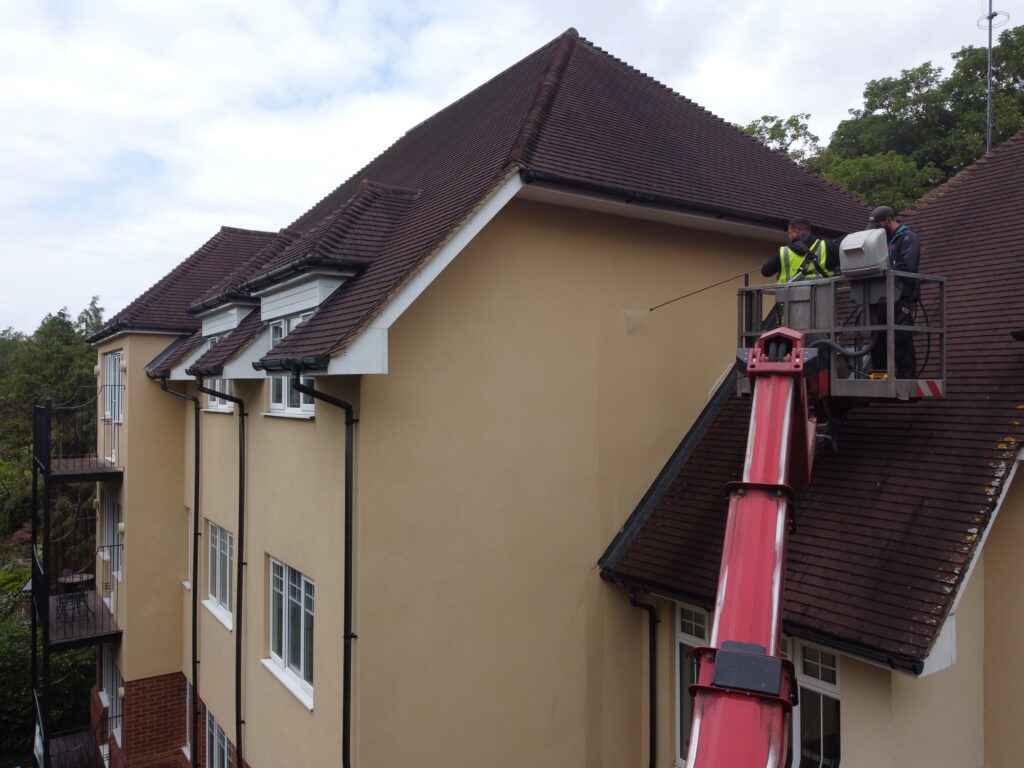
Soft washing is a cleaning process that uses low-pressure application equipment combined with specialist treatment solutions to remove biological contamination.
Unlike pressure washing, soft washing relies primarily on cleaning chemistry rather than force.
The process targets:
- Green algae
- Red algae
- Moss
- Lichen
- Mould
- Mildew
- Bacteria
Rather than blasting contaminants from the surface, soft washing eliminates them at their source.
This significantly reduces the risk of surface damage.
Why People Worry About Render Damage
Many property owners have seen examples of damage caused by aggressive cleaning methods.
Common concerns include:
- Cracking
- Colour fading
- Surface erosion
- Water penetration
- Loss of finish
- Staining
In many cases these issues are associated with pressure washing rather than soft washing.
Understanding the difference is essential.
Soft Washing vs Pressure Washing
The biggest misconception is that soft washing and pressure washing are the same thing.
They are entirely different cleaning systems.
| Feature | Soft Washing | Pressure Washing |
|---|---|---|
| Cleaning Method | Chemical treatment | High-pressure water |
| Water Pressure | Low | High |
| Surface Impact | Minimal | Potentially damaging |
| Biological Growth Removal | Excellent | Limited |
| Long-Term Results | Excellent | Short-term |
| Render Safety | High | Variable |
Pressure washing relies on mechanical force, while soft washing relies on biological treatment.
This distinction makes a substantial difference when cleaning render.
Can Soft Washing Damage Render?
When performed correctly by trained professionals, soft washing should not damage render.
In fact, it is widely regarded as one of the safest cleaning methods available for rendered surfaces.
The key reasons include:
Low Pressure Application
The low-pressure nature of soft washing eliminates many of the risks associated with pressure cleaning.
The cleaning solution is applied gently to the surface rather than being forced into the render.
This reduces the likelihood of:
- Cracks
- Surface erosion
- Water ingress
- Finish deterioration
No Abrasive Action
Pressure washing physically strips contaminants from surfaces.
Soft washing instead breaks down organic growth using specially formulated treatments.
This avoids abrasive contact with the render finish.
Treatment Rather Than Force
Soft washing is designed to kill biological growth.
It targets the cause of staining rather than simply removing visible contamination.
This means less physical stress is placed on the render surface.
Situations Where Problems Can Occur
Although soft washing is generally safe, problems can arise if inexperienced operators use unsuitable products or incorrect procedures.
Potential issues include:
| Poor Practice | Possible Result |
|---|---|
| Incorrect chemical dilution | Surface marking |
| Failure to assess render type | Inconsistent results |
| Insufficient rinsing where required | Residue issues |
| Untrained application | Localised staining |
| Ignoring existing defects | Highlighting underlying problems |
These situations are not caused by soft washing itself but by poor workmanship.
Professional assessment is therefore essential.
Does Soft Washing Damage Silicone Render?
Silicone render is among the most common render finishes installed across modern UK housing developments.
Many homeowners worry about damaging the coloured finish.
Professional soft washing is widely considered suitable for silicone render because:
- It uses low pressure.
- It removes biological growth effectively.
- It preserves the textured finish.
- It avoids surface abrasion.
Silicone render manufacturers often advise against high-pressure cleaning while supporting gentler cleaning methods.
Does Soft Washing Remove Render Colour?
One concern often raised by homeowners is whether cleaning treatments can strip colour from render.
In most cases, soft washing does not remove colour.
Instead, it removes contamination that has accumulated on the surface.
This often results in:
- Brighter colours
- More consistent appearance
- Improved uniformity
- Enhanced kerb appeal
Many customers initially believe their render has faded when it is actually covered by algae and atmospheric pollution.
Can Soft Washing Cause Cracks?
Soft washing does not normally cause cracks in render.
Cracking is more commonly associated with:
- Building movement
- Thermal expansion
- Poor installation
- Impact damage
- Age-related deterioration
Because soft washing uses very low pressure, it does not place significant stress on the render surface.
However, existing cracks may become more visible once staining has been removed.
This can create the impression that cleaning has caused damage when the defects were already present.
Can Soft Washing Cause Water Ingress?
Water ingress is another common concern.
Pressure washing can force water into:
- Cracks
- Expansion joints
- Weak points
- Damaged render
Soft washing significantly reduces this risk because it uses low-pressure application methods.
Water is not driven aggressively into the building envelope.
For this reason, soft washing is generally considered safer for rendered properties than high-pressure cleaning.
How Soft Washing Removes Green Algae and Red Algae
Green algae and red algae are among the most common causes of render staining.
These biological growths thrive in damp environments and can spread rapidly across exterior walls.
Green Algae
Green algae often appears as:
- Green patches
- Streaks
- Surface discolouration
It is particularly common on north-facing walls.
Red Algae
Red algae is becoming increasingly common throughout the UK.
It may appear as:
- Red staining
- Pink streaks
- Orange discolouration
Many homeowners mistakenly believe red algae is rust staining but it is called by a growth called Trentepohlia.
Soft washing treatments target both green algae and red algae at a microbial level, helping prevent rapid regrowth.
Does Soft Washing Damage Older Render?
Older render often requires a more cautious approach.
Age-related issues can include:
- Hairline cracking
- Surface wear
- Repairs
- Previous coatings
Professional soft washing specialists will assess these factors before treatment begins.
In many cases, soft washing remains the safest cleaning option because it minimises physical stress on ageing surfaces.
Comparing Cleaning Risks
The following table highlights common cleaning methods and associated risks.
| Cleaning Method | Risk Level | Suitable for Render |
|---|---|---|
| Soft Washing | Low | Yes |
| Steam Cleaning | Low to Medium | Often |
| Pressure Washing | Medium to High | Not always |
| Abrasive Cleaning | High | Rarely |
| Mechanical Scrubbing | Medium | Limited |
For delicate render systems, soft washing often represents the lowest-risk solution.
How Long Does Soft Washing Protection Last?
Another reason soft washing is popular is its longevity.
Because treatments kill biological growth rather than merely removing visible contamination, results tend to last longer.
Typical expectations include:
| Property Environment | Expected Results |
|---|---|
| Open sunny location | 3–5 years |
| Standard suburban property | 2–4 years |
| Heavily shaded area | 1–3 years |
| Woodland setting | 1–3 years |
| Coastal property | 2–4 years |
The exact lifespan depends on local environmental conditions.
Cost of Render Repairs vs Professional Cleaning
One reason property owners worry about cleaning damage is the potential cost of repairs.
Repairing damaged render can be expensive.
| Service | Typical Cost Range |
|---|---|
| Local render repair | £250–£800 + VAT |
| Crack repairs | £300–£1,500+ VAT |
| Repainting render | £1,500–£5,000 upwards + VAT |
| Full re-rendering | £8,000–£25,000 + VAT |
| Professional soft washing | £350–£3,000 + VAT |
Choosing the correct cleaning method can therefore help avoid significant remedial expenses.
Signs a Soft Washing Company Understands Render
Not all exterior cleaning companies specialise in render cleaning.
Before arranging work, homeowners should ensure the contractor understands:
- Different render systems
- Biological contamination
- Green algae removal
- Red algae treatment
- Safe application methods
- Surface compatibility
A specialist approach reduces risk and improves results.
Common Myths About Soft Washing Render
Myth 1: Soft Washing Is Just Low-Pressure Washing
False.
Soft washing is primarily a treatment process rather than a pressure-based cleaning system.
Myth 2: Chemicals Damage Render
When used correctly, professional soft washing solutions are formulated to clean surfaces safely and effectively.
Myth 3: Render Must Be Pressure Washed to Get Clean
Many render manufacturers discourage pressure washing because of the potential for damage.
Soft washing often produces superior long-term results.
Myth 4: Soft Washing Is Only for Heavy Contamination
Even lightly stained render can benefit from soft washing treatment before contamination becomes severe.
Expected Results After Professional Soft Washing
Property owners typically notice significant improvements following treatment.
Common outcomes include:
| Improvement Area | Typical Result |
|---|---|
| Green algae removal | Excellent |
| Red algae removal | Excellent |
| Surface appearance | Significantly improved |
| Colour restoration | Noticeable |
| Kerb appeal | Enhanced |
| Long-term cleanliness | Improved |
The exact transformation depends on the render type, contamination level and environmental conditions.
Why Professional Assessment Matters
Every rendered property is different.
Factors influencing treatment include:
- Render age
- Surface condition
- Exposure levels
- Existing repairs
- Previous cleaning history
- Type of biological growth
A professional assessment helps determine the safest and most effective cleaning approach.
For specialist advice on render cleaning and soft washing services, homeowners can obtain further information from Soft Washing UK, specialists in the safe treatment of render surfaces throughout the UK.
What Happens If Render Is Already Damaged Before Cleaning?
One area that often causes confusion is the condition of the render before any cleaning takes place. Many rendered properties already have minor defects that are hidden beneath layers of dirt, green algae, red algae, moss or atmospheric staining.
These defects can include:
- Hairline cracks
- Small chips
- Previous patch repairs
- Surface crazing
- Minor impact damage
- Faded areas
When the render is professionally soft washed, the removal of contamination can make these existing issues easier to see. In some cases, homeowners mistakenly believe the cleaning process has caused the defect when it was already present beneath the staining.
A professional survey before work begins helps identify any existing issues and ensures realistic expectations regarding the final appearance.
Does Soft Washing Affect Render Warranties?
Many modern render systems are installed with manufacturer-backed warranties. Homeowners frequently ask whether cleaning could invalidate these warranties.
While warranty terms vary between manufacturers, aggressive cleaning methods such as high-pressure washing are often discouraged because they can damage the protective surface of the render.
Soft washing is generally viewed more favourably because it:
| Soft Washing Benefit | Why It Matters |
|---|---|
| Low-pressure application | Reduces physical stress |
| Non-abrasive process | Protects surface texture |
| Targets biological growth | Helps maintain appearance |
| Suitable for delicate finishes | Supports long-term maintenance |
Property owners should always review their warranty documentation and ensure any cleaning contractor understands the specific render system installed.
Why Render Maintenance Is Becoming More Important
Modern render systems are increasingly used on homes throughout the UK, particularly on new-build developments and energy-efficient properties.
As render becomes more common, maintenance is becoming a greater priority. Unlike traditional brickwork, render can show biological staining relatively quickly under the right environmental conditions.
Factors increasing contamination include:
- Higher rainfall levels
- Dense housing developments
- Increased tree planting
- Limited airflow between properties
- Improved insulation reducing wall surface temperatures
These conditions can encourage the growth of both green algae and red algae, leading to noticeable staining within a relatively short period.
Regular inspection allows problems to be identified early before extensive contamination develops.
The Importance of Ongoing Monitoring
After a property has been soft washed, homeowners should continue monitoring the render for signs of new biological growth.
Early indicators may include:
- Small green patches
- Faint red streaking
- Dark spots
- Moss development around damp areas
- Discolouration beneath gutters
Addressing these issues promptly can often extend the overall lifespan of the render finish and reduce future maintenance costs.
Routine maintenance is typically far more affordable than dealing with severe contamination or undertaking major restoration work.
Many property owners find that periodic professional inspections help preserve the appearance of their render and maintain the clean, modern look that made rendered finishes attractive in the first place.