


If you’ve invested in a newly rendered property, one of the first questions you may ask before arranging maintenance is whether render cleaning could affect your guarantee. Many homeowners are understandably cautious, particularly if their render is still covered by a manufacturer’s warranty or an installer-backed guarantee.
The good news is that professional render cleaning does not automatically void your guarantee. In fact, using the correct cleaning methods can help preserve the appearance and lifespan of your render. The key lies in choosing the right cleaning process, using suitable products, and following the recommendations provided by the render manufacturer.
At Soft Washing UK, specialist render cleaning is carried out using low-pressure soft washing methods designed specifically for delicate rendered surfaces.
Why Render Guarantees Exist
Most render systems are installed with guarantees covering defects in materials or workmanship. Depending on the manufacturer and installer, guarantees may range from 10 years to 25 years or even longer.
These guarantees are usually intended to protect against issues such as:
| What May Be Covered | Explanation |
|---|---|
| Material defects | Problems caused by manufacturing faults |
| Installation defects | Incorrect application by installers |
| Premature cracking | Structural failures not caused by movement |
| Delamination | Render separating from the wall |
| Water ingress | Failures relating to the render system itself |
However, guarantees rarely cover lack of maintenance or damage caused by inappropriate cleaning methods.
What Can Actually Void a Render Guarantee?
Cleaning itself isn’t usually the problem. Instead, guarantees can be affected if the render suffers unnecessary damage.
Examples include:
| Incorrect Practice | Possible Result |
|---|---|
| High-pressure washing | Surface erosion |
| Abrasive scrubbing | Permanent texture damage |
| Strong acidic cleaners | Chemical burns |
| Bleach misuse | Discolouration |
| Grinding or sanding | Removal of protective finish |
Professional soft washing avoids these issues by using specialist biocidal treatments combined with controlled low-pressure rinsing where appropriate.
Why Dirt Doesn’t Usually Affect Your Guarantee
Most render manufacturers expect external walls to require routine maintenance.
Over time you’ll commonly see:
- Atmospheric pollution
- Dust
- Organic staining
- Bird droppings
- Cobwebs
- Surface contamination
You may also notice both green algae and red algae, particularly on shaded elevations where moisture remains for longer.
These are considered normal environmental conditions rather than warranty defects.
Cleaning removes these contaminants without affecting the render when completed correctly.
Manufacturer Maintenance Recommendations
Many render systems include maintenance guidance that recommends periodic cleaning.
Typical recommendations include:
| Maintenance Task | Suggested Frequency |
|---|---|
| Visual inspection | Every 6–12 months |
| Wash surface if contaminated | As required |
| Remove algae growth | Early treatment advised |
| Repair impact damage | Immediately |
| Inspect sealants | Annually |
Ignoring heavy biological growth for years can actually shorten the life of the finish.
Why Pressure Washing Can Be Risky
One of the biggest causes of render damage is improper pressure washing.
Render is not designed to withstand concentrated high-pressure water jets.
Potential problems include:
- Surface pitting
- Removal of coloured finishes
- Water forced behind the render
- Hairline cracks becoming larger
- Protective coatings stripped away
This is why reputable specialists favour soft washing instead of aggressive cleaning.
What Is Soft Washing?
Soft washing is a specialist exterior cleaning process developed for delicate surfaces.
Instead of relying on pressure alone, it uses carefully selected cleaning solutions to remove biological contamination.
The process generally involves:
- Inspection
- Surface assessment
- Application of specialist treatment
- Controlled dwell time
- Low-pressure rinse where required
This method is considerably safer than pressure washing and is suitable for most modern render systems.
Common Types of Render
Different render finishes require slightly different cleaning approaches.
| Render Type | Cleaning Considerations |
|---|---|
| Silicone render | Low-pressure soft washing |
| Monocouche render | Gentle cleaning only |
| Acrylic render | Avoid aggressive chemicals |
| Mineral render | Careful moisture management |
| Traditional cement render | Tailored cleaning depending on age |
Professional assessment helps determine the safest process for each surface.
Biological Growth and Render
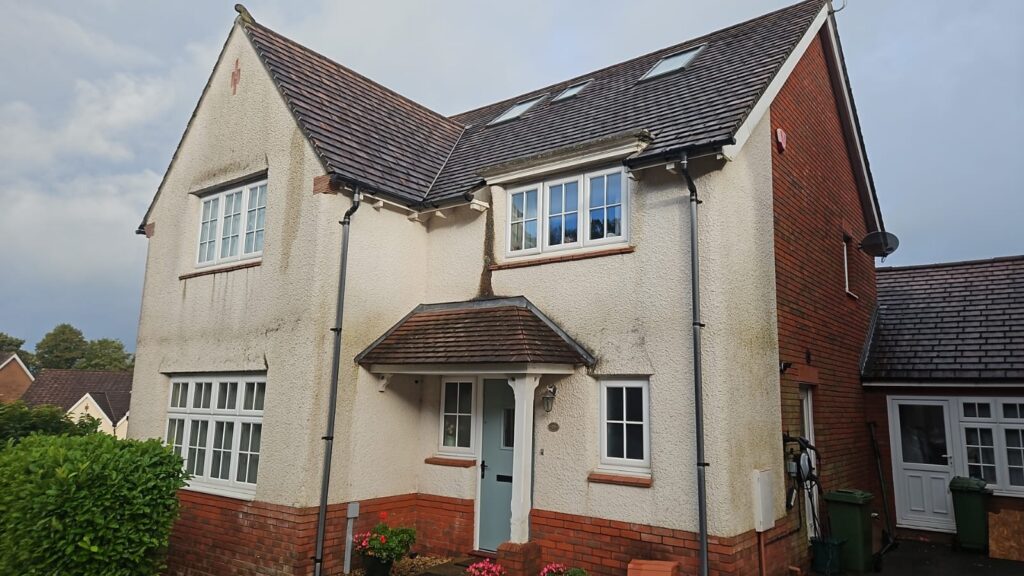
Many homeowners mistake algae or staining for render failure.
In reality, biological growth is extremely common.
Typical contaminants include:
- Green algae
- Red algae
- Black mould
- Moss around damp areas
- Lichen
- Airborne spores
These organisms thrive in damp, shaded environments and don’t necessarily indicate defective render.
Cleaning removes the contamination while preserving the underlying finish.
Signs Your Render Needs Cleaning
You don’t need to wait until your render looks heavily stained.
Early cleaning is often easier and safer.
Common signs include:
| Sign | Likely Cause |
|---|---|
| Green staining | Green algae |
| Red streaks | Red algae |
| Black spotting | Mould |
| Uneven colouring | Dirt accumulation |
| Dark patches | Moisture retention |
| Weather staining | Pollution |
Regular maintenance keeps staining manageable.
Why Professional Cleaning Helps Protect the Finish
Professional cleaning is about more than improving appearance.
Benefits include:
- Extending the decorative finish
- Removing moisture-holding contamination
- Improving kerb appeal
- Reducing biological regrowth
- Supporting long-term maintenance
Proper cleaning may even help prevent more expensive repairs later.
Questions to Ask Before Cleaning
Before arranging any render cleaning, ask the contractor:
| Question | Why It Matters |
|---|---|
| Do you specialise in render cleaning? | Experience reduces risk |
| Do you use soft washing? | Safer than high pressure |
| Have you cleaned this render type before? | Product compatibility |
| Are treatments suitable for coloured render? | Prevents fading |
| Are you insured? | Added protection |
Choosing experienced specialists helps protect both your property and your guarantee.
Does Age Make a Difference?
Yes.
Brand-new render often requires a different approach compared with render that’s been exposed to the elements for many years.
Newly installed render
Recently completed render may still be within its curing period.
Cleaning too soon could interfere with the finish.
A professional will advise whether cleaning should be delayed.
Older render
Older render generally accumulates:
- Pollution
- Organic growth
- Weather staining
- Biological contamination
These surfaces often benefit greatly from professional soft washing.
Can DIY Cleaning Affect Your Guarantee?
Possibly.
Many DIY mistakes cause accidental damage.
Examples include:
| DIY Mistake | Possible Consequence |
|---|---|
| Hiring a pressure washer | Surface damage |
| Using patio cleaner | Chemical staining |
| Wire brushing | Texture removal |
| Strong bleach | Colour fading |
| Washing during freezing weather | Surface stress |
Manufacturers are unlikely to support warranty claims if the render has clearly been damaged by incorrect maintenance.
Why Chemical Choice Matters
Not all exterior cleaning chemicals are suitable for render.
Professional render cleaning products are selected based on factors such as:
- Render type
- Surface condition
- Level of contamination
- Manufacturer recommendations
- Environmental considerations
Using unsuitable products may leave permanent marks or affect decorative coatings.
Should You Clean Before Selling Your Property?
A clean rendered property often creates a far stronger first impression.
Potential buyers frequently assume dirty render means expensive repairs are needed.
Professional cleaning can restore a brighter appearance without repainting.
Benefits include:
| Benefit | Impact |
|---|---|
| Improved kerb appeal | Better first impressions |
| Cleaner photographs | Stronger online listings |
| Reduced visible staining | More attractive exterior |
| Fresh appearance | Increased buyer confidence |
Is Repainting Better Than Cleaning?
Not usually.
Many people consider repainting because the render looks tired.
However, staining is often only surface contamination.
Professional cleaning can remove:
- Green algae
- Red algae
- Dirt
- Pollution
- Organic staining
This frequently restores much of the original appearance without the expense of repainting.
How Often Should Render Be Cleaned?
The answer depends on several factors.
Properties surrounded by trees, rivers or shaded gardens usually require more frequent maintenance than exposed properties.
Typical guidance is:
| Environment | Suggested Cleaning Interval |
|---|---|
| Open countryside | Every 4–6 years |
| Urban areas | Every 3–5 years |
| Heavy tree cover | Every 2–4 years |
| Coastal locations | Every 2–3 years |
| North-facing walls | As biological growth appears |
Regular inspections help identify early signs of contamination before extensive staining develops.
Keeping Your Guarantee Intact
If your render is still under guarantee, sensible maintenance is the safest approach.
Good practice includes:
- Reading the manufacturer’s maintenance guidance.
- Keeping records of professional cleaning and maintenance.
- Avoiding high-pressure washing.
- Treating biological growth before it becomes severe.
- Using experienced render cleaning specialists.
- Addressing small issues promptly before they develop into larger problems.
Professional soft washing is designed to clean render safely while helping preserve its protective finish. By using the correct methods and maintaining your render in line with manufacturer recommendations, you can keep your property looking its best without unnecessarily putting your guarantee at risk.
For specialist advice and professional render cleaning services, visit the Soft Washing UK homepage to learn more about maintaining modern rendered properties safely and effectively.
Does Every Render Manufacturer Have the Same Guarantee?
No. Every manufacturer has its own warranty terms and maintenance requirements. Some guarantees cover only the materials supplied, while others include systems that have been installed by approved contractors.
It’s important to understand exactly what your guarantee includes before arranging any maintenance.
Typical differences include:
| Guarantee Feature | May Vary Between Manufacturers |
|---|---|
| Length of cover | 10–30 years |
| Material warranty | Yes |
| Installation warranty | Sometimes |
| Colour stability | Occasionally |
| Approved installer requirement | Often |
| Maintenance requirements | Usually included |
If you no longer have your paperwork, your installer may be able to provide a copy of the guarantee conditions.
Keeping Records of Professional Maintenance
One of the easiest ways to protect yourself should a warranty issue ever arise is to keep a record of any professional maintenance carried out.
Useful records include:
- Cleaning invoices
- Before and after photographs
- Dates of maintenance
- Areas cleaned
- Products used
- Inspection reports
Having this information demonstrates that the render has been cared for responsibly rather than neglected.
Why Regular Inspections Are Just as Important as Cleaning
Cleaning is only one part of maintaining rendered walls.
A professional inspection can identify problems before they become expensive repairs.
During an inspection, specialists may look for:
| Inspection Item | Why It Matters |
|---|---|
| Hairline cracks | Can allow moisture penetration |
| Failed sealant | Prevents water ingress |
| Impact damage | Stops deterioration spreading |
| Heavy algae growth | Indicates persistent dampness |
| Drainpipe leaks | Can stain render quickly |
| Blocked gutters | May overflow onto walls |
Fixing these issues early helps preserve both the render and its appearance.
Why North-Facing Walls Become Dirty Faster
Not every elevation of a property weathers at the same rate.
North-facing walls usually receive far less direct sunlight, meaning they remain damp for longer after rainfall.
This creates ideal conditions for:
- Green algae
- Red algae
- Black mould
- Moss around lower sections
South-facing walls often dry much faster, meaning they can remain cleaner for longer despite being exposed to the same weather.
Trees Can Increase Cleaning Requirements
Properties surrounded by mature trees often require more frequent maintenance.
Trees contribute:
- Shade
- Moisture retention
- Falling leaves
- Pollen
- Sap deposits
- Bird activity
These conditions encourage biological growth while also increasing the amount of debris settling on rendered surfaces.
This doesn’t indicate poor-quality render—it simply reflects the environment around the property.
Coastal Properties Need Different Maintenance
Homes near the sea face additional challenges.
Salt carried by coastal winds combines with moisture and airborne contaminants, leaving deposits on rendered walls.
Coastal properties may also experience:
| Coastal Factor | Effect on Render |
|---|---|
| Salt spray | Surface deposits |
| Strong winds | Increased dirt accumulation |
| High humidity | Longer drying times |
| Driving rain | More moisture exposure |
Regular soft washing helps remove these contaminants before they become deeply established.
Commercial Buildings Benefit from Planned Maintenance
Render isn’t only found on homes.
Many commercial buildings use coloured render because it offers an attractive, modern finish.
These properties include:
- Offices
- Schools
- Retail units
- Hotels
- Apartment blocks
- Healthcare facilities
For commercial properties, maintaining clean render helps create a professional image while reducing the likelihood of extensive restoration work later.
Why Colour Changes Don’t Always Mean Damage
Homeowners sometimes panic when sections of render appear darker than others.
In many cases this isn’t permanent discolouration.
Possible causes include:
- Moisture
- Surface dirt
- Pollution
- Green algae
- Red algae
- Organic staining
Professional cleaning often restores a much more even appearance without the need for repainting.
The Importance of Allowing Cleaning Treatments to Work
One common misconception is that effective cleaning relies on force.
In reality, professional soft washing relies on chemistry rather than pressure.
Cleaning treatments are given sufficient dwell time to break down:
- Organic contamination
- Algae
- Mould
- Surface staining
This allows contaminants to be removed with minimal mechanical action, greatly reducing the risk of damaging the render.
Why Cheap Cleaning Can Become Expensive
Price is naturally an important consideration, but choosing purely on cost can sometimes lead to much larger bills.
Low-cost contractors may use equipment designed for cleaning driveways or patios rather than delicate rendered walls.
Potential consequences include:
| Poor Practice | Possible Cost Later |
|---|---|
| Excessive pressure | Render repairs |
| Incorrect chemicals | Recolouring |
| Inexperienced operators | Patch repairs |
| Surface damage | Full repainting |
| Water ingress | Additional building work |
Investing in specialist render cleaning helps minimise these risks.
Can Cleaning Improve Energy Efficiency?
Cleaning itself won’t improve the insulation performance of your render system.
However, removing heavy biological growth can help the wall dry more efficiently after rainfall.
Excessive moss, algae and organic contamination can retain moisture against the surface for longer than clean render.
Keeping the exterior clean supports the overall health of the building envelope.
How Weather Affects Cleaning Results
Professional render cleaning is usually planned around suitable weather conditions.
Very poor weather can affect both the application and effectiveness of cleaning treatments.
Factors considered include:
- Heavy rain
- Strong winds
- Frost
- Very high temperatures
- Direct sunlight
Choosing the right conditions helps treatments perform as intended while achieving consistent results.
When Is the Best Time to Arrange Render Cleaning?
Render can often be cleaned throughout much of the year, provided weather conditions are suitable.
Many homeowners choose to book cleaning:
| Time of Year | Reason |
|---|---|
| Spring | Remove winter contamination |
| Early summer | Improve appearance before outdoor entertaining |
| Autumn | Remove biological growth before winter |
| Before property sales | Maximise kerb appeal |
| Before repainting | Prepare the surface correctly |
Booking before staining becomes severe is generally easier than waiting until contamination is widespread.
Preventative Maintenance Is Better Than Reactive Cleaning
Waiting until render looks heavily stained often means contamination has had years to establish itself.
A preventative approach offers several advantages:
- Less intensive cleaning
- Better long-term appearance
- Reduced biological build-up
- Earlier identification of defects
- Longer-lasting decorative finish
Scheduling inspections every year and arranging cleaning when needed can help avoid more significant restoration work in the future.
Understanding the Difference Between Staining and Structural Problems
It’s easy to confuse cosmetic staining with structural defects, but the two are very different.
Cosmetic issues generally include:
- Dirt
- Green algae
- Red algae
- Pollution marks
- Water streaks
Structural issues may include:
- Large cracks
- Bulging render
- Loose sections
- Water ingress
- Delamination
Professional assessment helps determine whether a property simply needs cleaning or whether repairs should be carried out before any cleaning takes place.
Why Experience Matters With Modern Render Systems
Modern render systems are highly engineered products designed to provide long-lasting protection and an attractive finish. Although they are durable, they still require specialist knowledge when it comes to maintenance.
Different manufacturers use varying formulations, textures and finishes, meaning a one-size-fits-all approach is rarely appropriate. An experienced render cleaning specialist will assess the age, condition and type of render before selecting the safest cleaning method.
By using gentle soft washing techniques, appropriate cleaning solutions and careful application methods, professionally maintained render can continue looking its best for many years while remaining in line with the manufacturer’s maintenance recommendations.
For homeowners looking to protect both the appearance of their property and any existing warranty, choosing a specialist service from Soft Washing UK provides a safe and effective approach to long-term render care.