


Housing associations manage thousands of homes across the UK, ranging from modern apartment developments to traditional houses and supported living accommodation. Maintaining these properties is essential not only for preserving their appearance but also for protecting long-term investments and providing residents with clean, welcoming places to live.
One area that is often overlooked is the external render. Over time, rendered properties naturally become stained by weather, pollution and biological growth. Green algae, red algae, dirt and organic contamination can quickly affect the appearance of entire housing estates if left untreated.
Professional render cleaning forms an important part of planned property maintenance. At Softwashing UK, specialist softwashing techniques safely remove biological growth and environmental staining while protecting modern render systems.
Why Housing Association Properties Become Stained
Housing association homes are continually exposed to changing weather and environmental conditions.
Unlike private homes, many developments contain multiple buildings with similar render finishes, meaning staining can become widespread across an estate if regular maintenance is not carried out.
Common causes include:
- Heavy rainfall
- Air pollution
- Green algae
- Red algae
- Moss spores
- Tree sap
- Organic debris
- Bird droppings
- Wind-blown dust
- Splashback from surrounding landscaping
Over time these contaminants reduce the clean appearance of rendered properties.
The Importance of Exterior Maintenance
The condition of external walls contributes significantly to the overall appearance of a neighbourhood.
Well-maintained render helps create:
- Attractive communal areas.
- Positive first impressions.
- Greater resident satisfaction.
- Improved estate presentation.
- Better long-term property management.
Exterior cleaning also complements wider planned maintenance programmes.
Types of Housing Association Properties
Professional render cleaning is suitable for many residential developments.
Examples include:
- Apartment blocks
- Semi-detached houses
- Terraced housing
- Sheltered accommodation
- Supported living schemes
- Retirement developments
- New-build estates
- Low-rise flats
- Mid-rise apartment buildings
Each property may require a different maintenance approach depending on its location and exposure.
Why Modern Render Requires Maintenance
Modern render systems are designed to withstand the UK’s changing weather.
However, they remain vulnerable to environmental contamination.
Common render types include:
| Render Type | Characteristics |
|---|---|
| Silicone render | Water-repellent finish |
| Monocouche render | Popular on new developments |
| Acrylic render | Flexible decorative coating |
| Mineral render | Breathable traditional finish |
Each system should be cleaned using suitable methods that protect the decorative finish.
Common Causes of Render Staining
Several environmental factors work together to create staining.
| Cause | Effect |
|---|---|
| Rain | Moisture retention |
| Pollution | Grey discolouration |
| Green algae | Green staining |
| Red algae | Pink or red patches |
| Moss | Organic growth |
| Dust | Surface contamination |
| Bird activity | Localised staining |
| Trees | Organic deposits |
Understanding the cause helps determine the most appropriate cleaning method.
Green Algae and Red Algae
One of the biggest challenges facing housing associations is biological growth.
Green algae commonly appears on shaded elevations where moisture remains for prolonged periods.
Red algae has become increasingly widespread across the UK and is often mistaken for rust due to its reddish appearance.
Both organisms continue spreading if conditions remain damp.
Professional softwashing targets the biological contamination itself rather than simply removing the visible staining.
Why Entire Estates Can Become Dirty Together
Housing developments are often constructed at the same time using identical materials.
As a result:
- Buildings weather at similar rates.
- Biological growth appears across multiple homes.
- Pollution affects entire streets.
- Similar drainage systems create comparable moisture patterns.
Cleaning properties individually can leave obvious differences between neighbouring homes.
Estate-wide maintenance programmes often provide a more consistent appearance.
The Effect of Weather
The British climate creates ideal conditions for biological growth.
Throughout the year render is exposed to:
- Rain
- Wind
- Frost
- Humidity
- Storms
- UV exposure
Moisture combined with mild temperatures encourages green algae and red algae to establish themselves.
Trees and Landscaping
Housing associations often invest heavily in landscaping.
While attractive, mature planting increases render maintenance requirements.
Common issues include:
- Shade
- Falling leaves
- Moss spores
- Organic debris
- Reduced airflow
- Increased dampness
These conditions encourage biological staining.
Why Pressure Washing Can Damage Render
Pressure washing may seem like a fast solution.
However, many render manufacturers advise against excessive water pressure.
Potential risks include:
| Risk | Possible Consequence |
|---|---|
| Surface erosion | Decorative finish damaged |
| Water ingress | Moisture enters render |
| Uneven cleaning | Patchy appearance |
| Existing cracks | Further deterioration |
| Shortened render lifespan | Increased maintenance |
Professional softwashing provides a safer alternative.
What Is Softwashing?
Softwashing uses specialist cleaning treatments instead of high-pressure water.
Typical stages include:
- Site survey.
- Identification of staining.
- Application of specialist cleaning solutions.
- Appropriate dwell time.
- Gentle rinsing where required.
This process removes biological contamination while helping reduce future regrowth.
Benefits for Residents
Maintaining clean rendered buildings benefits everyone living on the estate.
Advantages include:
- Cleaner surroundings.
- Improved pride in the neighbourhood.
- Better kerb appeal.
- Enhanced communal areas.
- More attractive entrances.
Although cosmetic, these improvements contribute positively to the living environment.
Apartment Block Render Cleaning
Apartment developments often present additional challenges.
These include:
- Height
- Multiple elevations
- Shared entrances
- Parking management
- Resident access
Professional planning allows work to be completed safely while minimising disruption.
Working Around Residents
Housing association properties remain occupied throughout maintenance work.
Cleaning programmes therefore require careful coordination.
Considerations include:
| Planning Requirement | Reason |
|---|---|
| Resident communication | Advance notice |
| Access management | Safe pedestrian routes |
| Parking arrangements | Equipment positioning |
| Working hours | Minimise disruption |
| Weather planning | Safe operations |
Good planning helps projects run smoothly.
Health and Safety
Professional render cleaning requires detailed risk assessments.
Important considerations include:
- Working at height.
- Public safety.
- Vehicle movements.
- Landscaping protection.
- Weather conditions.
- Emergency access.
Safety remains the priority throughout every stage of the project.
Typical Areas Cleaned
Housing association cleaning programmes often include:
- External rendered walls
- Entrance areas
- Bin store surrounds
- Boundary walls
- Stairwell exteriors
- Communal entrances
- Low-level retaining walls
Cleaning multiple areas together creates a consistent finish.
Planned Property Maintenance
Render cleaning works best when incorporated into wider estate maintenance.
Other scheduled tasks often include:
- Roof inspections
- Gutter clearing
- Drainage maintenance
- Window cleaning
- External decorating
- Grounds maintenance
Coordinating these services improves efficiency.
Budgeting for Render Cleaning
Housing associations manage maintenance budgets carefully.
Planned cleaning allows costs to be forecast more accurately than reactive maintenance.
Factors influencing project costs include:
| Factor | Influence |
|---|---|
| Building height | Access requirements |
| Number of properties | Overall project size |
| Level of staining | Cleaning time |
| Site access | Equipment selection |
| Surrounding landscaping | Additional protection measures |
Preventative maintenance often represents better value than allowing biological growth to become widespread.
Signs Properties Need Cleaning
Routine inspections help identify problems before they become extensive.
Common warning signs include:
- Green algae
- Red algae
- Black streaking
- Dirty communal entrances
- Water staining
- Moss growth
- Uneven appearance
- General dullness
Early intervention helps maintain the appearance of the estate.
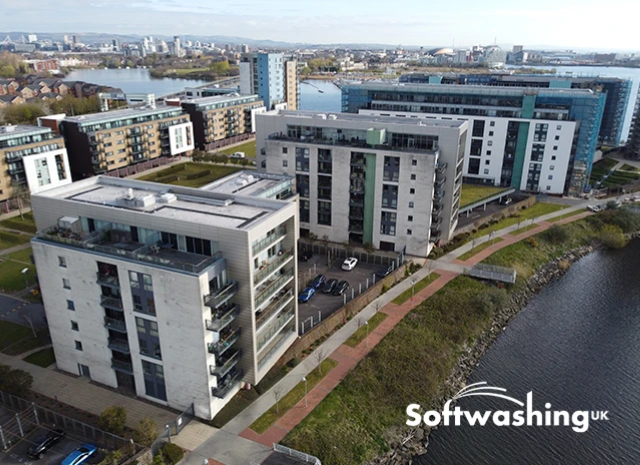
Why Estate-Wide Cleaning Is Beneficial
Cleaning individual properties as problems arise can leave neighbouring buildings looking inconsistent.
Estate-wide programmes provide several advantages.
| Estate-Wide Cleaning | Benefit |
|---|---|
| Consistent appearance | Improved presentation |
| Better planning | Efficient scheduling |
| Simplified communication | Easier resident management |
| Coordinated access | Reduced disruption |
| Planned budgeting | Greater cost control |
A coordinated approach helps maintain attractive residential communities.
Environmental Considerations
Professional softwashing should always be carried out with consideration for surrounding landscaping and communal spaces.
Careful planning helps protect:
- Trees
- Flower beds
- Shrubs
- Lawns
- Paved areas
- Children’s play spaces
Appropriate working practices help minimise disruption to residents while maintaining the appearance of shared outdoor areas.
Supporting Long-Term Asset Management
Housing association properties represent significant long-term investments.
Routine render cleaning forms part of a wider strategy aimed at preserving these assets and maintaining attractive neighbourhoods.
Removing environmental contamination and biological growth allows property managers to identify developing maintenance issues more easily while helping rendered surfaces retain their original appearance for longer.
For housing associations seeking a professional solution, Softwashing UK provides specialist render cleaning using carefully planned softwashing techniques. Their experienced approach safely removes dirt, pollution, green algae and red algae while protecting modern render systems, helping residential developments remain clean, welcoming and well maintained throughout the year.
Developing a Planned Estate Maintenance Schedule
A planned maintenance schedule helps housing associations manage multiple properties more efficiently while maintaining a consistent appearance across the estate.
Rather than responding only when staining becomes severe, regular inspections allow maintenance teams to identify developing issues early.
A typical programme may include:
| Frequency | Recommended Activity |
|---|---|
| Monthly | Visual inspection of communal buildings and rendered elevations |
| Every Season | Check for green algae, red algae and weather-related staining |
| Twice Yearly | Inspect gutters, drainage and roof run-off |
| Annually | Comprehensive external condition survey |
| As Required | Professional softwashing of affected buildings |
Planning maintenance throughout the year often helps spread budgets more effectively while reducing reactive repairs.
Why Different Buildings Stain at Different Rates
Even within the same housing development, some buildings become stained much faster than others.
Several factors influence this:
- North-facing elevations remain damp for longer.
- Buildings surrounded by mature trees receive less sunlight.
- Homes close to busy roads accumulate more pollution.
- Sheltered courtyards experience reduced airflow.
- Poor drainage increases splashback staining.
Understanding these differences allows property managers to prioritise cleaning where it is needed most.
Protecting Newly Built Housing Developments
Many new-build housing association developments feature modern silicone or monocouche render systems.
Although these finishes are highly durable, they are not maintenance-free.
During the first few years after construction, properties may experience:
- Construction dust settling on render.
- Bare soil creating mud splashback.
- Newly planted landscaping increasing moisture.
- Organic growth becoming established as gardens mature.
Introducing planned maintenance from the beginning helps preserve the clean appearance of new developments.
Resident Satisfaction and Estate Appearance
The condition of communal areas plays an important role in how residents feel about where they live.
Clean rendered buildings contribute to:
- A well-cared-for environment.
- Greater pride in the neighbourhood.
- Improved visual consistency.
- More welcoming communal spaces.
- Better first impressions for visitors.
Although render cleaning is primarily an external maintenance activity, it supports the overall presentation of the estate.
Managing Large Residential Portfolios
Housing associations often manage hundreds or even thousands of properties spread across different locations.
Prioritising maintenance becomes easier when developments are assessed according to:
| Assessment Factor | Importance |
|---|---|
| Level of staining | Identifies immediate priorities |
| Property age | Helps forecast future maintenance |
| Building height | Determines access requirements |
| Environmental exposure | Predicts cleaning frequency |
| Resident access | Supports project planning |
A structured approach helps maintenance teams allocate resources efficiently.
Common Questions About Housing Association Render Cleaning
Why does one block look dirtier than the next?
Small differences in shade, drainage, surrounding vegetation or exposure to prevailing weather can cause neighbouring buildings to weather at different rates.
Does green algae always mean the render is damaged?
No. Green algae is usually a surface biological growth rather than structural damage, although it should still be removed before it spreads.
Why has red algae become more common?
Red algae has become increasingly widespread across the UK due to changing weather patterns, including milder, wetter conditions that encourage biological growth.
Can cleaning improve the appearance of older rendered properties?
In many cases, professional softwashing can remove years of biological staining and environmental contamination, significantly improving the appearance of rendered surfaces.
Is every render finish cleaned in the same way?
No. Silicone, acrylic, monocouche and mineral renders each have different characteristics and should always be assessed before cleaning.
Integrating Render Cleaning With Other Maintenance Work
Render cleaning often fits naturally alongside other planned maintenance activities.
Housing associations frequently coordinate exterior works with:
- Roof inspections.
- Gutter clearing.
- Window cleaning.
- Drainage maintenance.
- External painting.
- Grounds maintenance.
Completing several tasks during the same maintenance period helps minimise disruption for residents.
Protecting Long-Term Property Assets
Housing association homes are valuable long-term assets that require ongoing care throughout their lifespan.
Routine render maintenance helps support wider asset management by:
- Maintaining attractive neighbourhoods.
- Making building inspections easier.
- Reducing the visual impact of environmental contamination.
- Supporting preventative maintenance programmes.
- Helping identify defects before they become significant.
Although render cleaning is largely cosmetic, it forms an important part of preserving the overall presentation of residential developments.
Why Preventative Maintenance Offers Better Value
Waiting until buildings become heavily stained often results in larger, more complex cleaning programmes.
Preventative maintenance allows housing associations to plan work before contamination becomes widespread.
| Preventative Maintenance | Long-Term Advantage |
|---|---|
| Regular inspections | Early detection of staining |
| Planned cleaning | Consistent estate appearance |
| Vegetation management | Better airflow around buildings |
| Gutter maintenance | Reduced water staining |
| Scheduled budgeting | Improved financial planning |
A proactive approach helps maintain attractive residential environments while supporting long-term maintenance objectives.
Choosing a Professional Softwashing Service
Every housing association development is different, with varying building heights, render systems, access requirements and environmental conditions.
Professional assessment ensures that:
- The correct cleaning method is selected.
- Modern render finishes are protected.
- Green algae and red algae are properly treated.
- Access is planned safely.
- Resident disruption is kept to a minimum.
For housing associations looking to maintain clean, welcoming communities, Softwashing UK provides specialist render cleaning using professional softwashing techniques tailored to residential developments. Their experienced approach safely removes dirt, pollution, green algae and red algae while helping preserve the appearance and longevity of rendered buildings across housing association estates throughout the UK.