


Property owners across the UK are increasingly aware of how important it is to maintain exterior surfaces, particularly rendered walls. Modern render systems can significantly improve the appearance of a building, but over time they are exposed to weather, pollution, and biological growth that can leave them stained and discoloured.
A common question is how much render cleaning costs per square metre. While pricing can vary, the truth is that it depends far more on the condition of the property than a fixed rate.
Professional specialists such as Soft Washing UK provide tailored render cleaning services designed to restore surfaces safely without damaging the finish.
Why Render Cleaning Is Necessary
Render is designed to protect external walls while improving appearance. However, the UK climate creates ideal conditions for organic growth and staining.
Common contaminants include:
- Green algae
- Red algae (from the genus Trentepohlia)
- Black mould
- Lichen
- Moss
- Airborne pollution
- Traffic film
- General dirt and dust
Walls that receive less sunlight, particularly north-facing elevations, tend to develop staining more quickly due to prolonged damp conditions.
If left untreated, these contaminants can spread and become more difficult to remove over time.
Typical Property Costs (Guide Only)
While per-square-metre pricing varies depending on condition and access, most residential projects fall within typical overall ranges:
- Small bungalow: £350–£700 + VAT
- Semi-detached house: £500–£1,000 + VAT
- Detached house: £800–£1,800 + VAT
- Large detached property: £1,500–£3,000 upwards + VAT
These figures are influenced by factors such as render condition, building height, and access requirements.
What Affects the Cost of Render Cleaning?
There is no single fixed price for render cleaning because every property is different. Several key factors determine the overall cost.
Type of Render
Different render systems require different approaches.
- Monocouche render
- Silicone render
- Acrylic render
- Traditional cement render
- Painted render
Some modern finishes require a more careful, low-pressure approach to avoid damage or colour change.
Level of Contamination
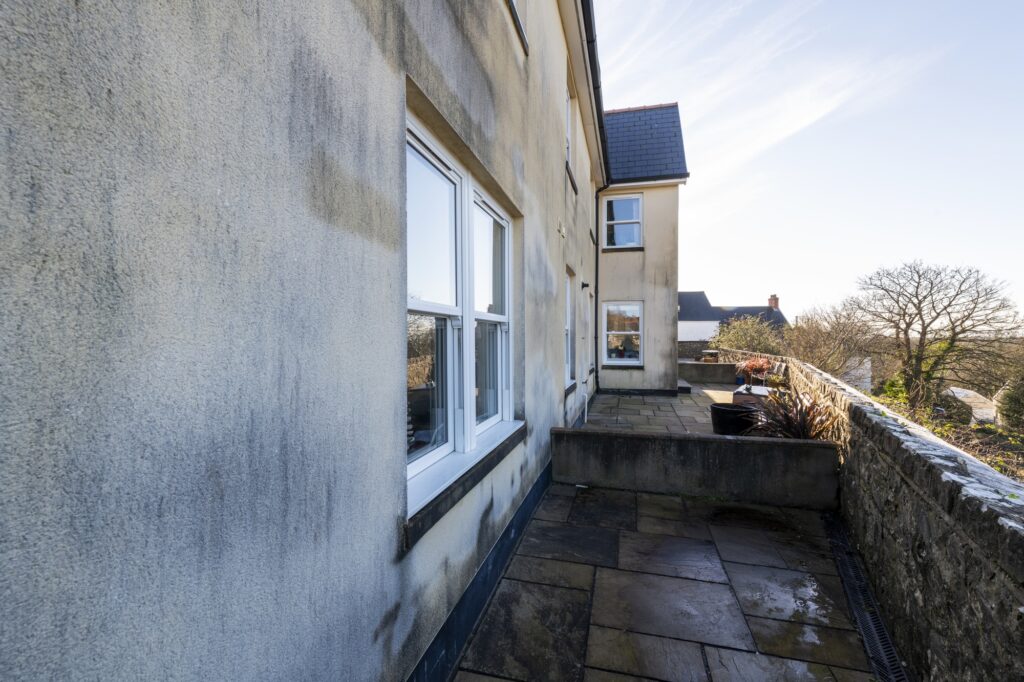
The extent of staining is one of the biggest cost drivers.
Common levels include:
- Light surface staining
- Moderate algae growth
- Heavy biological contamination
- Severe long-term staining
Properties affected by widespread green algae and red algae typically require more intensive treatment to fully restore the surface.
Building Height
Height directly affects access and safety requirements.
- Single-storey properties are generally the simplest
- Two-storey homes are standard
- Three-storey and above usually require additional equipment
Higher buildings increase both complexity and time on site.
Access Around the Property
Good access helps keep costs lower. Restricted access increases labour time and equipment needs.
Common challenges include:
- Narrow side passages
- Conservatories or extensions
- Sloped gardens
- Limited parking
- Boundary obstructions
In more complex cases, specialist access equipment may be required.
Cleaning Methods and Their Impact
The method used plays a major role in both cost and long-term results.
Soft Washing
Soft washing uses specialist cleaning solutions to treat biological growth at its source.
Benefits include:
- Long-lasting results
- Effective treatment of algae
- Reduced risk of surface damage
- Slower regrowth
Pressure Washing
Pressure washing removes surface contamination using water force.
Limitations include:
- Only addresses surface staining
- Higher risk of damage on delicate render
- Faster regrowth in many cases
Steam Cleaning
Steam cleaning uses high-temperature water at low pressure.
It can be effective in certain situations but requires specialist equipment and careful application.
How the Cleaning Process Works
A professional render cleaning project usually follows a structured process:
Initial Survey
Assessment of:
- Render type
- Condition of surface
- Access requirements
- Contamination levels
- Safety considerations
Preparation
This may include:
- Protecting plants and nearby surfaces
- Setting up safe working areas
- Preparing equipment
Treatment Application
Specialist cleaning solutions are applied to break down organic growth and staining.
Rinse or Natural Weathering
Depending on the system used, surfaces are either gently rinsed or left to naturally clear over time.
Final Inspection
The completed work is reviewed to ensure consistent results.
Why Contamination Level Matters So Much
Biological growth is often deeper than it appears on the surface.
Green Algae
Common in damp, shaded areas and spreads quickly if untreated.
Red Algae (Trentepohlia)
Often appears as orange or red staining and can penetrate deeper into render, making it more difficult to remove.
Severe cases involving both types usually require more intensive treatment.
Regional Differences in Pricing
Location can also influence overall costs due to labour and operational differences.
- London and South East: generally higher
- South West and Midlands: moderate
- North of England and Wales: often lower
- Scotland: varies depending on location
Urban areas may also involve additional logistical considerations.
Commercial Render Cleaning
Commercial properties often require bespoke pricing due to scale and complexity.
This can include:
- Larger surface areas
- Working at height
- Public safety requirements
- Traffic management
- Out-of-hours scheduling
Typical commercial buildings include offices, retail units, schools, hotels, and apartment blocks.
How Often Should Render Be Cleaned?
Frequency depends on environment and exposure.
- Rural areas: every 4–6 years
- Suburban areas: every 3–5 years
- Urban areas: every 3–4 years
- Coastal areas: every 2–4 years
- Heavily shaded areas: every 2–3 years
Regular maintenance helps prevent severe staining and reduces long-term costs.
Signs Render Needs Cleaning
Common indicators include:
- Green or red staining
- Black spotting
- Moss growth
- Patchy discolouration
- Dull or tired appearance
Early treatment is usually more cost-effective than waiting for severe build-up.
Why Professional Cleaning Is Worth It
Incorrect cleaning methods can cause long-term damage, including:
- Surface erosion
- Colour fading
- Water ingress
- Cracking or weakening of render
Professional contractors assess each property individually and select the correct method based on material type and condition.
Additional Services That May Be Included
Some projects may require extra treatments:
- Biocide applications
- Protective coatings
- Gutter cleaning
- Stain removal treatments
- Access equipment hire
These can improve long-term results and reduce regrowth.
What Should Be Included in a Quote?
A professional quotation should clearly outline:
- Site survey
- Labour
- Cleaning products
- Equipment
- Access requirements
- Safety measures
- Final inspection
Clear breakdowns help ensure accurate comparisons between providers.
Final Thoughts
Render cleaning costs vary because every property presents different challenges. The main factors are surface condition, render type, access, building height, and the level of biological growth.
A proper assessment is always the most reliable way to determine an accurate price and ensure the correct cleaning method is used.