


Cement splashes on rendered walls are a common problem after building, landscaping and renovation work. A newly rendered or freshly cleaned property can quickly end up covered in grey marks, spots and hardened deposits after nearby bricklaying, pointing, paving or concrete work.
Unfortunately, removing cement from render is not always as simple as scraping it away or attacking it with a pressure washer. Render can be surprisingly vulnerable to aggressive cleaning, particularly modern coloured systems such as silicone, acrylic and monocouche render. The wrong technique can turn a relatively small cement splash into permanent surface damage.
The safest approach is to identify the type of render, assess how firmly the cement has bonded and choose a cleaning method that removes the contamination without unnecessarily affecting the surface beneath it.
For difficult contamination, professional render cleaning from SOFTWASHING UK can provide a more controlled approach to restoring the appearance of rendered elevations.
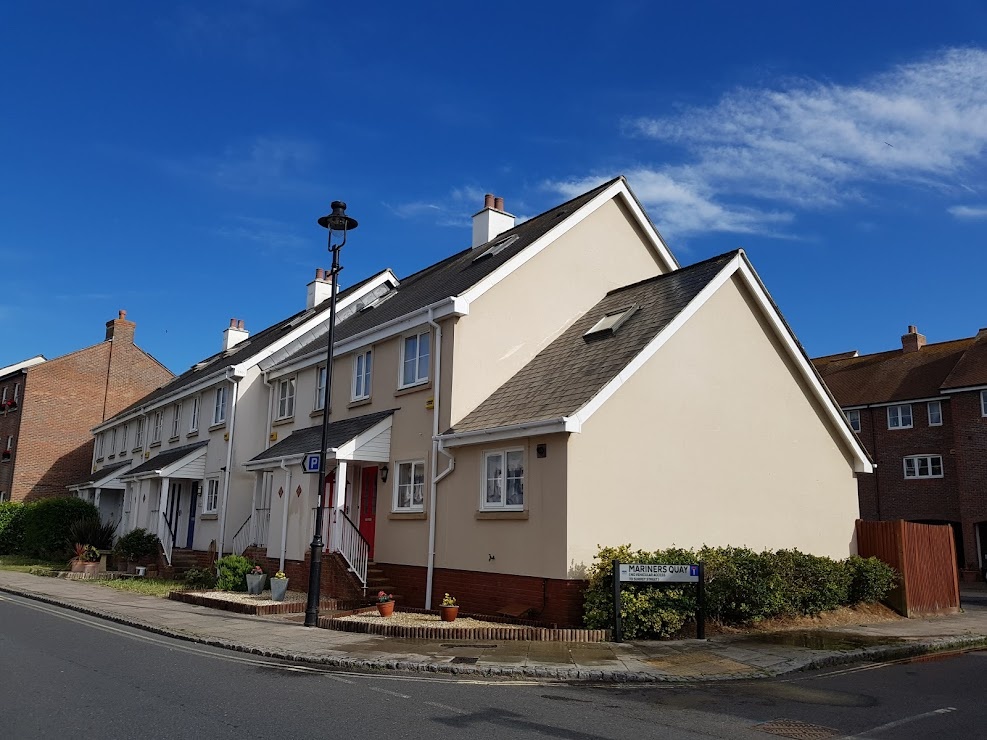
Why Do Cement Splashes Get Onto Render?
Cement and mortar contamination most commonly occurs during other building work. Wet cement-based materials can be flicked or dropped surprisingly far, particularly when contractors are mixing, cutting, pointing or washing equipment close to a rendered elevation.
Common causes include:
- Bricklaying
- Repointing
- Patio installation
- Driveway construction
- Concrete pouring
- Extension building
- Wall construction
- Roof repairs
- Rendering adjacent sections
- Landscaping
- Cement mixer cleaning
- Cutting paving slabs
- General renovation work
The contamination may initially look like harmless grey speckles. However, once cement dries and cures, it becomes considerably more difficult to remove.
This is why protecting surrounding surfaces during building work is so important.
Why Cement Is Difficult to Remove from Render
Cement is designed to harden. Once a cement splash lands on a textured or porous rendered surface, it can work into small imperfections and adhere strongly.
The difficulty is that the render itself may also contain cementitious materials or have a comparatively delicate decorative surface.
Aggressive removal could therefore damage the wall you are attempting to clean.
| Problem | Why It Matters |
|---|---|
| Cement has hardened | Mechanical removal becomes more difficult |
| Render is textured | Cement can lodge inside the texture |
| Render is coloured | Damage may expose a different colour underneath |
| Render is painted | Cleaning could affect the coating |
| Modern render can be delicate | Excessive pressure may alter the finish |
| Large deposits are present | More intensive removal may be necessary |
| Cement has been present for months | Weathering can make the contamination harder to assess |
The aim should not simply be to remove the cement at any cost. The objective is to achieve the best possible result while protecting the original rendered finish.
Identify the Render Before Cleaning
Not all render should be treated in the same way.
Before attempting cement removal, it is important to establish what type of render is on the building.
Common UK render systems include:
| Render Type | Characteristics | Cleaning Considerations |
|---|---|---|
| Monocouche | Through-coloured mineral render | Surface texture and colour need protecting |
| Silicone | Modern, water-repellent finish | Aggressive cleaning should be avoided |
| Acrylic | Flexible decorative render | Surface finish may be vulnerable |
| Sand and cement | Traditional hard render | Often robust but can still be damaged |
| Painted render | Render with decorative coating | Paint condition must be considered |
| Lime render | Traditional breathable material | Requires particularly careful treatment |
The age and condition of the render matter as well.
Cracked, loose, hollow or deteriorating areas should be identified before cleaning begins. What appears to be a cleaning problem can sometimes reveal an existing defect once contamination is removed.
Should You Scrape Cement Off Render?
It can be tempting to reach for a scraper, screwdriver or wire brush when you discover hardened cement.
This can cause problems.
Metal tools can scratch the render, flatten textured areas or remove the surface finish. On through-coloured render, aggressive scraping may create a visibly different patch.
If a large piece of cement is barely attached, careful mechanical removal may form part of the professional cleaning process. However, blindly scraping every splash is very different.
The harder you have to scrape, the greater the possibility of affecting the substrate underneath.
Avoid aggressive tools such as:
- Wire brushes
- Screwdrivers
- Metal chisels
- Angle grinders
- Abrasive discs
- Hard metal scrapers
The original condition and type of render should dictate the technique rather than simply choosing the strongest available tool.
Can You Pressure Wash Cement Splashes Off Render?
Using a pressure washer might seem like an obvious solution.
If the cement is stubborn, increasing the pressure can feel logical. Unfortunately, render cleaning does not work that way.
High-pressure water can potentially affect the rendered surface before it removes the cement contamination. Excessive pressure can contribute to surface erosion, uneven texture and patchy cleaning.
There is also a danger of concentrating the jet on one small area while trying to remove a stubborn spot.
This can leave obvious cleaning marks.
SOFTWASHING UK specialises in lower-pressure exterior cleaning methods designed around protecting exterior substrates rather than relying unnecessarily on aggressive pressure.
Fresh Cement Versus Hardened Cement
How long the cement has been present can make a significant difference.
Fresh contamination
Fresh cement that has not fully cured may potentially be easier to deal with. However, rubbing wet cement across the wall can spread the contamination and push material deeper into a textured finish.
Hardened contamination
Once cement has cured, the problem changes. The contamination is now physically bonded to the surface and may require carefully selected mechanical or specialist cleaning techniques.
| Condition | Typical Challenge |
|---|---|
| Fresh splashes | Risk of spreading the cement |
| Partially cured cement | Increasing adhesion |
| Fully hardened spots | Strong bond with surface |
| Thick cement deposits | May require staged removal |
| Cement within textured render | Difficult to remove uniformly |
| Old weathered contamination | May be combined with other staining |
This is one reason there is no universal method for every cement-stained rendered wall.
Specialist Cement Removal Products
Specialist products exist for dealing with cementitious contamination, but this does not mean that every cement remover is automatically suitable for render.
Chemical compatibility is critical.
A product capable of attacking cement residue may potentially affect certain mineral surfaces, coatings, pigments or surrounding materials.
Before any specialist cleaning product is applied across a visible elevation, professional contractors can assess the substrate and carry out a discreet test where appropriate.
A test area can help establish:
- Whether the contamination responds
- Whether the render changes colour
- Whether the texture is affected
- How much dwell time may be appropriate
- Whether repeat treatment is required
- Whether additional mechanical assistance is necessary
Simply purchasing a strong cement remover and applying it across an entire rendered wall without testing can create a much larger problem than the original splashes.
Why Acid Cleaning Requires Particular Care
Acid-based products are sometimes associated with cement and mortar removal because acids can react with cementitious deposits.
However, this is exactly why caution is necessary around rendered surfaces.
Many renders themselves contain mineral or cement-based components. An inappropriate acidic cleaner, excessive concentration or excessive dwell time could therefore affect more than the unwanted contamination.
Surrounding materials also need consideration, including:
- Windows
- Metalwork
- Painted surfaces
- Natural stone
- Brickwork
- Paving
- Sealants
- Plants
- Drainage systems
Professional cleaning is about controlling the entire process rather than focusing solely on whether a chemical can dissolve a particular stain.
Cement Splashes on Coloured Render
Coloured render requires particular care because the appearance of the wall depends on a consistent surface.
Imagine dozens of small cement spots across a cream, white or pale grey elevation. Removing each spot aggressively could leave dozens of slightly different patches behind.
In some situations, the cement contamination itself may come away but leave residual shadowing or staining.
The condition of the render beneath the cement also matters. If a cement splash has covered part of the wall for a considerable period while the surrounding render has weathered, there may be a slight difference once the deposit is removed.
Expectations therefore need to be realistic.
Professional cleaning aims for the best possible improvement while avoiding unnecessary damage to the original finish.
Cement Splashes After Building Work
One of the best times to inspect rendered walls is immediately after construction or renovation work has finished.
Walk around the property and look closely at areas surrounding the work.
Pay particular attention to:
- Lower sections of walls
- Corners
- Areas beside new patios
- Walls next to extensions
- Render around new windows
- Areas beside newly built walls
- Sections near scaffolding
- Walls surrounding concrete work
- Render beside newly pointed brickwork
Small cement spots are much easier to identify during a dedicated inspection than several months later.
What About Other Building Stains?
Cement is not the only contamination that can be left behind following construction work.
A rendered property may have several different forms of staining at the same time.
| Contamination | Possible Appearance |
|---|---|
| Cement | Grey or off-white hardened spots |
| Mortar | Raised grey deposits |
| General building dust | Dull film across the surface |
| Soil | Brown splash marks |
| Rust | Orange or brown staining |
| Organic contamination | Dark or coloured growth |
| Sealant residue | Localised marks around building work |
| Water run-off | Vertical streaking |
Correct identification matters because a treatment intended for one type of contamination may have little effect on another.
Cement Staining and Organic Growth Are Different Problems
It is also important to distinguish cement contamination from biological staining.
Rendered walls commonly develop organic contamination because exterior surfaces are continually exposed to moisture and environmental conditions.
Green algae and red algae, mould, lichen and other biological growth require a different cleaning approach from hardened cement.
For example, a rendered wall could have cement splashes around a recently installed patio while also suffering from green algae and red algae on the shaded elevation.
Treating the entire wall as one problem would be inappropriate.
A professional assessment can separate the different forms of contamination and determine which cleaning processes are suitable for each section.
Why Softwashing Alone May Not Remove Hardened Cement
Softwashing is highly effective for many forms of organic exterior contamination, but hardened cement is not biological growth.
This distinction is important.
Cement contamination may require a specialist stain-removal process rather than simply the same treatment used for algae, mould or other organic matter.
The overall restoration of a building might therefore involve several stages.
For example:
- Inspect the render and contamination.
- Identify the cement-affected areas.
- Assess existing render condition.
- Carry out suitable test areas.
- Carefully reduce or remove hardened deposits.
- Treat remaining staining where appropriate.
- Clean wider organic contamination separately if required.
- Inspect the finished elevation.
The exact process will depend on the render and severity of contamination.
When Should You Call a Professional?
A couple of tiny splashes on robust traditional render are very different from hundreds of hardened cement spots across a modern rendered house.
Professional assistance becomes particularly worthwhile when:
- The render is monocouche, silicone or acrylic.
- The contamination covers a large area.
- Cement has fully hardened.
- Previous DIY attempts have failed.
- The render is high up.
- The wall has existing cracks or damage.
- The property has recently been renovated.
- Appearance is particularly important.
- The render is light-coloured.
- You are unsure which cleaning chemical is safe.
- Cement is mixed with other forms of contamination.
Using a specialist can also reduce the temptation to keep escalating pressure, chemical strength or abrasion when the first DIY attempt fails.
Why Test Cleaning Is So Important
One of the most useful steps when dealing with unusual stains is testing.
A small, discreet test area provides information before treatment is expanded across the building.
Professionals can assess how both the contamination and substrate respond.
| Test Observation | What It Can Indicate |
|---|---|
| Cement softens or reduces | Treatment may be effective |
| Render colour changes | Method may be unsuitable |
| Surface becomes rough | Treatment may be too aggressive |
| Little change occurs | Alternative approach may be needed |
| Cement removes but shadow remains | Further assessment required |
| Excellent local result | Wider treatment may be possible |
Testing is particularly important when the render manufacturer, age, coating or previous maintenance history is uncertain.
Protecting Render During Future Building Work
Prevention is far easier than removing cured cement afterwards.
Before builders begin work around a rendered property, nearby walls should be considered as part of the protection plan.
Protective measures can include appropriate sheeting, careful positioning of mixing areas and preventing dirty water or cement residue from being washed towards rendered elevations.
Contractors should also avoid cleaning cement-covered equipment immediately beside finished render.
If contamination does occur, identifying it quickly gives the property owner more options than discovering it after the material has been allowed to harden and weather for months.
Professional Render Cleaning from SOFTWASHING UK
Cement splashes can be deceptively complicated. What appears to be a handful of grey marks may involve hardened mineral contamination attached to a comparatively delicate decorative surface.
SOFTWASHING UK has extensive experience with traditional and modern rendered systems and uses cleaning methods selected according to the substrate and type of contamination rather than relying on a one-method-fits-all approach.
The company specialises in professional exterior and render cleaning throughout the UK, working with domestic and commercial properties.
Where cement splashes form part of a wider exterior cleaning problem, the rendered elevation can be assessed for additional staining, weathering and organic contamination so that the appropriate cleaning method can be considered for each issue.
Property owners dealing with cement, mortar or construction-related staining can contact SOFTWASHING UK to discuss the condition of their rendered walls and the most appropriate approach to cleaning them safely.
How to Remove Cement Splashes from Render
Cement splashes on rendered walls are a common problem after building, landscaping and renovation work. A newly rendered or freshly cleaned property can quickly end up covered in grey marks, spots and hardened deposits after nearby bricklaying, pointing, paving or concrete work.
Unfortunately, removing cement from render is not always as simple as scraping it away or attacking it with a pressure washer. Render can be surprisingly vulnerable to aggressive cleaning, particularly modern coloured systems such as silicone, acrylic and monocouche render. The wrong technique can turn a relatively small cement splash into permanent surface damage.
The safest approach is to identify the type of render, assess how firmly the cement has bonded and choose a cleaning method that removes the contamination without unnecessarily affecting the surface beneath it.
For difficult contamination, professional render cleaning from SOFTWASHING UK can provide a more controlled approach to restoring the appearance of rendered elevations.
Why Do Cement Splashes Get Onto Render?
Cement and mortar contamination most commonly occurs during other building work. Wet cement-based materials can be flicked or dropped surprisingly far, particularly when contractors are mixing, cutting, pointing or washing equipment close to a rendered elevation.
Common causes include:
- Bricklaying
- Repointing
- Patio installation
- Driveway construction
- Concrete pouring
- Extension building
- Wall construction
- Roof repairs
- Rendering adjacent sections
- Landscaping
- Cement mixer cleaning
- Cutting paving slabs
- General renovation work
The contamination may initially look like harmless grey speckles. However, once cement dries and cures, it becomes considerably more difficult to remove.
This is why protecting surrounding surfaces during building work is so important.
Why Cement Is Difficult to Remove from Render
Cement is designed to harden. Once a cement splash lands on a textured or porous rendered surface, it can work into small imperfections and adhere strongly.
The difficulty is that the render itself may also contain cementitious materials or have a comparatively delicate decorative surface.
Aggressive removal could therefore damage the wall you are attempting to clean.
| Problem | Why It Matters |
|---|---|
| Cement has hardened | Mechanical removal becomes more difficult |
| Render is textured | Cement can lodge inside the texture |
| Render is coloured | Damage may expose a different colour underneath |
| Render is painted | Cleaning could affect the coating |
| Modern render can be delicate | Excessive pressure may alter the finish |
| Large deposits are present | More intensive removal may be necessary |
| Cement has been present for months | Weathering can make the contamination harder to assess |
The aim should not simply be to remove the cement at any cost. The objective is to achieve the best possible result while protecting the original rendered finish.
Identify the Render Before Cleaning
Not all render should be treated in the same way.
Before attempting cement removal, it is important to establish what type of render is on the building.
Common UK render systems include:
| Render Type | Characteristics | Cleaning Considerations |
|---|---|---|
| Monocouche | Through-coloured mineral render | Surface texture and colour need protecting |
| Silicone | Modern, water-repellent finish | Aggressive cleaning should be avoided |
| Acrylic | Flexible decorative render | Surface finish may be vulnerable |
| Sand and cement | Traditional hard render | Often robust but can still be damaged |
| Painted render | Render with decorative coating | Paint condition must be considered |
| Lime render | Traditional breathable material | Requires particularly careful treatment |
The age and condition of the render matter as well.
Cracked, loose, hollow or deteriorating areas should be identified before cleaning begins. What appears to be a cleaning problem can sometimes reveal an existing defect once contamination is removed.
Should You Scrape Cement Off Render?
It can be tempting to reach for a scraper, screwdriver or wire brush when you discover hardened cement.
This can cause problems.
Metal tools can scratch the render, flatten textured areas or remove the surface finish. On through-coloured render, aggressive scraping may create a visibly different patch.
If a large piece of cement is barely attached, careful mechanical removal may form part of the professional cleaning process. However, blindly scraping every splash is very different.
The harder you have to scrape, the greater the possibility of affecting the substrate underneath.
Avoid aggressive tools such as:
- Wire brushes
- Screwdrivers
- Metal chisels
- Angle grinders
- Abrasive discs
- Hard metal scrapers
The original condition and type of render should dictate the technique rather than simply choosing the strongest available tool.
Can You Pressure Wash Cement Splashes Off Render?
Using a pressure washer might seem like an obvious solution.
If the cement is stubborn, increasing the pressure can feel logical. Unfortunately, render cleaning does not work that way.
High-pressure water can potentially affect the rendered surface before it removes the cement contamination. Excessive pressure can contribute to surface erosion, uneven texture and patchy cleaning.
There is also a danger of concentrating the jet on one small area while trying to remove a stubborn spot.
This can leave obvious cleaning marks.
SOFTWASHING UK specialises in lower-pressure exterior cleaning methods designed around protecting exterior substrates rather than relying unnecessarily on aggressive pressure.
Fresh Cement Versus Hardened Cement
How long the cement has been present can make a significant difference.
Fresh contamination
Fresh cement that has not fully cured may potentially be easier to deal with. However, rubbing wet cement across the wall can spread the contamination and push material deeper into a textured finish.
Hardened contamination
Once cement has cured, the problem changes. The contamination is now physically bonded to the surface and may require carefully selected mechanical or specialist cleaning techniques.
| Condition | Typical Challenge |
|---|---|
| Fresh splashes | Risk of spreading the cement |
| Partially cured cement | Increasing adhesion |
| Fully hardened spots | Strong bond with surface |
| Thick cement deposits | May require staged removal |
| Cement within textured render | Difficult to remove uniformly |
| Old weathered contamination | May be combined with other staining |
This is one reason there is no universal method for every cement-stained rendered wall.
Specialist Cement Removal Products
Specialist products exist for dealing with cementitious contamination, but this does not mean that every cement remover is automatically suitable for render.
Chemical compatibility is critical.
A product capable of attacking cement residue may potentially affect certain mineral surfaces, coatings, pigments or surrounding materials.
Before any specialist cleaning product is applied across a visible elevation, professional contractors can assess the substrate and carry out a discreet test where appropriate.
A test area can help establish:
- Whether the contamination responds
- Whether the render changes colour
- Whether the texture is affected
- How much dwell time may be appropriate
- Whether repeat treatment is required
- Whether additional mechanical assistance is necessary
Simply purchasing a strong cement remover and applying it across an entire rendered wall without testing can create a much larger problem than the original splashes.
Why Acid Cleaning Requires Particular Care
Acid-based products are sometimes associated with cement and mortar removal because acids can react with cementitious deposits.
However, this is exactly why caution is necessary around rendered surfaces.
Many renders themselves contain mineral or cement-based components. An inappropriate acidic cleaner, excessive concentration or excessive dwell time could therefore affect more than the unwanted contamination.
Surrounding materials also need consideration, including:
- Windows
- Metalwork
- Painted surfaces
- Natural stone
- Brickwork
- Paving
- Sealants
- Plants
- Drainage systems
Professional cleaning is about controlling the entire process rather than focusing solely on whether a chemical can dissolve a particular stain.
Cement Splashes on Coloured Render
Coloured render requires particular care because the appearance of the wall depends on a consistent surface.
Imagine dozens of small cement spots across a cream, white or pale grey elevation. Removing each spot aggressively could leave dozens of slightly different patches behind.
In some situations, the cement contamination itself may come away but leave residual shadowing or staining.
The condition of the render beneath the cement also matters. If a cement splash has covered part of the wall for a considerable period while the surrounding render has weathered, there may be a slight difference once the deposit is removed.
Expectations therefore need to be realistic.
Professional cleaning aims for the best possible improvement while avoiding unnecessary damage to the original finish.
Cement Splashes After Building Work
One of the best times to inspect rendered walls is immediately after construction or renovation work has finished.
Walk around the property and look closely at areas surrounding the work.
Pay particular attention to:
- Lower sections of walls
- Corners
- Areas beside new patios
- Walls next to extensions
- Render around new windows
- Areas beside newly built walls
- Sections near scaffolding
- Walls surrounding concrete work
- Render beside newly pointed brickwork
Small cement spots are much easier to identify during a dedicated inspection than several months later.
What About Other Building Stains?
Cement is not the only contamination that can be left behind following construction work.
A rendered property may have several different forms of staining at the same time.
| Contamination | Possible Appearance |
|---|---|
| Cement | Grey or off-white hardened spots |
| Mortar | Raised grey deposits |
| General building dust | Dull film across the surface |
| Soil | Brown splash marks |
| Rust | Orange or brown staining |
| Organic contamination | Dark or coloured growth |
| Sealant residue | Localised marks around building work |
| Water run-off | Vertical streaking |
Correct identification matters because a treatment intended for one type of contamination may have little effect on another.
Cement Staining and Organic Growth Are Different Problems
It is also important to distinguish cement contamination from biological staining.
Rendered walls commonly develop organic contamination because exterior surfaces are continually exposed to moisture and environmental conditions.
Green algae and red algae, mould, lichen and other biological growth require a different cleaning approach from hardened cement.
For example, a rendered wall could have cement splashes around a recently installed patio while also suffering from green algae and red algae on the shaded elevation.
Treating the entire wall as one problem would be inappropriate.
A professional assessment can separate the different forms of contamination and determine which cleaning processes are suitable for each section.
Why Softwashing Alone May Not Remove Hardened Cement
Softwashing is highly effective for many forms of organic exterior contamination, but hardened cement is not biological growth.
This distinction is important.
Cement contamination may require a specialist stain-removal process rather than simply the same treatment used for algae, mould or other organic matter.
The overall restoration of a building might therefore involve several stages.
For example:
- Inspect the render and contamination.
- Identify the cement-affected areas.
- Assess existing render condition.
- Carry out suitable test areas.
- Carefully reduce or remove hardened deposits.
- Treat remaining staining where appropriate.
- Clean wider organic contamination separately if required.
- Inspect the finished elevation.
The exact process will depend on the render and severity of contamination.
When Should You Call a Professional?
A couple of tiny splashes on robust traditional render are very different from hundreds of hardened cement spots across a modern rendered house.
Professional assistance becomes particularly worthwhile when:
- The render is monocouche, silicone or acrylic.
- The contamination covers a large area.
- Cement has fully hardened.
- Previous DIY attempts have failed.
- The render is high up.
- The wall has existing cracks or damage.
- The property has recently been renovated.
- Appearance is particularly important.
- The render is light-coloured.
- You are unsure which cleaning chemical is safe.
- Cement is mixed with other forms of contamination.
Using a specialist can also reduce the temptation to keep escalating pressure, chemical strength or abrasion when the first DIY attempt fails.
Why Test Cleaning Is So Important
One of the most useful steps when dealing with unusual stains is testing.
A small, discreet test area provides information before treatment is expanded across the building.
Professionals can assess how both the contamination and substrate respond.
| Test Observation | What It Can Indicate |
|---|---|
| Cement softens or reduces | Treatment may be effective |
| Render colour changes | Method may be unsuitable |
| Surface becomes rough | Treatment may be too aggressive |
| Little change occurs | Alternative approach may be needed |
| Cement removes but shadow remains | Further assessment required |
| Excellent local result | Wider treatment may be possible |
Testing is particularly important when the render manufacturer, age, coating or previous maintenance history is uncertain.
Protecting Render During Future Building Work
Prevention is far easier than removing cured cement afterwards.
Before builders begin work around a rendered property, nearby walls should be considered as part of the protection plan.
Protective measures can include appropriate sheeting, careful positioning of mixing areas and preventing dirty water or cement residue from being washed towards rendered elevations.
Contractors should also avoid cleaning cement-covered equipment immediately beside finished render.
If contamination does occur, identifying it quickly gives the property owner more options than discovering it after the material has been allowed to harden and weather for months.
Professional Render Cleaning from SOFTWASHING UK
Cement splashes can be deceptively complicated. What appears to be a handful of grey marks may involve hardened mineral contamination attached to a comparatively delicate decorative surface.
SOFTWASHING UK has extensive experience with traditional and modern rendered systems and uses cleaning methods selected according to the substrate and type of contamination rather than relying on a one-method-fits-all approach.
The company specialises in professional exterior and render cleaning throughout the UK, working with domestic and commercial properties.
Where cement splashes form part of a wider exterior cleaning problem, the rendered elevation can be assessed for additional staining, weathering and organic contamination so that the appropriate cleaning method can be considered for each issue.
Property owners dealing with cement, mortar or construction-related staining can contact SOFTWASHING UK to discuss the condition of their rendered walls and the most appropriate approach to cleaning them safely.
Why Cement Splashes Can Become More Noticeable Over Time
Cement contamination is sometimes overlooked immediately after building work because the surrounding render is already dusty or dirty. Once the general building dust has been washed away by rain, however, individual cement spots can become much more obvious.
Weathering can also increase the visual contrast between the contamination and the surrounding elevation. A small grey mark on an already dusty wall may not attract much attention, but the same mark can stand out significantly once the rest of the render has naturally weathered or been professionally cleaned.
This is particularly noticeable on white, cream and other pale rendered finishes. It can also become apparent when sunlight strikes the wall from an angle, highlighting raised cement deposits and changes in surface texture.
For this reason, cement contamination should ideally be assessed as soon as it is discovered rather than assuming that weather exposure will eventually make it disappear.
Why Painting Over Cement Splashes Is Not Always the Answer
Another tempting solution is simply to paint over the affected render. While repainting may be appropriate in some circumstances, it should not automatically be used to disguise contamination without first considering the condition of the surface.
Raised cement deposits can remain visible beneath paint because the physical texture is still present. Painting over them may change their colour without actually removing the lumps, ridges or splashes.
There may also be differences in adhesion between clean render and contaminated areas. Good surface preparation is therefore important before any decorative coating is considered.
Where a property owner is planning to repaint an elevation, professional cleaning beforehand can help reveal the true condition of the substrate. Cement spots, organic contamination, general grime and other defects can then be identified rather than simply being hidden beneath another coating.
| Approach | Potential Issue |
|---|---|
| Painting directly over cement | Raised deposits may remain visible |
| Aggressive sanding | Can alter the render texture |
| Heavy scraping | May damage the surrounding finish |
| Cleaning first | Allows the surface condition to be properly assessed |
| Professional inspection | Helps identify different types of contamination |
Cement Around Windows, Doors and Extensions
Some areas of a property are particularly vulnerable to cement contamination during improvement work.
Windows and doors are common examples. Replacing openings, installing lintels or carrying out surrounding masonry work can result in mortar and cement splashes reaching nearby render. Similar problems can occur where a new extension meets an existing rendered elevation.
These areas require additional care because there may be several different materials within a relatively small space. Render may sit alongside glass, uPVC, aluminium, painted timber, sealants, brickwork and metal fixtures.
A cleaning method suitable for one material may not necessarily be appropriate for everything surrounding it.
This makes controlled application especially important. The objective is to target the contamination while protecting adjacent surfaces and avoiding unnecessary chemical contact or abrasion.
Removing Cement from Textured Render
Texture can make cement removal considerably more complicated.
On a completely smooth surface, contamination sits predominantly on top. On textured render, wet cement can enter small valleys and irregularities before curing. The resulting contamination can therefore follow the shape of the render rather than forming a simple deposit that can be lifted away.
Trying to mechanically remove material from every indentation can potentially flatten the texture and create a visibly smoother patch.
The greater the contrast between the repaired area and surrounding wall, the more obvious the attempted cleaning may become.
This is why patience is important. Specialist stain removal can sometimes involve repeated controlled treatments rather than attempting to achieve complete removal in one aggressive operation.
When Cement Has Run Down the Wall
Not all cement contamination appears as individual splashes. Cement-rich water can sometimes run down an elevation and create vertical marks or streaks.
This may happen when building materials are mixed above the affected area, when tools are washed nearby or when rainwater passes through fresh construction residue before running across the render.
Run marks can be more challenging visually because they may cover a much larger area than individual spots.
Before treatment begins, it is important to determine whether the mark is actually cement residue, general construction dirt, mineral staining or another form of contamination. The appearance alone does not always provide enough information.
Why Access Matters During Cement Removal
Cement splashes are not always conveniently located at ground level.
Building work involving scaffolding, roofing, extensions and upper-storey masonry can leave contamination several metres above the ground. Attempting detailed stain removal from a ladder can make controlled cleaning considerably more difficult.
Safe access allows the affected area to be inspected closely rather than attempting to judge the contamination from ground level. It can also make it easier to control cleaning products and work carefully around individual deposits.
Professional exterior cleaning therefore involves considering access as well as the cleaning method itself.
Should the Whole Rendered Wall Be Cleaned Afterwards?
Removing cement contamination can sometimes reveal a difference between the treated area and the surrounding render.
This does not necessarily mean that the cement removal has caused discolouration. The newly treated section may simply be cleaner than a wall that has accumulated years of atmospheric dirt and biological contamination.
In these circumstances, cleaning a wider section of the elevation may produce a more consistent appearance.
For example, an older rendered wall could contain cement splashes as well as general grime, green algae and red algae. Treating only the cement spots may address the building contamination without improving the surrounding organic staining.
The most appropriate scope of work depends on the overall condition of the property and the result the owner wants to achieve.
Cement Removal Before Selling a Property
Exterior presentation can become particularly important when preparing a home for sale. Cement splashes left behind after an extension, new patio or other improvement work can make otherwise completed renovations appear unfinished.
Prospective buyers may not know whether the marks are superficial contamination or permanent damage to the render. Cleaning obvious building residue can therefore help present the exterior in a cleaner and better-maintained condition.
The same applies to landlords, developers and property managers preparing buildings for handover or occupation. Small finishing details can have a disproportionate impact on how completed work is perceived.
Checking Render After the Cement Has Been Removed
Cleaning should not necessarily end the moment the visible cement has disappeared.
The treated area should be inspected once it has dried because damp render can temporarily look different from the surrounding wall. Allowing the surface to dry makes it easier to judge colour consistency, remaining shadows and any areas requiring further attention.
A post-clean inspection may identify:
- Small deposits that remain in textured areas
- Residual staining
- Differences caused by previous weathering
- Existing cracks previously hidden by contamination
- Areas where further treatment may be appropriate
- Sections where no additional intervention is advisable
Knowing when to stop is just as important as knowing how to clean. Repeatedly treating a small remaining mark can eventually cause more visual disruption than leaving a minor imperfection in place.
A Careful Approach Protects the Render
The biggest mistake with cement splashes is assuming that stronger always means better. More pressure, more abrasion or a stronger chemical does not automatically produce a superior result.
Modern rendered elevations are decorative finishes as well as protective building surfaces. Preserving their texture, colour and overall consistency should remain central to the cleaning process.
Where cement contamination is widespread, old or located on a specialist render system, SOFTWASHING UK can assess the affected elevation and determine an appropriate cleaning approach based on the render, contamination and surrounding materials.