


Cleaning render is not simply a matter of applying a chemical, giving the wall a rinse and hoping for the best. The weather conditions before, during and after the clean can have a significant effect on the quality of the finished result.
This is particularly important in the UK, where conditions can change surprisingly quickly. A morning that begins cool and overcast can turn into strong sunshine by lunchtime, while a seemingly dry afternoon can suddenly bring heavy rain.
For an inexperienced contractor or homeowner attempting a DIY render clean, these changing conditions can turn an already questionable cleaning method into a poor result.
Professional render cleaning from Softwashing UK takes far more into account than whether it happens to be raining at the time. Temperature, wind, sunlight, surface temperature, humidity and the likelihood of rainfall can all influence how cleaning products behave on a rendered surface.
Get these factors wrong and the result may be streaking, uneven cleaning, missed contamination or even unnecessary damage to the render.
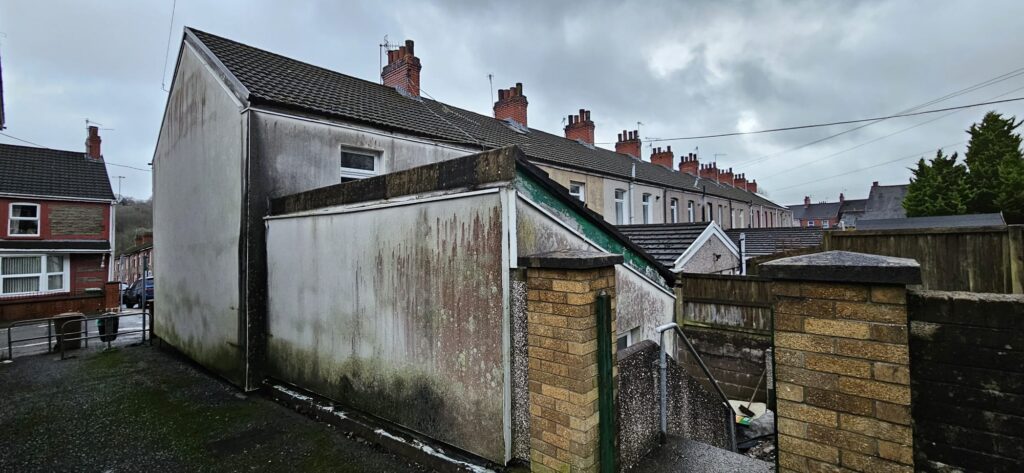
Why Weather Matters When Cleaning Render
Render is an exposed external surface. It spends its entire life dealing with British weather, but that does not mean it can be cleaned effectively in every possible weather condition.
Professional render cleaning normally involves controlled application of specialist products and carefully managed dwell times.
The weather can affect virtually every stage.
| Weather condition | Potential problem during a poor clean |
|---|---|
| Strong sunshine | Cleaning solution can dry too quickly |
| High temperatures | Accelerated evaporation and reduced control |
| Heavy rain | Product can become excessively diluted or washed away |
| Strong winds | Spray drift and uneven application |
| Frost | Frozen surfaces and unsafe working conditions |
| Very cold temperatures | Cleaning products may work differently or more slowly |
| Rapidly changing weather | Difficult to maintain consistent treatment |
| High humidity | Can alter drying and dwell behaviour |
The important point is that weather does not automatically make render cleaning impossible.
Instead, professionals need to understand how conditions affect the process and adjust their working method accordingly.
Strong Sunshine Can Cause a Render Clean to Dry Too Quickly
One of the biggest mistakes is assuming that a hot, sunny day must be perfect for exterior cleaning.
It may actually make the job considerably more difficult.
Direct sunlight can heat rendered walls significantly above the surrounding air temperature. A south-facing wall exposed to strong summer sunshine may therefore behave very differently from a shaded north-facing elevation.
If a cleaning solution is applied to a hot wall, evaporation can occur much more quickly.
That can interfere with the required dwell time.
A poor operator might simply continue applying the same amount of product using exactly the same method across every elevation.
The result can be inconsistent cleaning.
One wall might receive sufficient treatment while another dries prematurely.
You Cannot Judge Conditions by Air Temperature Alone
A weather app might say that it is 21°C outside, but that does not necessarily mean the render itself is 21°C.
Surface temperature matters.
Dark surfaces and walls receiving direct sunlight can become considerably warmer than shaded areas.
Professional cleaning therefore requires awareness of the actual conditions at the building rather than blindly following a weather forecast.
| Area of property | Possible conditions |
|---|---|
| North-facing elevation | Cool and shaded |
| South-facing elevation | Warm with prolonged sunshine |
| East-facing elevation | Stronger morning sun |
| West-facing elevation | Stronger afternoon sun |
| Wall beneath trees | Cooler and potentially damper |
| Exposed upper elevations | Increased wind exposure |
This is one reason why treating an entire property identically can produce disappointing results.
Rain Can Wash Away a Poorly Timed Treatment
Rain is another obvious concern.
However, the issue is more complicated than simply saying that render cannot be cleaned when rain is forecast.
The timing and intensity of rainfall matter.
Light rain at one stage of a professionally controlled cleaning process may not necessarily create a problem. Heavy rain immediately after applying a treatment can be completely different.
If the product needs time to work but is immediately diluted or washed down the wall, it may not achieve the intended result.
An inexperienced cleaner might continue because the equipment is already set up and they want to finish the job.
That can be false economy.
You could end up paying for a clean that needs repeating.
Professional Softwashing UK render cleaning is based on understanding the surface, contamination and environmental conditions rather than simply completing the work as quickly as possible.
Wind Creates Problems People Often Overlook
Wind can be one of the most underestimated weather conditions during exterior cleaning.
Cleaning products need to reach the intended surface in a controlled manner.
Strong wind can interfere with that.
Spray can drift away from the wall, creating uneven coverage and increasing the risk of products reaching places they were never intended to go.
That could include:
- neighbouring property;
- vehicles;
- windows;
- doors;
- garden furniture;
- plants and lawns;
- people nearby.
The higher the building, the more relevant wind conditions can become.
What feels like a relatively mild breeze at ground level may be considerably more noticeable when working on upper elevations.
Wind Can Also Make a Wall Dry Faster
Spray drift is not the only problem.
Wind encourages evaporation.
Combine moderate temperatures, direct sunshine and a strong breeze and a cleaning solution can begin drying much faster than expected.
That creates another potential cause of patchy results.
An experienced operator has to continually assess conditions rather than simply following exactly the same process from 8am until 4pm.
Frost and Render Cleaning Are a Bad Combination
Cleaning a frozen rendered surface is obviously something that needs careful consideration.
But frost creates additional problems beyond the wall simply feeling cold.
Water used during exterior cleaning can freeze on paths, driveways, access equipment and other surfaces.
That introduces serious safety risks.
Cold temperatures can also affect the behaviour of cleaning products.
| Cold-weather issue | Why it matters |
|---|---|
| Frozen render | Surface conditions may be unsuitable |
| Ice on access areas | Increased slip risk |
| Freezing rinse water | Can create hazardous surfaces |
| Low temperatures | Treatment performance may change |
| Overnight frost | Residual moisture may freeze |
| Short daylight hours | Reduced working window |
A professional contractor therefore needs to consider not only conditions while the cleaning takes place but what is expected afterwards.
A relatively mild afternoon followed by a severe overnight frost may require a different decision from a mild day followed by a mild night.
Hot Weather Doesn’t Mean “Use More Chemical”
Another potentially damaging response to difficult weather is trying to compensate by simply increasing chemical strength.
More is not automatically better.
Professional softwashing depends on using appropriate products, concentrations, application methods and dwell times for the surface and contamination being treated.
Increasing concentration unnecessarily can introduce additional risks without solving the actual problem.
If the issue is that a wall is extremely hot and the solution is drying too quickly, blindly increasing chemical strength does not address the underlying cause.
The cleaning method needs to be adapted to the conditions.
Weather Can Make Bad Pressure Washing Even Worse
Weather is particularly problematic when poor cleaning technique already involves excessive pressure.
Render is not a concrete driveway.
Aggressive pressure washing can potentially damage delicate rendered finishes, particularly where the surface already contains weaknesses or deterioration.
Add weather-related factors and the risks can increase.
For example, a contractor may find that contamination is not disappearing as quickly as expected because their treatment has dried too quickly.
Rather than addressing the treatment process, they increase pressure.
The wall may look cleaner initially, but forcing a result mechanically is very different from properly treating the contamination.
Softwashing is designed around a lower-pressure approach.
Softwashing UK specialises in professional exterior cleaning techniques designed to remove contamination while protecting the underlying surface.
Green Algae and Red Algae Thrive Because of Environmental Conditions
Weather is also one of the reasons render becomes contaminated in the first place.
The UK’s damp and changeable climate can encourage biological growth on external surfaces.
Green algae and red algae staining can become particularly noticeable on rendered buildings, alongside black staining, mould, lichen and other contamination.
Different elevations of the same property may suffer differently.
A shaded, damp wall might develop significant green algae and red algae contamination while a sunnier elevation remains relatively clean.
That is another reason a professional inspection matters.
A building is not necessarily one identical cleaning surface.
Weather Exposure Can Vary Around One House
Consider a typical detached property.
One elevation faces an open field. Another sits beside trees. One receives sunshine for most of the afternoon while another remains shaded.
Although every wall has the same render, its environment is completely different.
| Elevation condition | Possible effect |
|---|---|
| Shaded wall | Slower drying and increased moisture retention |
| Sunny wall | Faster drying and higher surface temperature |
| Tree-covered area | Greater organic contamination |
| Exposed elevation | More wind and driving rain |
| Wall near leaking gutter | Persistent localised dampness |
| Protected elevation | Reduced direct weather exposure |
Treating all of these areas in exactly the same way ignores the conditions affecting them.
Bad Timing Can Leave Visible Streaks
One of the most frustrating outcomes of an unsuccessful render clean is uneven colouring.
Instead of the property looking consistently refreshed, there may be obvious differences between elevations or even sections of the same wall.
Weather-related drying can contribute to this.
Imagine applying treatment across a large wall while the sun gradually moves around the building.
The first section may remain shaded while the final section receives direct sunlight.
The product is now behaving differently despite being applied to the same type of render.
Without adjusting technique, dwell times or working sequence, the finished appearance may become inconsistent.
Rainwater Run-Off Must Be Considered
Rain can also change how contamination moves across a building.
Faulty gutters, leaking downpipes, poorly positioned outlets and architectural features can create persistent wet areas.
Those areas often become obvious because contamination repeatedly returns in particular patterns.
Simply cleaning the visible staining without investigating why that part of the wall remains wetter than surrounding areas can mean the appearance deteriorates again unnecessarily quickly.
Professional render cleaning should therefore involve looking at the building as a whole.
The question is not only:
“How do we remove this stain?”
It is also:
“Why has this particular area become so heavily contaminated?”
Seasonal Conditions Change the Cleaning Strategy
There is no single “render cleaning season” where every day provides identical conditions.
Each season brings different challenges.
| Season | Typical considerations |
|---|---|
| Spring | Variable temperatures, showers and increasing daylight |
| Summer | Strong sunshine, hot surfaces and rapid evaporation |
| Autumn | Rain, wind, falling leaves and increasing moisture |
| Winter | Frost, low temperatures, shorter days and slippery surfaces |
This does not necessarily mean work cannot take place during a particular season.
It means professional judgement becomes important.
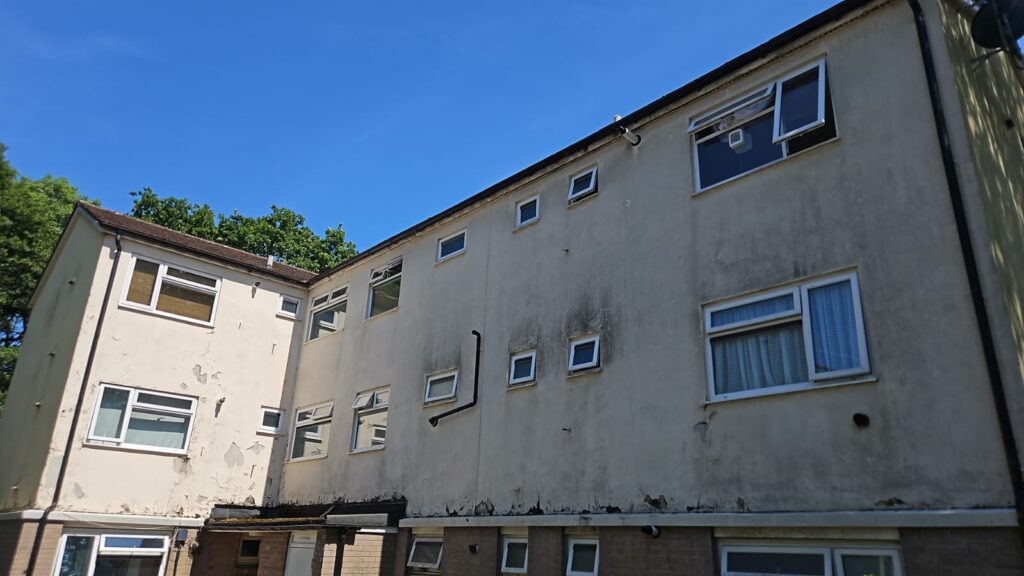
Cheap Render Cleaning Can Become Expensive
Choosing a contractor purely because they provide the lowest quote can become expensive if the work needs correcting.
A professional render cleaning service includes far more than labour and a few litres of cleaning product.
You are paying for experience, specialist equipment, appropriate chemicals, insurance, access knowledge, safety procedures and an understanding of the substrate being cleaned.
Typical costs will depend heavily on the building, access requirements, level of contamination and cleaning method required.
| Property requirement | Effect on cost |
|---|---|
| Small accessible elevation | Lower overall project requirement |
| Large detached property | More labour and treatment |
| Heavy contamination | More intensive treatment may be required |
| Difficult access | Specialist access equipment may be necessary |
| Multi-storey building | Increased planning and access requirements |
| Commercial property | Usually requires bespoke assessment |
| Restoration work | More involved than routine maintenance cleaning |
Softwashing UK should not be viewed as the cheapest possible way to get something sprayed onto a wall. Specialist render cleaning is a professional service intended to deliver the right result without unnecessarily risking the surface.
A Professional Cleaner Knows When to Stop
One of the biggest differences between professional and poor exterior cleaning is knowing when conditions have become unsuitable.
A bad contractor may think:
“We’re already here, so we’ll carry on.”
A professional considers whether continuing will compromise safety or quality.
Weather changes.
If conditions deteriorate substantially, postponing part of a project can sometimes be better than forcing the work to continue simply to keep to a schedule.
That approach protects both the property and the quality of the finished clean.
The Weather Forecast Is Only the Starting Point
Checking the forecast before a render cleaning project is important, but it cannot replace on-site judgement.
Local conditions can vary considerably.
Buildings create shade. Trees affect moisture. Wind behaves differently between buildings. Surface temperatures change throughout the day.
Professional render cleaning therefore involves continuously assessing what is happening at the property itself.
Softwashing UK has more than 20 years of commercial and domestic exterior cleaning experience and provides specialist render cleaning throughout the UK. Its approach uses low-pressure softwashing techniques designed to treat organic contamination rather than relying on aggressive pressure alone.
When green algae and red algae, mould, lichen and other organic staining have taken hold of a rendered building, the objective should not simply be to make the wall look cleaner for a photograph taken immediately afterwards.
The cleaning process needs to work with the render, the contamination and the weather conditions surrounding the building.
Signs a Previous Render Clean May Have Gone Wrong
Sometimes the evidence of a poor clean becomes apparent shortly afterwards.
Look for:
- obvious streaking across elevations;
- sections noticeably cleaner than neighbouring areas;
- green algae and red algae staining returning unusually quickly;
- lines showing where treatment has run down the wall;
- damaged or roughened render;
- areas apparently missed completely;
- inconsistent colour across the property;
- contamination remaining around awkward access areas;
- signs excessive pressure has been used.
These problems do not automatically mean weather was responsible.
However, poor weather management combined with poor technique can certainly contribute.
A competent contractor should be able to explain how the render will be cleaned, what type of contamination is present, how surrounding areas will be protected and how weather conditions may influence the work.
Render Cleaning Is a Controlled Process
The best render cleaning should look straightforward to the customer.
Behind that apparently simple process, however, are multiple decisions about concentration, application, dwell time, rinsing, access, surface condition, contamination and weather.
A contractor who understands these variables can adjust the process as conditions change.
Someone without that knowledge may simply keep spraying.
That difference matters.
For homeowners, landlords, facilities managers and commercial property owners dealing with dirty or badly stained render, Softwashing UK provides specialist softwash render cleaning throughout the UK, including treatment for green algae and red algae, mould, lichen and other organic contamination.
Weather will always be part of exterior cleaning in Britain. The skill lies in understanding it rather than fighting against it.
Morning Weather Can Be Completely Different From Afternoon Conditions
One of the challenges of professional render cleaning is that conditions at the beginning of a job may bear little resemblance to those experienced later in the day.
A contractor could arrive at 8am to find a cool, slightly damp property with virtually no wind. By early afternoon, the same building could be exposed to strong sunshine, considerably warmer surface temperatures and a noticeable breeze.
This matters when several elevations are being treated.
A cleaning method that worked perfectly on a shaded wall during the morning may need adjusting when work moves onto a sun-facing elevation later in the day.
| Time of day | Potential render cleaning conditions |
|---|---|
| Early morning | Cool surfaces, dew and higher moisture levels |
| Late morning | Increasing temperatures and changing sunlight |
| Midday | Potentially strongest sunshine and warmer surfaces |
| Afternoon | Hot sun-facing elevations and possible increased wind |
| Late afternoon | Falling temperatures and changing shade |
| Evening | Increased moisture and reduced drying |
Professional cleaning therefore requires ongoing assessment.
It is not enough to check the forecast once before leaving home.
Dew Can Affect Early-Morning Render Cleaning
Heavy overnight dew can leave rendered surfaces noticeably damp first thing in the morning.
The amount of moisture present will depend on temperature, humidity, the property’s surroundings and the orientation of individual elevations.
That moisture needs to be considered before applying a treatment.
Simply arriving at a property and immediately spraying every wall because the appointment started at 8am is not necessarily the correct approach.
A professional contractor can assess the condition of each elevation and determine how the surface moisture might affect the planned treatment.
This becomes particularly relevant during spring and autumn, when cool nights can be followed by relatively warm days.
A Sudden Shower Can Expose Poor Workmanship
British weather has a habit of producing showers even when an entire day is not forecast to be wet.
This is where preparation becomes particularly important.
An experienced exterior cleaning company should already be monitoring conditions and understand what would happen if rainfall arrived during a particular stage of the cleaning process.
A poor operator may only react once the rain starts.
If treatment has just been applied, unexpected heavy rainfall could dilute it or cause it to run before it has had sufficient opportunity to work.
The answer is not necessarily to panic whenever a cloud appears.
It is to understand the products being used and how they behave under different environmental conditions.
Driving Rain Creates Different Problems
Not all rain hits a building in the same way.
Light vertical rainfall can affect a property differently from heavy rain being driven horizontally by strong wind.
Driving rain can soak exposed elevations while more sheltered areas remain comparatively dry.
Over time, these differences can contribute to uneven weathering and contamination.
They can also help explain why one side of a property develops considerably more staining than another.
If green algae and red algae are particularly noticeable on one elevation, for example, its exposure to moisture, shade and surrounding vegetation may all be contributing factors.
Removing the visible contamination is therefore only one part of understanding what has happened to the building.
Trees Can Create Their Own Microclimate
Properties surrounded by mature trees can experience completely different conditions from neighbouring buildings in open locations.
Trees provide shade, restrict airflow and can help surfaces remain damp for longer.
They can also introduce leaves, pollen and other organic material around the property.
This can create favourable conditions for biological contamination.
A rendered wall surrounded by vegetation may therefore require more attention than an exposed wall that receives several hours of direct sunlight every day.
Professional render cleaning from Softwashing UK can take these differences into account when assessing a property.
Gutters Can Make Weather-Related Staining Worse
Sometimes the problem blamed on the weather is actually being intensified by a defect elsewhere on the property.
A leaking gutter is a good example.
Every time it rains, water may overflow or escape from a joint and repeatedly run down the same section of render.
Eventually, a distinctive dirty or contaminated area can develop.
Cleaning that wall may dramatically improve its appearance, but if the gutter continues leaking, the underlying moisture problem remains.
The same principle can apply to damaged downpipes and overflowing outlets.
| Building issue | Possible effect on render |
|---|---|
| Leaking gutter joint | Repeated localised water staining |
| Blocked gutter | Overflow down the elevation |
| Damaged downpipe | Persistent wet patch |
| Poor drainage | Increased moisture around lower walls |
| Dense vegetation | Shade and prolonged dampness |
| Defective roof drainage | Concentrated water exposure |
Exterior cleaning should therefore involve looking beyond the stain itself.
Storms Can Delay Render Cleaning for Good Reason
When strong winds or severe rainfall are forecast, postponing exterior work can be the sensible professional decision.
Customers can understandably become frustrated when an appointment needs rearranging because of weather.
However, there is an important difference between cancelling work unnecessarily and delaying a project because conditions could affect safety or quality.
Access equipment can have operating limitations.
Strong winds can also increase spray drift, make application more difficult and create additional hazards around a working area.
A professional contractor should prioritise carrying out the work properly rather than simply completing the appointment regardless of conditions.
If that means waiting for a more suitable weather window, the delay can ultimately protect the customer’s property.
The Cheapest Quote May Leave No Room for Weather Delays
Pricing can influence contractor behaviour.
Imagine a company has quoted an extremely low amount for a job and allocated exactly one day to complete it.
The weather deteriorates halfway through.
The contractor now has a choice.
They can stop and return another day, increasing their labour and travelling costs, or they can continue and hope for the best.
When pricing is unrealistically low, there can be significant commercial pressure to choose the second option.
That is one reason specialist exterior cleaning should not necessarily be purchased on price alone.
Softwashing UK positions professional exterior cleaning as a specialist service rather than attempting to compete as the cheapest possible option.
Paying more for experienced contractors can provide greater confidence that decisions are being made around the property and quality of the work rather than simply how quickly the team can leave the site.
Weather Can Reveal Weak or Damaged Render
Cleaning can also expose existing defects that were previously hidden beneath dirt and biological contamination.
Cracks, failing coatings, hollow areas and damaged sections may become more noticeable once the surface is cleaner.
This does not necessarily mean the cleaning process caused the defect.
Rendered properties naturally experience years of rain, frost, temperature fluctuations and sunlight.
These environmental conditions can gradually contribute to deterioration, particularly where the render or coating is already ageing.
That is why the condition of the surface should be considered before cleaning begins.
An aggressive cleaning method applied without proper assessment can turn a relatively minor weakness into a much more obvious problem.
Freeze-Thaw Cycles Can Be Particularly Harsh
British winters frequently involve temperatures moving above and below freezing rather than remaining consistently cold.
This creates freeze-thaw cycles.
Moisture can enter small cracks or vulnerable areas. When temperatures drop sufficiently, that moisture can freeze and expand.
Repeated cycles can contribute to deterioration over time.
This is another reason aggressive pressure should not automatically be used to clean rendered surfaces.
Where the substrate already contains weaknesses, blasting the wall with excessive pressure may be entirely inappropriate.
Softwashing instead focuses on treating contamination using specialist solutions combined with controlled, low-pressure application.
The Best Day Is Not Necessarily the Hottest Day
Customers sometimes assume summer provides ideal cleaning conditions because warm weather helps everything dry.
Drying is useful, but extremely rapid drying can be counterproductive during certain stages of treatment.
An overcast but mild day may sometimes provide more manageable working conditions than a scorching summer afternoon.
Likewise, a small amount of cloud cover can prevent a wall becoming excessively hot.
The objective is not to find the sunniest possible day.
It is to find conditions that allow the treatment process to remain controlled.
Weather Awareness Should Be Part of Professional Render Cleaning
Anyone can look at a wall and decide that it looks dirty.
Professional exterior cleaning involves understanding considerably more.
The contractor needs to assess the contamination, substrate, access, surrounding property and environmental conditions before deciding how the work should proceed.
Weather forms an important part of that assessment.
Temperature determines how surfaces and cleaning solutions behave. Sunshine changes surface temperature. Wind influences application and evaporation. Rain affects dilution and run-off. Frost introduces additional surface and safety concerns.
None of these factors exists independently.
A warm, sunny and windy afternoon, for example, presents a different combination of conditions from a cool, cloudy and still morning.
For properties affected by black staining, mould, lichen, green algae and red algae or other organic contamination, Softwashing UK can assess the condition of the render and determine an appropriate professional cleaning approach.
The aim should always be controlled treatment of the contamination while respecting both the rendered surface and the conditions in which the work is being carried out.