


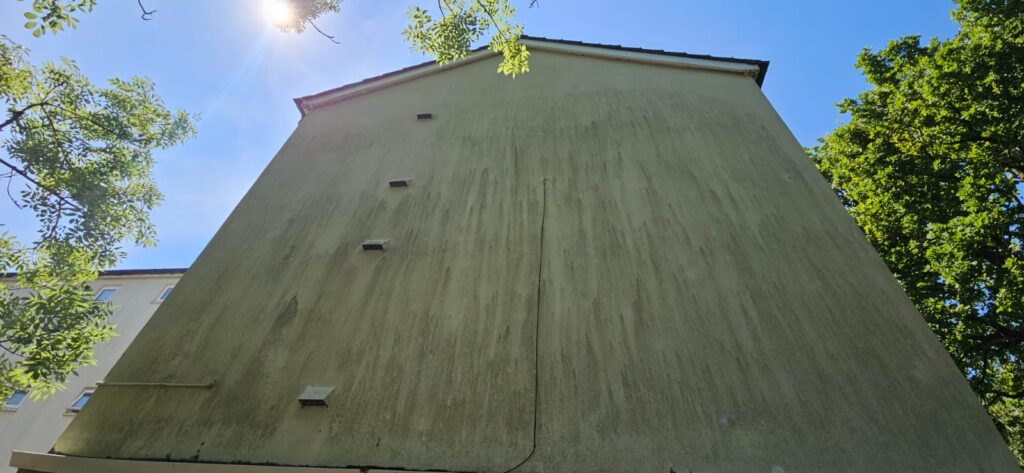
K Rend is designed to give properties a clean, attractive exterior finish, but over time you may notice areas beginning to turn green. This can be particularly frustrating on lighter-coloured render, where even relatively small patches of contamination can become highly visible.
If your K Rend is going green, it does not necessarily mean the render has failed or needs replacing. In many cases, the discolouration is biological growth developing on the surface because environmental conditions are allowing it to thrive.
The important thing is to understand what is causing the problem and choose an appropriate cleaning method. Aggressive cleaning can potentially damage a rendered finish, while simply removing the visible colour may not adequately address the contamination responsible for it.
Softwashing UK specialises in professional exterior cleaning and can assess contaminated rendered surfaces before determining a suitable treatment.
Why Does K Rend Turn Green?
The green appearance commonly associated with dirty render is often caused by biological contamination. Green algae and red algae can develop on external surfaces where moisture, shade and other favourable conditions are present.
Render is exposed to the weather every day. Rain wets the surface, airborne contamination settles on it and certain areas may remain damp considerably longer than others.
This creates noticeable differences between elevations.
A south-facing wall receiving plenty of sunlight might remain relatively clean while a shaded side elevation becomes visibly contaminated. Likewise, a section underneath a leaking gutter could develop staining significantly faster than the rest of the property.
Common contributing factors include:
- Shade from neighbouring buildings
- Trees and dense vegetation
- Persistent damp conditions
- Limited airflow
- Leaking or overflowing gutters
- Damaged downpipes
- Wind-driven rain
- Organic debris
- Local environmental conditions
Understanding why the contamination has developed can help reduce the likelihood of simply cleaning the wall only for the same problem to quickly become noticeable again.
Is Green K Rend Damaged?
Not necessarily.
A change in colour can look dramatic, particularly when the original render is cream, white or another pale shade. However, visible contamination does not automatically mean the underlying render system has structurally failed.
The first step should be distinguishing between surface contamination and physical damage.
| What you notice | What it could indicate |
|---|---|
| Green discolouration | Biological contamination |
| Red or pink discolouration | Possible red algae or other biological contamination |
| Dark patches | Dirt, biological growth or persistent moisture |
| Vertical streaks | Water runoff or contamination |
| Cracking | Potential physical issue requiring separate investigation |
| Chips or missing areas | Physical damage |
| Staining beneath gutters | Possible water-management problem |
| Dirty lower sections | Rain splashback or environmental contamination |
Cleaning should not be treated as a repair for cracked, loose or otherwise damaged render. If there are obvious physical defects, those may need to be investigated separately.
Why Are Certain Parts of the House Greener?
It is common for homeowners to ask why one wall looks considerably worse than another when all elevations were rendered at the same time.
The answer is often exposure.
Sunlight, wind, surrounding vegetation and the direction of prevailing weather can create completely different conditions around a single building.
A shaded side passage, for example, may receive very little direct sunlight. After rainfall, that wall can remain damp while a more exposed elevation dries much faster.
Trees can make the situation more noticeable by creating shade and reducing airflow while also depositing leaves, pollen and other organic material around the property.
This means contamination is rarely perfectly uniform.
Should You Pressure Wash Green K Rend?
Reaching for a pressure washer might seem like the obvious solution. A powerful jet can remove visible dirt from many hard exterior surfaces, so it is understandable that homeowners consider using one on dirty render.
However, K Rend should not automatically be treated in the same way as a concrete driveway or paving slab.
Excessive or inappropriate pressure can potentially affect the surface finish. Uneven pressure washing may also leave inconsistent results across an elevation.
There is another important consideration: removing visible discolouration and appropriately treating biological contamination are not necessarily the same thing.
Professional softwashing focuses on treating contamination using a process selected for the surface rather than relying purely on aggressive pressure.
What Is Softwashing?
Softwashing is an exterior cleaning approach that uses appropriate cleaning solutions and controlled application methods to treat contamination.
For rendered properties, this can provide an alternative to attacking the surface with unnecessarily high pressure.
The exact approach should depend on factors including:
- The type of render
- Its current condition
- The severity of contamination
- Accessibility
- Surrounding surfaces
- The size and height of the property
- The nature of the staining
This is why an assessment is valuable before cleaning begins.
Softwashing UK can assess the property and identify an appropriate professional cleaning approach for contaminated K Rend.
Green Algae and Red Algae on Render
Although homeowners often describe the problem simply as their render “going green”, biological contamination can appear in different colours.
Green algae and red algae can both affect external rendered surfaces.
Green growth is usually immediately noticeable because of the contrast it creates against pale render. Red algae can produce reddish, pink or rusty-looking discolouration that homeowners may initially mistake for another form of staining.
Both can significantly change the appearance of an otherwise attractive rendered property.
Rather than assuming every stain has the same cause, it is useful to identify what type of contamination is actually present before deciding how it should be treated.
Check Your Gutters Before Cleaning
If one section of K Rend is significantly greener than surrounding areas, look upwards.
Guttering can play a major role in localised contamination.
A partially blocked gutter may overflow whenever there is heavy rain, repeatedly soaking the same section of wall. A leaking joint can create a similar effect.
Downpipes should also be inspected for visible leaks or poorly connected sections.
| Gutter problem | Possible effect on render |
|---|---|
| Blocked gutter | Water overflowing onto wall |
| Leaking joint | Repeated localised wetting |
| Damaged downpipe | Water staining down elevation |
| Leaves and debris | Restricted drainage |
| Incorrect water flow | Concentrated damp areas |
Cleaning the render without addressing the moisture source could mean the same area becomes problematic again.
Look at Trees and Vegetation
Mature gardens can create excellent conditions for biological contamination.
Large trees can keep elevations shaded for significant portions of the day. Bushes planted directly against walls can restrict airflow, while climbing plants can hold moisture close to the building.
You do not necessarily need to remove established landscaping because your render has become dirty. However, sensible trimming can improve separation between vegetation and the exterior wall.
Look particularly closely at areas where branches touch the property or where dense planting creates a permanently sheltered section.
Can You Clean K Rend Yourself?
Small amounts of loose surface dirt may tempt homeowners to attempt DIY cleaning, but considerable care is required.
The main risk is treating K Rend as though it were an extremely robust hard surface and using unsuitable equipment, chemicals or physical force.
Avoid experimenting with random household cleaning products simply because they happen to remove stains elsewhere around the home.
Likewise, aggressive scrubbing can potentially affect the appearance of a finished rendered surface.
There is also the issue of height. Cleaning a small accessible section near ground level is very different from trying to treat an entire two-storey elevation.
Working from ladders while handling liquids and cleaning equipment introduces additional safety considerations.
Why Simply Painting Over Green K Rend Isn’t the Answer
Painting over contamination without appropriately preparing the surface can hide the visual problem temporarily rather than dealing with its cause.
If a homeowner is considering decorating their render because it looks tired, the existing contamination should first be properly assessed.
The same applies if the wall is going to undergo repairs or other exterior work. Contractors should be made aware of existing contamination so that preparation can be planned correctly.
Cleaning can sometimes restore a surprisingly significant amount of the render’s original appearance, potentially changing the homeowner’s view of what further cosmetic work is actually necessary.
Why Has My K Rend Gone Green So Quickly?
There is no single timetable for render contamination.
Two apparently similar houses can age very differently depending on their surroundings.
Consider these examples:
| Property environment | Likely influence |
|---|---|
| Open, sunny position | Faster drying after rainfall |
| Heavily wooded garden | More shade and organic debris |
| Narrow shaded side access | Limited sunlight and airflow |
| Exposed rural location | Greater weather exposure |
| Property beside busy road | Increased airborne contamination |
| Wall beneath damaged gutter | Persistent concentrated moisture |
| North-facing elevation | Potentially longer damp periods |
If K Rend appears to have become green unusually quickly, examining these environmental conditions can be more useful than simply assuming something is wrong with the render itself.
What to Do When You First Notice Green Patches
Do not panic when the first areas of green appear.
Instead, look at where they are developing.
Are they concentrated beneath the guttering? Are they appearing mainly behind trees? Is the north-facing wall affected while the other elevations remain relatively clean?
Photographs can help you monitor how quickly the contamination is changing. Take pictures from the same positions and compare them after several weeks or months.
This can show whether the issue is relatively stable or spreading across a larger area.
Also inspect the property following heavy rain. Watching how water behaves around gutters, rooflines and rendered elevations can reveal problems that are difficult to identify during dry weather.
Can Green K Rend Be Restored?
In many situations, professional cleaning can make a substantial difference to contaminated render.
However, every property should be considered individually.
The render’s age, condition, finish and level of contamination can all influence the appropriate cleaning method and expected result.
This is another reason to avoid treating every green rendered wall with exactly the same DIY method.
A professional assessment allows the condition of the surface to be considered before treatment begins.
How to Reduce Future Contamination
Once K Rend has been professionally cleaned, a few straightforward property-maintenance habits may help keep it looking better.
Keep gutters clear and deal with leaks promptly. Trim vegetation where it is constantly touching the walls. Avoid allowing soil, compost or garden debris to accumulate against lower sections of render.
Also pay attention to sprinkler systems and garden hoses. Repeatedly wetting one area of wall unnecessarily can create different moisture conditions from the surrounding elevation.
Periodically walking around the property and inspecting each wall can help you notice new contamination while it remains relatively localised.
When Professional K Rend Cleaning Makes Sense
Once green algae and red algae or other contamination becomes established across substantial areas of K Rend, repeatedly experimenting with DIY solutions may not be the best approach.
A professional cleaner can consider the render itself, the contamination present, accessibility and the surrounding property before beginning treatment.
This is particularly important where upper-storey elevations are affected or where the building has difficult-to-access areas.
Softwashing UK provides specialist exterior cleaning for rendered properties and can assess K Rend that has developed green, red, dark or generally weathered-looking contamination.
Check the Cause as Well as the Colour
Cleaning addresses the appearance of contaminated K Rend, but homeowners should also consider why particular areas became affected.
If the same patch continually becomes green underneath an overflowing gutter, gutter maintenance forms an important part of protecting the newly cleaned appearance.
If dense vegetation keeps one elevation permanently shaded and damp, carefully managing that vegetation may improve conditions around the wall.
If green algae and red algae are appearing across elevations exposed to ordinary UK weather, periodic professional cleaning may simply form part of maintaining the property’s exterior.
Thinking about both the contamination and the conditions surrounding the building provides a much more useful approach than waiting until the render is heavily discoloured and then attacking it with the strongest cleaning method available.
Does the Texture of K Rend Affect How Dirty It Looks?
The texture of a rendered finish can influence how noticeable contamination becomes. K Rend is available in different finishes, and a more textured surface naturally creates tiny variations where airborne dirt and organic material can settle.
This can make staining appear differently from one property to another. On a smooth-looking, pale elevation, discolouration may appear as obvious streaks or patches. On a heavily textured surface, contamination can initially look more scattered before gradually becoming more noticeable.
Texture is therefore another reason why cleaning should be appropriate for the particular rendered surface rather than approached as though every exterior wall is identical.
Why Pale K Rend Can Look Dirty So Quickly
White, cream and other light-coloured renders can produce a striking appearance when clean, but they also create a strong contrast against contamination.
A relatively modest amount of discolouration can therefore make a pale property appear much dirtier than a darker rendered building with a similar level of surface contamination.
This does not necessarily mean pale K Rend attracts more contamination. In many cases, it is simply easier to see.
| K Rend appearance | How contamination may appear |
|---|---|
| White | Green, red and dark marks can be highly visible |
| Cream | Biological staining can create obvious patches |
| Grey | Darker contamination may initially be less noticeable |
| Textured finish | Dirt can appear uneven across the surface |
| Uniform pale elevation | Individual marks can stand out considerably |
Homeowners with lighter render may therefore notice changes earlier, which can actually be useful when deciding when professional attention is required.
Why Partial Cleaning Can Create an Uneven Appearance
When one small section looks particularly dirty, cleaning only that patch can seem sensible. However, an isolated clean area may end up looking noticeably different from the surrounding render.
Exterior surfaces weather gradually. Even areas without obvious green algae and red algae may have accumulated general atmospheric contamination over time.
Cleaning one prominent patch could therefore reveal the original appearance more clearly and make the untreated sections look duller by comparison.
For larger areas of contamination, considering the elevation as a whole can produce a more consistent appearance.
K Rend Around Extensions and Altered Properties
Extensions can create unusual contamination patterns because they change the original shape of the building.
A new single-storey extension, porch or conservatory can introduce additional rooflines and sheltered corners. Sections of the original render that previously received plenty of airflow may become more protected after building work.
Likewise, rainwater may now travel differently around the property.
This can explain why homeowners sometimes notice contamination appearing in new locations following alterations, even though the K Rend itself has not changed.
When assessing discolouration, it is useful to consider whether changes to the building have altered the conditions around that elevation.
Why Newer-Looking Render Can Still Develop Contamination
Homeowners are sometimes surprised when relatively modern render begins losing its pristine appearance.
However, biological contamination is influenced by the environment surrounding the surface rather than simply the age of the property.
A newer rendered home positioned in favourable conditions for organic growth may begin showing green algae and red algae before an older property situated somewhere sunnier or more exposed.
This is why the presence of contamination alone should not be used to judge the quality or remaining lifespan of a rendered finish.
The surrounding conditions matter considerably.
Be Careful With Advice Designed for Brick or Stone
Exterior cleaning advice is often presented as though every façade can be treated in exactly the same way.
That can be misleading.
A cleaning technique appropriate for a robust stone patio, concrete path or certain masonry surfaces is not automatically appropriate for K Rend. The surface characteristics and finish need to be taken into consideration.
This is particularly important when following DIY advice online. A dramatic before-and-after result achieved on one material does not demonstrate that the same equipment, chemical or technique should be applied to another.
K Rend should be treated as K Rend, rather than simply as another dirty exterior surface.
Does Cleaning Change the Colour of K Rend?
Professional cleaning is intended to remove or treat contamination rather than change the original colour of the render.
However, homeowners can sometimes be surprised by how different the property looks afterwards.
Years of gradual environmental contamination can make the surface appear duller without the change being obvious from day to day. Once that contamination is removed, the original finish may appear considerably brighter.
This can be particularly noticeable on large uninterrupted elevations.
It is one reason homeowners should not automatically assume faded-looking render needs painting before investigating whether accumulated contamination is responsible for some of the visual change.
What About K Rend on Commercial Properties?
K Rend contamination is not limited to houses.
Rendered offices, apartment developments, shops and other commercial buildings can experience similar exterior staining. In some settings, the visual impact can be even more important because the building forms part of the organisation’s public appearance.
Commercial sites may also experience different contamination pressures.
| Location factor | Potential effect |
|---|---|
| Busy car park | Increased airborne dirt |
| Main road frontage | Traffic-related contamination |
| Landscaped grounds | Organic material near elevations |
| Large shaded façade | Extended damp conditions |
| Multiple storeys | More challenging access |
| High pedestrian traffic | Greater importance of presentation |
Larger buildings can also require more careful planning because access, surrounding pedestrians and neighbouring surfaces all need to be considered.
Softwashing UK can assess rendered residential and commercial exteriors to determine an appropriate cleaning approach.
Why You Should Avoid Waiting for the Whole House to Turn Green
Contamination does not normally appear across every elevation at precisely the same rate.
Waiting until every wall looks equally dirty can mean the worst-affected elevations become heavily contaminated while others remain comparatively presentable.
Instead, the condition of the property can be judged according to the overall appearance and severity of contamination.
A heavily affected front elevation, for example, may have a much greater impact on kerb appeal than a lightly weathered rear wall.
The point at which cleaning becomes worthwhile therefore depends on the individual building rather than a rule that says every elevation must reach a particular condition first.
K Rend Cleaning Before Selling a Property
The exterior is one of the first things prospective buyers see when approaching a house.
Green algae and red algae, dark streaks and widespread weathering can make a rendered property appear poorly maintained, even when the issue is primarily surface contamination.
For homeowners preparing to sell, having contaminated K Rend professionally assessed can therefore form part of preparing the exterior for photographs, viewings and valuation.
A cleaner façade can help the colour and architectural details of the property become visible again without immediately resorting to more substantial cosmetic alterations.
Think Beyond the Most Obvious Green Areas
Once K Rend starts turning green, attention naturally goes straight to the strongest patches. However, the remainder of the façade may also carry less obvious contamination.
Stand further away from the building and look at the elevation as a whole rather than examining it only from close range.
You may notice gradual differences in colour, broad dull areas or staining patterns that are difficult to recognise when standing immediately beside the wall.
Viewing the property from different angles can provide a much clearer picture of its overall condition and help determine whether isolated attention or broader professional treatment is appropriate.
Where the extent or type of contamination is unclear, Softwashing UK can assess the rendered exterior and recommend a suitable approach based on the condition actually present.