


Many homeowners are surprised to discover that the render on their brand-new home starts developing green algae within just a year or two of moving in. After investing hundreds of thousands of pounds in a modern property, seeing green staining spread across clean white or coloured render can be frustrating.
The good news is that this doesn’t necessarily mean there’s a problem with the render itself. In most cases, the cause is environmental rather than structural. Modern render systems are extremely durable, but they still require occasional maintenance to keep them looking their best.
If your new build has started showing signs of biological growth, Soft Washing UK offers professional render cleaning using specialist soft washing techniques designed to safely remove contamination without damaging the finish.
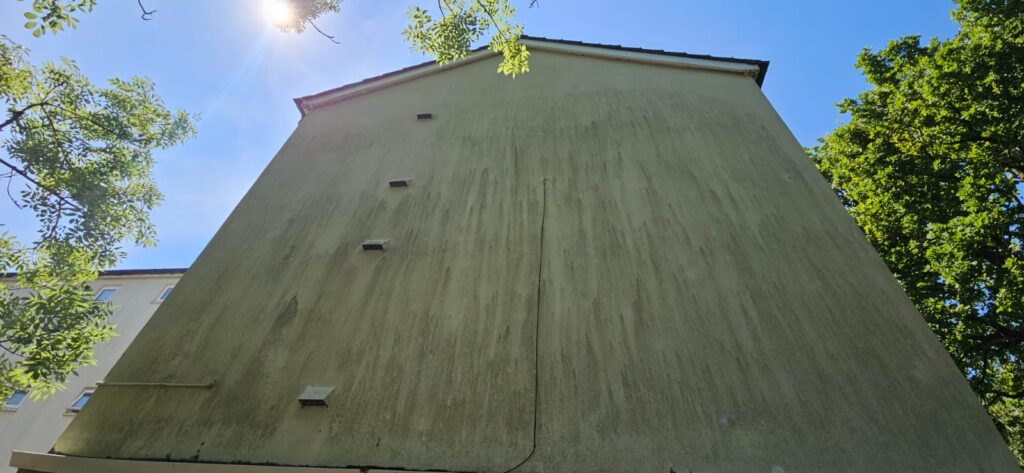
Why Does New Build Render Turn Green So Quickly?
One of the biggest misconceptions is that only older properties suffer from staining.
In reality, many modern developments experience biological growth surprisingly quickly.
Common reasons include:
| Cause | Effect on Render |
|---|---|
| Damp weather | Encourages algae growth |
| Shaded walls | Slower drying times |
| Nearby trees | Increased moisture |
| Modern insulation | Cooler external surfaces |
| Poor air circulation | Damp conditions remain longer |
| Heavy rainfall | Surface stays wet |
When moisture remains on the render for extended periods, it creates ideal conditions for both green algae and red algae to establish themselves.
It’s Usually Not a Fault With the Builder
Many homeowners initially believe the builder has used poor-quality materials.
However, this is rarely the case.
Modern render systems such as silicone and monocouche render are designed to be highly weather resistant.
The issue is usually environmental rather than a manufacturing defect.
Factors outside the builder’s control include:
- Local weather conditions
- Tree coverage
- Property orientation
- Air pollution
- Surrounding vegetation
- Nearby water sources
Modern Render Holds Moisture Differently
Today’s energy-efficient homes are built differently from older properties.
Improved insulation means less heat escapes through external walls.
While this improves energy efficiency, it also means render dries more slowly after rain.
Older houses often generated more heat through the walls, naturally helping exterior surfaces dry quicker.
Modern construction creates:
| Older Homes | Modern Homes |
|---|---|
| More heat loss | Better insulation |
| Faster wall drying | Slower drying |
| Less surface moisture | More persistent moisture |
| Lower algae risk | Increased algae potential |
This is one reason biological growth appears sooner on many new developments.
North-Facing Walls Usually Show Problems First
Not every side of the property will become stained at the same rate.
North-facing elevations receive much less direct sunlight.
This means:
- Slower evaporation
- Longer damp periods
- Increased biological activity
- Faster growth of green algae
- Increased likelihood of red algae
Homeowners often notice one wall becoming discoloured while the others remain relatively clean.
Trees Can Accelerate Biological Growth
Many housing developments include newly planted trees or retain mature landscaping.
While attractive, trees create several conditions that encourage render contamination.
These include:
| Tree Effect | Result |
|---|---|
| Shade | Damp render |
| Falling leaves | Trapped moisture |
| Bird activity | Organic contamination |
| Pollen | Surface deposits |
| Reduced airflow | Slower drying |
Properties surrounded by woodland or large gardens often experience faster algae development.
Rain Isn’t Cleaning Your Render
Many people assume regular rainfall keeps external walls clean.
Unfortunately, the opposite is often true.
Rainwater:
- Keeps render damp
- Carries airborne dirt
- Encourages biological growth
- Leaves mineral deposits
- Creates runoff staining
Frequent rainfall is one reason UK properties are particularly susceptible to biological contamination.
Green Doesn’t Always Mean Structural Damage
Seeing green staining spread across bright white render can be alarming.
Fortunately, algae growth usually affects appearance rather than structural integrity.
However, leaving contamination untreated allows it to continue spreading.
Over time, staining becomes:
- More noticeable
- Harder to remove
- More widespread
- Less attractive
Regular maintenance helps preserve the appearance of the property.
Red Algae Is Becoming More Common
While many homeowners recognise green algae, fewer are aware of red algae.
Red algae often appears as:
- Pink staining
- Orange patches
- Rust-coloured streaks
- Red discolouration
It thrives in many of the same damp conditions as green algae and can spread surprisingly quickly if ignored.
Professional treatment addresses both forms of biological contamination.
Why Pressure Washing Isn’t the Answer
It can be tempting to hire a pressure washer.
However, render manufacturers generally recommend avoiding high-pressure cleaning.
Potential problems include:
| High Pressure Cleaning | Possible Consequence |
|---|---|
| Surface erosion | Damaged finish |
| Water penetration | Moisture behind render |
| Colour changes | Uneven appearance |
| Cracking | Costly repairs |
| Surface scarring | Permanent marks |
Professional soft washing is specifically designed to clean render safely.
What Is Soft Washing?
Soft washing uses specialist cleaning solutions alongside controlled low-pressure application.
Rather than relying on force, the process targets the biological organisms responsible for staining.
Typical steps include:
- Property assessment
- Identifying render type
- Applying specialist treatment
- Allowing the solution to work
- Gentle rinsing if required
- Removing contamination
This method is suitable for most modern render systems.
Different Render Types Need Different Cleaning
Not all render is the same.
Professional assessment helps determine the correct cleaning approach.
| Render Type | Cleaning Method |
|---|---|
| Silicone render | Specialist soft washing |
| Monocouche | Low-pressure treatment |
| Acrylic render | Controlled chemical cleaning |
| Mineral render | Gentle application |
| Painted render | Careful cleaning techniques |
Using the wrong method may damage decorative finishes.
Can the Green Staining Be Prevented?
No property can be guaranteed never to develop algae.
However, several factors can reduce the likelihood.
These include:
- Keeping gutters clear
- Trimming nearby vegetation
- Improving airflow
- Removing leaves regularly
- Scheduling professional cleaning before heavy contamination develops
Early maintenance usually produces better results than waiting until staining becomes extensive.
Why Gutters Matter
Overflowing gutters frequently contribute to render staining.
Water constantly running down rendered walls creates perfect conditions for:
- Dirt streaking
- Mould
- Mildew
- Green algae
- Red algae
Checking gutters annually helps reduce unnecessary moisture.
Does House Colour Make a Difference?
White render often shows staining sooner simply because contamination is more visible.
However, darker coloured render can also develop biological growth.
The algae doesn’t choose walls based on colour.
Instead, it develops wherever moisture remains long enough.
Typical Areas That Become Green First
Most homeowners notice staining in similar locations.
These commonly include:
| Area | Reason |
|---|---|
| Below windows | Water runoff |
| Around gutters | Overflow |
| North-facing walls | Reduced sunlight |
| Beneath rooflines | Rain splash |
| Garden-facing walls | Shade from plants |
These areas should be inspected regularly.
Is Cleaning Covered by the Builder’s Warranty?
Many homeowners assume exterior cleaning falls under their new build warranty.
In most cases, routine cleaning and maintenance are considered homeowner responsibilities rather than warranty issues.
Always check your warranty documentation for specific details, but biological growth is generally treated as part of ongoing property maintenance rather than a construction defect.
How Much Does Professional Render Cleaning Cost?
Costs depend on several factors including:
- Property size
- Access requirements
- Level of contamination
- Height
- Render type
Typical guide prices include:
| Property | Typical Cost |
|---|---|
| Small house | £500–£850 |
| Semi-detached | £700–£1,200 |
| Detached property | £900–£1,800 |
| Larger homes | £1,500+ |
Professional soft washing companies using specialist treatments and equipment may charge more than general exterior cleaning services, but the emphasis is on protecting the render while delivering longer-lasting results.
Why Timing Matters
Cleaning lightly stained render is usually simpler than tackling years of accumulated contamination.
Regular inspections allow homeowners to identify:
- Early green algae
- Initial red algae
- Water staining
- Gutter issues
- Drainage problems
Addressing these early often reduces the amount of work required.
Choosing the Right Time for Cleaning
Render cleaning can usually be carried out throughout much of the year, although weather conditions influence scheduling.
| Season | Suitability |
|---|---|
| Spring | Excellent |
| Summer | Very good |
| Autumn | Good |
| Winter | Weather dependent |
Very cold temperatures or prolonged heavy rainfall may require work to be postponed to achieve the best possible results.
Why Professional Assessment Makes a Difference
Every property is unique. Two houses built side by side on the same development may experience different levels of contamination depending on shade, nearby planting, drainage and airflow.
A professional inspection identifies:
- The type of render installed
- The extent of biological growth
- Areas affected by green algae
- Areas affected by red algae
- Access requirements
- The safest cleaning method
By identifying the causes of staining rather than simply removing what is visible, homeowners can make informed decisions about future maintenance. Professional soft washing through Soft Washing UK provides a safe solution for restoring the appearance of modern rendered homes while protecting the finish and helping keep new build properties looking their best for years to come.
Why Some New Build Estates Experience More Algae Than Others
Homeowners often compare their property with friends or family living elsewhere and wonder why their render seems to become dirty much sooner.
The reality is that every housing development has its own environmental conditions.
Factors that influence algae growth include:
| Environmental Factor | Impact on Render |
|---|---|
| Nearby woodland | Increased moisture and shade |
| Open countryside | Greater exposure to rain and wind |
| Dense housing | Reduced airflow between buildings |
| Lakes or ponds | Higher humidity |
| Coastal locations | Salt deposits and damp conditions |
| Busy roads | Pollution build-up |
Even homes built by the same developer using identical render systems may age differently because of their surroundings.
Landscaping Can Affect Your Render
New housing developments often include attractive landscaping, shrubs and young trees.
While these features improve the appearance of the estate, they can also contribute to render staining.
Dense planting close to external walls can:
- Trap moisture against the building
- Reduce airflow
- Increase humidity
- Prevent walls drying quickly after rainfall
- Encourage both green algae and red algae
Keeping shrubs and climbing plants trimmed away from rendered walls helps improve ventilation and reduce moisture retention.
Your Home’s Orientation Makes a Difference
The direction your property faces has a significant impact on how quickly render dries.
| Property Orientation | Typical Condition |
|---|---|
| North-facing | Damp for longer |
| East-facing | Morning sun only |
| South-facing | Receives most sunlight |
| West-facing | Afternoon sun but often exposed to driving rain |
North-facing elevations generally require more frequent inspections because they remain cooler and wetter throughout much of the year.
Air Pollution Can Speed Up Discolouration
Even if your home isn’t surrounded by trees, pollution can still affect the appearance of the render.
Tiny airborne particles from:
- Vehicle exhausts
- Brake dust
- Construction work
- Industrial activity
- Agricultural operations
can settle on the surface.
When combined with moisture, these particles create a nutrient-rich layer that encourages biological growth.
Why New White Render Shows Every Mark
White and very light-coloured render remains one of the most popular finishes for modern homes.
Its clean appearance is one of its biggest attractions—but also one of its biggest challenges.
Even small amounts of contamination become noticeable.
Common marks include:
| Type of Mark | Appearance |
|---|---|
| Dust | Grey film |
| Water streaks | Brown or grey lines |
| Green algae | Green patches |
| Red algae | Pink or reddish staining |
| Bird droppings | White or dark marks |
| Cobwebs | Surface dirt traps |
Darker coloured render may hide some dirt, but it is still susceptible to the same biological growth.
Don’t Ignore Small Green Patches
Many homeowners notice a tiny green mark and assume it isn’t worth worrying about.
Unfortunately, algae spreads gradually.
Small isolated patches often develop into much larger areas over time, especially during wet autumn and winter months.
Early cleaning is usually:
- Faster
- More effective
- Less disruptive
- Better for maintaining appearance
Waiting several years often allows contamination to become much heavier.
How Moisture Reaches the Render
Rain isn’t the only source of moisture affecting external walls.
Render can also become damp from:
- Morning dew
- Condensation
- Garden sprinklers
- Overflowing gutters
- Leaking downpipes
- Splashback from patios
All of these can contribute to conditions where green algae and red algae thrive.
New Homes Are Built to Be Airtight
Modern building regulations require excellent thermal efficiency.
This means today’s homes are much more airtight than older properties.
While this reduces heating costs, it also means:
| Modern Construction Feature | Result |
|---|---|
| Better insulation | Cooler external walls |
| Reduced heat transfer | Slower drying render |
| Improved energy efficiency | Increased surface moisture |
| Airtight construction | More favourable conditions for algae |
This doesn’t indicate poor construction—it’s simply one consequence of improved energy performance.
The Importance of Annual Exterior Inspections
Many homeowners inspect their roof after storms but rarely look closely at the rendered walls.
A simple annual inspection can identify:
- Early staining
- Gutter leaks
- Damaged sealant
- Blocked downpipes
- Signs of green algae
- Signs of red algae
Catching these issues early often prevents more extensive cleaning later.
Can Algae Damage Render?
Algae itself is primarily an aesthetic issue.
However, allowing heavy biological contamination to remain on render for years may increase the likelihood of:
- Persistent staining
- Harder-to-remove deposits
- Increased moisture retention
- Reduced kerb appeal
Routine maintenance helps preserve both the appearance and condition of the render over the long term.
Why Soft Washing Produces Longer-Lasting Results
Unlike aggressive cleaning methods that rely purely on pressure, soft washing focuses on treating the source of the problem.
Professional treatments help:
- Remove biological contamination
- Kill algae spores
- Reduce regrowth
- Clean evenly across the surface
- Preserve delicate render finishes
This makes soft washing particularly suitable for newer rendered properties where maintaining the manufacturer’s finish is important.
Common Questions Homeowners Ask
“Will the green staining disappear on its own?”
Generally, no. Rain and sunshine may slightly alter its appearance, but biological growth normally continues spreading unless treated.
“Can I scrub it off with a brush?”
Scrubbing can damage decorative render finishes and often fails to remove the underlying biological growth.
“Will repainting solve the problem?”
Painting over contaminated render without first treating the algae may only disguise the issue temporarily.
“Does every new build eventually turn green?”
Not every property develops staining at the same speed, but most rendered homes will require some level of exterior maintenance during their lifetime.
Why Access Equipment May Be Needed
Many modern homes are two or three storeys high, making upper walls difficult to reach safely.
Professional contractors may use suitable access equipment depending on:
- Property height
- Ground conditions
- Access restrictions
- Safety requirements
Attempting to clean high-level render using ladders without appropriate experience can present unnecessary risks.
Looking Beyond the Visible Staining
Sometimes the most noticeable green patches aren’t the only affected areas.
A professional inspection may identify:
| Hidden Issue | Why It Matters |
|---|---|
| Early algae growth | Easier to treat |
| Water run-off patterns | Helps identify drainage issues |
| Small gutter leaks | Prevents future staining |
| Areas with poor airflow | Reduces repeat contamination |
| Shaded sections | Higher maintenance requirements |
Addressing these underlying factors can help improve the long-term appearance of the property.
Maintaining Your Home’s Kerb Appeal
For many homeowners, a new build represents one of the biggest investments they will ever make.
Keeping the render clean helps preserve the modern appearance that attracted them to the property in the first place.
Regular maintenance can support:
- A brighter exterior
- Improved kerb appeal
- Greater pride in ownership
- Better presentation for visitors
- A cleaner-looking neighbourhood
When the first signs of green algae or red algae appear, acting promptly is usually the most effective approach. Professional soft washing from Soft Washing UK safely removes biological growth while protecting modern render finishes, helping homeowners maintain the fresh appearance of their new build property and avoid more extensive contamination developing over time.