


Modern rendered homes look clean, contemporary and attractive, but they also require ongoing maintenance to keep them looking their best. One of the biggest concerns homeowners face is staining caused by rain, damp conditions and biological growth. Black streaks, green algae, red algae, moss and general discolouration can quickly spoil the appearance of an otherwise beautiful property.
At Softwashing UK, we regularly help homeowners understand why render stains develop and, more importantly, how they can be safely removed without damaging the surface. Unlike aggressive cleaning methods, professional softwashing tackles both the visible staining and the underlying biological growth responsible for many of these problems.
Understanding the relationship between moisture and render is the first step towards protecting your property’s appearance and extending the lifespan of its exterior finish.
Why Does Render Become Stained?
Render is designed to protect masonry while providing an attractive decorative finish. Although modern render systems are highly durable, most remain slightly porous.
This means they can absorb small amounts of moisture during wet weather. While this moisture usually evaporates naturally, repeated cycles of rain, damp weather and poor drying conditions create an ideal environment for contamination.
Common causes include:
| Cause | Effect on Render |
|---|---|
| Frequent rainfall | Keeps surfaces damp for longer |
| High humidity | Slows drying times |
| Poor sunlight | Encourages biological growth |
| Trees nearby | Shade and organic debris |
| Leaking gutters | Constant moisture exposure |
| Poor drainage | Splashback staining |
| Air pollution | Dirt adheres to damp surfaces |
| Wind-driven rain | Concentrated staining on exposed walls |
Often, staining is not simply dirt—it is living biological growth feeding on constant moisture.
How Rain Affects Render
Rain itself is not harmful to quality render.
The issue comes from what happens after rainfall.
When water remains on the surface for extended periods, microscopic spores begin colonising the render. These spores are naturally present in the air and settle on almost every external surface.
If conditions remain damp, they multiply.
Repeated rainfall throughout the UK creates ideal growing conditions, particularly during autumn, winter and spring.
Areas receiving little direct sunlight remain wet for significantly longer than south-facing elevations.
This prolonged dampness allows algae, fungi and other microorganisms to establish themselves.
Why Some Walls Get Dirtier Than Others
Many homeowners notice one side of the house stains much faster.
This is completely normal.
Several environmental factors influence how quickly staining develops.
| Property Feature | Increased Risk |
|---|---|
| North-facing wall | Very High |
| East-facing wall | Moderate |
| South-facing wall | Lower |
| Under trees | Very High |
| Near hedges | High |
| Close to rivers | High |
| Sheltered courtyards | High |
| Open windy areas | Lower |
North-facing walls often receive very little direct sunlight throughout the year, allowing moisture to remain trapped for much longer.
The Role of Damp
Damp is one of the biggest contributors to render staining.
Unlike internal damp issues, external damp simply means the render remains moist for extended periods.
Sources include:
- Rainfall
- Morning dew
- Mist
- Condensation
- Water splashback
- Overflowing gutters
- Blocked downpipes
- Poor drainage
- Dense vegetation
When render rarely dries fully, biological growth accelerates.
Understanding Green Algae and Red Algae
One of the most common misconceptions is that all coloured staining is dirt.
Much of it is actually living algae.
Green algae is particularly common on shaded walls, while red algae has become increasingly widespread across the UK in recent years.
Red algae is often mistaken for rust or brick dust because of its distinctive pink or reddish appearance.
Both thrive in damp conditions.
| Biological Growth | Appearance | Typical Location |
|---|---|---|
| Green algae | Green film or patches | Shaded damp walls |
| Red algae | Pink, orange or red staining | Sunny and shaded elevations |
| Moss | Thick green clumps | Roof edges and walls |
| Lichen | Grey or white crusts | Older rendered surfaces |
Both green algae and red algae should be treated professionally as simply pressure washing the surface rarely addresses the root cause.
Why Red Algae Is Becoming More Common
Red algae has increased noticeably over the past decade.
Warmer winters combined with wetter weather provide ideal growing conditions.
Unlike green algae, red algae can establish itself even on walls receiving moderate sunlight.
It often begins as tiny pink spots before gradually spreading into larger patches.
Many homeowners initially believe their render is permanently stained, when in reality the growth can usually be professionally removed using specialist softwashing treatments.
How Dirt and Pollution Contribute
Rainwater naturally washes airborne pollution onto render.
This includes:
- Dust
- Vehicle emissions
- Soot
- Pollen
- Organic debris
- Bird droppings
- Insect residue
Once these contaminants become trapped in damp biological growth, staining becomes increasingly difficult to remove without specialist cleaning.
Why Pressure Washing Can Make Things Worse
Many homeowners assume pressure washing is the quickest solution.
In reality, it can cause several problems.
High-pressure water may:
| Risk | Potential Damage |
|---|---|
| Surface erosion | Removes decorative finish |
| Water penetration | Moisture enters render |
| Cracking | Existing defects worsen |
| Patchy finish | Uneven appearance |
| Reduced lifespan | Protective coating weakened |
Even if staining initially disappears, surviving algae spores often regrow within months.
Professional softwashing removes the biological contamination rather than simply blasting away the surface growth.
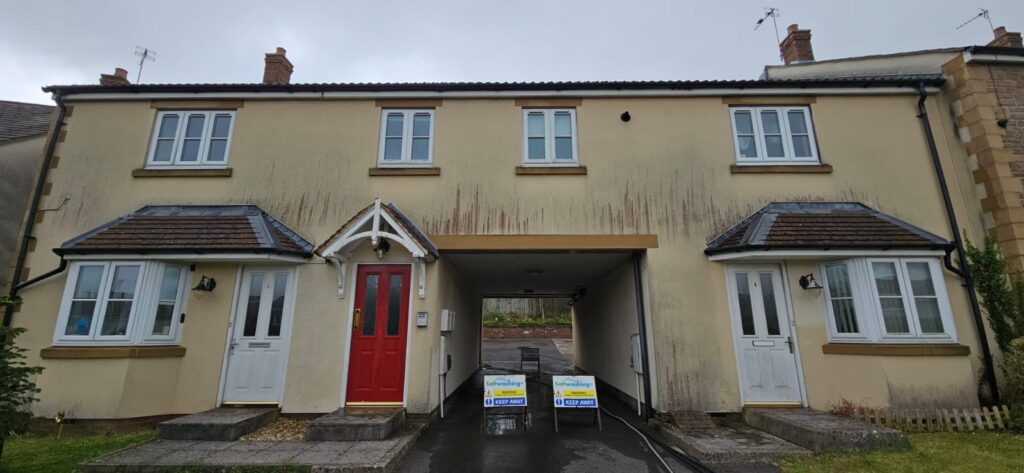
Signs Your Render Needs Cleaning
Many homeowners wait until staining becomes severe before taking action.
Early treatment is usually simpler and more effective.
Common warning signs include:
- Green patches
- Red algae staining
- Black streaks
- White discolouration
- Dark damp areas
- Moss growth
- Uneven colouring
- Dirty splashback near ground level
Removing growth early helps prevent deeper staining developing over time.
Weather Conditions That Encourage Staining
Britain’s climate creates ideal conditions for render contamination.
| Weather Condition | Impact |
|---|---|
| Heavy rainfall | Increases moisture |
| Mild winters | Biological growth continues |
| High humidity | Slower drying |
| Fog | Prolonged dampness |
| Warm temperatures | Faster algae growth |
| Still air | Less evaporation |
The combination of mild temperatures and frequent rain means many rendered homes require periodic cleaning throughout their lifespan.
Why Certain Areas of the House Stain First
Render staining is rarely uniform.
Certain areas consistently become dirty before others.
These include:
- Beneath window sills
- Around downpipes
- Under leaking gutters
- Behind shrubs
- Near garden sprinklers
- Below roof valleys
- Beneath overflowing hopper heads
- Close to soil and flower beds
These locations remain wetter for longer, making them ideal environments for algae and fungi.
The Importance of Good Drainage
Drainage problems contribute significantly to render staining.
Splashback from saturated ground repeatedly wets the lower section of walls.
Over time this encourages both green algae and red algae.
Improving drainage can dramatically reduce future staining.
Examples include:
| Drainage Issue | Recommended Improvement |
|---|---|
| Standing water | Improve ground levels |
| Overflowing gutters | Repair guttering |
| Blocked downpipes | Clear obstructions |
| Soil against render | Reduce soil height |
| Poor paving drainage | Improve falls |
Addressing these issues alongside cleaning helps maintain a cleaner exterior for longer.
Can Render Staining Damage the Surface?
In many cases staining is primarily cosmetic.
However, allowing biological growth to remain for years can create additional problems.
Moisture-retaining organisms keep the surface damp almost continuously.
This increases the likelihood of:
- Surface degradation
- Organic staining
- Frost damage during winter
- Increased maintenance requirements
- Reduced kerb appeal
Regular maintenance helps preserve both appearance and long-term durability.
How Professional Softwashing Works
Professional softwashing is designed specifically for delicate rendered surfaces.
Rather than relying on excessive water pressure, specialist cleaning solutions target the biological contamination responsible for staining.
The process typically involves:
- Inspecting the render.
- Identifying the type of staining.
- Applying professional softwashing treatments.
- Allowing sufficient dwell time.
- Gently rinsing where appropriate.
- Treating remaining biological growth.
This approach removes contamination while helping inhibit future regrowth.
Preventing Future Render Staining
Although no exterior surface stays perfectly clean forever, good maintenance significantly slows the return of staining.
Helpful preventative measures include:
| Maintenance Task | Benefit |
|---|---|
| Clean gutters annually | Prevents water overflow |
| Trim nearby vegetation | Improves airflow |
| Remove moss from roofs | Reduces organic debris |
| Repair leaks quickly | Minimises damp areas |
| Keep drainage clear | Reduces splashback |
| Schedule periodic softwashing | Controls biological growth |
Small maintenance tasks often prevent much larger cleaning jobs later.
Choosing the Right Cleaning Method
Not every rendered property requires the same treatment.
The appropriate cleaning approach depends on:
- Age of the render
- Manufacturer’s recommendations
- Type of staining
- Biological growth present
- Existing damage
- Surrounding environment
Older mineral renders, silicone renders, monocouche render and acrylic render systems all respond differently to cleaning, making a professional assessment worthwhile before any work begins.
For homeowners looking to restore stained render safely, Softwashing UK specialises in professional softwashing techniques designed to remove dirt, green algae, red algae and other biological staining while protecting the integrity of the render itself. Their careful approach focuses on long-lasting results rather than aggressive cleaning methods that may shorten the life of the render.
Why Newly Rendered Homes Can Still Develop Staining
Many homeowners assume that brand-new render will stay bright and clean for years without any maintenance. While modern render systems are designed to resist weathering, they are still exposed to exactly the same environmental conditions as older properties.
In fact, many newly built developments experience staining surprisingly quickly because numerous homes are constructed at the same time on open sites where dust, soil and moisture are abundant. During the first few years after construction, landscaping is also still becoming established, meaning bare soil can splash onto lower walls during heavy rain.
Other factors affecting new properties include:
| Factor | Impact on New Render |
|---|---|
| Bare gardens | Increased soil splashback |
| New turf | Mud during establishment |
| Construction dust | Surface contamination |
| Immature drainage | Temporary pooling of water |
| Closely built houses | Reduced airflow |
This is why even relatively new homes can begin showing green algae, red algae and dark staining within just a few years if conditions are favourable.
Does Render Colour Affect Visible Staining?
The colour of the render doesn’t change how quickly algae grows, but it certainly affects how noticeable staining becomes.
Light-coloured renders remain extremely popular throughout the UK because they create a fresh, modern appearance. Unfortunately, they also highlight even small amounts of contamination.
Darker renders tend to disguise dirt for longer but may show lighter mineral deposits or salt staining more clearly.
| Render Colour | Most Visible Staining |
|---|---|
| White | Green algae, red algae, black streaks |
| Cream | Green algae, dirt |
| Grey | White deposits, dust |
| Beige | Organic staining |
| Dark Grey | Salt deposits and water marks |
Regardless of colour, all rendered surfaces benefit from periodic inspection and maintenance.

The Difference Between Surface Dirt and Biological Growth
Not all stains are created equal.
Surface dirt usually consists of airborne dust, traffic pollution and general environmental contamination. This type of dirt often builds up gradually and can usually be removed relatively easily.
Biological staining is different.
Green algae, red algae, mould and fungi are living organisms that attach themselves to the render. Even if the visible growth is removed, microscopic spores often remain unless the surface is treated correctly.
This explains why some homeowners clean their render only to find the staining returning a few months later.
Professional softwashing targets these organisms at their source, helping reduce the speed at which they return.
Seasonal Changes and Their Effect on Render
Every season affects render differently.
Spring
Spring brings warmer temperatures and increased rainfall. This combination encourages rapid biological growth after winter.
Common issues include:
- Fresh green algae
- Red algae becoming more visible
- Pollen deposits
- Organic debris
Summer
Although surfaces dry faster during summer, shaded walls can still remain damp enough for algae to thrive.
Trees are also in full leaf, creating additional shade and reducing airflow around many homes.
Autumn
Autumn is one of the busiest seasons for render staining.
Falling leaves increase organic debris, while cooler temperatures slow evaporation.
Frequent rainfall also keeps surfaces damp for extended periods.
Winter
Contrary to popular belief, algae does not stop growing completely during winter.
Many biological organisms remain active during mild UK winters, particularly when temperatures stay above freezing.
Why Trees Can Increase Render Problems
Trees provide numerous environmental benefits, but they can also contribute significantly to render staining.
Large trees:
- Block sunlight
- Reduce airflow
- Trap humidity
- Deposit sap
- Drop leaves
- Encourage moss growth nearby
The combination of shade and moisture creates perfect growing conditions for both green algae and red algae.
This doesn’t necessarily mean trees should be removed, but properties surrounded by mature vegetation often require more regular exterior maintenance.
How Roof Run-Off Affects Walls
One commonly overlooked source of staining is roof run-off.
Every time it rains, water flows across roof coverings before reaching the gutters.
Along the way it can collect:
- Dust
- Moss spores
- Organic matter
- Atmospheric pollution
- Small fragments of roofing material
If gutters overflow or water escapes from damaged joints, these contaminants repeatedly wash down the render below.
Over time this creates the familiar dark streaks often seen beneath gutter joints and downpipes.
Repairing faulty guttering is an important part of preventing recurring staining.
Why Maintenance Costs Less Than Restoration
Many homeowners delay cleaning because the staining initially seems minor.
However, allowing biological growth to continue spreading usually makes future cleaning more involved.
Regular maintenance offers several benefits:
| Regular Maintenance | Delayed Cleaning |
|---|---|
| Easier removal | Heavier contamination |
| Better appearance | Deep staining |
| Reduced biological growth | Larger affected areas |
| Lower long-term maintenance | Greater restoration work |
| Improved kerb appeal | Noticeable discolouration |
Maintaining render before severe staining develops is often the most cost-effective approach over the lifetime of the property.
Common Myths About Render Staining
There are several misconceptions surrounding rendered properties.
“Rain cleans render.”
While rain can wash away loose dust, it actually contributes to the damp conditions that encourage algae and staining.
“Pressure washing solves the problem permanently.”
Pressure washing may improve appearance temporarily but often fails to eliminate the biological organisms responsible for regrowth.
“Only old houses get stained.”
New-build homes can develop staining surprisingly quickly depending on location, weather exposure and surrounding vegetation.
“Red staining is always rust.”
In many cases, reddish discolouration on render is actually red algae rather than corrosion.
Correct identification ensures the most appropriate treatment is used.
When Should Homeowners Arrange Professional Cleaning?
There is no fixed schedule suitable for every property.
The ideal timing depends on several environmental factors, including:
- Local climate
- Tree coverage
- Property orientation
- Nearby vegetation
- Previous maintenance
- Exposure to prevailing weather
As a general rule, homeowners should arrange an inspection if they notice green algae, red algae, black streaking or uneven discolouration beginning to spread across the render.
Addressing these issues early is usually simpler than waiting until large sections of the property become heavily stained.
For homeowners wanting to keep their property looking its best throughout the year, Softwashing UK provides specialist render cleaning using professional softwashing techniques that safely remove biological staining while helping protect the finish for longer. Regular maintenance not only restores the appearance of rendered walls but also helps preserve the investment made in the property’s exterior.