


Building work can dramatically improve a property, but it can also leave the exterior looking considerably worse before it looks better. New extensions, replacement windows, roofing work, landscaping, scaffolding and general renovations can all leave rendered walls covered with dust, dirt, splash marks and other residues.
Even areas that were nowhere near the main building work can become affected. Fine construction dust travels surprisingly easily, while repeated foot traffic, machinery, wet weather and materials stored against walls can all contribute to a dirty exterior.
Once the builders have finished, professional render cleaning can help restore the appearance of the property. However, post-construction cleaning needs to be approached carefully because different types of staining require different treatments.
SOFTWASHING UK provides specialist render cleaning for domestic and commercial properties, including buildings requiring attention following construction or renovation work.
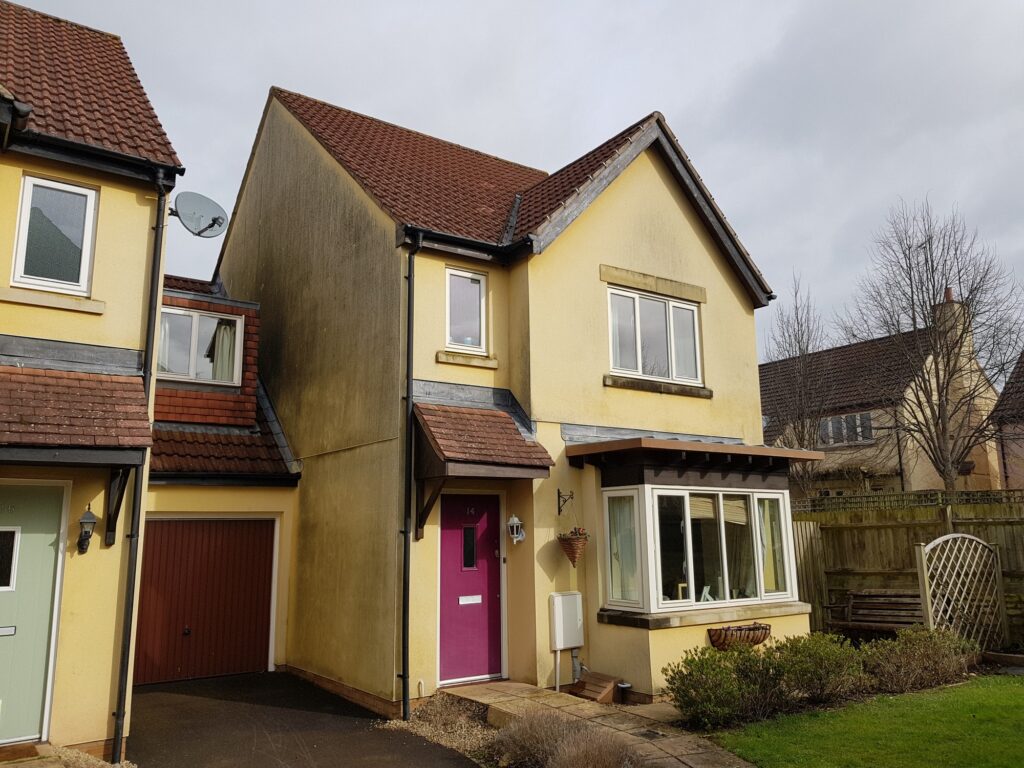
Why Does Render Get So Dirty During Building Work?
Construction sites generate a substantial amount of dust and debris.
Cutting bricks, blocks, tiles, timber and other materials can create fine particles that settle across surrounding surfaces. Vehicles and machinery may also carry mud and dirt around the site.
When this combines with rain, previously dry dust can turn into streaks and deposits across rendered elevations.
Common post-building-work contamination can include:
- General construction dust
- Mud splashes
- Soil
- Organic debris
- Scaffold marks
- Airborne dirt
- Dust from cutting materials
- Green algae and red algae
- Moss and lichen
- Traffic film
- Water run-off marks
- Existing environmental staining
It is important to identify exactly what is on the wall before deciding how it should be cleaned.
Not Every Mark Is the Same
One of the most important things to understand about post-construction render cleaning is that not every mark is simply “dirt”.
Some contamination may be organic, while other marks could be building materials that have accidentally reached the render.
| Type of mark | Possible source |
|---|---|
| Brown splash marks | Mud or soil |
| Grey dusty coating | General construction dust |
| Green or red staining | Green algae and red algae |
| Dark marks | Organic or atmospheric contamination |
| White deposits | Mineral or construction-related residue |
| Localised marks | Scaffolding or stored materials |
| Streaking | Water running across dirty surfaces |
| Cement-like deposits | Building materials requiring specialist assessment |
The treatment required for organic contamination can be very different from the treatment required for cement, paint, sealant or other building products.
This is why an assessment should come before cleaning.
Wait Until the Messy Building Work Is Finished
Timing matters.
There is little value in professionally cleaning rendered elevations if builders are going to spend another two weeks cutting blocks, removing scaffolding and creating dust immediately afterwards.
Where possible, render cleaning should be scheduled towards the end of the project.
That does not necessarily mean every contractor must have completely left the site, but the main dust-producing and messy work should normally be complete.
A sensible sequence could be:
| Stage | Typical activity |
|---|---|
| 1 | Main construction work |
| 2 | Roofing and exterior alterations |
| 3 | Windows, doors and external fittings |
| 4 | Major landscaping or groundwork |
| 5 | Removal of significant waste and debris |
| 6 | Scaffolding removal where appropriate |
| 7 | Inspection of render |
| 8 | Professional render cleaning |
| 9 | Final exterior detailing |
Coordinating cleaning with the wider project can reduce the risk of freshly cleaned walls immediately becoming dirty again.
Inspect the Render for Damage First
Before cleaning begins, the render itself should be inspected.
Building work can occasionally reveal or cause defects that need attention separately from cleaning.
Look for:
- Fresh cracks
- Chipped corners
- Impact damage
- Loose render
- Areas damaged by fixings
- Holes left by scaffolding or fittings
- Failed sealant around windows
- Damaged edges around new openings
- Areas where new and old render meet
Cleaning will not repair physical damage.
If a builder has damaged the render, that issue may need to be resolved before or after cleaning depending on the circumstances and repair system involved.
New Render and Existing Render May Look Different
Extensions are a common reason for post-building-work cleaning.
For example, an existing rendered house may have a newly rendered rear or side extension. The new render can look dramatically cleaner than the older elevations.
This sometimes creates an unexpected problem: the extension looks excellent, but suddenly the original house looks noticeably dirty.
Professional cleaning of the older render may help reduce this visual contrast.
However, cleaning does not change the fundamental age, texture or colour of the existing material. Old and new render may still look different after cleaning because they are different surfaces installed at different times.
Setting realistic expectations is important.
Can Construction Dust Simply Be Hosed Off?
It depends on the contamination.
Loose surface dust may sometimes rinse away relatively easily, but once fine particles have combined with moisture and dried onto textured render, the situation can become more complicated.
Aggressively spraying the wall is not automatically the best answer.
Rendered finishes can vary significantly in strength, texture and condition. Excessive pressure may potentially damage vulnerable surfaces.
SOFTWASHING UK uses specialist low-pressure softwashing methods for render cleaning rather than relying on unnecessarily aggressive pressure washing.
What Is Softwashing?
Softwashing is an exterior cleaning approach that combines appropriate treatments with controlled low-pressure application.
It is particularly useful for biological contamination.
If building work has taken place over several months, the property may not only have accumulated construction dirt. Existing green algae and red algae, mould, mildew, moss or lichen may also be present.
Cleaning the building provides an opportunity to address this organic contamination at the same time.
Rather than simply blasting the surface with high-pressure water, professional softwashing focuses on treating contamination while protecting the underlying exterior.
Green Algae and Red Algae May Have Developed During the Project
Long building projects can sometimes create ideal conditions for biological contamination.
Scaffolding may shade elevations that previously received more sunlight. Protective sheeting can reduce airflow, while materials stored close to walls may prevent sections from drying normally.
If the project runs through autumn or winter, damp conditions can make the problem more noticeable.
Green algae and red algae may therefore become visible during or shortly after renovation work.
Simply assuming every mark was caused directly by the builders can be misleading.
Some staining may have been developing naturally while the work was underway.
Scaffold Marks Can Become Noticeable
Scaffolding can leave an exterior looking patchy after it has been removed.
Areas behind poles, boards and protective sheeting may have experienced different levels of rain, sunlight and contamination from the exposed sections of the wall.
Dust and debris can also collect around scaffold contact points.
Once the scaffold comes down, these differences can become much more obvious.
A professional clean can help improve the overall appearance, although permanent physical marks or damage cannot simply be washed away.
Be Careful With Cement and Mortar Deposits
Cementitious contamination should not automatically be treated in the same way as organic staining.
If mortar, cement or another construction material has been splashed onto the render, aggressive attempts to scrape or dissolve it can potentially damage the underlying finish.
The safest approach depends on:
- The type of render
- The material causing the mark
- How long it has been present
- The extent of contamination
- Whether the render is coloured or painted
- The condition of the surrounding surface
Avoid experimenting with strong household chemicals or scraping tools without understanding the consequences.
Paint, Sealant and Adhesive Are Different Again
Building work can also leave isolated spots of paint, silicone, adhesive, expanding foam or other products on external walls.
These are not the same as biological contamination.
Softwashing should not be presented as a universal method for removing every construction product from every surface.
Some marks may require separate specialist attention, and others may not be removable without affecting the render underneath.
An honest assessment is therefore essential before work begins.
Protect Newly Installed Features
Post-construction cleaning often takes place when a property has just received expensive new features.
These might include:
- New windows
- Aluminium doors
- Rooflights
- External lighting
- New paving
- Composite decking
- Timber cladding
- Glass balustrades
- Landscaping
- New guttering
- Decorative metalwork
These surrounding materials need to be considered when planning the cleaning process.
Professional exterior cleaning is not simply about treating the wall. It also involves considering what sits beside, underneath and in front of that wall.
Newly Landscaped Gardens Need Particular Care
Extensions and major renovations are often followed by landscaping.
If the garden has just received new turf, planting, patios or decorative areas, tell the cleaning contractor before work begins.
Access routes may also need to be considered.
Heavy foot traffic across newly laid turf or unfinished landscaping may be undesirable, so coordinating the cleaning with the landscaping schedule can make the project easier.
In some cases, it may make more sense to complete the render cleaning before particularly delicate planting or finishing work takes place.
Will Render Look Brand New After Cleaning?
This is one of the most important expectation-setting questions.
Professional cleaning can produce a significant improvement, but cleaning cannot reverse every form of ageing or damage.
| Cleaning may address | Cleaning cannot necessarily fix |
|---|---|
| Organic contamination | Cracked render |
| Green algae and red algae | Impact damage |
| General environmental dirt | Permanent discolouration |
| Moss and lichen | Poor previous repairs |
| Some surface staining | Texture differences |
| Construction-related dirt | Failed paint |
| Atmospheric contamination | Defective render |
An older elevation may look substantially cleaner without becoming identical to newly installed render.
The objective is to remove appropriate contamination, not artificially make every surface look as though it was installed yesterday.
What Happens During a Professional Assessment?
Before cleaning, the contractor needs to understand the surface and contamination.
The assessment may consider the render type, access, surrounding materials and severity of staining.
Particular attention may be given to areas where building works have recently taken place.
For example, there may be a clear distinction between ordinary biological staining and a hard construction deposit.
Identifying that difference can determine what is realistically achievable.
SOFTWASHING UK can assess rendered surfaces and recommend an appropriate cleaning approach based on the condition of the property.
Access Can Change After Building Work
Building projects frequently alter the layout around a property.
A new extension may make certain elevations harder to reach, while a conservatory, glass roof or landscaping feature can restrict direct access to the wall.
This needs to be considered when arranging cleaning.
Likewise, scaffolding may already have been removed before anyone realises that the render behind it requires attention.
Planning the cleaning stage before access equipment disappears can sometimes make sense on larger renovation projects.
Don’t Automatically Blame the Builders for Every Mark
Once a project is finished, homeowners naturally inspect everything closely.
A stain that was barely noticeable before construction may suddenly stand out because the rest of the property has changed.
Existing organic contamination, weathering and age-related discolouration can easily be mistaken for new construction damage.
Before raising concerns with a contractor, it can help to establish whether the issue is:
- Construction dust or dirt.
- Organic contamination.
- Green algae and red algae.
- A building-product deposit.
- Physical render damage.
- Existing weathering.
- A combination of several issues.
The appropriate remedy will depend on the answer.
How Long After Building Work Should Render Be Cleaned?
There is no single waiting period that applies to every project.
The right timing depends on what work has been completed and whether any newly installed render, sealants, paints or other materials have specific curing requirements.
New materials should always be allowed to cure according to the manufacturer’s instructions before inappropriate cleaning treatments are applied around them.
Where the cleaning involves existing render away from newly applied materials, scheduling may be more straightforward.
A professional assessment can help determine the appropriate approach.
Renovation Projects Can Expose Existing Organic Growth
Removing an old conservatory, porch, lean-to or extension can expose areas of wall that have been hidden for years.
These sections may look completely different from the surrounding render.
There may be dirt lines, biological contamination or variations in colour.
Likewise, removing climbing plants or external fixtures can reveal outlines and staining underneath.
Professional cleaning can help improve these areas, although differences caused by long-term weathering may remain.
Cleaning Before the Final Handover
For larger renovation or development projects, exterior cleaning can form part of the final presentation of the property.
After months of trades, deliveries and construction activity, exterior walls may not reflect the quality of the completed project.
Cleaning can help remove the accumulated environmental and organic contamination that distracts from new windows, extensions, roofing or landscaping.
A final inspection should ideally take place before cleaning so that genuine building defects are not confused with removable contamination.
A Post-Building Render Cleaning Checklist
Before arranging cleaning, it can help to work through a simple checklist.
| Question | Why it matters |
|---|---|
| Is the dusty building work finished? | Prevents immediate recontamination |
| Has scaffolding been removed or is it still required? | Affects access planning |
| Is any render newly installed? | May have curing requirements |
| Are there cement or mortar deposits? | May need separate assessment |
| Is green algae and red algae present? | Indicates biological contamination |
| Are there cracks or impact damage? | Cleaning will not repair these |
| Has landscaping been completed? | Access and protection may be needed |
| Are new windows or doors installed? | Surrounding materials need consideration |
| Is repainting planned afterwards? | Cleaning may form part of preparation |
Arranging Render Cleaning With SOFTWASHING UK
After building work, it is tempting to treat the final exterior clean as a simple wash-down. Render often requires a more considered approach.
Construction dust may sit alongside years of environmental contamination. Green algae and red algae may be present on shaded elevations, while cement, paint or sealant marks may require a completely different assessment.
SOFTWASHING UK specialises in professional render cleaning using low-pressure softwashing techniques designed to tackle appropriate organic contamination without relying on aggressive pressure washing.
For homeowners, landlords, property managers and commercial clients, arranging the cleaning once the main construction activity has finished can help bring the older parts of a property back in line with the appearance of newly completed work.
The key is to identify what is actually on the render first. Once construction dirt, biological contamination, physical damage and permanent building-material deposits have been separated into the correct categories, the appropriate cleaning work can be planned without treating every post-construction mark as though it has the same cause.
Why Builders’ Cleaning Isn’t Always Enough
Many building projects include a basic site clean before handover, but this is not the same as specialist render cleaning.
A builders’ clean is primarily designed to remove loose debris, packaging, obvious dirt and waste materials so the property is presentable. It does not necessarily involve treating biological contamination, assessing delicate rendered finishes or addressing staining that has developed over the course of the project.
For example, a rendered wall may still have:
- Fine construction dust embedded in its textured surface
- Water streaks caused by rain mixing with site dust
- Green algae and red algae developing on shaded elevations
- Marks left where scaffolding protected parts of the wall differently
- Existing atmospheric contamination that became more noticeable once the renovation was complete
Professional render cleaning takes a more considered approach, particularly where the appearance of the finished property is important.
Why Dust Can Be More Stubborn Than It Looks
Construction dust is often much finer than ordinary household dust.
Cutting masonry, concrete products and other building materials can create microscopic particles that settle into the texture of rendered surfaces. Once rain wets these particles, they can cling much more firmly than dry dust alone.
This is particularly noticeable on light-coloured render, where even a thin layer of residue can dull the finish.
Rather than assuming every dusty wall needs aggressive cleaning, the surface should be assessed so the appropriate low-pressure cleaning method can be selected.
Cleaning Around Newly Installed Windows
Replacement windows are one of the most common reasons homeowners notice how dirty their render has become.
Once bright new frames are installed, surrounding walls can suddenly appear discoloured by comparison.
Window installations can also leave behind:
- Dust around reveals
- Sealant smears nearby
- Finger marks
- Localised dirt where installers have worked repeatedly
- Water run-off marks beneath sills
When arranging render cleaning, these areas should be inspected carefully so the surrounding finish complements the newly installed windows.
Older Render Can Reveal Hidden Colour Differences
After a renovation, homeowners sometimes expect the entire property to look perfectly uniform once cleaned.
However, older render may have weathered differently across various elevations.
For example:
| Area | Possible difference |
|---|---|
| South-facing wall | More sun exposure |
| North-facing wall | Greater biological contamination |
| Behind removed extension | Previously sheltered finish |
| Around old fixtures | Visible outlines after removal |
| Beneath gutters | Water staining |
Cleaning can significantly improve consistency, but these long-term differences may still remain visible because they reflect years of exposure rather than removable dirt alone.
Why Weather After Building Work Matters
The period immediately after construction can have a surprisingly large impact on exterior appearance.
If heavy rain arrives before site dust has been properly managed, streaking can become much more noticeable. Likewise, autumn and winter projects may leave rendered walls damp for longer, creating favourable conditions for green algae and red algae.
When planning post-construction cleaning, weather should therefore be considered alongside the building schedule.
| Weather condition | Possible impact |
|---|---|
| Heavy rain | Streaking from construction dust |
| High humidity | Slower drying |
| Strong sunshine | Faster surface drying |
| Cold weather | Longer drying times |
| Wind | Dust movement across the site |
This is another reason why cleaning should be properly coordinated rather than treated as the final task squeezed into the end of the project.
Preparing Render Before Decorating After Renovation
Many homeowners plan to repaint once building work has finished.
If that is the intention, cleaning should become part of the decorating preparation rather than a separate cosmetic exercise.
A logical sequence is:
- Complete the messy construction work.
- Remove major debris.
- Inspect the render.
- Professionally clean the surface.
- Allow suitable drying time.
- Repair any defects.
- Apply the appropriate decorating system.
This approach gives painters a much cleaner and more stable substrate to work with.
Commercial Developments Benefit From Final Render Cleaning
The same principles apply to commercial properties, housing developments and apartment blocks.
Newly completed buildings often attract attention immediately after handover, making first impressions particularly important.
Even high-quality construction can look disappointing if rendered elevations remain dusty or patchy after months of building activity.
Professional cleaning can help present:
- Apartment blocks
- Office buildings
- Retail units
- Housing developments
- Schools
- Community buildings
- Healthcare facilities
For larger developments, coordinating cleaning with scaffold removal and final landscaping can help achieve a much more polished appearance.
Avoid DIY Shortcuts
After investing heavily in building work, it can be tempting to save money by cleaning the render yourself using whatever equipment is available.
However, different render systems require different approaches.
Potential mistakes include:
- Using excessive pressure.
- Scrubbing aggressively.
- Applying unsuitable chemicals.
- Cleaning before new materials have cured.
- Treating biological contamination as ordinary dirt.
These shortcuts can create unnecessary problems, particularly on modern rendered finishes.
SOFTWASHING UK uses low-pressure softwashing techniques designed to clean rendered surfaces without relying on unnecessarily aggressive pressure washing.
Protecting Newly Finished Projects
A completed renovation often represents months of planning, disruption and investment.
The extension is finished.
The windows have been replaced.
The landscaping is complete.
The last thing most homeowners want is for dusty, streaked or algae-affected render to distract from the improvements.
Professional cleaning can help bring together old and new sections of the property by removing appropriate contamination before the building enters everyday use.
Signs It’s Time to Book Render Cleaning
If you’ve recently completed building work, these signs may indicate it’s worth arranging professional cleaning:
| Sign | What it may indicate |
|---|---|
| Dusty-looking walls | Construction residue |
| Green algae and red algae | Biological contamination |
| Streaks after rainfall | Dust mixed with water run-off |
| Patchy appearance after scaffold removal | Uneven weather exposure |
| Dirty older render beside new extension | Contrast between old and new surfaces |
| Marks around window reveals | Installation-related contamination |
Addressing these issues early can help restore the overall appearance of the property while ensuring the rendered finish receives appropriate care after construction.
Coordinating the Final Exterior Finish
One of the biggest advantages of arranging render cleaning towards the end of a renovation is that it ties together all the other improvements.
Rather than seeing spotless new windows next to dusty walls or a beautiful extension beside algae-stained original render, the entire property presents a much more cohesive appearance.
By allowing the messy work to finish first, inspecting the render carefully and arranging professional cleaning from SOFTWASHING UK at the appropriate stage, homeowners and property managers can give completed building projects the clean, well-presented exterior they deserve without relying on unnecessarily aggressive cleaning methods or treating every mark as though it has the same cause.