


Windows and doors can be some of the most noticeable areas when rendered walls begin to look dirty. Dark streaks beneath window sills, discolouration around frames and patches of biological growth can make an otherwise well-maintained property appear tired.
However, cleaning render around windows and doors requires more care than simply washing an open section of wall.
Window seals, door frames, glazing, vents, painted surfaces and surrounding materials all need to be considered. The cleaning method also needs to be appropriate for the type and condition of render.
For many properties, professional softwashing provides an effective way to treat organic contamination without relying on aggressive high-pressure cleaning.
Specialists such as Softwashing UK can assess the render and surrounding materials before determining an appropriate cleaning process.
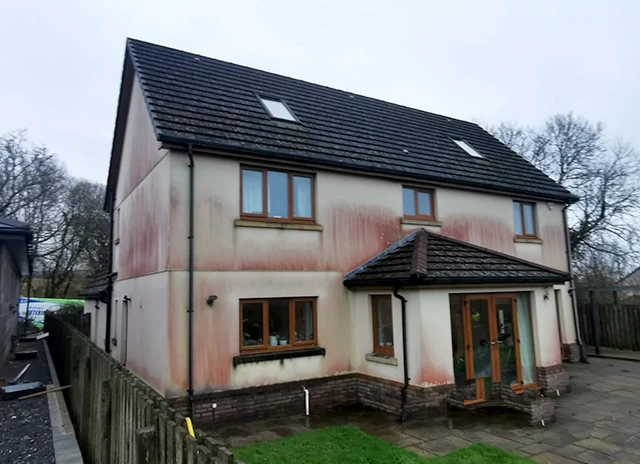
Why Does Render Get Dirty Around Windows and Doors?
The areas surrounding windows and doors can develop staining for several reasons.
Rainwater naturally runs across exterior walls, window sills and architectural features. Certain areas may therefore remain damp longer than others.
Window sills can also influence how water travels across the elevation. Instead of rainwater running evenly down the wall, it may collect around corners or drip repeatedly onto the same section of render.
Over time, these conditions can encourage biological contamination.
Common causes include:
- Persistent moisture
- Shaded elevations
- Poor airflow
- Leaking gutters
- Damaged seals
- Water running from window sills
- Nearby trees and vegetation
- Atmospheric pollution
- General weather exposure
Green algae and red algae can also become established on rendered surfaces where conditions are suitable.
The result can be noticeable streaks and patches around windows and doors.
Why Cleaning Around Windows Requires Extra Care
Cleaning a large uninterrupted rendered wall is relatively straightforward compared with working around several windows.
Each window introduces different materials and potential vulnerable points.
A typical window area might include:
| Area | Cleaning Consideration |
|---|---|
| Render | Condition and type of finish |
| Glass | Cleaning products and run-off |
| Window frame | Material and condition |
| Rubber seals | Avoid unnecessary aggressive treatment |
| Window sill | Dirt and water can collect here |
| Vents | Prevent unnecessary water ingress |
| Silicone | Check condition before cleaning |
| Painted trim | May react differently from render |
This is why the entire elevation should be assessed rather than concentrating solely on the dirty render.
Is Pressure Washing Safe Around Windows?
Using a pressure washer around windows requires considerable caution.
Windows are designed to resist normal weather conditions, but that does not mean they should be subjected to concentrated high-pressure water at close range.
Water forced towards seals, vents and joints could potentially enter areas it would not normally reach during rainfall.
High pressure may also be unsuitable for certain rendered finishes.
Older render can contain cracks or deteriorated areas that are not immediately obvious from ground level. Aggressive cleaning may expose or worsen existing weaknesses.
Softwashing takes a different approach.
Rather than depending primarily on mechanical force, an appropriate cleaning treatment is used to target contamination.
| High-Pressure Cleaning | Softwashing |
|---|---|
| Relies heavily on water pressure | Relies primarily on suitable treatment |
| Can produce significant spray | Allows more controlled application |
| Requires caution around seals | Reduces reliance on mechanical force |
| May affect vulnerable render | Suitable for many rendered surfaces |
| Can remove visible contamination quickly | Targets organic contamination |
The appropriate method will depend on the individual property.
Cleaning Render Around uPVC Windows
uPVC windows are extremely common throughout the UK and are often surrounded by rendered elevations.
Although uPVC is relatively durable, consideration still needs to be given to seals, silicone, vents and decorative finishes.
Cleaning products applied to the render can naturally travel downwards and come into contact with the window.
Professional cleaning therefore involves controlling both application and run-off.
Before treatment begins, it may be necessary to inspect:
- Window seals
- Silicone joints
- Trickle vents
- Drainage holes
- Decorative trim
- Window sills
- Existing damage
If a seal has already deteriorated, this should be recognised before exterior cleaning begins.
Cleaning Render Around Aluminium Windows
Aluminium window systems are increasingly popular, particularly on modern properties and extensions.
Their appearance can complement contemporary render extremely well, but the surrounding surfaces still need careful cleaning.
Different finishes and coatings can react differently to cleaning products, which is why suitability should be assessed before treatment.
A professional cleaner should consider the window frame as part of the overall exterior rather than treating the render in isolation.
The same principle applies to metal doors, bifold doors and large glazed sections.
Render Cleaning Around Bifold Doors
Large bifold doors can create a particular challenge.
Modern extensions often combine rendered walls with wide areas of aluminium-framed glazing. The render above and beside the doors can become stained while the doors themselves remain relatively clean.
Applying aggressive water pressure around these areas is rarely the most sensible starting point.
Instead, careful application and control are important.
Professional render cleaning from Softwashing UK can take account of the render, glazing, frames and other materials present on the elevation.
What Causes Black Streaks Under Window Sills?
Dark marks beneath window sills are a common problem.
They can develop because water repeatedly follows the same route from the sill onto the wall below.
The staining may involve biological contamination, dirt, pollution or a combination of different substances.
It is important to identify the likely cause before choosing a cleaning treatment.
| Type of Staining | Possible Cause |
|---|---|
| Green or red patches | Green algae and red algae |
| Black streaks | Organic growth or atmospheric dirt |
| General grey appearance | Pollution and weathering |
| Staining beneath sill corners | Repeated water run-off |
| Isolated damp area | Leak or drainage problem |
Cleaning can improve the appearance of the wall, but an underlying water problem should also be investigated.
If a leaking gutter is continually saturating one area, for example, simply cleaning the render will not stop the moisture source.
Cleaning Render Around Front Doors
Front entrances are particularly important because they are one of the first parts of a property visitors see.
Dirty render surrounding an otherwise attractive front door can significantly affect kerb appeal.
The cleaning process needs to account for several materials that may be positioned close together.
A front entrance could include:
- Render
- Composite or timber door
- uPVC or aluminium frames
- Glass
- Door furniture
- External lighting
- House numbers
- Doorbells
- Security cameras
- Painted trim
- Stone or tiled steps
These features should be considered before cleaning products are applied.
Electrical equipment such as lights, cameras and doorbells requires particular care.
Does Render Need to Be Cleaned Before Painting?
If rendered walls are being prepared for painting or coating, cleaning can be an important part of the preparation process.
Painting directly over biological contamination or heavily soiled render may compromise the finished appearance.
The surface should be appropriately prepared and allowed to dry before subsequent work begins.
However, cleaning does not repair damaged render.
Cracks, loose areas and other defects may require separate attention before painting.
Can Cracked Render Around Windows Be Cleaned?
Cracks frequently appear around window and door openings because these areas can experience different stresses within the building.
Minor surface cracking does not automatically mean that cleaning is impossible, but it should be identified before work starts.
More substantial cracks may require investigation or repair.
The condition of the render can influence both the cleaning method and the level of water that should be introduced to the surface.
Particular care may be needed where cracks meet:
| Location | Potential Concern |
|---|---|
| Window corners | Existing cracking |
| Door openings | Movement or deterioration |
| Window sill joints | Water penetration |
| Silicone joints | Failed or damaged seals |
| Previous repairs | Different surface characteristics |
A professional assessment can help determine whether cleaning should proceed or repairs should be carried out first.

Protecting Windows During Softwashing
Professional softwashing involves more than applying treatment to a wall.
The surrounding property needs to be considered throughout the process.
Windows may require appropriate rinsing, and run-off needs to be managed carefully.
Nearby plants, patios, decking and decorative materials may also need protection depending on their location and the products being used.
Preparation can therefore account for a significant part of a professional render-cleaning project.
Why Window Seals Should Be Checked Before Cleaning
Window seals naturally deteriorate over time.
Older silicone may crack, shrink or separate from the surrounding frame and render.
If water is already entering around a window during heavy rainfall, exterior cleaning could expose the same weakness.
This does not necessarily mean the cleaning caused the problem.
An existing defect may simply become apparent during the process.
Checking obvious seals and joints beforehand helps identify potential problems before work begins.
How Often Should Render Around Windows Be Cleaned?
There is no universal schedule.
The speed at which contamination returns depends on the building’s location and environment.
A shaded elevation surrounded by mature trees may develop organic contamination considerably faster than a sunny, exposed wall.
Rather than automatically cleaning render every year, homeowners can monitor its appearance.
Early patches of green algae and red algae, dark streaking or general discolouration can indicate that maintenance treatment may be worthwhile.
Preventing Render From Becoming Dirty Again
It is impossible to prevent exterior render from ever becoming dirty.
Buildings are continuously exposed to rain, wind, pollution and biological spores.
However, maintenance can reduce some of the conditions that encourage staining.
Gutters should be kept clear, leaking downpipes repaired and obvious water-management problems addressed.
Vegetation touching the building may also need cutting back.
Window sills should be checked for damage that causes water to run towards the building rather than away from it.
| Maintenance Task | Potential Benefit |
|---|---|
| Clear gutters | Reduces overflowing rainwater |
| Repair leaking downpipes | Prevents persistent wet areas |
| Check window seals | Identifies deterioration |
| Cut back vegetation | Improves airflow and sunlight |
| Inspect window sills | Helps identify drainage problems |
| Monitor render | Allows contamination to be treated earlier |
Cleaning Render Around Bay Windows
Bay windows introduce additional angles, corners and horizontal surfaces.
Water can collect or travel differently around these features, resulting in concentrated areas of staining.
Upper sections can also be difficult to access safely from ground level.
A professional cleaner should assess both the contamination and access requirements before beginning work.
Trying to reach awkward sections from unsuitable ladders can create unnecessary risks, while attempting to compensate by using extremely high water pressure from a distance may not be appropriate for the render.
Cleaning Above Window and Door Openings
The render immediately above windows and doors is sometimes overlooked.
These sections can develop staining beneath gutters, rooflines and architectural features.
They may also contain vents, flashing or decorative elements that require careful treatment.
Before cleaning, the entire elevation should therefore be inspected rather than simply treating the most visibly contaminated sections.
A more comprehensive approach can produce a much more consistent appearance across the property.
For homeowners and property managers considering professional treatment, Softwashing UK provides specialist exterior softwashing and render-cleaning services for properties affected by organic contamination and exterior staining.
Should Windows Be Open or Closed During Render Cleaning?
Windows and doors should generally be securely closed while the surrounding render is being cleaned.
This helps reduce the possibility of cleaning solution, water or loosened contamination entering the property. It is particularly important to check windows that have been left slightly open for ventilation.
Trickle vents and other ventilation points also need to be considered. These features are specifically designed to allow airflow through the window system, so care should be taken when applying treatment nearby.
Before professional render cleaning begins, it is sensible to walk around the property and check that windows and external doors are properly secured.
Homeowners may also want to tell the contractor about any known problems with particular windows, such as damaged seals or windows that do not close completely.
What About Render Around Older Timber Windows?
Timber windows require different considerations from modern uPVC or aluminium frames.
Painted or stained timber may have coatings that have deteriorated over time. Flaking paint, exposed wood and damaged sealant should therefore be identified before the surrounding render is treated.
Older properties may also have more complicated junctions between the render and window frames.
| Timber Window Condition | What to Consider |
|---|---|
| Sound painted finish | Appropriate protection and controlled cleaning |
| Flaking paint | Loose coating could be vulnerable |
| Exposed timber | Additional care may be required |
| Failed sealant | Potential route for moisture |
| Rotten sections | Repairs may be necessary |
| Recently painted frame | Check curing time before nearby cleaning |
Professional cleaning should take account of these differences rather than treating every window frame in exactly the same way.
Why Patch Cleaning Can Sometimes Look Uneven
If one particularly dirty section beneath a window is cleaned while the remainder of the elevation is left untreated, the newly cleaned area may appear noticeably different.
This does not necessarily mean anything has gone wrong.
Exterior surfaces weather gradually. Even sections that do not look particularly dirty may contain a degree of general atmospheric contamination.
Cleaning one isolated patch can therefore highlight the difference between treated and untreated render.
Where staining affects numerous windows and doors across the same elevation, treating a larger continuous area may produce a more uniform appearance.
A professional assessment from Softwashing UK can help determine whether targeted treatment or cleaning the wider elevation is more appropriate.
Why Are Upper-Floor Windows Often More Difficult?
First and second-floor windows introduce an additional access challenge.
The contractor needs to reach the surrounding render while maintaining control over the cleaning treatment and avoiding unnecessary pressure around windows, vents and seals.
Extensions and conservatories can make this even more complicated.
For example, a first-floor bedroom window positioned directly above a single-storey extension may be relatively close to the ground vertically but difficult to approach because the extension projects several metres from the building.
Access considerations can include:
- Building height
- Extension roofs
- Conservatories
- Narrow side passages
- Sloping ground
- Fences and walls
- Trees
- Overhead cables
- Limited equipment access
This is why quotations for professional render cleaning are usually based on more than simply the total square metres requiring treatment.
Can Render Cleaning Remove Stains From Leaking Window Sills?
Cleaning may remove or significantly improve contamination associated with persistent water run-off, but the cause of the staining also matters.
If a damaged sill, failed joint or another defect continues directing water onto the render, staining could eventually return.
The sensible approach is therefore to distinguish between the stain and the cause of the stain.
Consider a dark vertical mark extending from the corner of a window sill. Professional cleaning may deal with the biological contamination and dirt on the render, but if water continues dripping from exactly the same point whenever it rains, the conditions that originally contributed to the staining remain.
Where there is an obvious defect, repairing it can help protect the cleaned appearance.
Render Cleaning Around French Doors and Patio Doors
French doors and sliding patio doors create large areas of glazing close to the render being cleaned.
As with bifold doors, careful control of treatment and run-off is particularly important.
Thresholds also need consideration because water naturally travels downwards towards the bottom of the door opening.
The condition of drainage channels, seals and surrounding paving should therefore be assessed.
| Area Around Patio Doors | Consideration |
|---|---|
| Large glass panels | Control treatment and rinse appropriately |
| Door frames | Consider frame material and finish |
| Threshold | Prevent unnecessary pooling |
| Drainage channels | Check they are unobstructed |
| Silicone joints | Look for deterioration |
| Nearby paving | Consider run-off |
| Render immediately above | Check for cracks or staining |
Large glazed doors are often one of the main visual features of a modern extension, making clean surrounding render particularly important to the overall appearance.
Why Does Render Sometimes Look Worse Around Window Corners?
Corners can become particularly noticeable because water and contamination do not always spread evenly across an elevation.
Window openings interrupt the natural flow of rainwater down a wall.
Water can travel along a sill before dripping from its corners, resulting in two distinctive streaks beneath the window.
Shading can also differ around recessed windows.
These small variations in moisture, sunlight and airflow can be enough to create visible differences in biological growth.
Green algae and red algae may therefore appear more heavily in certain sections even though the same rendered finish covers the entire wall.
Understanding these patterns can help identify whether the problem is simply environmental contamination or whether there could also be a drainage issue.
Should New Render Be Softwashed?
Newly installed render should not automatically require cleaning.
However, modern rendered properties can eventually experience biological growth, particularly where elevations remain shaded or damp.
The age of the render should always be considered before treatment.
If render has only recently been applied, it may still be curing or subject to installer requirements. Cleaning too soon could potentially interfere with the finish or associated guarantees.
Homeowners should therefore check any relevant installation or manufacturer information before arranging treatment on very recently applied render.
Once the surface is established, an appropriate professional cleaning method can be selected according to the render system and contamination present.
Why Cleaning Products Should Be Used Correctly
Professional softwashing involves more than purchasing an exterior cleaning chemical and spraying it onto the wall.
Product selection, concentration, application, dwell time, weather conditions and surrounding materials all need to be considered.
Using too little treatment may fail to deal effectively with contamination, while inappropriate or excessive use could create unnecessary risks to surrounding surfaces.
The person carrying out the work also needs to consider where the treatment will travel after application.
This becomes particularly important around windows and doors because there may be glass, frames, seals, decorative finishes and paving immediately beneath the treated area.
Render Cleaning for Commercial Properties
Render around windows and doors is not exclusively a residential maintenance issue.
Rendered offices, apartment buildings, schools, shops and other commercial properties can develop the same types of staining.
The appearance of entrances can be particularly important for commercial buildings because customers, tenants and visitors frequently pass through these areas.
Commercial projects may also introduce additional considerations, including pedestrian management, working hours, access equipment and larger elevations.
| Property Type | Typical Areas Requiring Attention |
|---|---|
| Offices | Entrances and window surrounds |
| Apartment blocks | Multiple floors and communal entrances |
| Retail premises | Shopfront surrounds |
| Schools | Windows, doors and high-traffic entrances |
| Hotels | Guest entrances and bedroom elevations |
| Managed developments | Large rendered communal elevations |
Planning the work carefully can allow the render to be treated while protecting surrounding glazing, entrances and external features.
Property owners, landlords and facilities managers can find further information about professional render and exterior cleaning from Softwashing UK.