Follow the water and you will find the staining. Almost every discoloured elevation we assess tells a story about where rain has been going: a dark plume beneath a blocked hopper, a vertical stripe tracking a leaking joint, a broad grey band along the base of a wall where splash-back from a hard surface has kept the render permanently damp. Growth follows moisture and moisture follows failures in detailing. That is where our render cleaning services begin — not with the wall as a whole, but with the reason one part of it is worse than the rest. Sills and copings are the usual culprits. Where a drip groove has been filled or a coping throws water back onto the face instead of away from it, the render below stays wet for hours longer than everything around it and algae colonises that strip first. Overhangs create the opposite problem: sheltered from cleansing rainfall but not from damp air, they accumulate a fine, tenacious growth that never gets washed off naturally. Treatment addresses the whole elevation regardless, because uneven cleaning is as obvious as uneven dirt. A biocidal solution is applied at low pressure across every face, held long enough to break the colony down at root level, then rinsed gently. Render algae removal is chemical throughout and nothing is scoured off. Render moss removal on the ledges where deposits are thickest takes a second, targeted application. Where a drainage fault caused the problem we will point it out, because exterior render cleaning cannot outlast a defect that keeps feeding the wall. Professional render cleaning of a Blandford Forum property should leave you with a clean elevation and an accurate idea of why it went that way; house render cleaning is worth considerably more when the cause is understood.
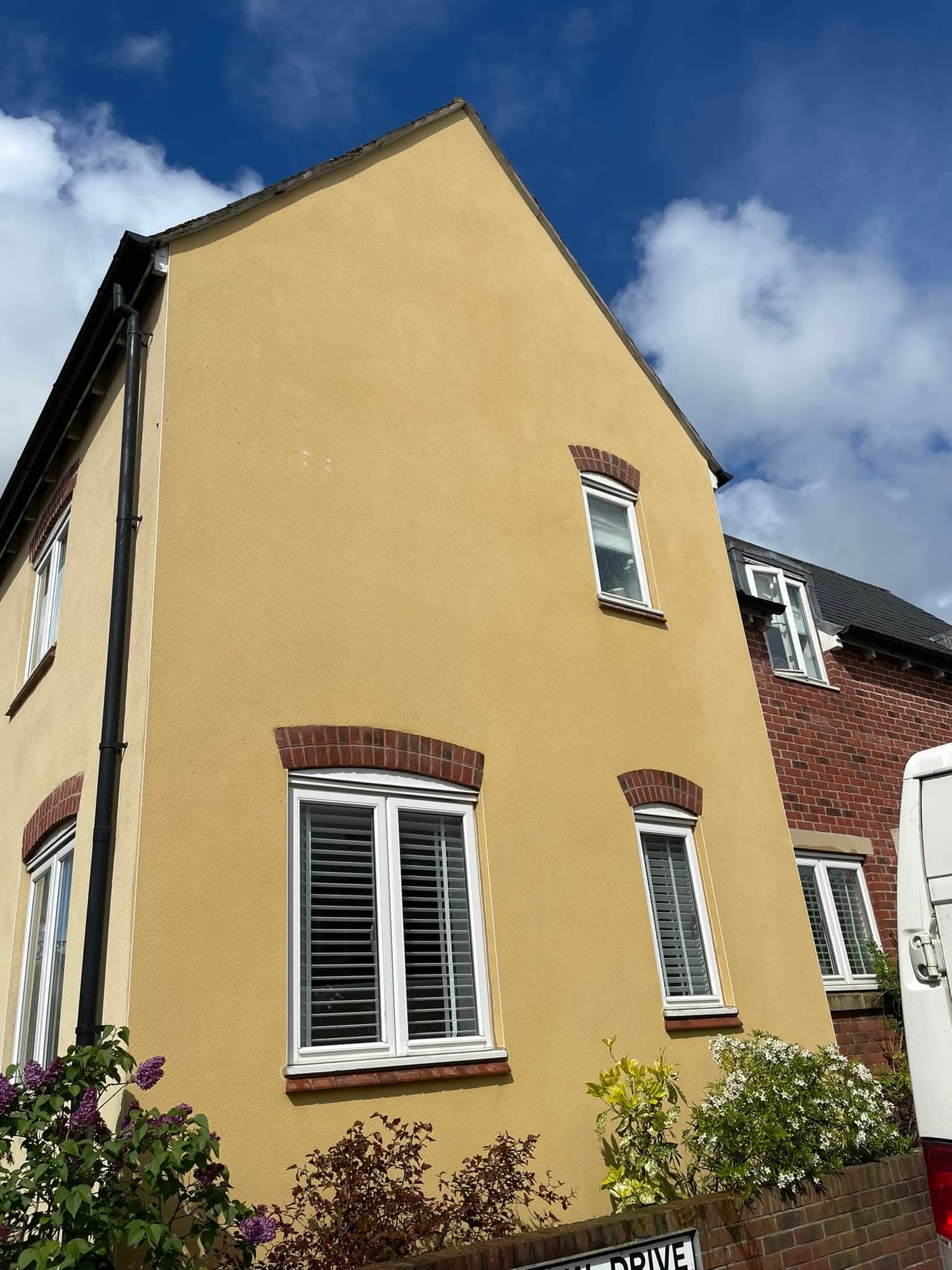
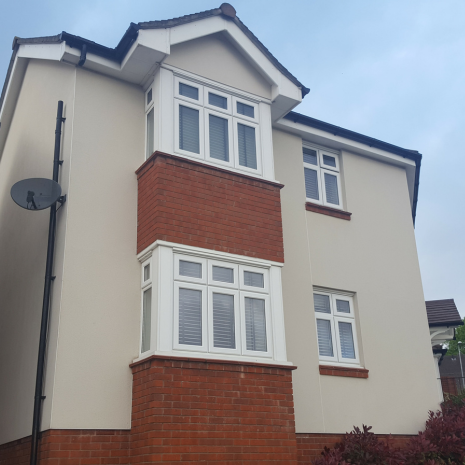

K Rend systems are usually applied over board or blockwork with mesh reinforcement, and it is the junctions rather than the flat panels that determine how a clean should be approached. Board joints, mesh laps, movement beads and the line where render meets a window frame are the points at which water can get behind the coating, and once it does the staining that eventually bleeds through cannot be cleaned off the front. K Rend cleaning is therefore as much about controlling water as about removing growth. The method is entirely chemical. Soft wash render cleaning applies a biocidal solution at a pressure barely above a hose, letting the product break down algae and lichen across a long dwell rather than relying on any physical action. Nothing is scrubbed and nothing is scraped, which matters enormously on a through-coloured silicone finish where abrasion removes pigment permanently. Silicone render cleaning has one working peculiarity worth understanding: the surface is deliberately water-repellent, so solution wants to run off before it has finished working. Correct volume, correct dilution and treating shaded elevations first rather than faces baking in full sun is how that is managed. Applied properly, residue left in the surface continues inhibiting regrowth well after the job is complete. Render stain removal covers everything the biocide will not touch — iron bleed from fixings and brackets, cement residue from installation, dark tide marks where an outlet has overflowed. Each is a different contaminant and each gets its own treatment, tested small before going wider. On many Blandford Forum properties the finished job is a full soft wash plus three or four spot treatments, priced and explained separately.
Ask what makes monocouche difficult and the answer is not really the material — it is that the material is unforgiving of mistakes. Applied in one thick coat, coloured throughout, scraped back to a fine open texture and never painted, it is designed to be left alone. When it does need attention, Monocouche render cleaning has to work within what the surface will accept, which is very little indeed. Softwashing UK approaches these elevations chemically and slowly. Solution is applied at low pressure in enough volume to soak into the depth of the scraped texture rather than sit on the peaks, then left to break the growth down at root level. Heavier colonisation beneath copings and along projecting bands gets a repeat application instead of mechanical attention. The rinse is soft, even and taken across whole faces so nothing dries in patches. Render pressure washing is what ruins these walls, and it happens constantly. A lance flattens the scraped profile in seconds, exposes the aggregate beneath and leaves tracking that catches the light for ever afterwards. Because there is no top coat, coloured render cleaning offers no route to putting it right; the only remedy is recoating an entire elevation to restore consistency, at many times the cost of the clean. Handled correctly, render wall cleaning of monocouche gives back a completely uniform face with no banding and no bright spots. On buildings where growth has darkened the finish for a decade or more the difference is stark enough that render restoration is a fair description, since the colour appearing is the one applied originally and simply uncovered.
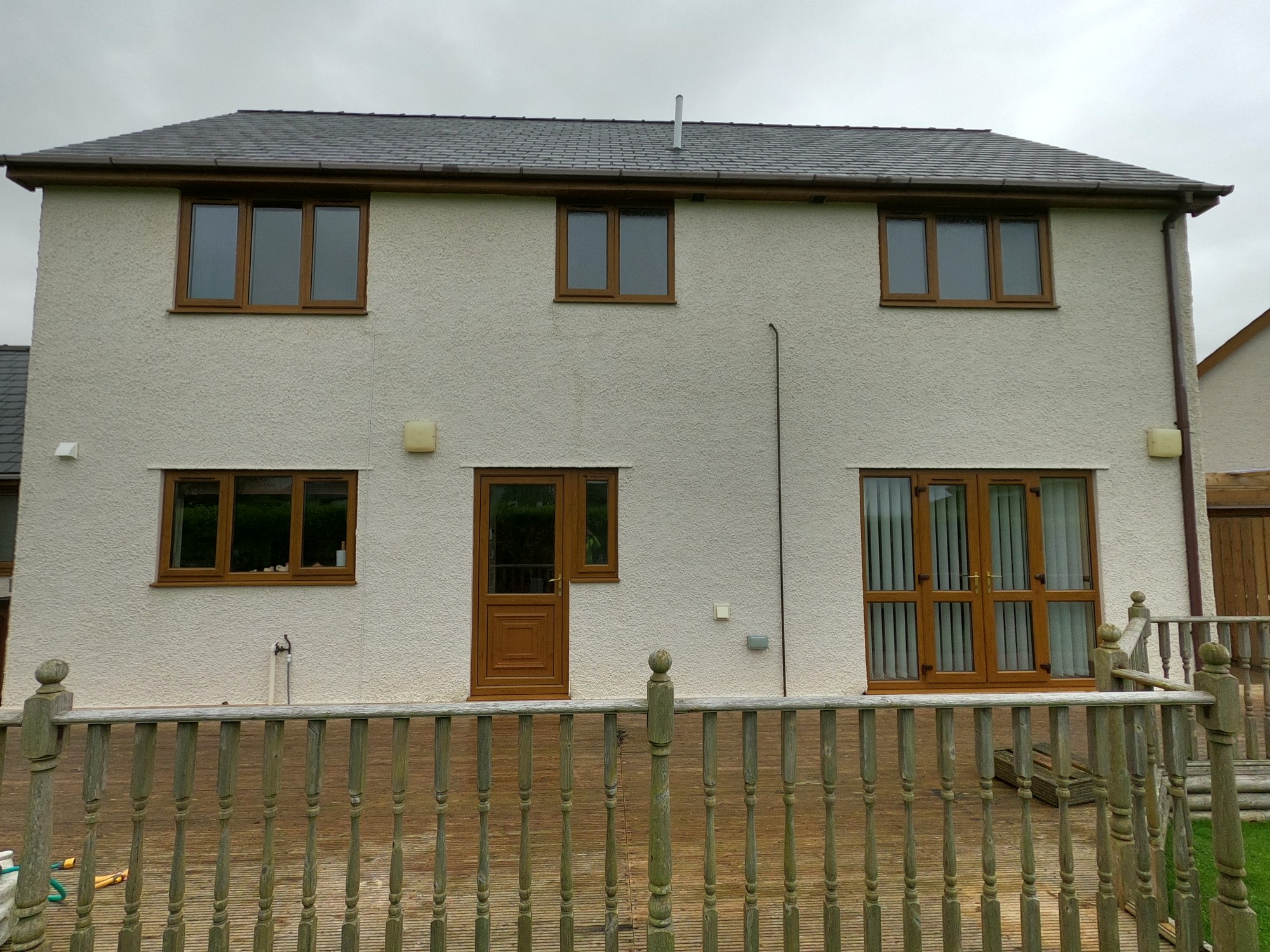
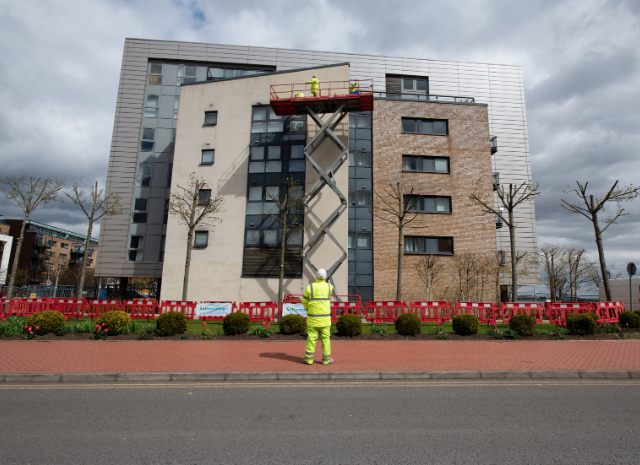

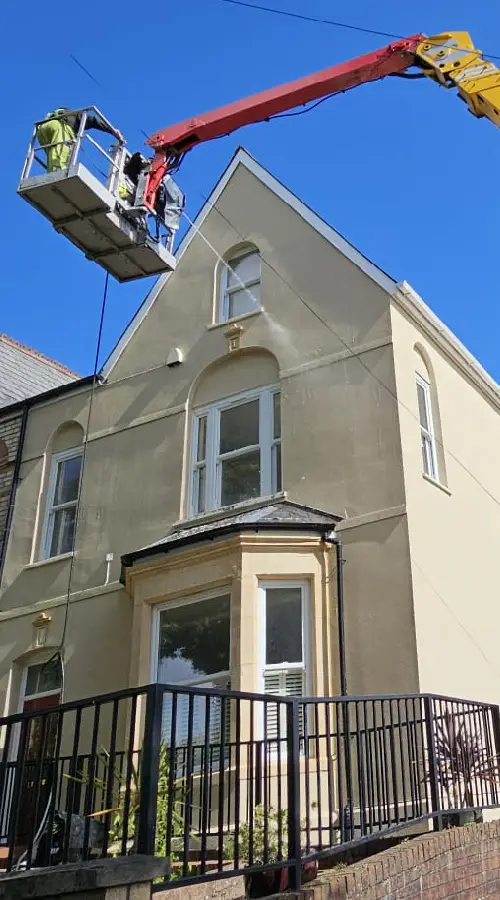
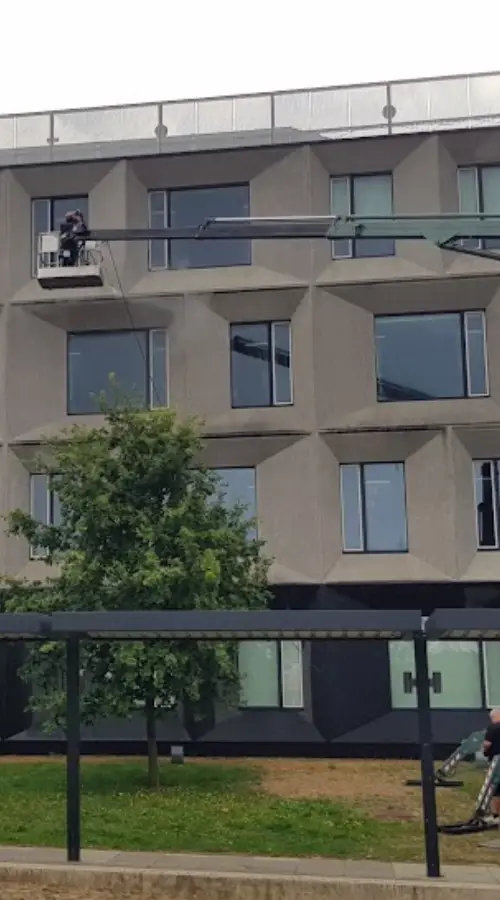
Anyone holding more than one rendered building quickly learns that the elevations all deteriorate at different rates. A unit with an open aspect stays presentable for years; one hemmed in by planting or shaded by an adjoining block goes black within two. Commercial render cleaning across a portfolio therefore works far better as a rolling programme than as a series of emergencies. The practical work is organised around the site rather than the wall. Access is settled first — powered platform, tower or extended pole systems according to height and ground conditions — then the schedule is agreed around opening hours, deliveries and staff movement. Method statements and risk assessments are issued in advance and the site contact is told exactly who is arriving and when. Render facade cleaning on a working building lives or dies on that groundwork. Render soft washing is used throughout. On large elevations it delivers even coverage from one end to the other, uses a fraction of the water pressure equipment requires, produces run-off that can be directed away from entrances and vehicles, and creates almost no drift near occupied doorways or open windows. It also lets an operator working from a platform apply treatment steadily instead of fighting the recoil of a lance at height. Render mould removal is the item that recurs most often, because shaded faces blacken faster than anything else on a building and return quickest when growth has only been rinsed rather than killed. Placing those elevations on a render maintenance cycle at a fixed interval spreads the cost, keeps premises in Blandford Forum consistently presentable, and prevents the coating ever reaching the point where cleaning is no longer the answer.
A proper quotation for this work should tell you five things: which elevations are included, what product is going onto them, how access is being achieved, how long the job will take, and what the total is. Anything shorter than that is a number rather than a quotation, and it is usually the first sign that corners are already planned. Ours is written after somebody has stood in front of the building. Render cleaning prices move with height, with the number of faces, with access requirements and with how many years growth has been left to establish, and none of those can be judged from a postcode. Once the assessment is done you get a fixed render cleaning cost that does not change unless the scope does. Affordable render cleaning follows from arriving with the right kit and finishing in one visit, not from reducing dwell time or diluting solution beyond what the job needs. The crews are render cleaning specialists, which in practice means they work on rendered elevations continuously rather than fitting them around other exterior jobs. That shows in whether they identify a coating on sight, spot a section that has been overpainted at some stage, recognise a bead that will not take handling, or flag a defect instead of quietly cleaning over it. Every product used is an eco friendly render cleaning treatment selected to biodegrade after it has done its work, since run-off from any domestic wall finds its way into planting and drainage. When people compare firms and try to settle on the best render cleaning service, the useful comparison is rarely the price — it is how much of the job was explained before anyone asked for a deposit.
Coverage runs from Blandford Forum out to every settlement attached to it, and the way we plan a job depends far more on access than on distance. Straightforward two-storey work with clear ground on every side — which covers much of the residential render cleaning at Blandford St Mary and Stourpaine — is handled from poles and completed inside a day. Durweston and Tarrant Keyneston bring more of the properties where planting, boundary walls and narrow frontages restrict where equipment can stand. Those are assessed individually, because a wall that is easy to treat from one side may need a platform on another, and quoting without knowing that is how jobs overrun. Where planting has to be tied back or a gate lifted to bring equipment through, that is agreed with the owner beforehand rather than improvised on the morning. The Tarrant addresses further out — Tarrant Crawford, Tarrant Gunville, Tarrant Hinton, Tarrant Launceston, Tarrant Monkton, Tarrant Rawston and Tarrant Rushton — tend towards older, larger buildings on open ground, often carrying render that has been in place for decades and rarely been treated. Growth there is heavy, dwell times are longer, and access frequently means bringing platform equipment rather than working from poles. All of that is established at assessment and priced into the quotation rather than raised afterwards. None of these addresses attracts a travel charge and none is treated as too small to bother with. Someone typing render cleaning near me from a single cottage receives the same site visit, the same written quotation and the same crew as a large detached property, which is the only meaningful test of whether a local render cleaning company is worth calling.
Most properties in Blandford Forum benefit from professional render cleaning every 3 to 5 years, although this depends on the surrounding environment. Properties near trees, woodland, busy roads or coastal areas may require more frequent cleaning due to algae, mould and airborne contaminants. Our soft washing process removes existing growth and helps keep your render cleaner for longer.
Yes. Soft washing is specifically designed for delicate surfaces such as K-Rend, silicone render, monocouche render and painted render. Unlike high-pressure washing, it cleans at low pressure while treating biological growth at its source, reducing the risk of damage to the render finish.
We clean virtually all external render finishes, including K-Rend, Monocouche, Weber, Sto, silicone render, acrylic render, painted render, roughcast and pebble dash. Every cleaning method is tailored to the specific render type to achieve the best possible results.
Yes. Our specialist soft washing treatments are highly effective at removing green algae, red algae, black mould, mildew, lichen and other organic staining. We also apply professional biocide treatments to kill spores and slow down regrowth.
Because our process targets the biological growth rather than simply washing the surface, results typically last much longer than pressure washing alone. The exact lifespan depends on weather conditions, surrounding vegetation and the property’s location.
No. Our soft washing process is specifically designed to clean render safely. We use low-pressure application methods and specialist cleaning solutions that remove contamination without damaging the render surface when carried out by trained professionals.
The UK’s damp climate provides ideal conditions for algae, mould and other biological growth to develop on rendered surfaces. Areas with limited sunlight, nearby trees or persistent moisture are especially susceptible. Professional soft washing safely removes these contaminants and restores your property’s appearance.










































WhatsApp us