Rendered walls are cleaned badly by well-meaning owners more often than by anyone else, and the mistakes are consistent enough to be worth listing. The first is reaching for a pressure washer. On render this removes growth and surface together, driving water behind the coating, opening the texture and, on through-coloured finishes, lifting pigment in patches that never even out afterwards. The second is household bleach. It appears to work, because it removes colour from the growth almost immediately, but it does not reliably kill root structures, it damages planting wherever it runs off, and on coloured render it can permanently alter tone. A wall treated this way looks clean for a few weeks and then returns. The third is scrubbing. Physical agitation on a textured render face detaches aggregate and leaves smooth areas that catch the light differently for good. The fourth is working at height from a ladder with a lance, which is how a routine job becomes a serious incident. Our render cleaning services avoid all of it by using the correct chemistry at controlled dilution, applied at very low pressure, given genuine dwell time so growth is destroyed at root level, then rinsed carefully. Render algae removal works from the inside out rather than by force, which is why the result holds for years. Nothing about this is dramatic to watch, and that is rather the point. Exterior render cleaning done properly on a property in Bredon should be a quiet morning’s work followed by a wall that keeps improving for several weeks as dead growth weathers off.
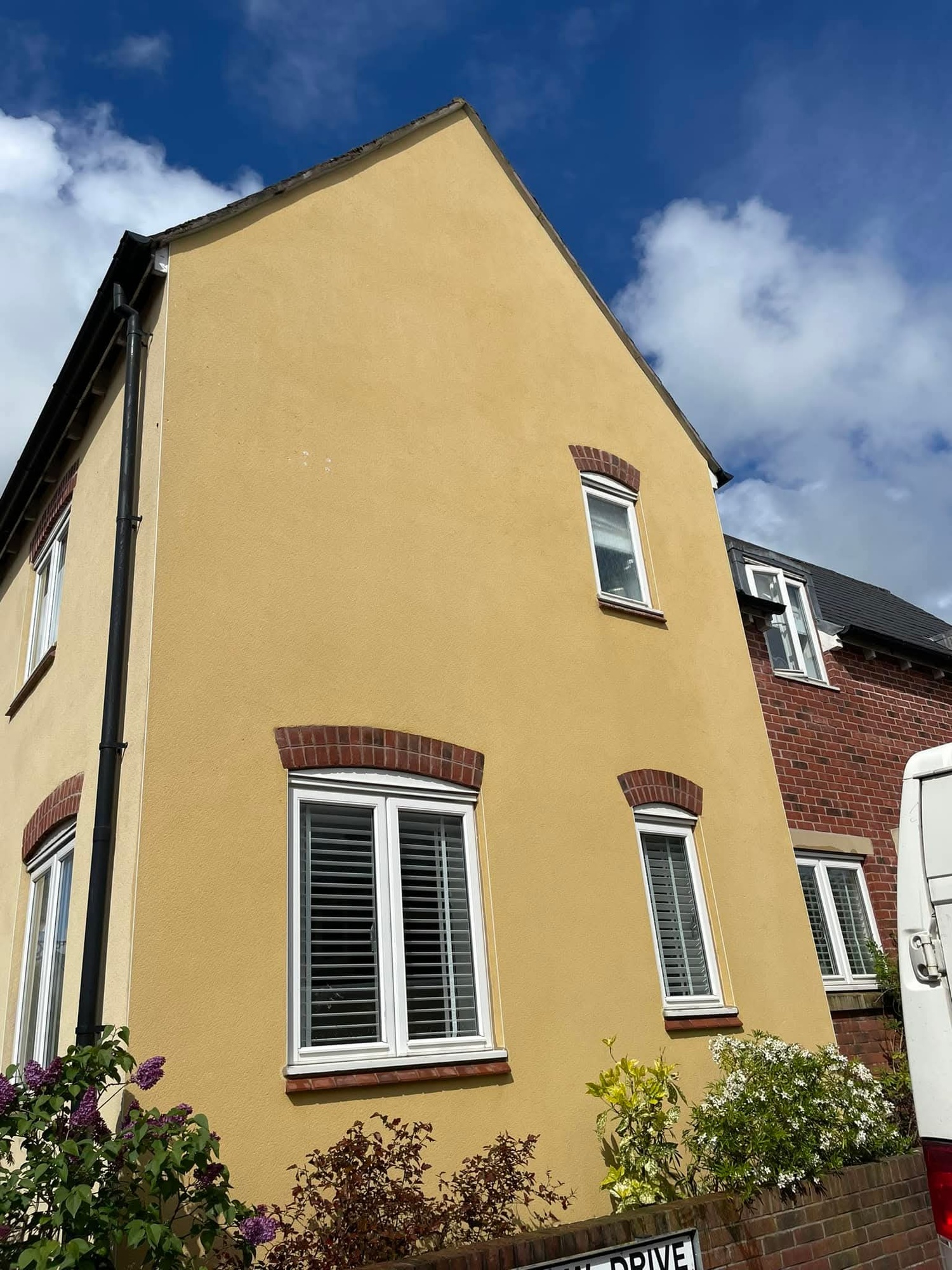
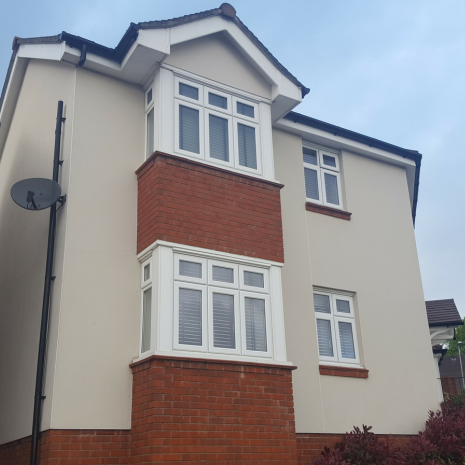

Dwell time is the variable that decides whether a K Rend elevation stays clean, and it is the thing most often cut short. Softwashing UK treat it as the core of the process rather than an inconvenience between application and rinsing. The reason is biological. Algal filming, black fungal spotting and lichen all have structures extending below what is visible, into the texture of the render and into the pores of the surface. A treatment that is applied and rinsed off quickly deals with the exposed part of the colony and leaves the rest intact, which is exactly why so many walls green over again within a single season after being cleaned. Given sufficient dwell, the same treatment penetrates to the root structures and destroys them. Recolonisation then has to begin from nothing, which takes years rather than months. How long is enough depends on what is present. Light algal filming clears comparatively quickly. Black spotting needs longer. Lichen, which bonds physically as well as biologically, needs longer still and often continues weathering off for weeks after the visit. K Rend cleaning specified realistically accounts for that at survey rather than promising immediate perfection. Everything else about silicone render cleaning follows from the same principle. Because chemistry and time are doing the work, pressure never needs to rise, nothing is brushed, and the through-coloured surface is left entirely undisturbed. Coloured render cleaning depends on that restraint, since abrasion on integral pigment cannot be corrected. House render cleaning on a K Rend property should be judged a month after the visit rather than on the afternoon it finished.
Owners frequently ask how often monocouche render should be cleaned, and the honest answer is that it depends far more on the wall than on the calendar. A south-facing elevation with open ground in front of it and good air movement may go five or six years between treatments and still look acceptable. A north-facing wall with mature planting close to it might need attention in half that time. What determines the interval is drying time. Monocouche has an open scraped texture that retains moisture in the profile, and a wall that stays damp is a wall that supports growth. Aspect, shelter, overhanging vegetation and anything that keeps a particular area persistently wet all shorten the cycle. Monocouche render cleaning done correctly lengthens it considerably, because the growth is destroyed at root level rather than removed from view. Treatment is applied in volume at low pressure so it reaches the base of the texture, left to dwell properly, then rinsed gently. Nothing abrasive is used, since the surface aggregate is lightly bound and detaches permanently under brushing or pressure. We give interval advice per elevation rather than per property, because the walls of one house genuinely do behave differently from one another. Sensible render maintenance means treating the wall that needs it rather than the whole building on a fixed rotation. Render restoration on monocouche remains effective across repeated cycles provided the texture has never been damaged, and the mineral pigment beneath is stable enough that residential render cleaning brings a wall back to close to its original tone each time.
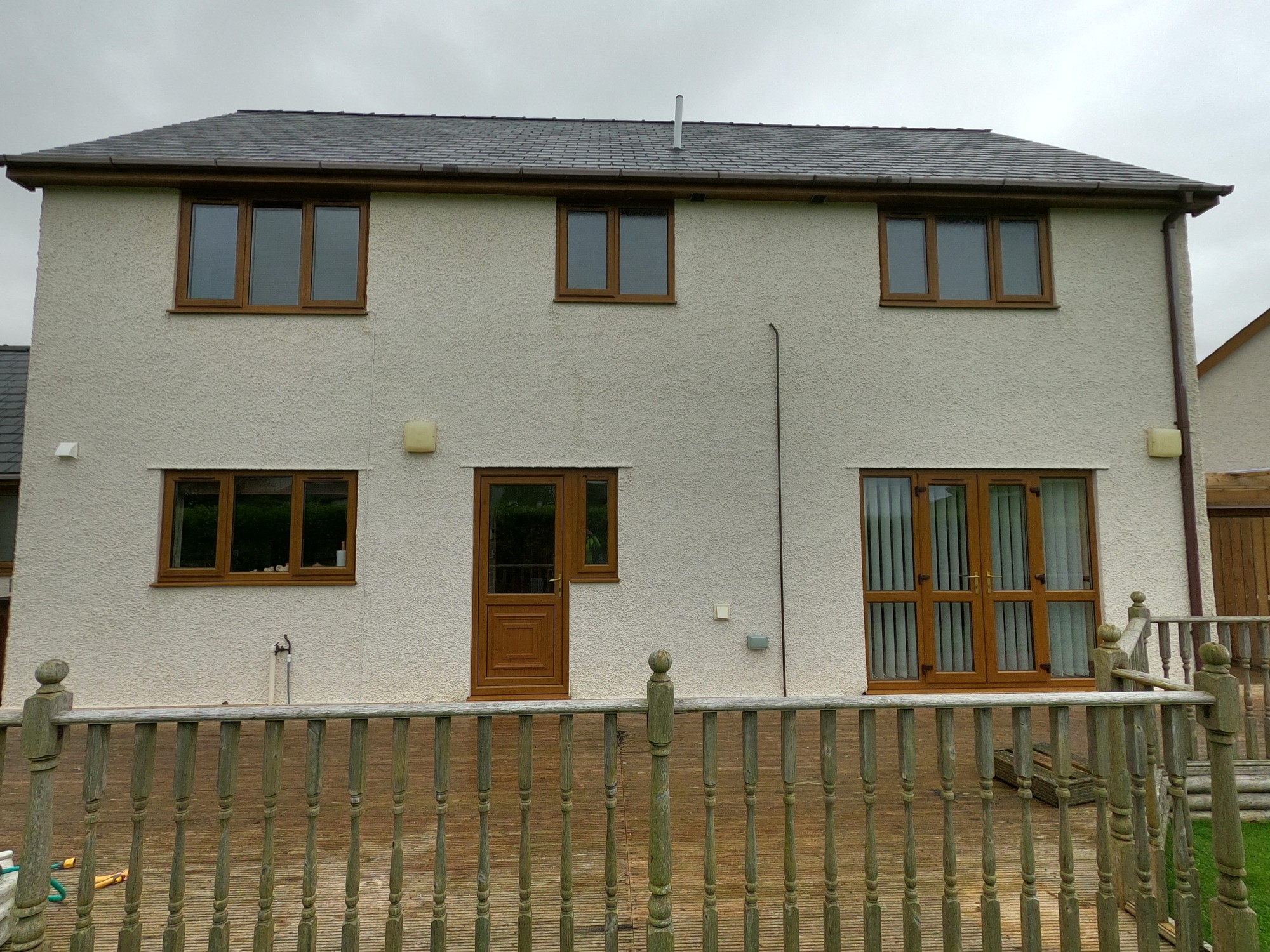
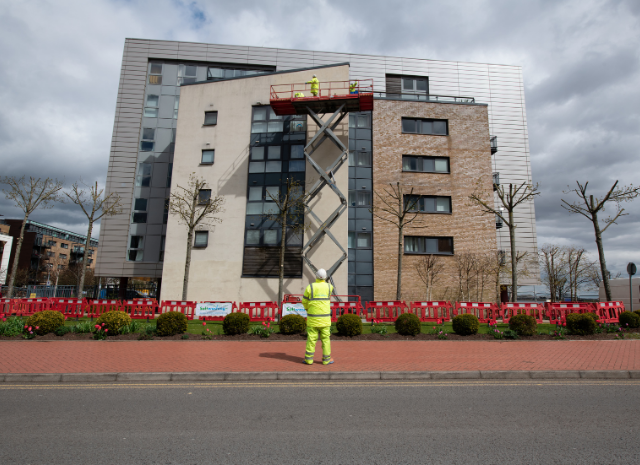

Rural business premises, farm buildings, converted units and agricultural offices with rendered elevations face a harder environment than most. Open exposure, high spore load from surrounding vegetation, dust from vehicle movement and limited shelter combine to soil elevations faster than an equivalent building in a built-up setting. Commercial render cleaning on these properties starts with a survey covering elevation area, height, coating type and access. Ground conditions matter more than usual, since yards, hard standing and approaches vary considerably and determine what equipment can be positioned where. We establish all of that before quoting so that the figure is firm. Operationally the work fits around whatever the site does. Vehicle movements, deliveries and livestock or stock handling all take priority, and we agree working areas and timings that avoid interference. Method statements, risk assessments and insurance documentation are issued ahead of attendance, and operatives hold current working at height certification. Our vehicles carry water and treatment on board and run at length, which is particularly useful on rural sites where a mains connection close to the building may not exist. Elevations can be reached without needing to bring plant across yards or soft ground. Technically, long single-storey elevations need the same consistency as any large wall. Render facade cleaning holds identical dilution and continuous wet edges throughout, because a wall completed across disconnected sessions shows it once dry. For business premises around Bredon, keeping rendered elevations clean is straightforward preventative maintenance. A coating held permanently damp by moss and algae fails sooner, and regular render wall cleaning is far cheaper than bringing forward a full recoat.
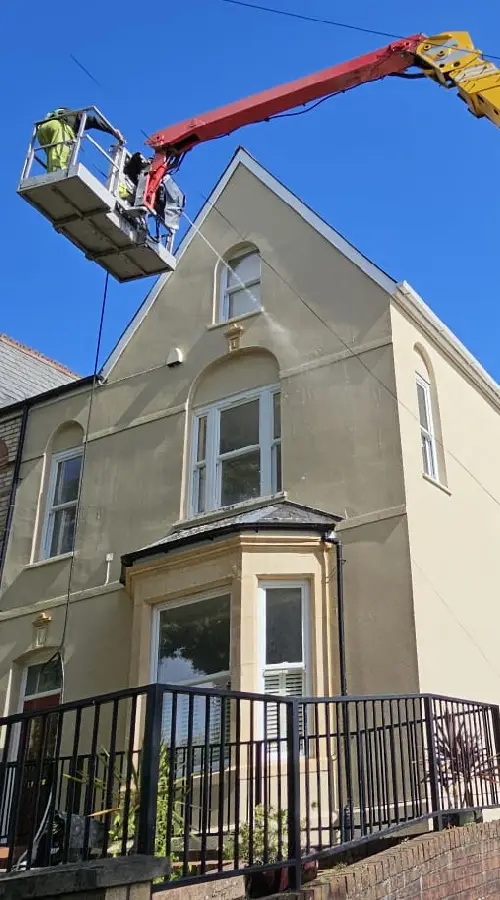
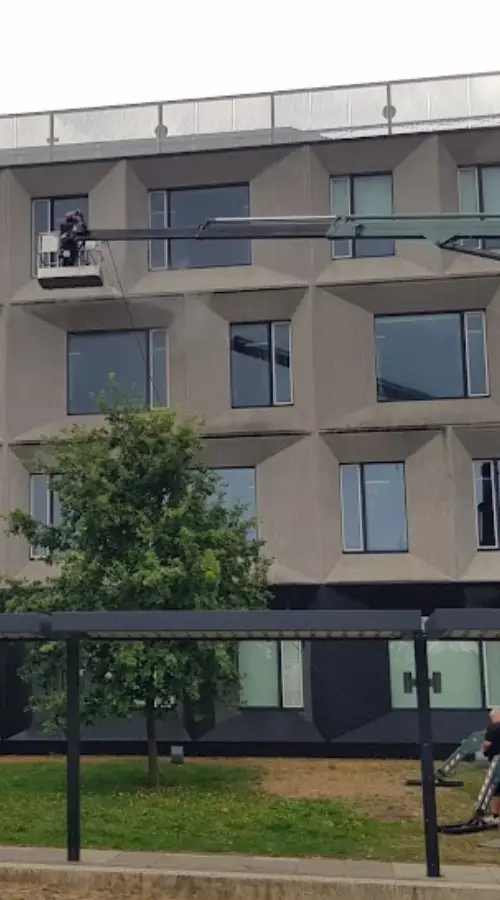
Most rendered elevations that need cleaning have their worst growth well above head height. Shaded gables, the upper sections of two and three storey frontages, and the areas beneath sills at first floor level are all common problem areas, and all of them sit in a working zone where a mistake has serious consequences. Height is therefore the part of this trade we take most seriously. Our operatives hold current certification for working at height, and the equipment is specified to allow treatment from ground level wherever it can be achieved safely. Telescopic delivery reaches the majority of domestic elevations without anyone leaving the ground, which is both safer and faster. Where ground-level work is not possible, we use appropriate access rather than improvising. That cost is identified at survey and included in the quoted figure, so nobody discovers halfway through that reaching the gable was never priced in. Render cleaning prices given by us are complete. Full public liability cover is in place, and it covers the work we actually do rather than a general trade description. Anyone quoting for work at height on your property should be able to produce both certification and cover without hesitation. Professional render cleaning also means recognising when conditions make height work inadvisable. Wind is the main constraint, both for safety and because it disperses treatment before it reaches the wall. We move dates when we need to. As render cleaning specialists working locally, we would rather reschedule a job than complete it in conditions that compromise either the safety of the work or the quality of the result.
Bredon is served in full, and Overbury and Strensham are included on precisely the same terms, with no distinction in pricing, survey process or scheduling. The most useful thing to say about these settlements is that the housing is genuinely mixed in age, and that dictates the approach more than anything else. Older properties frequently carry traditional coatings that have been repaired and painted across many decades. These need careful assessment, because previous work leaves a wall with varying absorbency, and paint that has begun to chalk or lift will not survive a clean regardless of how gently it is carried out. We test and advise honestly, including where the answer is that cleaning is not the right next step. Alongside those sit newer properties and extensions finished in modern through-coloured systems, which behave predictably but permit no abrasion whatsoever. Finding both on one building is entirely normal, and it means one property can require two separate specifications. Properties in Overbury and Strensham are often detached with elevations facing every direction, so exposure varies considerably around a single building. We quote per elevation, which reflects what each wall actually needs rather than averaging across the whole. Access is usually straightforward, and where approaches are narrow or parking is limited our hose runs allow the vehicle to remain clear of the property while treatment still reaches every wall. Bookings are grouped geographically so that travel is shared. Where several properties arrange within the same period, that saving is reflected in the individual quotations. A survey takes around twenty minutes and produces an itemised written figure.
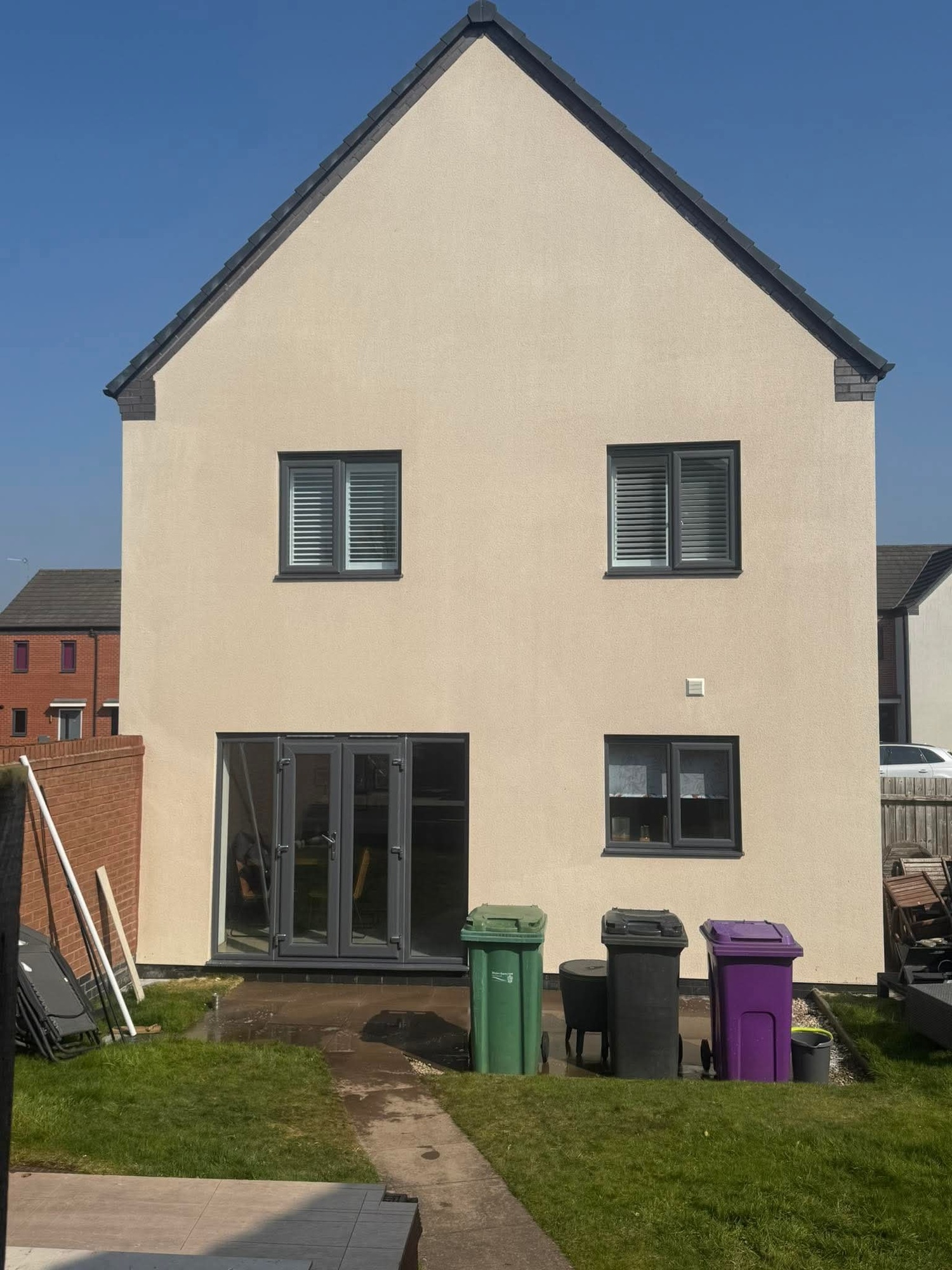
Most properties in Bredon benefit from professional render cleaning every 3 to 5 years, although this depends on the surrounding environment. Properties near trees, woodland, busy roads or coastal areas may require more frequent cleaning due to algae, mould and airborne contaminants. Our soft washing process removes existing growth and helps keep your render cleaner for longer.
Yes. Soft washing is specifically designed for delicate surfaces such as K-Rend, silicone render, monocouche render and painted render. Unlike high-pressure washing, it cleans at low pressure while treating biological growth at its source, reducing the risk of damage to the render finish.
We clean virtually all external render finishes, including K-Rend, Monocouche, Weber, Sto, silicone render, acrylic render, painted render, roughcast and pebble dash. Every cleaning method is tailored to the specific render type to achieve the best possible results.
Yes. Our specialist soft washing treatments are highly effective at removing green algae, red algae, black mould, mildew, lichen and other organic staining. We also apply professional biocide treatments to kill spores and slow down regrowth.
Because our process targets the biological growth rather than simply washing the surface, results typically last much longer than pressure washing alone. The exact lifespan depends on weather conditions, surrounding vegetation and the property’s location.
No. Our soft washing process is specifically designed to clean render safely. We use low-pressure application methods and specialist cleaning solutions that remove contamination without damaging the render surface when carried out by trained professionals.
The UK’s damp climate provides ideal conditions for algae, mould and other biological growth to develop on rendered surfaces. Areas with limited sunlight, nearby trees or persistent moisture are especially susceptible. Professional soft washing safely removes these contaminants and restores your property’s appearance.









































WhatsApp us