Properties within reach of the sea deal with a combination that inland buildings do not: salt carried in the air, persistent humidity, and rain driven horizontally rather than falling. Each of those affects a rendered wall differently, and together they shorten the interval between cleans on almost every exposed property. Salt is the least understood of the three. It settles on a surface, attracts and holds moisture from the air, and keeps a wall damp for far longer than the weather alone would. That damp is exactly what an algal colony needs, which is why an exposed elevation frequently colonises faster than an identical one further inland. Wind-driven rain is the second. It reaches faces that would otherwise stay dry, forces water into any junction, sill or bead not shedding properly, and concentrates soiling on whichever elevation takes the weather. Our render cleaning services allow for that unevenness rather than treating a building as four equal faces. Render algae removal on the exposed side is usually the largest part of such a job, while the sheltered elevations often need very little. Render moss removal is heavier on the sheltered side instead, since those faces stay damp without the wind to dry them. The two sides of a building can be years apart in condition. Professional render cleaning of a house in Burton Bradstock is quoted face by face for that reason, and house render cleaning priced as a single figure for the property will be wrong in both directions. Exterior render cleaning near open water is a job of two halves on the same building. Pricing it as one is where most quotations go wrong.
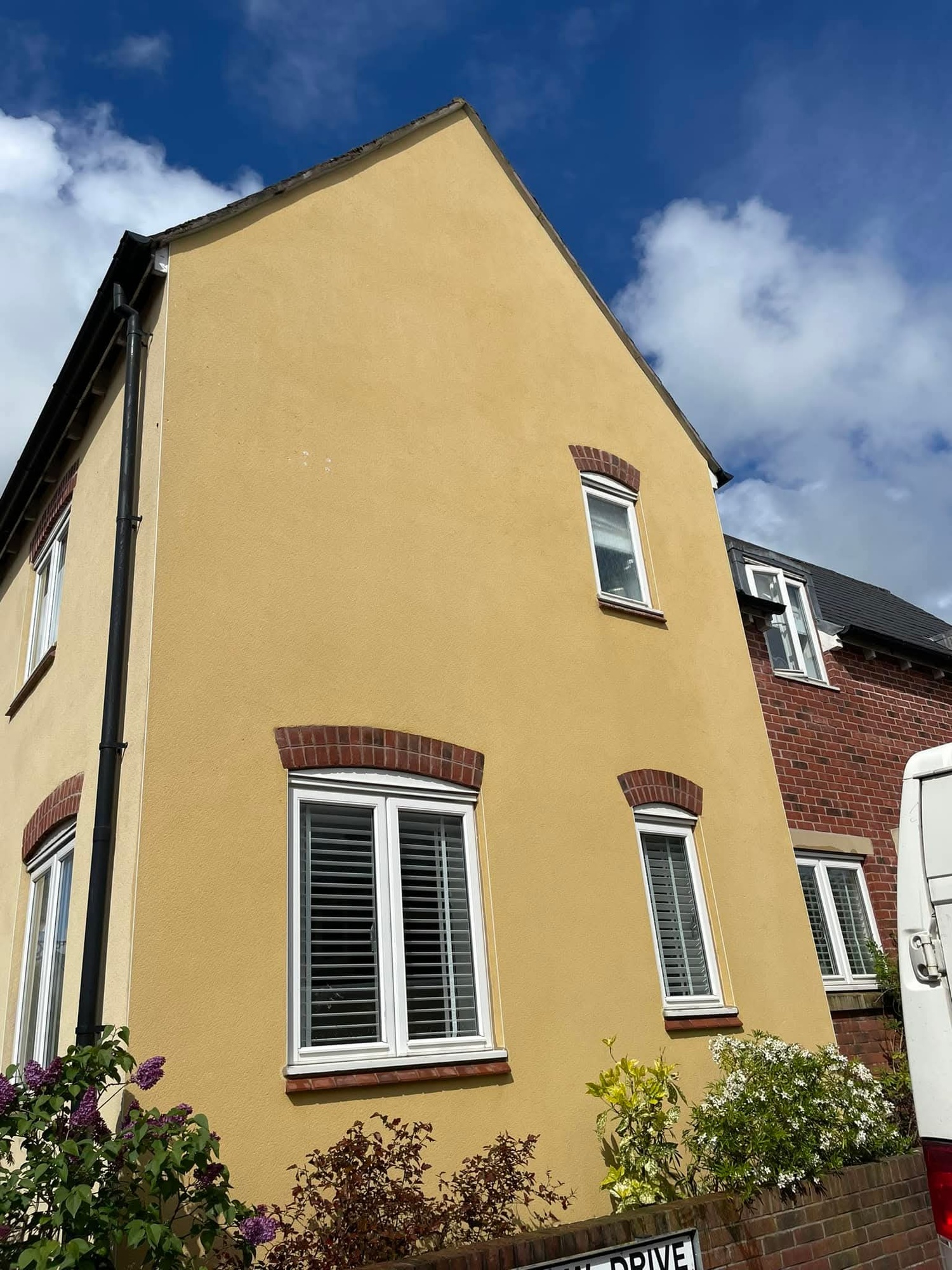
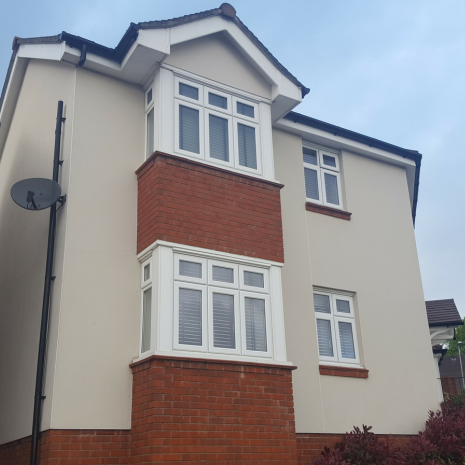

Silicone systems handle exposure better than most finishes, which is part of why they are specified on newer housing in open positions. A hydrophobic surface sheds wind-driven rain rather than absorbing it, and salt sits on the face rather than working into the coating. K Rend cleaning on an exposed property is generally no harder than anywhere else. What does change is the pattern. Growth concentrates heavily on the sheltered elevations, which stay damp without wind to dry them, while the weather side stays comparatively clear despite taking the worst of the conditions. That is the opposite of what most owners expect. Wind dries a wall as effectively as sun does. The method is unchanged. Soft wash render cleaning applies a biocidal solution at a pressure barely above hose flow, dwells long enough to destroy algae and lichen at root level, then rinses with a gentle controlled flow. Nothing mechanical touches the surface, since pigment runs through the material and abrasion removes it permanently. Silicone render cleaning needs generous volume to keep a hydrophobic face wet through the dwell, and on an exposed elevation a breeze shortens that window considerably. Working in wind is the practical constraint. A gusting day makes controlled application impossible and the appointment gets moved rather than attempted. That happens more often on exposed sites than anywhere else. Render stain removal in these positions frequently involves corrosion. Iron bleed from ties, brackets and fixings appears sooner in salt-laden air, along with cement residue at fixing points and dark runs beneath a leaking joint. Each needs a specific product and a test patch, and on a Burton Bradstock property those marks are quoted separately.
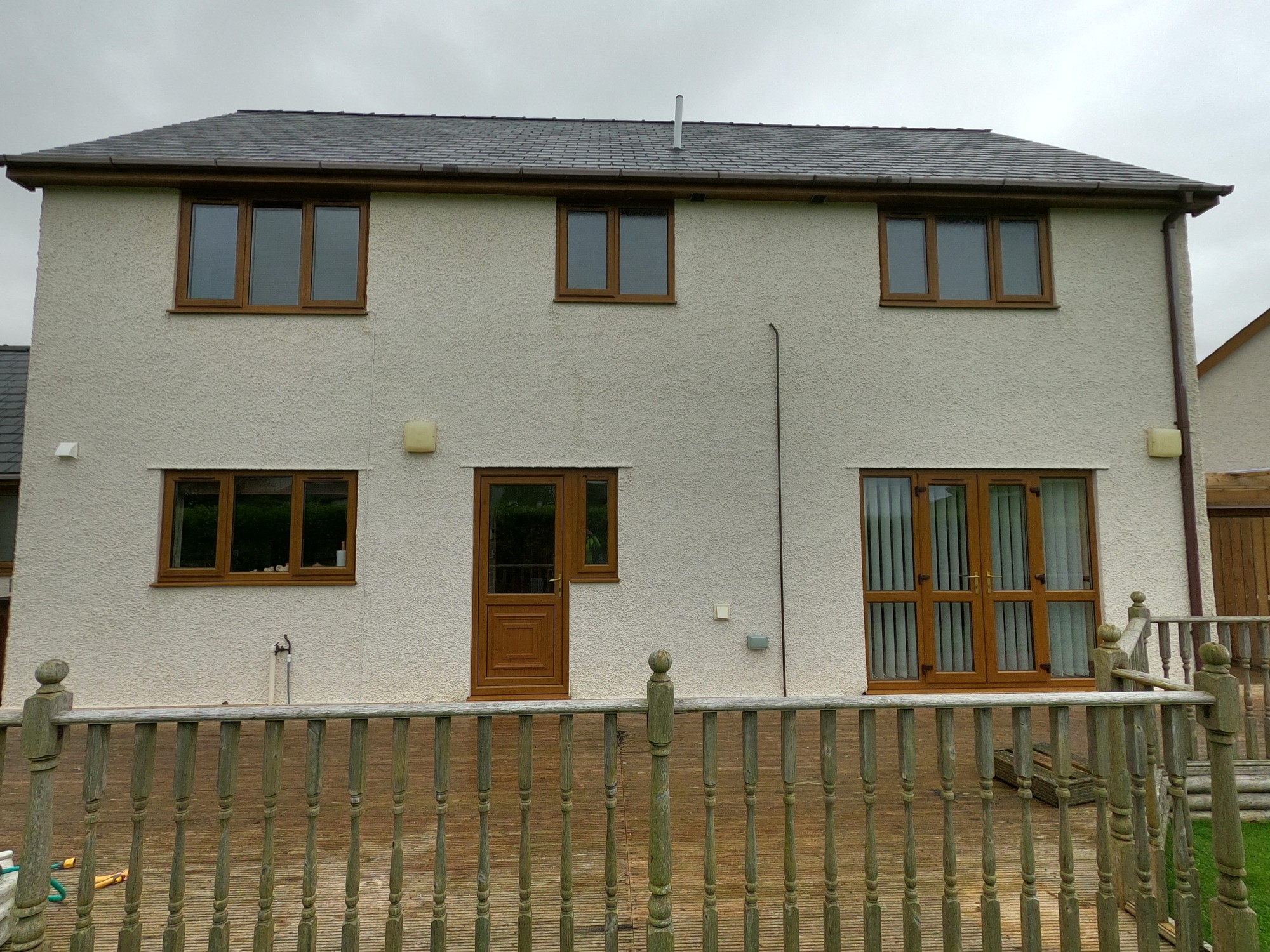
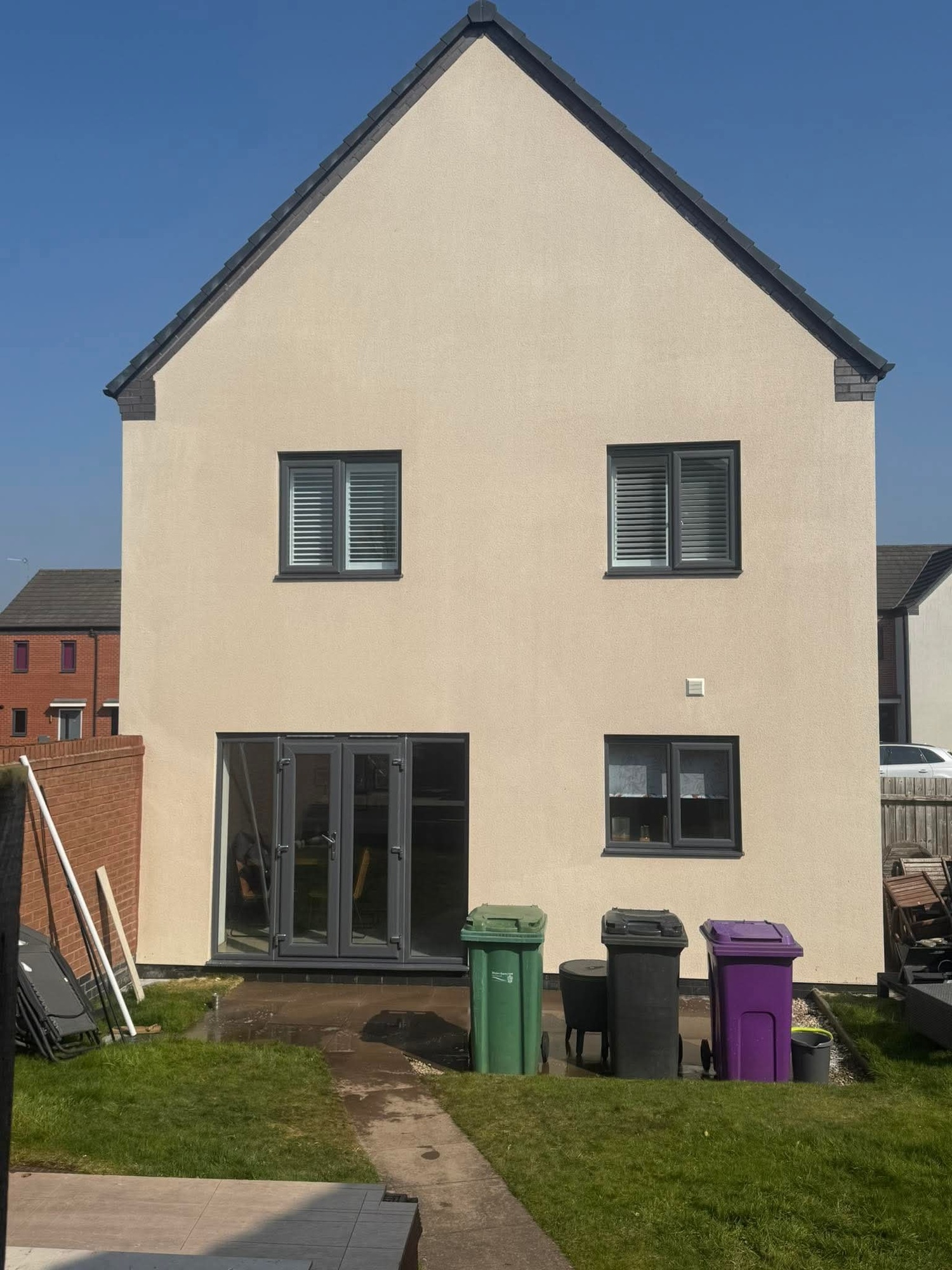
Monocouche on an exposed site takes a harder life than almost anywhere else. The scraped texture catches salt and holds it, wind-driven rain reaches every part of the elevation including the areas that would normally stay sheltered, and the beads at every edge weather faster than they would inland. Monocouche render cleaning on such a property is quoted for more product and a longer dwell than an equivalent building further in. Rinsing matters more too. Salt held within a texture needs to be carried away properly rather than redistributed, so the rinse is generous but still soft, taken evenly across each full face from the top down. Anything left in the texture will hold moisture through the next spell of weather. Render pressure washing is excluded here as everywhere, and the temptation is greater because the deposits are heavier. It flattens the scrape, exposes the paler aggregate beneath and leaves permanent tracking, and coloured render cleaning offers no top coat to renew over any of it. On a coating already working hard against the weather, that damage accelerates everything else. An exposed wall has no capacity to absorb an additional problem. The treatment itself is the standard sequence: solution applied at low pressure in enough volume to soak the texture through, a long dwell to kill growth at root level, a repeat application on the heaviest deposits along copings and projecting bands, then a soft even rinse. Given that, render wall cleaning of monocouche returns an exposed elevation to its specified tone. On buildings around Burton Bradstock where years of weather had darkened the finish, that recovery over the following weeks is a genuine render restoration.
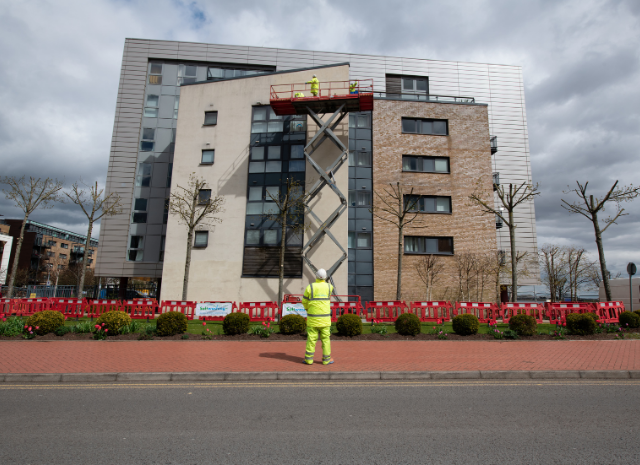

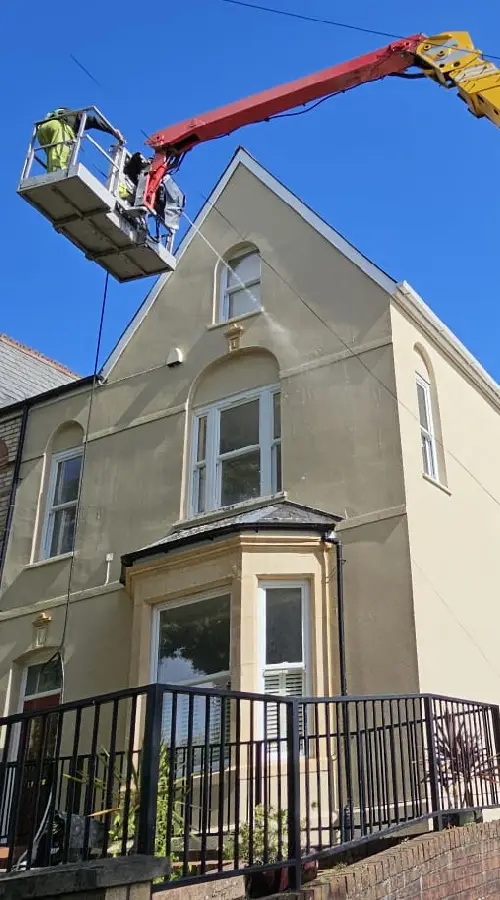
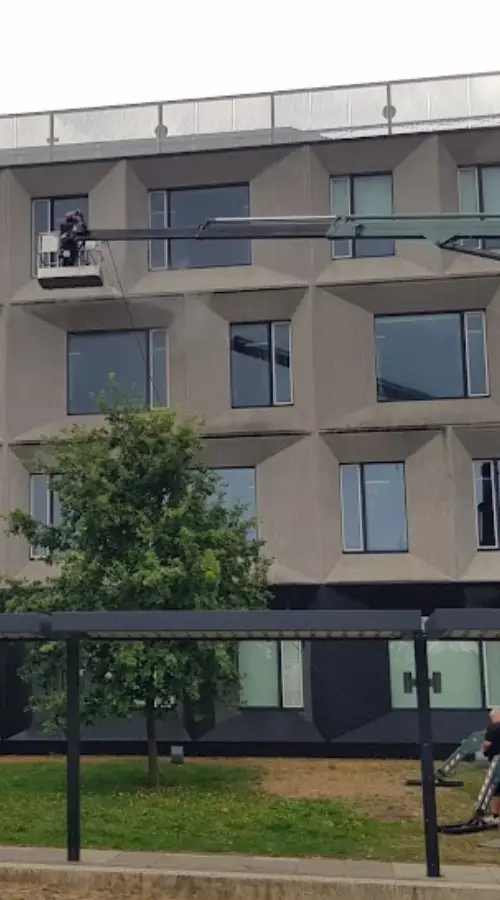
Commercial buildings on exposed sites deteriorate visibly faster, and the elevations that suffer are not always the ones anybody is looking at. A frontage sheltered by its own position can stay presentable for years while a flank taking the weather goes first, and commercial render cleaning has to be scoped from a survey rather than from the approach. Access is the other complication. Wind affects platform work more than any other factor, and a programme on an exposed site needs flexibility in the schedule rather than fixed days. Access is established first — powered platforms, tower scaffold or extended pole systems according to height and standing ground — with the programme written around trading hours, deliveries and staff movement, and method statements and risk assessments issued in advance. Render soft washing is the only workable method in those conditions. Low pressure produces droplets rather than mist, which matters enormously where a breeze would otherwise carry a fine spray across a car park; very low water volumes keep run-off manageable; and coverage stays even along a full flank. Render facade cleaning attempted with pressure equipment in wind reaches places nobody intended. Vehicles and glazing across an open site are the usual casualties. Render mould removal on the sheltered elevations is usually the recurring item rather than on the weather side, which surprises most managers. Those faces set the render maintenance interval for premises in Burton Bradstock, and a shorter cycle on them alone is generally cheaper than treating everything more often. Splitting the intervals is what keeps an exposed building affordable.
Softwashing UK is straightforward about intervals on exposed properties. A building taking the weather will generally need attention sooner than a sheltered one, and saying so at the first visit is more useful than presenting it as a surprise two years later. Render cleaning prices are established at an assessment from elevation count, working height, access arrangements and the extent of the growth on each face, with an expected interval attached. The written render cleaning cost then holds. Affordable render cleaning on an exposed property usually means treating the weather side a little more often rather than the whole building more often, and the quotation is broken down so that can be arranged. Treating one face on a shorter cycle is a legitimate way to control the cost. The crews are render cleaning specialists rather than general exterior cleaners, and on exposed stock that experience shows in what gets checked. Salt-laden surfaces behave differently under treatment, beads and edges weather harder, and recognising an overpainted section or cracking that would carry solution behind a coating matters more where wind-driven rain will find it. Everything used is an eco friendly render cleaning product chosen because it breaks down safely once its work is complete, which matters wherever run-off reaches open ground or drainage heading anywhere sensitive. Anyone comparing firms in search of the best render cleaning service on an exposed property should ask how long the result is expected to hold there specifically. A general answer given for every building is not an answer at all. Exposure varies enormously between properties a few hundred metres apart.
Property that is not permanently occupied accounts for a good share of the residential render cleaning arranged across this patch, and that changes the scheduling more than it changes the work. Holiday lets and second homes at West Bexington and Swyre are usually best treated in a changeover gap or outside the busier months, and since nobody needs to be present the arrangement is straightforward: an unlocked side gate, or agreement with whoever holds a key, is all that is required. A note is left afterwards setting out what was done and what to expect. Litton Cheney and Puncknowle bring more of a mix, with owner-occupied houses alongside let property and the occasional building standing empty between owners. Where a property is empty for a long period the timing is entirely ours to choose, which usually means the work can be fitted around better conditions and better prices for everybody. Quieter weeks in the diary are cheaper weeks to book. Managing agents booking on behalf of an owner are quoted in writing exactly as an owner would be, with the figure and the expected duration set out so it can be passed on without translation. Nothing has to be explained twice. There is no travel charge, no minimum job size and no charge for the assessment, and the assessment can go ahead without anybody present provided the perimeter is reachable. Anyone searching render cleaning near me should expect a local render cleaning company to work around an empty property as readily as an occupied one. Empty properties are frequently the easiest jobs in the diary.
Most properties in Burton Bradstock benefit from professional render cleaning every 3 to 5 years, although this depends on the surrounding environment. Properties near trees, woodland, busy roads or coastal areas may require more frequent cleaning due to algae, mould and airborne contaminants. Our soft washing process removes existing growth and helps keep your render cleaner for longer.
Yes. Soft washing is specifically designed for delicate surfaces such as K-Rend, silicone render, monocouche render and painted render. Unlike high-pressure washing, it cleans at low pressure while treating biological growth at its source, reducing the risk of damage to the render finish.
We clean virtually all external render finishes, including K-Rend, Monocouche, Weber, Sto, silicone render, acrylic render, painted render, roughcast and pebble dash. Every cleaning method is tailored to the specific render type to achieve the best possible results.
Yes. Our specialist soft washing treatments are highly effective at removing green algae, red algae, black mould, mildew, lichen and other organic staining. We also apply professional biocide treatments to kill spores and slow down regrowth.
Because our process targets the biological growth rather than simply washing the surface, results typically last much longer than pressure washing alone. The exact lifespan depends on weather conditions, surrounding vegetation and the property’s location.
No. Our soft washing process is specifically designed to clean render safely. We use low-pressure application methods and specialist cleaning solutions that remove contamination without damaging the render surface when carried out by trained professionals.
The UK’s damp climate provides ideal conditions for algae, mould and other biological growth to develop on rendered surfaces. Areas with limited sunlight, nearby trees or persistent moisture are especially susceptible. Professional soft washing safely removes these contaminants and restores your property’s appearance.











































WhatsApp us