


The word “chemical” can make render cleaning sound far more alarming than it actually is. Homeowners may understandably wonder what is being sprayed onto their property, whether it could damage the render and what happens to nearby plants, windows, lawns and other surfaces.
The reality is more nuanced.
Professional render cleaning chemicals can be extremely effective when the correct product is selected, mixed appropriately and applied by someone who understands the surface being treated. At the same time, cleaning chemicals are not products that should be used carelessly.
The difference between safe professional softwashing and a potentially damaging render clean is often not whether chemicals are used, but how they are used.
At Softwashing UK, render cleaning is approached as a specialist exterior cleaning process. That means considering the type of render, contamination, surrounding surfaces, weather conditions and appropriate treatment rather than simply applying the strongest chemical available.

Why Are Chemicals Used to Clean Render?
Render can develop substantial biological contamination.
Depending on the building and its environment, this can include mould, lichen, black biological staining, green algae and red algae.
These organisms are not necessarily sitting loosely on top of the wall waiting to be rinsed away.
Biological contamination can adhere strongly to the surface and spread across large elevations.
This is why simply blasting render with water is not always the best answer.
Softwashing uses specialist cleaning treatments to target contamination while allowing the cleaning process to operate at significantly lower pressures than aggressive pressure washing.
| Cleaning approach | Basic principle |
|---|---|
| Water alone | Attempts to rinse contamination away |
| High-pressure washing | Uses mechanical force to remove contamination |
| Softwashing | Uses controlled chemical treatment with low-pressure application |
| Manual cleaning | Physical brushing or agitation |
| Specialist stain treatment | Targets a particular type of staining |
Different situations can require different approaches, which is why identifying the contamination is important before treatment begins.
Are Render Cleaning Chemicals Dangerous?
Any professional cleaning chemical needs to be treated with respect.
That does not mean its professional use is automatically dangerous.
Products used within exterior cleaning can have specific handling requirements, recommended concentrations and safety precautions.
The operator needs to understand these requirements.
Sodium hypochlorite, for example, is commonly associated with professional exterior cleaning because of its effectiveness against certain types of organic contamination. However, it is a hazardous chemical in concentrated form and inappropriate exposure can affect the skin and eyes, while incorrect mixing with incompatible substances can create serious risks.
Professional use therefore requires proper controls.
The important distinction is between hazard and risk.
Something can have hazardous properties while the risk is controlled through correct storage, handling, dilution, application, personal protective equipment and working procedures.
What Chemicals Are Used During Softwashing?
There is not necessarily one universal bottle of “render cleaner” suitable for every building.
Professional exterior cleaners can use different formulations depending on what needs treating.
Softwashing frequently involves cleaning solutions designed to tackle organic contamination.
Surfactants may also form part of a professional cleaning process.
A surfactant can help a cleaning solution spread and remain in contact with a surface rather than immediately running away.
The exact cleaning approach should be determined by the surface and contamination rather than assuming that more chemical automatically produces a better clean.
Sodium Hypochlorite and Render Cleaning
Sodium hypochlorite is one of the chemicals commonly discussed in relation to exterior softwashing.
It is an oxidising cleaning agent capable of treating organic contamination on suitable surfaces.
But professional sodium hypochlorite use is very different from someone simply purchasing a strong product and covering their house with it.
Factors that need to be considered include:
- product concentration;
- dilution;
- condition of the render;
- type of contamination;
- surrounding vegetation;
- nearby materials;
- weather;
- dwell time;
- application method;
- rinsing requirements;
- run-off management.
Professional cleaners should also follow relevant product documentation and safety requirements.
Stronger Does Not Mean Better
One of the biggest misconceptions surrounding cleaning chemicals is that increasing their strength will automatically improve the result.
That can be a serious mistake.
The objective should be to use an appropriate treatment for the contamination and surface.
Using unnecessarily strong chemicals can increase the possibility of unwanted effects without providing a corresponding improvement in cleaning performance.
| Approach | Likely professional assessment |
|---|---|
| Correct product at suitable strength | Controlled treatment |
| Weak treatment | May not adequately address contamination |
| Excessively strong treatment | Unnecessary risk |
| Unknown chemical mixture | Potentially dangerous |
| Product incompatible with surface | Risk of damage |
| Correct treatment but poor application | Inconsistent results |
Professional render cleaning is about control rather than brute force.
That applies to chemical strength just as much as it applies to water pressure.
Can Render Cleaning Chemicals Damage Render?
Potentially, yes — if the wrong chemical is used or an appropriate chemical is used incorrectly.
Render is not one universal material.
There are different render systems, coatings, ages and conditions.
A relatively new rendered property in excellent condition presents a different situation from an older building where coatings are already failing or the surface contains cracks and deterioration.
That is why assessment matters.
A professional contractor should consider the substrate before deciding how to treat it.
Test areas can also be useful where there is uncertainty about how a surface will react.
Can Chemicals Damage Windows and Metal?
The rendered wall is not the only consideration.
Properties contain many different materials.
There may be:
- window frames;
- glass;
- aluminium;
- painted surfaces;
- doors;
- gutters;
- downpipes;
- leadwork;
- decorative metal;
- external lighting;
- security equipment.
Cleaning solutions therefore need to be controlled so they do not simply spread indiscriminately around the property.
Some materials can be particularly sensitive to certain chemicals or prolonged exposure.
Protection, controlled application and appropriate rinsing are consequently important parts of professional exterior cleaning.
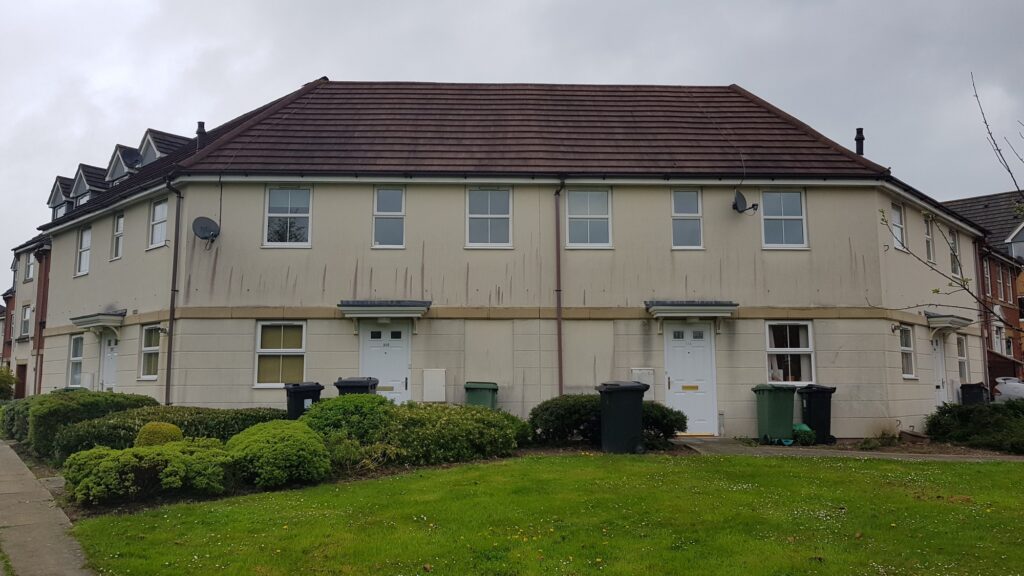
What About Plants and Lawns?
This is one of the most common concerns homeowners have about chemical render cleaning.
A beautifully cleaned house is little consolation if the garden surrounding it has been unnecessarily damaged.
Plants, grass and landscaping therefore need to be considered before work begins.
Depending on the treatment and site conditions, professional precautions can include protecting particularly sensitive areas, wetting vegetation with clean water, controlling overspray and run-off and thoroughly rinsing where required.
| Surrounding area | Why protection matters |
|---|---|
| Lawn | Chemical exposure can potentially damage grass |
| Flower beds | Plants may be sensitive to cleaning products |
| Shrubs | Overspray needs to be controlled |
| Ponds | Chemical contamination must be prevented |
| Garden furniture | May contain sensitive finishes |
| Vehicles | Should be protected from spray and drift |
| Neighbouring property | Overspray must remain controlled |
This is another reason weather matters.
Strong winds can significantly increase spray drift and make controlled chemical application more difficult.
Can Render Cleaning Chemicals Harm Pets?
Pets should be kept away from active cleaning areas and cleaning chemicals.
Professional contractors should establish a controlled working area so occupants, visitors, children and animals are not unnecessarily exposed to cleaning products or equipment.
Homeowners should tell their contractor about pets before work begins, particularly if animals normally have unrestricted access to gardens surrounding the property.
A dog unexpectedly running into a working area is something that can be prevented with basic planning.
Chemical Mixing Is Where Things Can Become Particularly Dangerous
Cleaning chemicals should never be randomly mixed.
This is one area where DIY experimentation can become genuinely hazardous.
Sodium hypochlorite should not be mixed with incompatible products such as acids or ammonia because dangerous gases can potentially be produced.
That means a homeowner should never think:
“If one cleaner works, adding another cleaner must make it stronger.”
It does not work that way.
Professional chemical use involves understanding product compatibility, labels, Safety Data Sheets and correct working procedures.
Unknown combinations should never be improvised.
Why PPE Matters
Personal protective equipment is another important part of professional chemical handling.
Depending on the product and application, appropriate PPE can include gloves, protective clothing and eye protection, with additional protection determined by the relevant risk assessment.
This is not an indication that professionally treated render becomes inherently dangerous.
It reflects the fact that workers handling concentrated cleaning products and repeatedly applying them need suitable protection against occupational exposure.
The same principle exists across countless professional trades.
Is Chemical Cleaning Better Than Pressure Washing?
The answer depends on the surface and what is being removed, but one of the major advantages of softwashing is that the chemical treatment does much of the cleaning work.
This reduces reliance on aggressive mechanical pressure.
Imagine biological contamination across a rendered wall.
One approach is to try to physically blast that contamination away.
Another is to use an appropriate treatment designed to address the organic contamination and then work at much lower pressure.
For delicate rendered surfaces, reducing unnecessary mechanical force can be an important advantage.
Softwashing UK specialises in this lower-pressure approach to exterior cleaning.
Chemicals Need Time to Work
Professional chemical cleaning is not necessarily instantaneous.
Products can require a period of contact with the surface, commonly referred to as dwell time.
Correct dwell time allows the treatment to work against the contamination.
Several things can affect this process.
| Factor | Possible effect |
|---|---|
| Hot render | Solution may dry more rapidly |
| Strong sunshine | Increased evaporation |
| Wind | Faster drying and increased spray drift |
| Heavy rain | Treatment may become diluted or washed away |
| Heavy contamination | May require additional treatment |
| Porous surface | Different absorption behaviour |
| Incorrect concentration | Treatment may perform poorly |
This is why professional render cleaning cannot be reduced to a single chemical recipe.
Chemicals Should Not Be Allowed to Dry Uncontrollably
Applying a treatment and then allowing it to bake onto sensitive surfaces in strong sunshine is not good practice.
Weather and surface temperature need to be monitored.
A rendered wall receiving direct summer sunshine can become substantially warmer than the surrounding air.
That may alter how quickly a treatment dries.
Professional contractors can adjust their working sequence around these conditions rather than blindly applying the same process to every elevation.
What Happens to the Chemicals Afterwards?
The answer depends on the product, surface and cleaning method being used.
Professional cleaners need to consider where cleaning solutions and rinse water are travelling.
Run-off should not simply be ignored.
Nearby drains, ponds, watercourses, soil, plants and neighbouring areas can all require consideration.
Responsible exterior cleaning involves managing the entire process rather than concentrating solely on the appearance of the wall.
Are “Chemical-Free” Render Cleans Better?
The word “chemical-free” can sound reassuring from a marketing perspective, but it does not automatically mean the cleaning method is more appropriate.
If avoiding a suitable cleaning treatment means substantially increasing mechanical pressure, that can create a different set of risks.
The question should therefore not simply be:
“Are chemicals being used?”
A better question is:
“Is the chosen cleaning method appropriate for this particular render?”
Professional exterior cleaning is about balancing effective contamination removal with protection of the substrate and surrounding environment.
Why DIY Chemical Render Cleaning Can Go Wrong
The availability of cleaning products online can make render cleaning appear straightforward.
Buy a chemical, dilute it, spray the wall and rinse it.
In reality, several mistakes can occur.
These include using an inappropriate concentration, failing to identify the surface, mixing incompatible products, allowing chemicals to dry, failing to protect plants, ignoring weather conditions or applying the product through unsuitable equipment.
There is also the issue of access.
Attempting to spray upper-storey elevations from ladders while simultaneously handling chemicals introduces obvious additional hazards.
Hiring a professional Softwashing UK team removes the need for a homeowner to experiment with chemical concentrations, application equipment and difficult access.
Not Every Stain Is Biological
Another reason experience matters is that not every mark on render responds to the same treatment.
A wall may contain several different types of staining simultaneously.
Biological contamination can potentially include mould, lichen, green algae and red algae.
Other marks may come from rust, pollution, water run-off or building defects.
Applying increasingly strong biological cleaning chemicals to a stain that has a completely different cause may achieve very little.
Correct identification comes first.
Why Professional Render Cleaning Costs More Than DIY
Professional render cleaning is not priced solely around the amount of chemical used.
Customers are also paying for specialist knowledge, insurance, equipment, access arrangements, preparation, safety procedures, labour and the ability to recognise potential problems before treatment begins.
A larger or more complicated property can therefore cost considerably more than purchasing a container of DIY cleaner.
| Cost factor | Why it affects the quotation |
|---|---|
| Property size | More surface area requires additional labour and treatment |
| Building height | Access becomes more complicated |
| Heavy contamination | More treatment may be required |
| Difficult access | Specialist equipment may be necessary |
| Sensitive surroundings | Additional protection may be required |
| Commercial premises | Greater planning and site controls may apply |
| Complex render system | More detailed assessment may be necessary |
Softwashing UK should be considered a specialist professional service rather than a budget alternative to DIY cleaning. Paying a premium for experienced render cleaning can be worthwhile when compared with the potential cost of repairing damaged render, replacing affected plants or correcting an unsuccessful clean.
The Safest Chemical Is One Used Properly
There is no sensible reason to pretend professional cleaning chemicals are completely harmless substances.
They require appropriate handling.
Equally, describing all chemical render cleaning as dangerous ignores why these products are used professionally in the first place.
The key factors are selection, concentration, application, protection and control.
A knowledgeable operator understands what the chemical is intended to achieve, how it interacts with the surface and what needs protecting around the working area.
Ask What Is Being Used on Your Property
Homeowners should feel comfortable asking a render cleaning contractor about the process.
A professional company should be able to explain what it intends to achieve and why a particular approach is appropriate.
Questions might cover the type of cleaning treatment, how surrounding vegetation will be protected, whether test areas are required and what happens if weather conditions change.
Vague answers such as “it’s just bleach” or “we use the strongest stuff available” should not inspire confidence.
Professional softwashing is much more controlled than that.
Chemical Strength Is Only One Part of the Equation
Successful render cleaning depends on a combination of factors rather than one magic concentration.
The chemical has to reach the contamination, remain in contact for an appropriate period and be used under suitable conditions.
The render itself must also be capable of receiving the treatment.
This means two properties on the same street do not necessarily require an identical process.
One could have relatively light biological contamination while another has years of heavy staining, shaded elevations and persistent moisture problems.
The professional approach is to assess first and treat second.
For property owners concerned about what is safe to use on their exterior walls, Softwashing UK can assess the render, contamination and surrounding areas before determining an appropriate cleaning method.
Used incorrectly, render cleaning chemicals can cause problems. Used professionally, with the correct controls and understanding of the surface, they can provide an effective way of treating biological contamination without relying on unnecessarily aggressive pressure.
Render Cleaning Chemicals: Safe or Harmful?
The word “chemical” can make render cleaning sound far more alarming than it actually is. Homeowners may understandably wonder what is being sprayed onto their property, whether it could damage the render and what happens to nearby plants, windows, lawns and other surfaces.
The reality is more nuanced.
Professional render cleaning chemicals can be extremely effective when the correct product is selected, mixed appropriately and applied by someone who understands the surface being treated. At the same time, cleaning chemicals are not products that should be used carelessly.
The difference between safe professional softwashing and a potentially damaging render clean is often not whether chemicals are used, but how they are used.
At Softwashing UK, render cleaning is approached as a specialist exterior cleaning process. That means considering the type of render, contamination, surrounding surfaces, weather conditions and appropriate treatment rather than simply applying the strongest chemical available.
Why Are Chemicals Used to Clean Render?
Render can develop substantial biological contamination.
Depending on the building and its environment, this can include mould, lichen, black biological staining, green algae and red algae.
These organisms are not necessarily sitting loosely on top of the wall waiting to be rinsed away.
Biological contamination can adhere strongly to the surface and spread across large elevations.
This is why simply blasting render with water is not always the best answer.
Softwashing uses specialist cleaning treatments to target contamination while allowing the cleaning process to operate at significantly lower pressures than aggressive pressure washing.
| Cleaning approach | Basic principle |
|---|---|
| Water alone | Attempts to rinse contamination away |
| High-pressure washing | Uses mechanical force to remove contamination |
| Softwashing | Uses controlled chemical treatment with low-pressure application |
| Manual cleaning | Physical brushing or agitation |
| Specialist stain treatment | Targets a particular type of staining |
Different situations can require different approaches, which is why identifying the contamination is important before treatment begins.
Are Render Cleaning Chemicals Dangerous?
Any professional cleaning chemical needs to be treated with respect.
That does not mean its professional use is automatically dangerous.
Products used within exterior cleaning can have specific handling requirements, recommended concentrations and safety precautions.
The operator needs to understand these requirements.
Sodium hypochlorite, for example, is commonly associated with professional exterior cleaning because of its effectiveness against certain types of organic contamination. However, it is a hazardous chemical in concentrated form and inappropriate exposure can affect the skin and eyes, while incorrect mixing with incompatible substances can create serious risks.
Professional use therefore requires proper controls.
The important distinction is between hazard and risk.
Something can have hazardous properties while the risk is controlled through correct storage, handling, dilution, application, personal protective equipment and working procedures.
What Chemicals Are Used During Softwashing?
There is not necessarily one universal bottle of “render cleaner” suitable for every building.
Professional exterior cleaners can use different formulations depending on what needs treating.
Softwashing frequently involves cleaning solutions designed to tackle organic contamination.
Surfactants may also form part of a professional cleaning process.
A surfactant can help a cleaning solution spread and remain in contact with a surface rather than immediately running away.
The exact cleaning approach should be determined by the surface and contamination rather than assuming that more chemical automatically produces a better clean.
Sodium Hypochlorite and Render Cleaning
Sodium hypochlorite is one of the chemicals commonly discussed in relation to exterior softwashing.
It is an oxidising cleaning agent capable of treating organic contamination on suitable surfaces.
But professional sodium hypochlorite use is very different from someone simply purchasing a strong product and covering their house with it.
Factors that need to be considered include:
- product concentration;
- dilution;
- condition of the render;
- type of contamination;
- surrounding vegetation;
- nearby materials;
- weather;
- dwell time;
- application method;
- rinsing requirements;
- run-off management.
Professional cleaners should also follow relevant product documentation and safety requirements.
Stronger Does Not Mean Better
One of the biggest misconceptions surrounding cleaning chemicals is that increasing their strength will automatically improve the result.
That can be a serious mistake.
The objective should be to use an appropriate treatment for the contamination and surface.
Using unnecessarily strong chemicals can increase the possibility of unwanted effects without providing a corresponding improvement in cleaning performance.
| Approach | Likely professional assessment |
|---|---|
| Correct product at suitable strength | Controlled treatment |
| Weak treatment | May not adequately address contamination |
| Excessively strong treatment | Unnecessary risk |
| Unknown chemical mixture | Potentially dangerous |
| Product incompatible with surface | Risk of damage |
| Correct treatment but poor application | Inconsistent results |
Professional render cleaning is about control rather than brute force.
That applies to chemical strength just as much as it applies to water pressure.
Can Render Cleaning Chemicals Damage Render?
Potentially, yes — if the wrong chemical is used or an appropriate chemical is used incorrectly.
Render is not one universal material.
There are different render systems, coatings, ages and conditions.
A relatively new rendered property in excellent condition presents a different situation from an older building where coatings are already failing or the surface contains cracks and deterioration.
That is why assessment matters.
A professional contractor should consider the substrate before deciding how to treat it.
Test areas can also be useful where there is uncertainty about how a surface will react.
Can Chemicals Damage Windows and Metal?
The rendered wall is not the only consideration.
Properties contain many different materials.
There may be:
- window frames;
- glass;
- aluminium;
- painted surfaces;
- doors;
- gutters;
- downpipes;
- leadwork;
- decorative metal;
- external lighting;
- security equipment.
Cleaning solutions therefore need to be controlled so they do not simply spread indiscriminately around the property.
Some materials can be particularly sensitive to certain chemicals or prolonged exposure.
Protection, controlled application and appropriate rinsing are consequently important parts of professional exterior cleaning.
What About Plants and Lawns?
This is one of the most common concerns homeowners have about chemical render cleaning.
A beautifully cleaned house is little consolation if the garden surrounding it has been unnecessarily damaged.
Plants, grass and landscaping therefore need to be considered before work begins.
Depending on the treatment and site conditions, professional precautions can include protecting particularly sensitive areas, wetting vegetation with clean water, controlling overspray and run-off and thoroughly rinsing where required.
| Surrounding area | Why protection matters |
|---|---|
| Lawn | Chemical exposure can potentially damage grass |
| Flower beds | Plants may be sensitive to cleaning products |
| Shrubs | Overspray needs to be controlled |
| Ponds | Chemical contamination must be prevented |
| Garden furniture | May contain sensitive finishes |
| Vehicles | Should be protected from spray and drift |
| Neighbouring property | Overspray must remain controlled |
This is another reason weather matters.
Strong winds can significantly increase spray drift and make controlled chemical application more difficult.
Can Render Cleaning Chemicals Harm Pets?
Pets should be kept away from active cleaning areas and cleaning chemicals.
Professional contractors should establish a controlled working area so occupants, visitors, children and animals are not unnecessarily exposed to cleaning products or equipment.
Homeowners should tell their contractor about pets before work begins, particularly if animals normally have unrestricted access to gardens surrounding the property.
A dog unexpectedly running into a working area is something that can be prevented with basic planning.
Chemical Mixing Is Where Things Can Become Particularly Dangerous
Cleaning chemicals should never be randomly mixed.
This is one area where DIY experimentation can become genuinely hazardous.
Sodium hypochlorite should not be mixed with incompatible products such as acids or ammonia because dangerous gases can potentially be produced.
That means a homeowner should never think:
“If one cleaner works, adding another cleaner must make it stronger.”
It does not work that way.
Professional chemical use involves understanding product compatibility, labels, Safety Data Sheets and correct working procedures.
Unknown combinations should never be improvised.
Why PPE Matters
Personal protective equipment is another important part of professional chemical handling.
Depending on the product and application, appropriate PPE can include gloves, protective clothing and eye protection, with additional protection determined by the relevant risk assessment.
This is not an indication that professionally treated render becomes inherently dangerous.
It reflects the fact that workers handling concentrated cleaning products and repeatedly applying them need suitable protection against occupational exposure.
The same principle exists across countless professional trades.
Is Chemical Cleaning Better Than Pressure Washing?
The answer depends on the surface and what is being removed, but one of the major advantages of softwashing is that the chemical treatment does much of the cleaning work.
This reduces reliance on aggressive mechanical pressure.
Imagine biological contamination across a rendered wall.
One approach is to try to physically blast that contamination away.
Another is to use an appropriate treatment designed to address the organic contamination and then work at much lower pressure.
For delicate rendered surfaces, reducing unnecessary mechanical force can be an important advantage.
Softwashing UK specialises in this lower-pressure approach to exterior cleaning.
Chemicals Need Time to Work
Professional chemical cleaning is not necessarily instantaneous.
Products can require a period of contact with the surface, commonly referred to as dwell time.
Correct dwell time allows the treatment to work against the contamination.
Several things can affect this process.
| Factor | Possible effect |
|---|---|
| Hot render | Solution may dry more rapidly |
| Strong sunshine | Increased evaporation |
| Wind | Faster drying and increased spray drift |
| Heavy rain | Treatment may become diluted or washed away |
| Heavy contamination | May require additional treatment |
| Porous surface | Different absorption behaviour |
| Incorrect concentration | Treatment may perform poorly |
This is why professional render cleaning cannot be reduced to a single chemical recipe.
Chemicals Should Not Be Allowed to Dry Uncontrollably
Applying a treatment and then allowing it to bake onto sensitive surfaces in strong sunshine is not good practice.
Weather and surface temperature need to be monitored.
A rendered wall receiving direct summer sunshine can become substantially warmer than the surrounding air.
That may alter how quickly a treatment dries.
Professional contractors can adjust their working sequence around these conditions rather than blindly applying the same process to every elevation.
What Happens to the Chemicals Afterwards?
The answer depends on the product, surface and cleaning method being used.
Professional cleaners need to consider where cleaning solutions and rinse water are travelling.
Run-off should not simply be ignored.
Nearby drains, ponds, watercourses, soil, plants and neighbouring areas can all require consideration.
Responsible exterior cleaning involves managing the entire process rather than concentrating solely on the appearance of the wall.
Are “Chemical-Free” Render Cleans Better?
The word “chemical-free” can sound reassuring from a marketing perspective, but it does not automatically mean the cleaning method is more appropriate.
If avoiding a suitable cleaning treatment means substantially increasing mechanical pressure, that can create a different set of risks.
The question should therefore not simply be:
“Are chemicals being used?”
A better question is:
“Is the chosen cleaning method appropriate for this particular render?”
Professional exterior cleaning is about balancing effective contamination removal with protection of the substrate and surrounding environment.
Why DIY Chemical Render Cleaning Can Go Wrong
The availability of cleaning products online can make render cleaning appear straightforward.
Buy a chemical, dilute it, spray the wall and rinse it.
In reality, several mistakes can occur.
These include using an inappropriate concentration, failing to identify the surface, mixing incompatible products, allowing chemicals to dry, failing to protect plants, ignoring weather conditions or applying the product through unsuitable equipment.
There is also the issue of access.
Attempting to spray upper-storey elevations from ladders while simultaneously handling chemicals introduces obvious additional hazards.
Hiring a professional Softwashing UK team removes the need for a homeowner to experiment with chemical concentrations, application equipment and difficult access.
Not Every Stain Is Biological
Another reason experience matters is that not every mark on render responds to the same treatment.
A wall may contain several different types of staining simultaneously.
Biological contamination can potentially include mould, lichen, green algae and red algae.
Other marks may come from rust, pollution, water run-off or building defects.
Applying increasingly strong biological cleaning chemicals to a stain that has a completely different cause may achieve very little.
Correct identification comes first.
Why Professional Render Cleaning Costs More Than DIY
Professional render cleaning is not priced solely around the amount of chemical used.
Customers are also paying for specialist knowledge, insurance, equipment, access arrangements, preparation, safety procedures, labour and the ability to recognise potential problems before treatment begins.
A larger or more complicated property can therefore cost considerably more than purchasing a container of DIY cleaner.
| Cost factor | Why it affects the quotation |
|---|---|
| Property size | More surface area requires additional labour and treatment |
| Building height | Access becomes more complicated |
| Heavy contamination | More treatment may be required |
| Difficult access | Specialist equipment may be necessary |
| Sensitive surroundings | Additional protection may be required |
| Commercial premises | Greater planning and site controls may apply |
| Complex render system | More detailed assessment may be necessary |
Softwashing UK should be considered a specialist professional service rather than a budget alternative to DIY cleaning. Paying a premium for experienced render cleaning can be worthwhile when compared with the potential cost of repairing damaged render, replacing affected plants or correcting an unsuccessful clean.
The Safest Chemical Is One Used Properly
There is no sensible reason to pretend professional cleaning chemicals are completely harmless substances.
They require appropriate handling.
Equally, describing all chemical render cleaning as dangerous ignores why these products are used professionally in the first place.
The key factors are selection, concentration, application, protection and control.
A knowledgeable operator understands what the chemical is intended to achieve, how it interacts with the surface and what needs protecting around the working area.
Ask What Is Being Used on Your Property
Homeowners should feel comfortable asking a render cleaning contractor about the process.
A professional company should be able to explain what it intends to achieve and why a particular approach is appropriate.
Questions might cover the type of cleaning treatment, how surrounding vegetation will be protected, whether test areas are required and what happens if weather conditions change.
Vague answers such as “it’s just bleach” or “we use the strongest stuff available” should not inspire confidence.
Professional softwashing is much more controlled than that.
Chemical Strength Is Only One Part of the Equation
Successful render cleaning depends on a combination of factors rather than one magic concentration.
The chemical has to reach the contamination, remain in contact for an appropriate period and be used under suitable conditions.
The render itself must also be capable of receiving the treatment.
This means two properties on the same street do not necessarily require an identical process.
One could have relatively light biological contamination while another has years of heavy staining, shaded elevations and persistent moisture problems.
The professional approach is to assess first and treat second.
For property owners concerned about what is safe to use on their exterior walls, Softwashing UK can assess the render, contamination and surrounding areas before determining an appropriate cleaning method.
Used incorrectly, render cleaning chemicals can cause problems. Used professionally, with the correct controls and understanding of the surface, they can provide an effective way of treating biological contamination without relying on unnecessarily aggressive pressure.