Not everything on a dirty rendered wall is alive, and separating the two kinds of soiling is what determines whether a clean finishes properly or stops halfway. The biological part is familiar enough: algal filming, black fungal spotting, lichen and moss, all responding to biocidal treatment given sufficient dwell time. The non-biological part is less discussed and frequently more stubborn. Airborne particulate settles on any exposed surface and works into a textured face, where rain then carries it downward in concentrated lines. Traffic film does the same thing at greater density on elevations facing a road. Dust from surrounding land, agricultural or otherwise, adds to the loading. Splashback at low level drives grit and soil into the base course, and metal fixings can bleed rust into the surrounding render. None of that responds to biocide, because there is nothing living to kill. Applying a standard treatment to an elevation carrying heavy atmospheric soiling clears the green and leaves the grey, which reasonably strikes the owner as a job half done. Our render cleaning services identify both types at survey and specify for both. Render stain removal uses appropriate chemistry applied to the affected areas, always at the same low pressures used everywhere else, and it is carried out within a full-elevation treatment so no cleaner band is left where a stain was addressed in isolation. Render algae removal handles the living part alongside it. Exterior render cleaning on a property in Church Lench that sits near a road or open ground almost always needs both, and quoting for only one is how expectations get missed.
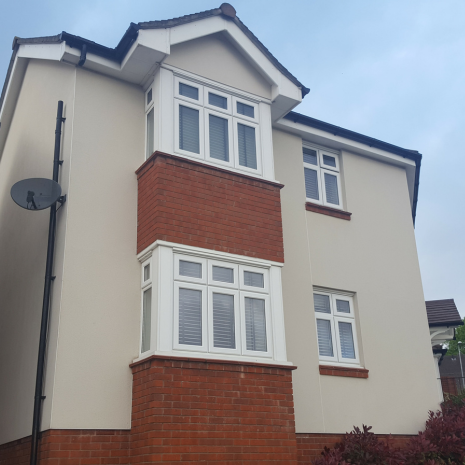

Rain does not fall evenly onto a wall, and understanding where it goes explains most of the staining on a silicone render elevation. Water is shed from projecting details and concentrated into lines. It runs from the ends of sills, from bead terminations, from the edges of openings and from any point where a surface above discharges onto the render below. Wherever it travels repeatedly, it carries whatever it has picked up with it and deposits some of that along the route. The visible result is tracking: darker vertical lines running down an otherwise uniform wall, usually starting at a specific detail and fading as they descend. On pale K Rend finishes this is one of the most common complaints, and it is frequently mistaken for biological growth. It is not, and treating it as such achieves very little. K Rend cleaning at our specification identifies tracking separately at survey and addresses it with appropriate chemistry, applied at the same very low pressures used across the rest of the elevation. Render stain removal of this kind has to be integrated into a full-elevation treatment rather than carried out in isolation. Working a stained strip on its own leaves a visibly cleaner band down a coloured wall, which replaces one problem with another. Alongside it, silicone render cleaning handles the biological colonisation present, usually algal filming and black spotting, at strengths judged for each. Coloured render cleaning depends on even coverage throughout, since integral pigment records any inconsistency permanently. House render cleaning that resolves tracking as well as growth is what leaves an elevation genuinely uniform rather than merely green-free.
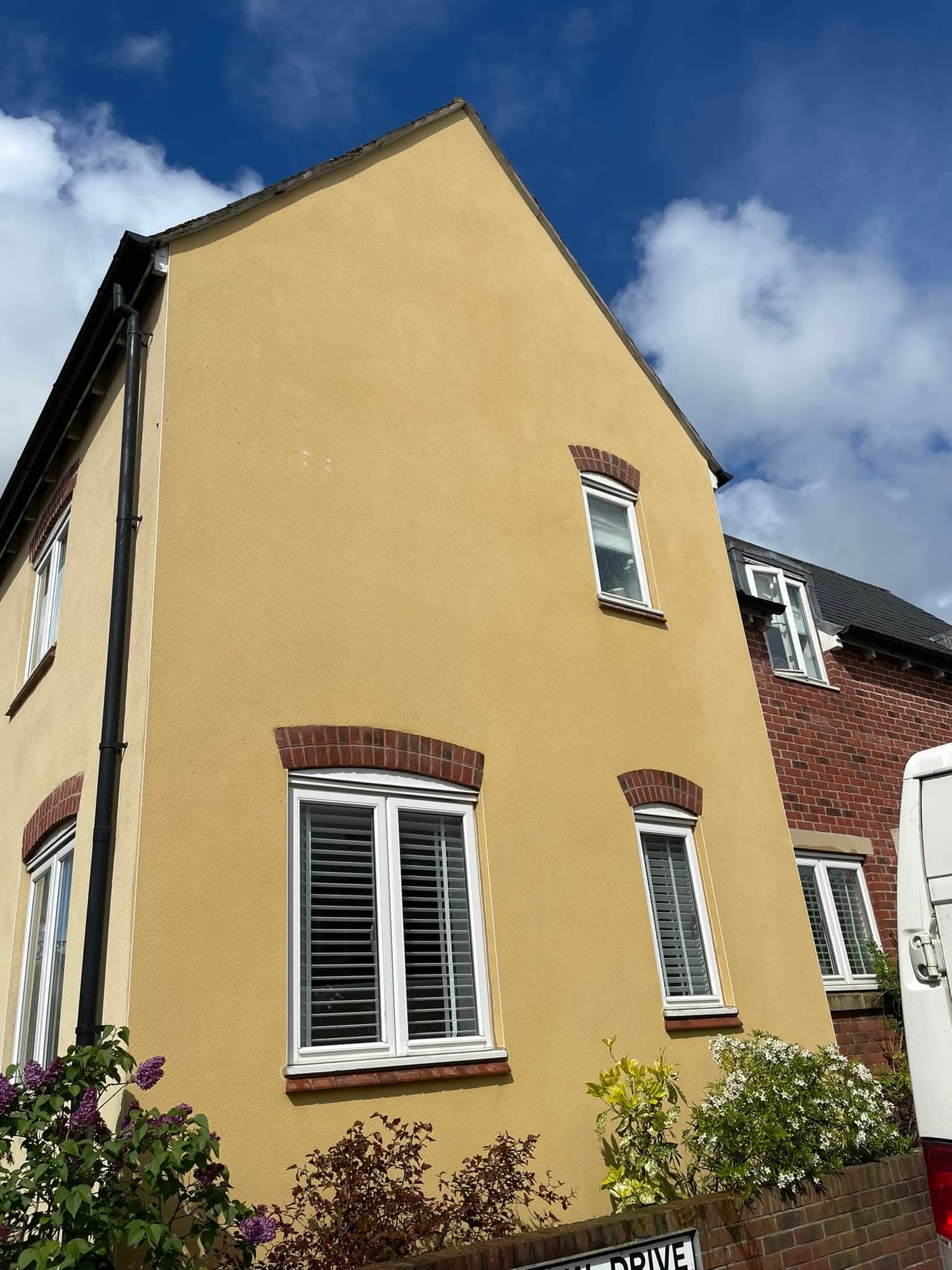
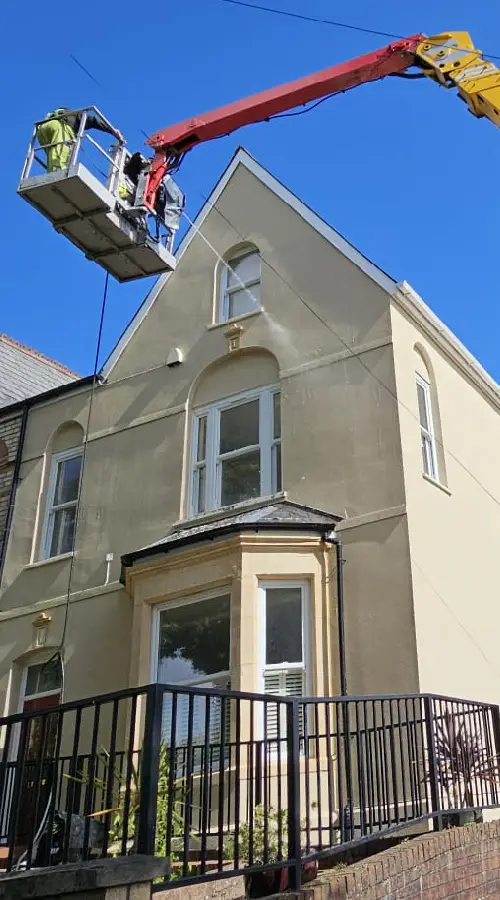
Large gables are where most of the difficulty on a monocouche property sits, and it is worth explaining why. They are tall, often reaching well above two storeys at the apex. They are frequently the most shaded elevation on the building. They usually have no openings to break up the surface, so any inconsistency in treatment is fully exposed. And they are the hardest part of the wall to reach. Those four things compound. A gable that colonises heavily because it is shaded also has to be treated in a single continuous pass because it is one uninterrupted surface, and it has to be reached properly at height for that to be possible. Monocouche render cleaning on gables therefore starts with access. Telescopic delivery reaches most domestic apexes from ground level, which is safer, faster and cheaper than the alternatives, and it allows the whole elevation to be worked without a break. Where reach is genuinely insufficient, appropriate access is identified at survey and included in the figure rather than raised afterwards. The treatment itself follows the same principles as anywhere on the finish. Applied at low pressure and in volume so it flows into the depth of the scraped texture, given a full dwell period, then rinsed gently with nothing brushed or agitated at any point. Consistency matters most here. Working a gable in sections that dry at different rates leaves banding across the largest unbroken surface on the building, which is exactly where it shows. Render restoration on a properly treated gable is often the most striking part of the job, and residential render cleaning that gets it right transforms how the whole property reads.
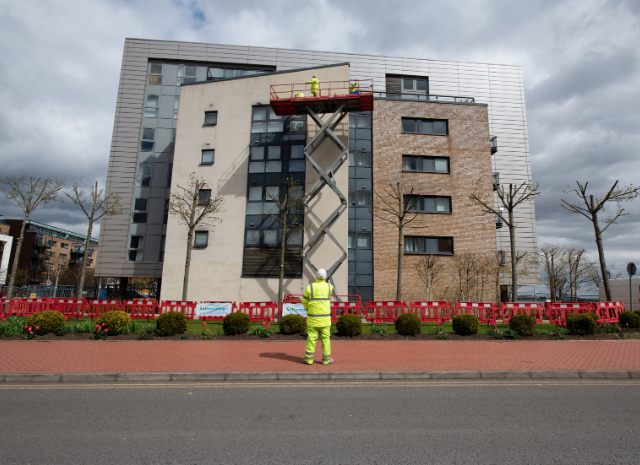

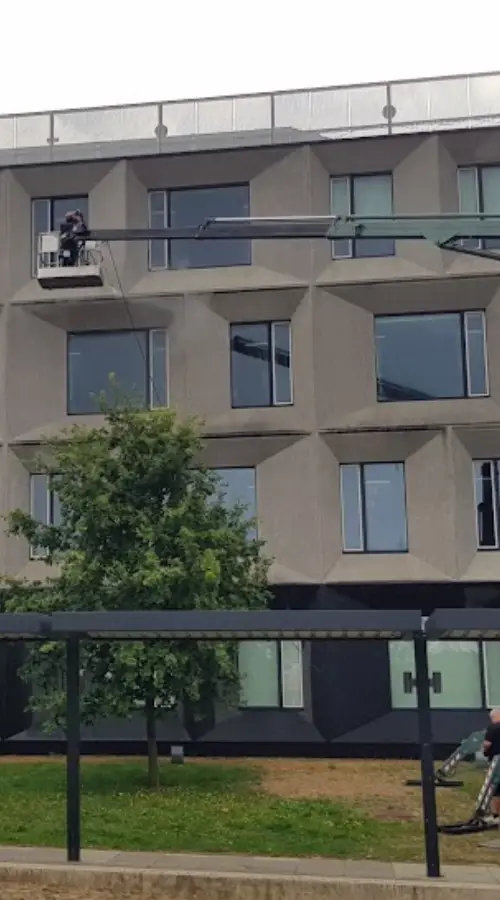
Sports facilities, leisure centres and clubhouses with rendered elevations combine high visibility with genuinely awkward scheduling. The buildings are used across long hours, often including evenings and weekends when a commercial site would be empty, and there is usually outdoor activity happening immediately alongside the walls that need treating. Softwashing UK plan commercial render cleaning on these sites around the fixture and booking calendar rather than around a standard working week. We survey first, identify which elevations sit alongside active areas, and agree a programme that keeps work away from anything in use. Where a facility has a genuine quiet period, that is usually where the job goes. Exclusion zones are agreed and signed, pedestrian routes stay clear, and anything at ground level within the working area is protected or moved. The low pressure method helps considerably, since there is little noise and no drifting spray across pitches, courts or car parks. Documentation is issued ahead of attendance as standard, covering insurance, method statements and risk assessments, and all operatives hold current working at height certification. Where safeguarding checks apply because of junior use, those are completed before we attend. Technically, these buildings often present long low elevations rather than tall ones, and consistency across a continuous run is the priority. Soft wash render cleaning maintains identical dilution and live wet edges throughout, because banding on a long horizontal wall is particularly obvious. For facilities around Church Lench, a planned cycle keeps the building presentable through the year, and keeping the coating dry defers recoating on what is usually a very substantial area of render.
The most useful question to ask about a render clean is not what it costs but how long it lasts, because the two together are what actually determine value. A cheap clean that greens over within eighteen months is expensive on any reasonable arithmetic. A properly specified treatment that holds for four or five years costs more on the day and considerably less across a decade, and it does so without progressively damaging the coating in the way repeated aggressive cleaning does. The variable is method. Growth on render is a living colony with structures extending into the texture, and a treatment that removes only the visible layer leaves the base in place to regenerate. Dwell-based soft washing destroys colonies at root level, so recolonisation has to begin again from airborne spores landing on a sterile surface. That is what we quote for. Render cleaning cost here reflects a specification written against the organisms actually present on each elevation, with dilution and dwell set to clear them properly rather than to finish quickly. Affordable render cleaning means paying once for a result that holds rather than repeatedly for one that does not. We give honest interval advice as part of the quotation, per elevation rather than per property, since a shaded gable and a sunny frontage genuinely do behave differently. Where a wall will not need attention for several years we say so. As a local render cleaning company we are not chasing volume through repeat visits that properties do not need. The best render cleaning service is the one you use less often, and our render cleaning prices are set on that basis.
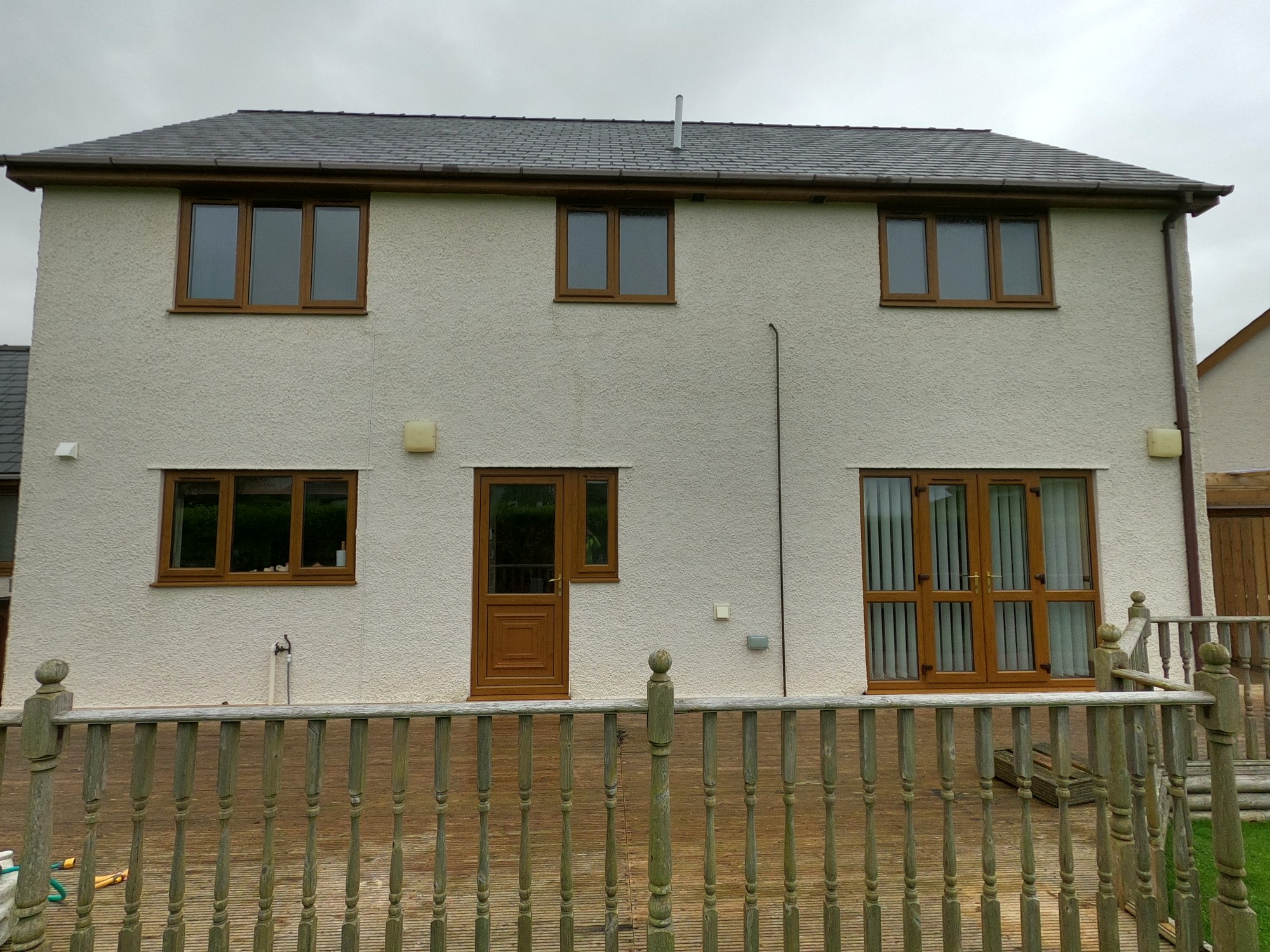
Coverage extends across Church Lench and takes in Ab Lench and Abberton on identical terms, with the same survey process and no travel loading applied. Growing conditions are the most useful thing to understand about rendered properties in settlements of this kind. Organic colonisation needs three things: moisture retained on the surface, limited air movement, and a supply of spores. Properties surrounded by mature planting, hedging, established gardens or open agricultural land have all three in greater measure than a building on an exposed frontage, and their walls reflect it. The pattern is consistent. Elevations facing north or east, or those sheltered by trees close to the building, hold damp for far longer after rain and carry noticeably heavier growth. Walls facing open ground upwind receive a higher spore load. Where both apply to the same elevation, that wall will usually need the strongest specification on the property while the others need comparatively little. We survey and price per elevation for exactly that reason. Applying one rate across a whole building either overcharges for the walls that need little or underspecifies the one that needs most, and neither serves the owner well. Properties in Ab Lench and Abberton are generally individual rather than uniform, so nothing carries over from one job to the next and every quotation is built from what is actually on the wall. Access is rarely a constraint. Hose runs allow the vehicle to remain on hard standing or at the roadside while treatment reaches every elevation, and telescopic delivery covers most domestic walls from ground level. Surveys take around twenty minutes and produce an itemised written figure by email.
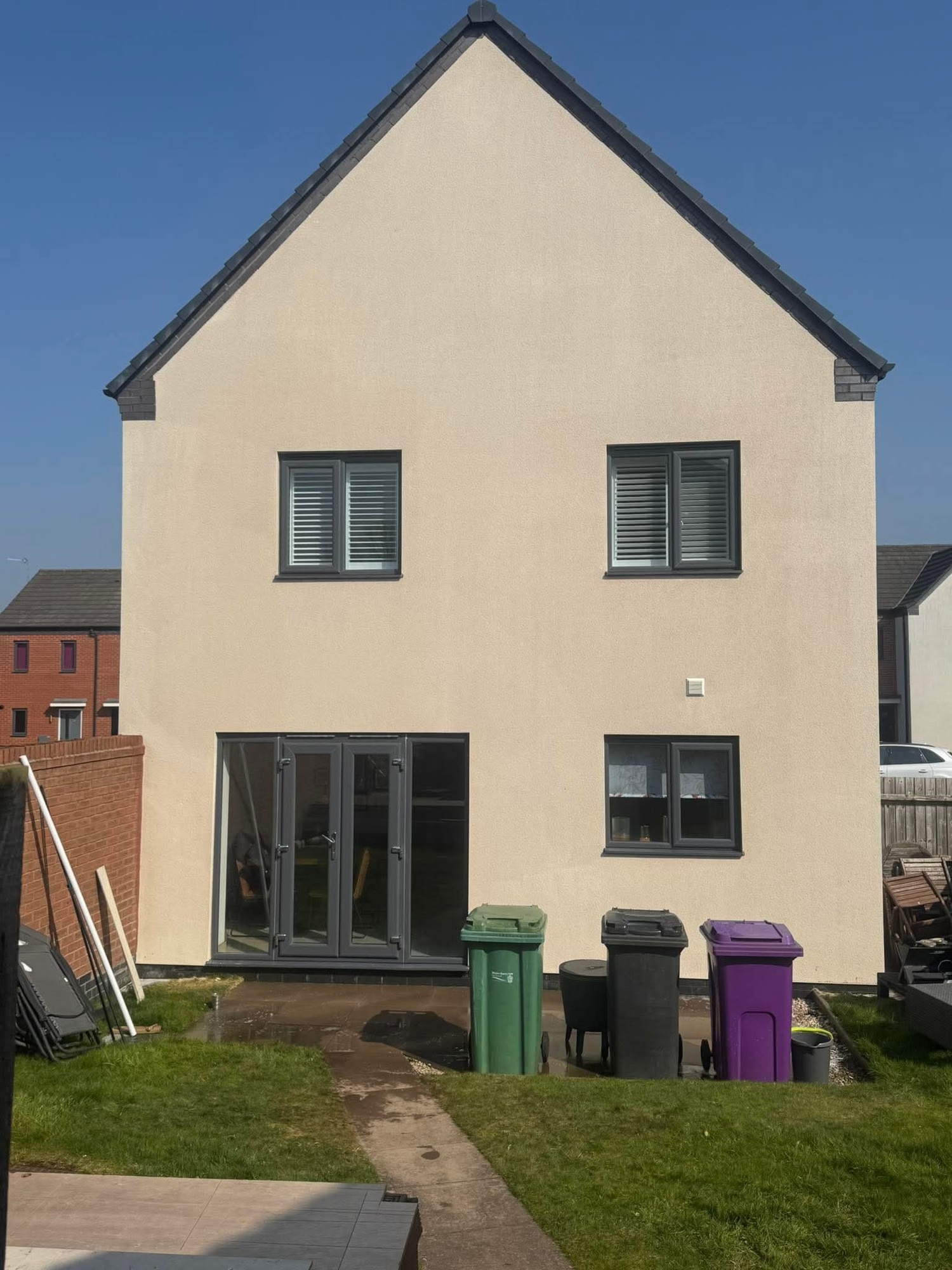
Most properties in Church Lench benefit from professional render cleaning every 3 to 5 years, although this depends on the surrounding environment. Properties near trees, woodland, busy roads or coastal areas may require more frequent cleaning due to algae, mould and airborne contaminants. Our soft washing process removes existing growth and helps keep your render cleaner for longer.
Yes. Soft washing is specifically designed for delicate surfaces such as K-Rend, silicone render, monocouche render and painted render. Unlike high-pressure washing, it cleans at low pressure while treating biological growth at its source, reducing the risk of damage to the render finish.
We clean virtually all external render finishes, including K-Rend, Monocouche, Weber, Sto, silicone render, acrylic render, painted render, roughcast and pebble dash. Every cleaning method is tailored to the specific render type to achieve the best possible results.
Yes. Our specialist soft washing treatments are highly effective at removing green algae, red algae, black mould, mildew, lichen and other organic staining. We also apply professional biocide treatments to kill spores and slow down regrowth.
Because our process targets the biological growth rather than simply washing the surface, results typically last much longer than pressure washing alone. The exact lifespan depends on weather conditions, surrounding vegetation and the property’s location.
No. Our soft washing process is specifically designed to clean render safely. We use low-pressure application methods and specialist cleaning solutions that remove contamination without damaging the render surface when carried out by trained professionals.
The UK’s damp climate provides ideal conditions for algae, mould and other biological growth to develop on rendered surfaces. Areas with limited sunlight, nearby trees or persistent moisture are especially susceptible. Professional soft washing safely removes these contaminants and restores your property’s appearance.











































WhatsApp us