External wall insulation systems finished in render need particular care, and they are far more common than most people realise. Where a property has been upgraded thermally, the render is not applied directly to blockwork but to an insulation board fixed to the outside of the wall, with a base coat and reinforcing mesh between the two. The visible finish looks like any other modern render. What is behind it does not. The implication for cleaning is significant. An insulated system is a layered assembly, and its weather protection depends entirely on the outer coating remaining intact and continuous. Driving water into it at pressure risks saturating the base coat and, where any detail is imperfect, getting moisture behind the insulation where it will not readily dry. The system is also comparatively thin and unforgiving of surface damage. Our render cleaning services treat insulated systems as chemical-only work without exception. Treatment is applied at very low pressure, given the dwell time the colonisation requires, and rinsed gently with modest volumes. Nothing is brushed and nothing is agitated at any stage. Identifying the system at survey matters for this reason. Insulated render usually shows deeper reveals at openings and a distinct edge detail at the base, and confirming it changes how the wall is approached even where the finish itself is identical to a directly applied render. Render algae removal and render mould removal both work perfectly well on these systems using dwell-based treatment. Exterior render cleaning on an upgraded property around Collett’s Green is entirely routine provided the method respects what sits behind the finish.
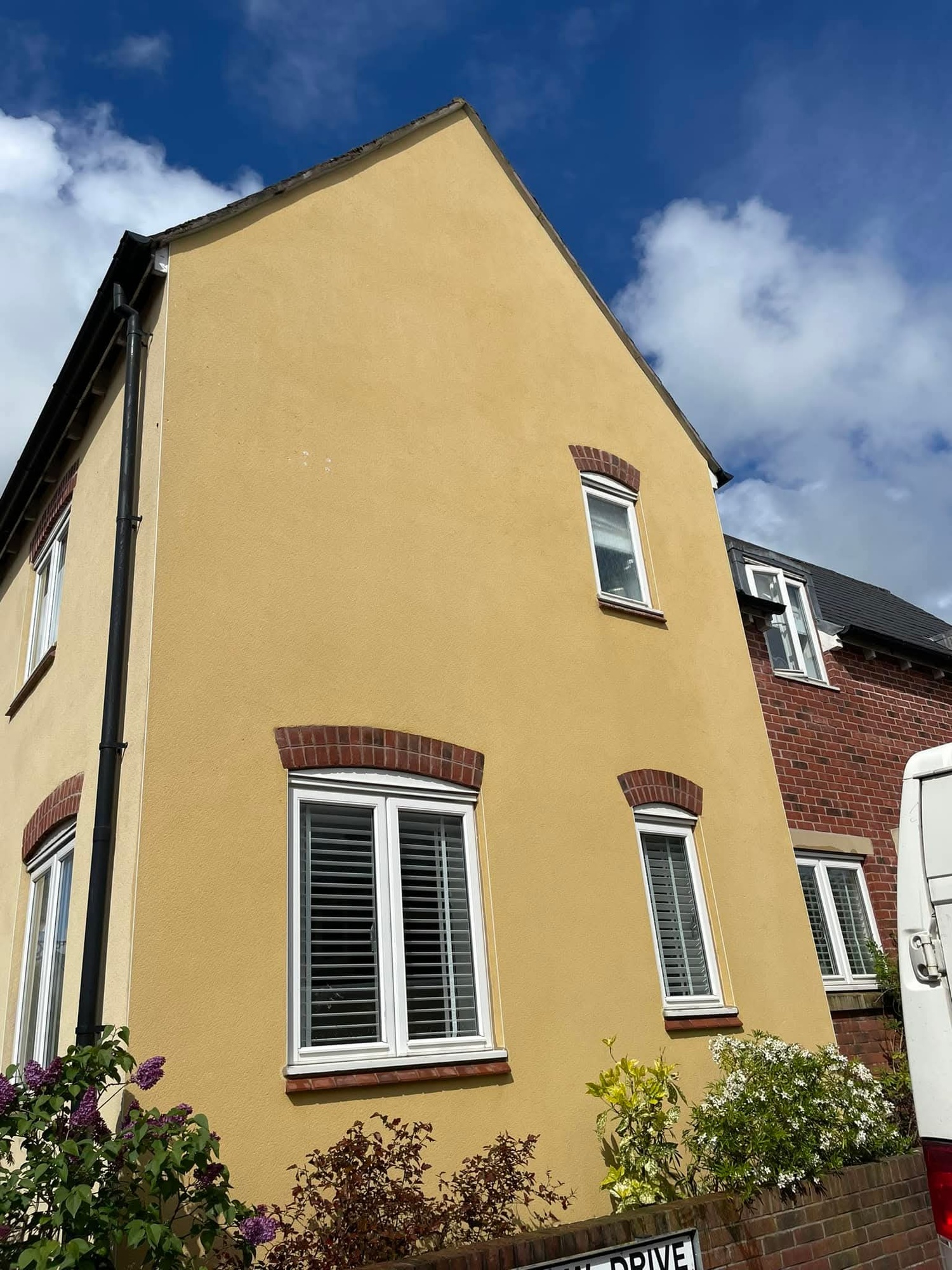
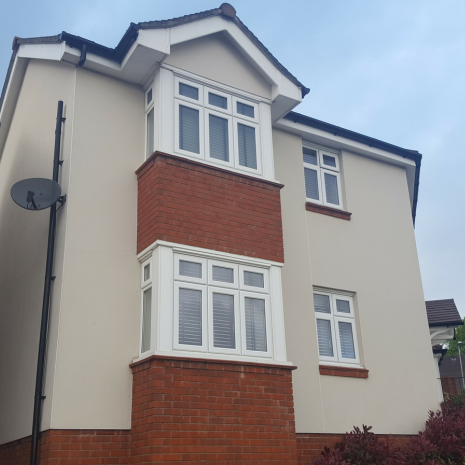

It is common for only one elevation of a property to need attention, and owners are often surprised that we will quote for a single wall rather than insisting on the whole building. The reason one wall goes first is drying time. An elevation receiving direct sun and air movement dries quickly after rain and offers spores a narrow window. A shaded gable, or a wall sheltered by planting close to the building, can stay damp for days at a time through winter. On the same house, one surface may be heavily colonised while the other three need nothing. K Rend cleaning priced per elevation reflects that honestly. We survey each wall separately, grade the growth present, and quote for what each one requires. Where three elevations genuinely do not need doing, the quotation says so. There is a technical caveat worth understanding. On a through-coloured silicone finish, treating one elevation and leaving another can leave a visible difference at the corner where they meet, particularly if the untreated wall carries moderate rather than negligible growth. We flag that at survey so the decision is informed. Where the difference would be obvious, treating both is usually the better answer. Within any elevation, silicone render cleaning is worked as a single continuous unit with a live wet edge throughout, at consistent dilution, entirely chemically and at very low pressure. Coloured render cleaning records any inconsistency permanently, so partial working within a wall is never an option even when partial working across a building is. House render cleaning specified this way costs what the property actually needs.
Telling monocouche apart from other renders is genuinely useful before commissioning any cleaning work, because the treatment differs and the consequences of getting it wrong are permanent. Monocouche has a distinctive appearance once you know what to look for. The surface is granular rather than smooth, with fine aggregate visible at the face where it has been scraped back during application. The colour is consistent throughout rather than sitting on top, so any chip or scrape shows the same shade beneath rather than a different base colour. It is applied thickly, so reveals at openings tend to be deep. And it is usually laid out in one continuous application per elevation, without the joint lines a boarded system might show. By contrast, a thin-coat silicone finish is generally shallower in texture and often finer or more uniform in grain. Painted render shows a film that can chip to reveal a different colour underneath. Traditional sand and cement is usually smoother and frequently painted. Monocouche render cleaning is specified around the open texture and the loosely bound aggregate at the face. Treatment is applied in volume at low pressure so it flows to the base of the profile, dwells fully so growth is destroyed at root level, and is rinsed gently with nothing brushed or agitated. If you are unsure what is on your wall, that is entirely normal and nobody expects an owner to know. We identify it at survey, and a photograph sent with an enquiry is often enough for an initial view. Render restoration on monocouche works well precisely because the identification was right in the first place.
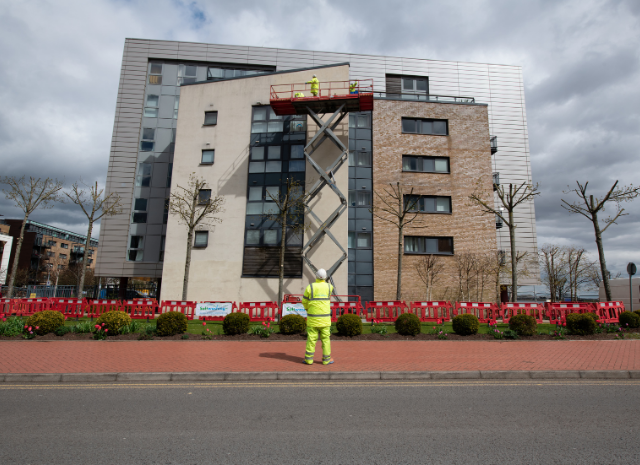

Car showrooms, trade counters and vehicle premises with rendered elevations have an unusually direct relationship between appearance and business. The forecourt is the product display, and a soiled elevation behind gleaming stock undermines the whole presentation. Softwashing UK plan commercial render cleaning on these sites around vehicle movement above everything else. Forecourts stay live, deliveries and collections continue, and stock cannot simply be relocated for a day. We survey first, agree which elevations can be worked when, and phase the job so that only one area is affected at a time. Protection is the other priority. Vehicles within reach of the working area are moved or fully sheeted, and the low pressure method means there is no spray drifting across a forecourt in the way a pressure washer would produce. Exclusion zones are agreed and signed, and customer access to the building stays open throughout. Insurance, method statements and risk assessments are issued ahead of attendance, and operatives hold current working at height certification. Technically these buildings often combine a tall glazed frontage with substantial rendered flank walls, which means the render areas are large, continuous and highly visible from the approach. Soft wash render cleaning across them must hold identical dilution and continuous wet edges throughout, since banding on a long unbroken elevation is immediately obvious. Scheduling usually works best early in the day or on a closing day, and most premises of this type can be completed in a single visit. For trade and vehicle businesses around Collett’s Green, a planned cycle keeps the premises presenting properly without the work ever becoming disruptive.
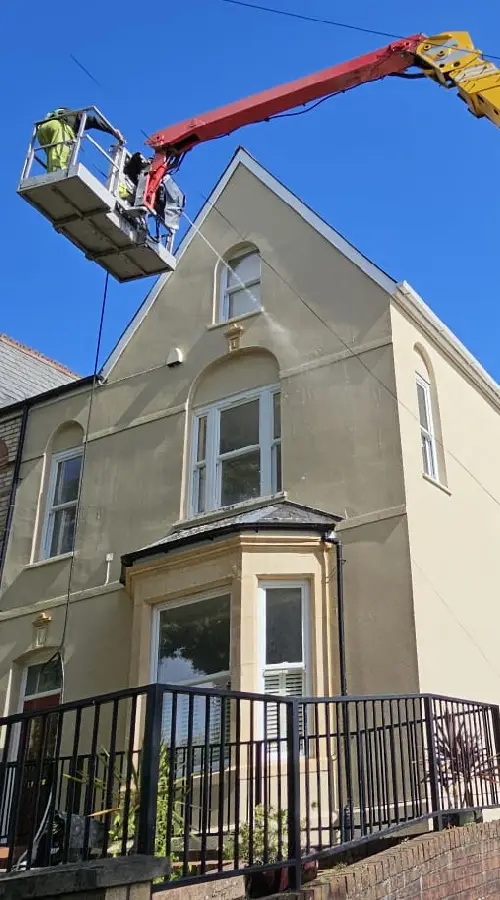
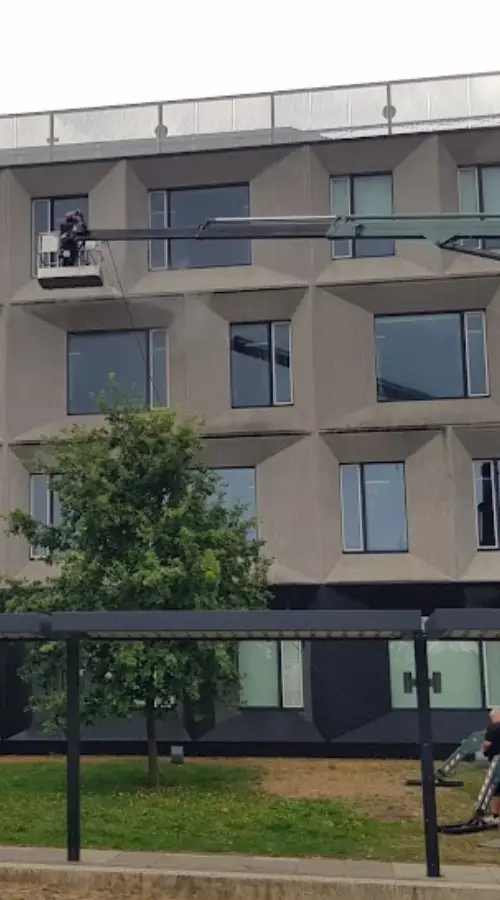
Equipment specification is not a glamorous subject and it decides a surprising amount about how a job goes. A soft wash setup is not a pressure washer turned down; it is a purpose-built system, and the differences show in the result. Water is carried on board, which means we are not dependent on a mains connection at the property and not limited by pressure or flow at an outside tap. On rural jobs and larger properties this is often the difference between a straightforward visit and an improvised one. Dosing and dilution are controlled at source rather than mixed by eye. Consistency across a whole elevation is what prevents tonal variation on coloured render, and that consistency comes from the system rather than from the operator’s judgement on the day. Hose runs are long enough to reach elevations at considerable distance, so the vehicle stays on hard standing or at the roadside and nothing is dragged across lawns or borders. Telescopic delivery reaches most domestic elevations from ground level, including gables at three storeys. That removes the need for access equipment on the majority of jobs, which shortens the visit and keeps render cleaning prices down. Rinsing uses purified water, which leaves no mineral deposit as the wall dries. Rinsing a freshly treated elevation with hard water can leave a faint haze that undoes some of the effect. Professional render cleaning depends on all of it working together. As render cleaning specialists we invest in this equipment because render is the only thing we clean, and general exterior kit does not do the job properly.
Collett’s Green is within our standard working area and covered in full, with the same survey process, pricing basis and scheduling applied to every property regardless of position. It may be useful to describe what a typical job here actually looks like, since most properties in a small settlement fall into a similar pattern. A survey takes around twenty minutes and establishes the coating on each elevation, its condition, which organisms are present and at what density, the areas involved and how each wall can be reached. An itemised quotation follows by email, broken down per elevation. On the day, the team arrives within an agreed window, sets out protection across planting and hard surfaces, masks external fittings, and applies treatment across each elevation in turn at the specified dilution. Most domestic properties here can be treated entirely from ground level using telescopic delivery, which means no access equipment and no extended set-up. Dwell time then runs while nothing appears to happen, followed by low pressure rinsing and clearing down. A standard three or four elevation property is usually a single day from arrival to departure, and often less. Afterwards the wall continues improving for two to four weeks as dead growth weathers off, which is expected rather than a shortfall and is explained before booking rather than after. Because we group work by area, properties booking within the same period share the mobilisation cost and see it reflected in their individual figures. If others nearby are considering the same work, mentioning it at the enquiry stage is worthwhile.
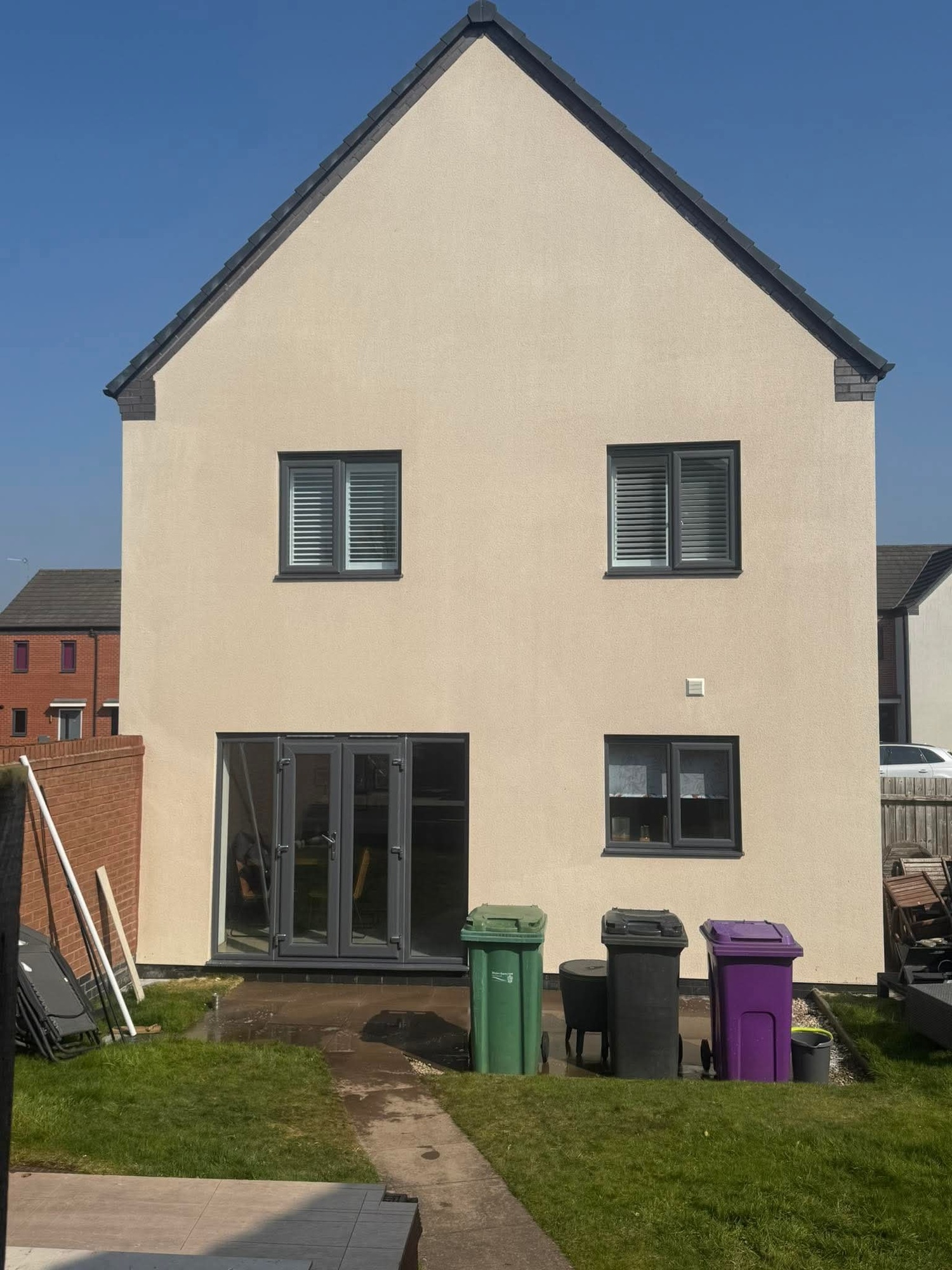
Most properties in Collett’s Green benefit from professional render cleaning every 3 to 5 years, although this depends on the surrounding environment. Properties near trees, woodland, busy roads or coastal areas may require more frequent cleaning due to algae, mould and airborne contaminants. Our soft washing process removes existing growth and helps keep your render cleaner for longer.
Yes. Soft washing is specifically designed for delicate surfaces such as K-Rend, silicone render, monocouche render and painted render. Unlike high-pressure washing, it cleans at low pressure while treating biological growth at its source, reducing the risk of damage to the render finish.
We clean virtually all external render finishes, including K-Rend, Monocouche, Weber, Sto, silicone render, acrylic render, painted render, roughcast and pebble dash. Every cleaning method is tailored to the specific render type to achieve the best possible results.
Yes. Our specialist soft washing treatments are highly effective at removing green algae, red algae, black mould, mildew, lichen and other organic staining. We also apply professional biocide treatments to kill spores and slow down regrowth.
Because our process targets the biological growth rather than simply washing the surface, results typically last much longer than pressure washing alone. The exact lifespan depends on weather conditions, surrounding vegetation and the property’s location.
No. Our soft washing process is specifically designed to clean render safely. We use low-pressure application methods and specialist cleaning solutions that remove contamination without damaging the render surface when carried out by trained professionals.
The UK’s damp climate provides ideal conditions for algae, mould and other biological growth to develop on rendered surfaces. Areas with limited sunlight, nearby trees or persistent moisture are especially susceptible. Professional soft washing safely removes these contaminants and restores your property’s appearance.






































WhatsApp us