What happens to a wall in the weeks after treatment matters more than what happens on the day, and the weather is doing most of the work. Once a colony has been killed the dead material has to leave the surface, and rainfall is what carries it away. A treated elevation followed by a wet fortnight will clear noticeably faster than the same wall followed by a dry one. That is worth knowing before judging a result. Our render cleaning services are designed around the assumption that weathering will finish the job, which is why nothing is forced off the surface on the day. Render algae removal is largely complete by the time the rinse ends, but the residue of denser growth stays until rain moves it. Sunlight helps as well, breaking down what remains on faces that get any. The elevations taking longest to settle are the shaded ones, which is unhelpful given they are usually the worst to begin with, and it is the main reason a north-facing wall can look disappointing at two weeks and entirely different at six. Frost causes no harm to a treated surface once the dwell has completed. Render moss removal on copings and ledges is the slowest of all to clear, since dense deposits break down gradually rather than washing off. Professional render cleaning of a house in Corfe Castle should be assessed about a month afterwards, and house render cleaning judged on the afternoon it finished is judged far too early. Exterior render cleaning is a process that continues long after anybody has left.
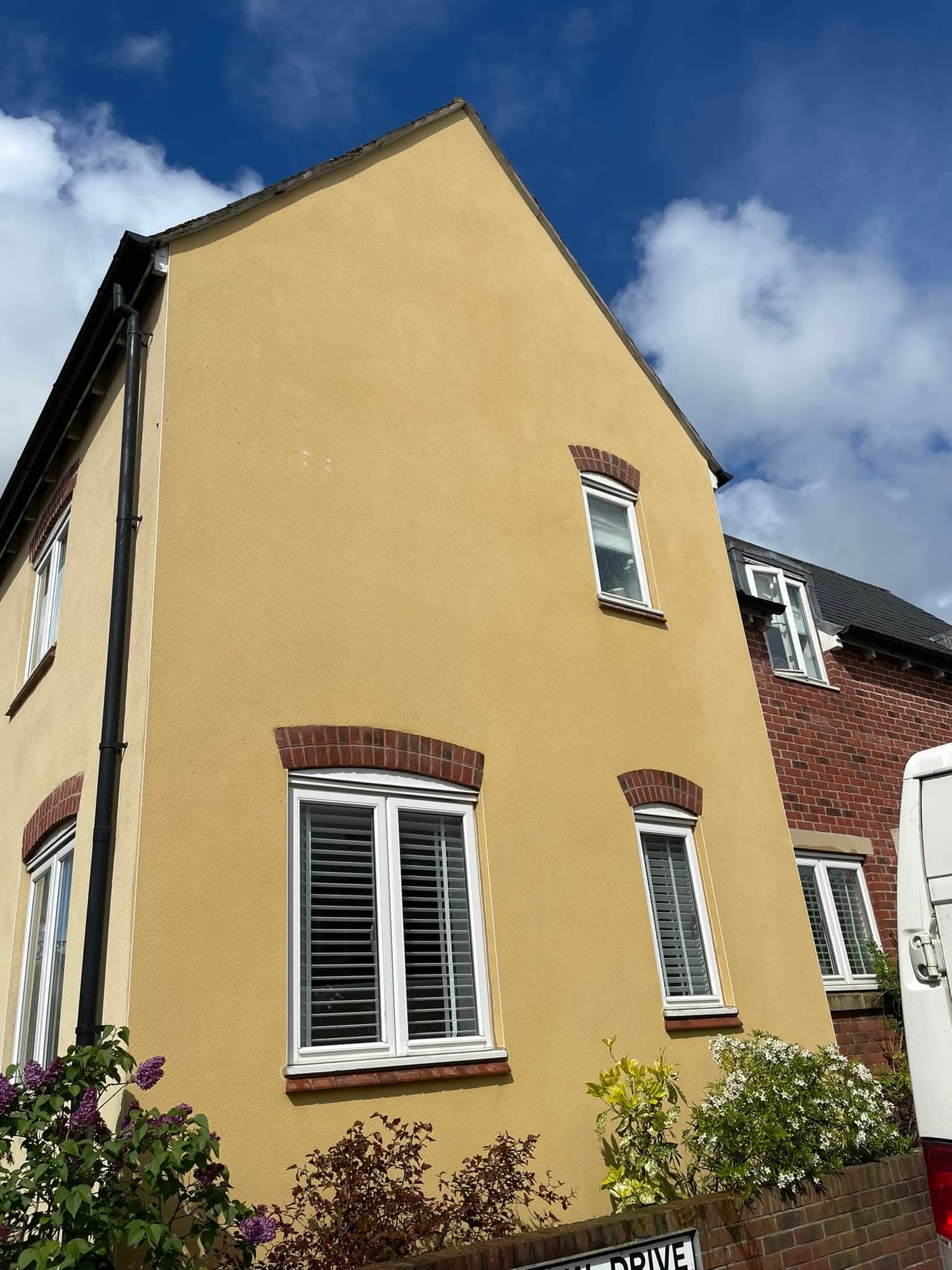
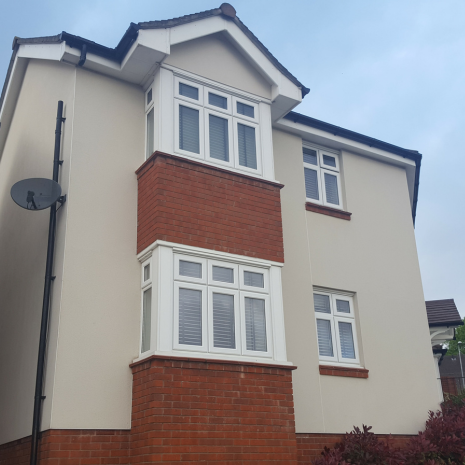

Silicone systems clear faster after treatment than almost any other finish, because a hydrophobic surface holds very little dead material and rainfall runs across it freely. Very little lodges in a face that sheds water. K Rend cleaning frequently looks close to finished within a fortnight, and settles completely well before the six-week mark. That is faster than any other finish we treat. The exceptions are the details rather than the panels. Sill returns, the tops of beads and the line above a bell-cast hold residue longer because water pauses there, and those areas continue clearing for several weeks after the open faces have finished. Those details are also where a second look is worth taking. The treatment itself is unchanged: a biocidal solution applied at a pressure barely above hose flow, a long dwell to destroy algae and lichen at root level, then a gentle rinse, with no mechanical contact anywhere since pigment runs through the material and abrasion removes it permanently. Soft wash render cleaning is designed to let weathering finish the work, and silicone render cleaning simply gets there sooner. Less material is held in the surface to begin with. Render stain removal behaves differently again, since mineral marks do not weather off. Iron bleed from ties and brackets, cement residue at fixing points and dark runs beneath a leaking joint either clear during the treatment or need a second application, and waiting for rain to improve them achieves nothing. On a Corfe Castle property that distinction is explained at the quotation so nobody spends a month hoping a stain will fade. Mineral marks are dealt with or they are not.
Monocouche takes the longest of any finish to settle after treatment, and Softwashing UK says so before starting rather than afterwards. The scraped texture holds dead growth several millimetres down inside the profile, and that material only leaves as rain and wind gradually work it out. A month is normal; on a deeply scraped face in a sheltered position it can be longer. Six weeks is the figure we quote as a settling period. Nothing about that is a fault, and nothing speeds it up safely. Monocouche render cleaning could be finished on the day only by removing the surface the growth is sitting in, and render pressure washing does exactly that — flattening the scrape, exposing the aggregate beneath and leaving permanent tracking. Coloured render cleaning offers no top coat to renew over the damage. Speed on this finish is bought at a permanent price. The method relies on patience instead. Solution at low pressure in enough volume to soak through the texture, a long dwell to kill growth at root level, a repeat application on the heaviest deposits along copings and projecting bands, then a soft even rinse across each face. Everything remaining is left to the weather. Wind does as much of that work as rain. By the six-week point render wall cleaning of monocouche has usually reached its final state, and on properties around Corfe Castle where the finish had been obscured for a decade the tone that has emerged by then is the original specified one. Calling that a render restoration is accurate, provided everybody understands it arrived gradually. Nothing about the process is dramatic at any single point.
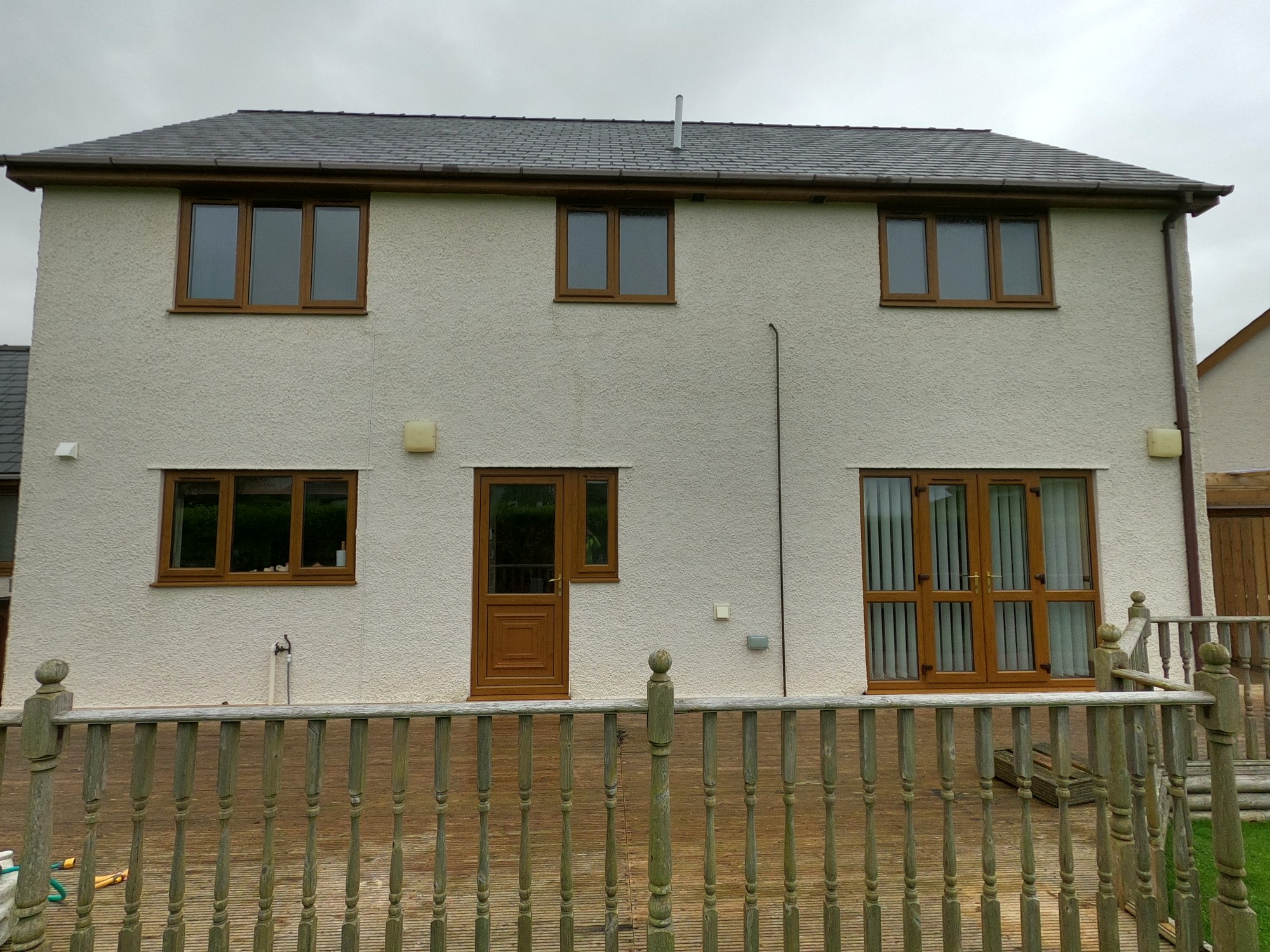
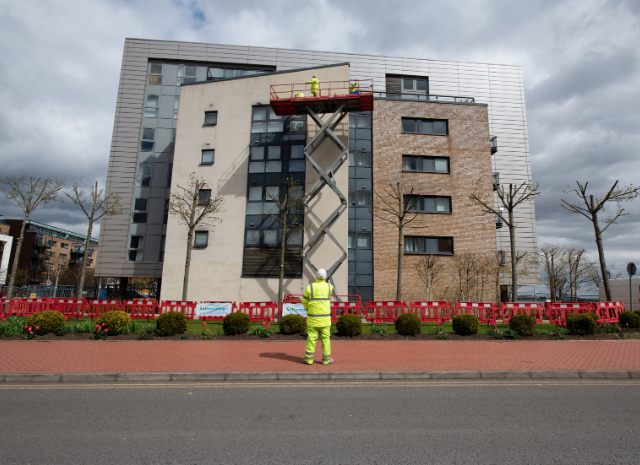

Programming a commercial job around a completion date needs the settling period built in. An elevation treated a week before an inspection, a letting viewing or an open day will look considerably better than it did and considerably worse than it will, and commercial render cleaning scheduled that tightly rarely shows what the work is capable of. It also produces photographs that undersell the result. Six weeks is the sensible allowance where a building has been neglected for years, and two to three where it is on an established cycle. Where a date cannot move, we will say plainly what the elevation will look like on it. An honest forecast is better than an optimistic one. Access is established first — powered platforms, tower scaffold or extended pole systems according to height and standing ground — with the programme written around trading hours, deliveries and staff movement, and method statements and risk assessments issued in advance. Render soft washing is used throughout, giving even coverage along a full flank, very low water volumes, run-off directable clear of entrances and parking, and negligible drift near occupied doorways. Render facade cleaning judged at the right moment shows a very different building from one photographed as the crew packs up. Render mould removal on shaded and north-facing elevations is the slowest element to settle, since those faces get the least sun to help. Where premises in Corfe Castle are on a render maintenance cycle the settling period shortens with every visit, because there is progressively less dead material to weather away. By the third visit the change is almost immediate.
Setting that expectation properly at the quotation stage prevents nearly every difficult conversation this trade produces. A customer told a wall will look transformed by the evening will be disappointed; one told it will improve steadily across a month and be judged at six weeks rarely is. The expectation is the whole difference between the two. Render cleaning prices are established at an assessment from elevation count, working height, access arrangements and the extent of the growth, with a plain description of how the result will develop. That description is written down rather than mentioned in passing. The written render cleaning cost then holds. Affordable render cleaning means paying for a method that continues working rather than for an appearance which peaks on the day and deteriorates afterwards. The two look identical for about a fortnight. The crews are render cleaning specialists rather than general exterior cleaners, and part of that is being able to say what a particular wall will look like at two weeks, at six, and at two years. Recognising an overpainted section, a fragile bead or cracking that would carry solution behind a coating is the other part. Both come from doing nothing else week after week. Everything used is an eco friendly render cleaning product chosen because it breaks down safely once its work is complete. Anyone comparing firms in search of the best render cleaning service should ask what the wall will look like in a month. A firm that only describes the finished day has either never checked or is describing a pressure wash. Those peak on the day and decline from there.
Corfe Castle falls within our regular working patch, and the commercial arrangements here are the same as everywhere else we work. They are worth setting out, since money is the part people are least likely to ask about directly. Setting it out avoids anybody having to. There is no deposit. Nothing is paid before the work and nothing is asked for on booking. The figure in the written quotation is the figure invoiced, and it does not move unless the scope changes, which is discussed before rather than after. Scope changes are rare on a job quoted from a proper assessment. Invoicing happens on completion rather than at the start, with payment due within a reasonable period afterwards. Where a job runs across two visits — a treatment and a second application several weeks later — the invoice follows the second visit rather than the first, so residential render cleaning is never paid for until it is genuinely finished. That arrangement suits us as much as it suits anybody. The assessment is free and carries no obligation. There is no travel charge and no minimum job size, and a single elevation or a boundary wall is quoted on exactly the same basis as a full property. Nothing is priced differently because it happens to be small. If something is not right it is put right before anything is settled. Anyone searching render cleaning near me should be wary of a local render cleaning company asking for money up front on a job that takes a day, since there is nothing about this work that requires it. No materials are ordered in advance and no scaffold is hired.
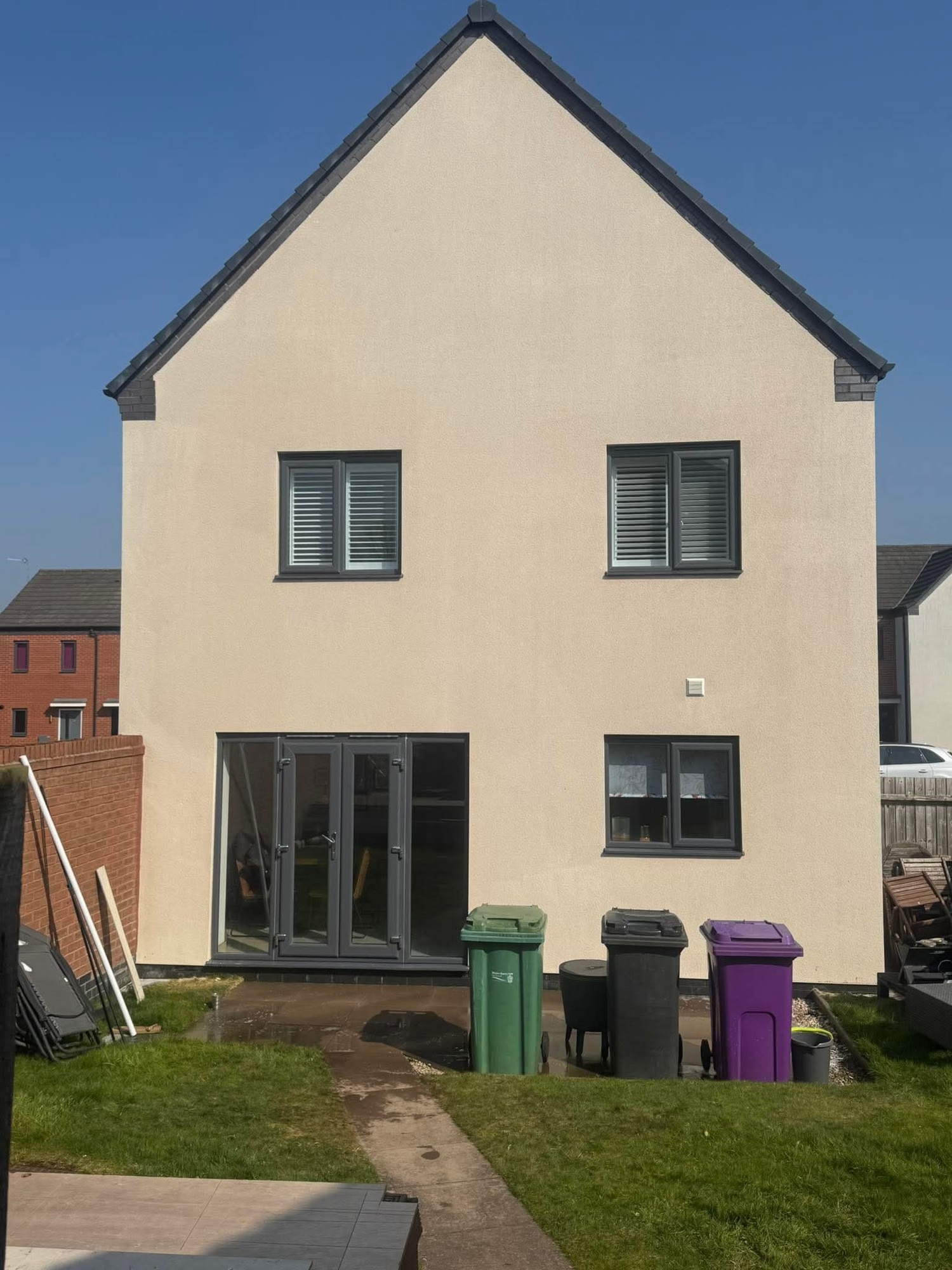
Most properties in Corfe Castle benefit from professional render cleaning every 3 to 5 years, although this depends on the surrounding environment. Properties near trees, woodland, busy roads or coastal areas may require more frequent cleaning due to algae, mould and airborne contaminants. Our soft washing process removes existing growth and helps keep your render cleaner for longer.
Yes. Soft washing is specifically designed for delicate surfaces such as K-Rend, silicone render, monocouche render and painted render. Unlike high-pressure washing, it cleans at low pressure while treating biological growth at its source, reducing the risk of damage to the render finish.
We clean virtually all external render finishes, including K-Rend, Monocouche, Weber, Sto, silicone render, acrylic render, painted render, roughcast and pebble dash. Every cleaning method is tailored to the specific render type to achieve the best possible results.
Yes. Our specialist soft washing treatments are highly effective at removing green algae, red algae, black mould, mildew, lichen and other organic staining. We also apply professional biocide treatments to kill spores and slow down regrowth.
Because our process targets the biological growth rather than simply washing the surface, results typically last much longer than pressure washing alone. The exact lifespan depends on weather conditions, surrounding vegetation and the property’s location.
No. Our soft washing process is specifically designed to clean render safely. We use low-pressure application methods and specialist cleaning solutions that remove contamination without damaging the render surface when carried out by trained professionals.
The UK’s damp climate provides ideal conditions for algae, mould and other biological growth to develop on rendered surfaces. Areas with limited sunlight, nearby trees or persistent moisture are especially susceptible. Professional soft washing safely removes these contaminants and restores your property’s appearance.









































WhatsApp us