Nobody really notices render getting dirty. It happens across six or seven winters, a fraction of a shade at a time, and the change only registers when low sun catches an elevation at the wrong angle or a neighbour has theirs done and the comparison becomes impossible to ignore. By that point most walls are carrying three separate problems at once: airborne dirt bound into the surface, algae feeding on it, and lichen colonising the shaded corners that never properly dry. Each of those responds to something different, which is why our render cleaning services start with identification rather than with equipment. Green filming across a broad face is algae and clears readily once treated. Raised grey or yellow discs are lichen, which grips hard and needs a longer dwell before it will release. Black spotting is usually a slower mould that has followed a moisture line down from a defective outlet. Reading which is which, and in what proportion, determines the strength of solution mixed on the day. Treatment is applied at low pressure from the top of an elevation downwards, so the whole face wets evenly and nothing dries in streaks before the chemistry has finished working. Render algae removal is largely a waiting game once the solution is on: the biocide breaks the growth down at cellular level and much of it washes clear in subsequent rainfall rather than needing to be forced off. Render moss removal along parapets and behind rainwater goods takes a second application in most cases. House render cleaning in Dorchester routinely uncovers a colour the owner had forgotten the building ever had. Exterior render cleaning is not cosmetic tidying, though — it removes the moisture-holding layer that had been quietly working against the coating for years.
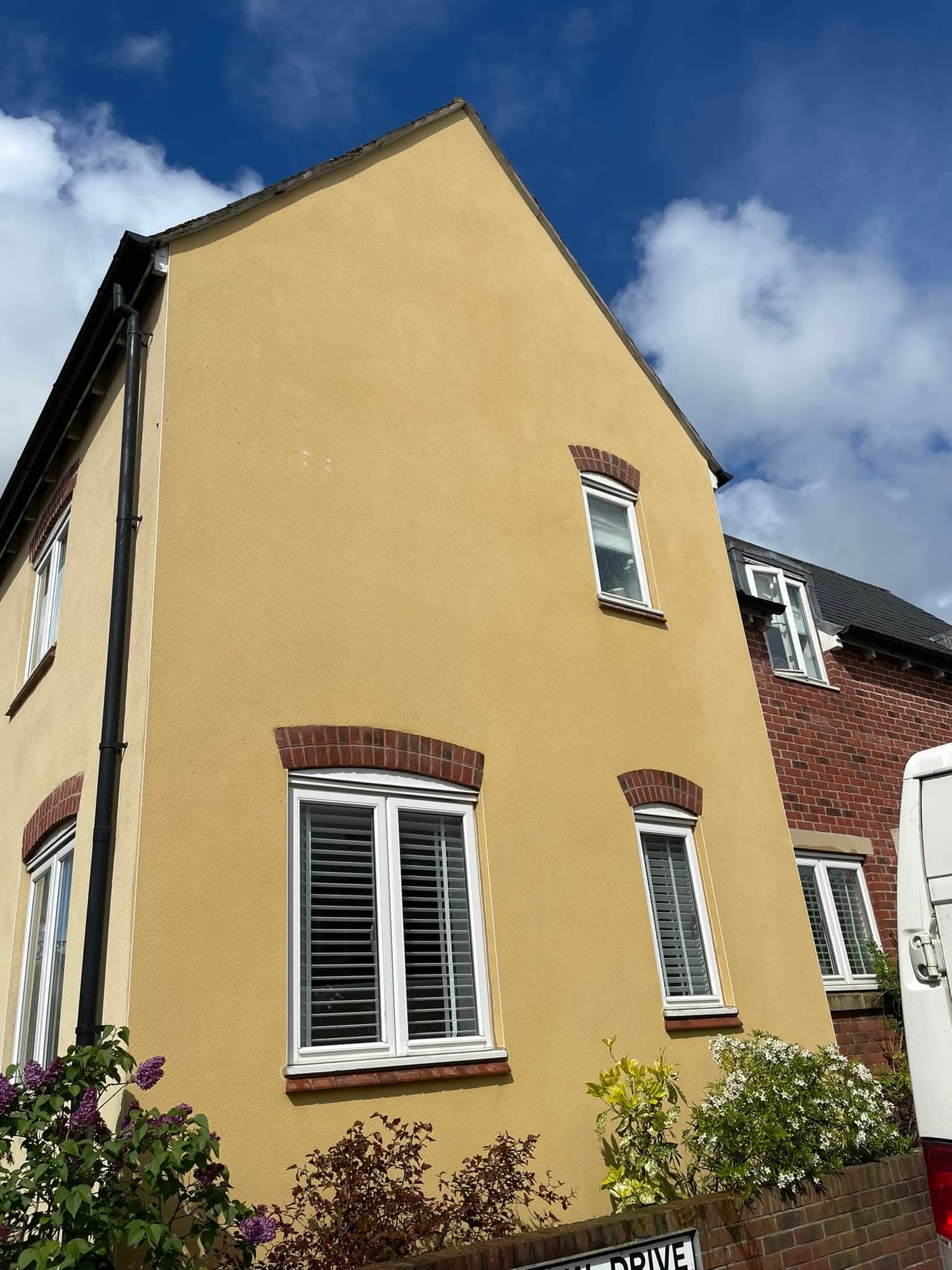
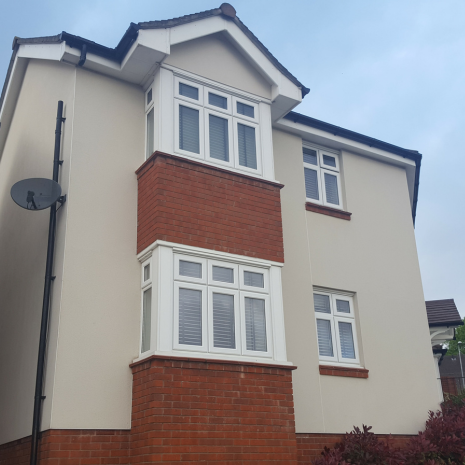

The quickest way to ruin a K Rend elevation is to treat it like brickwork. It looks robust, it feels hard to the touch, and it responds to a pressure washer by giving up its surface almost immediately — first the fine texture, then the pigment, then a permanent pale patch visible from the road for the life of the building. K Rend cleaning is a chemistry problem dressed up as a cleaning problem. Because the system is silicone-based, water beads on it rather than soaking in, which is excellent for weather resistance and thoroughly unhelpful for anything trying to clean it. Solution has to be applied in a way that holds on the face long enough to work, meaning correct dilution, correct volume and a low-pressure application that lays product on rather than blasting it past. Soft wash render cleaning was developed for exactly this scenario. Render stain removal on silicone systems splits into two jobs. Biological growth — the green and black across the main faces — comes away with the biocide. Everything else does not: iron staining from wall ties or brackets, mortar runs left by later building work, tannin bleed where planting has been trained against a wall. Those need spot treatments chosen for the specific contaminant and tested on a discreet section before anything is applied more widely. Silicone render cleaning finishes with a rinse calibrated to the joints rather than to the panel. Board junctions and mesh laps are the weak points, and water driven into them causes problems that surface months later as staining bleeding through from behind. Careful work at that stage is what keeps a Dorchester property looking cleaned rather than looking repaired.
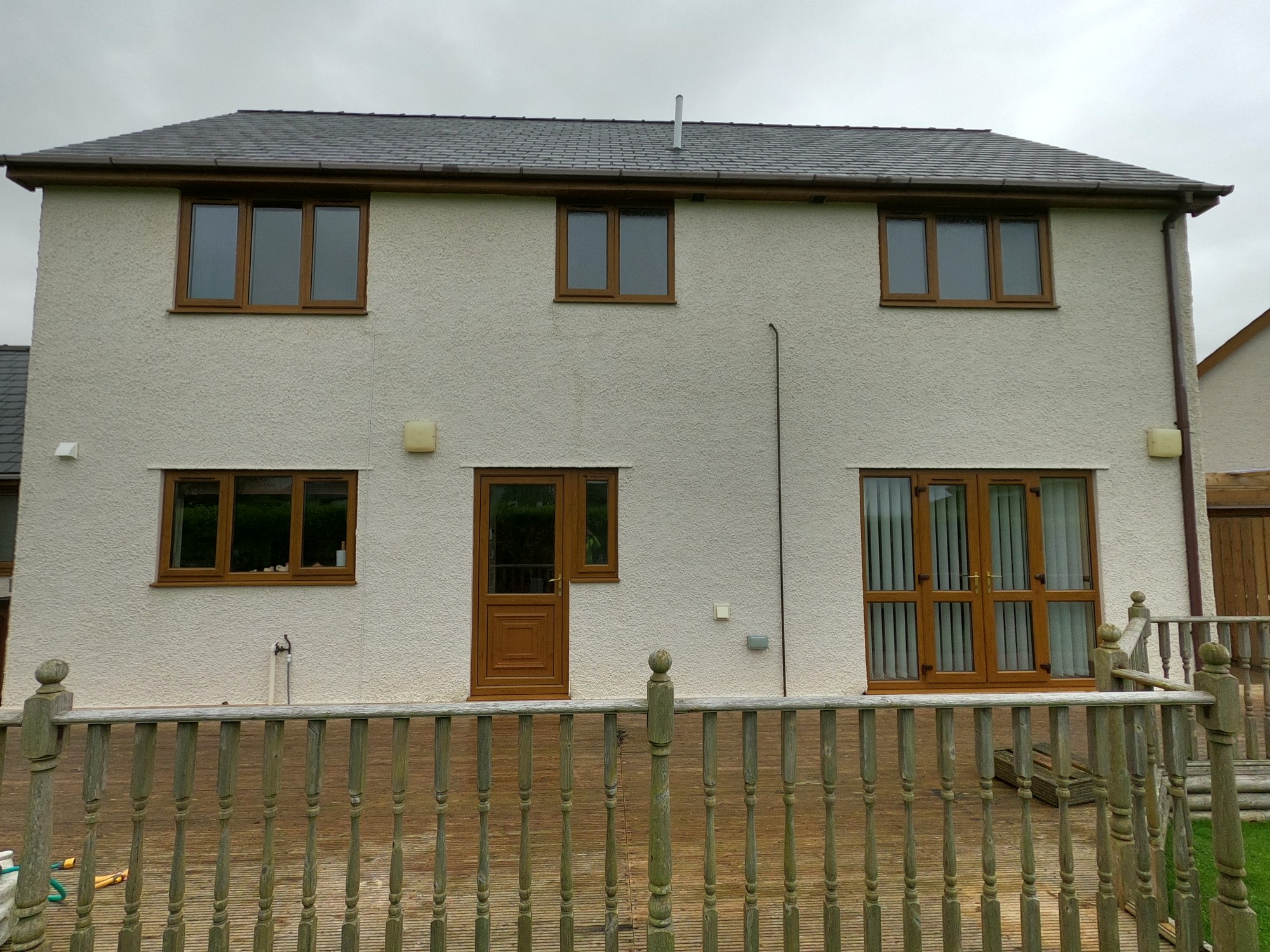
Monocouche earns its reputation on being low-maintenance rather than no-maintenance. A single-coat, through-coloured, mineral-based finish that sheds water well and never needs painting is a genuinely good system, and the only thing it consistently asks for is that organic growth is taken off it before that growth starts holding water against the face. Monocouche render cleaning is that maintenance task and very little more. What makes it demanding is the scraped texture. Those open pores are what give the finish its depth in daylight, and they are also perfect anchorage for algae and lichen. Render pressure washing flattens them. Even a moderate lance passed too close will polish the face, and because the colour is integral there is no coat to reapply over the damage — the repaired area reads as a different shade forever. Coloured render cleaning across greys, buffs and the darker modern tones is where that shows most cruelly, since the contrast against untouched wall is severe. Our process is deliberately slow. Solution goes on wet, sits, and is topped up on the elevations carrying the heaviest colonisation rather than being scrubbed. Moss and lichen are removed by letting the treatment kill the growth so it loses grip and comes away in the rinse or the next rainfall. Where lichen has been established for years we schedule a second visit instead of a harder first one. The result of that patience is render wall cleaning with no banding, no lance marks and no thin spots. On properties in Dorchester left twenty years or more it is fair to call the outcome render restoration rather than simply a clean.
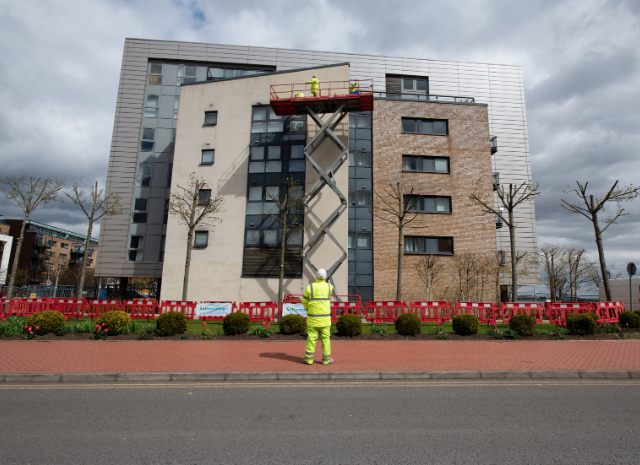

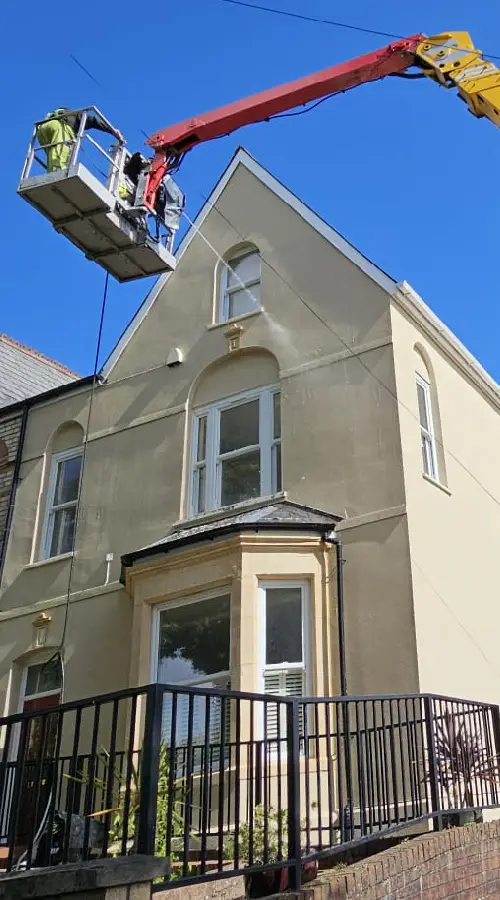
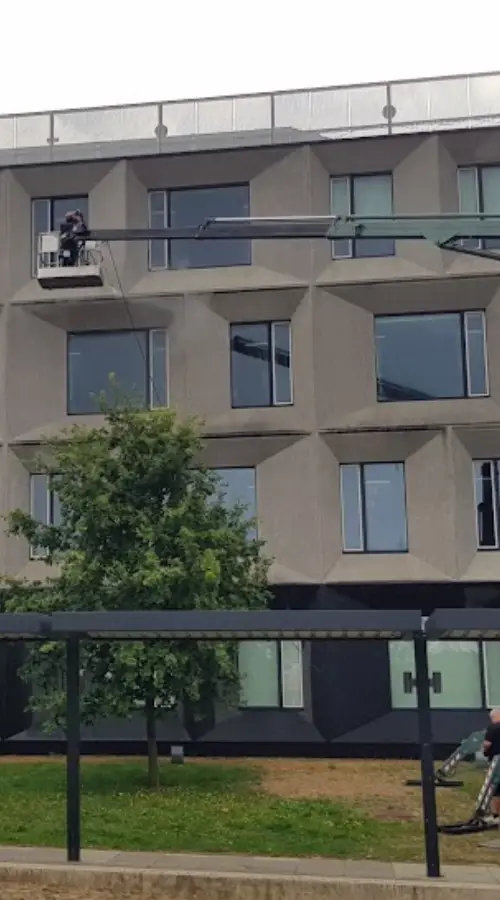
Facilities managers rarely ring about render because they have noticed it themselves. The call comes after a tenant complains, an inspection flags the elevations, or somebody photographs the entrance for a listing and the images come back looking twenty years old. Commercial render cleaning is generally reactive at first and becomes planned once the difference has been seen. The technical work is identical to a house; the logistics are not. A three-storey office or a long industrial flank needs an access plan, a pedestrian and traffic plan, and agreement about which hours the work can occupy. Render facade cleaning is programmed elevation by elevation with the client so entrances, loading areas and parking stay usable and no section of the building is left half-treated over a weekend. Documentation goes out beforehand and the site contact knows exactly who is arriving and when. Render soft washing suits large elevations for practical reasons as much as technical ones. It covers ground quickly, uses a fraction of the water pressure equipment demands, produces controlled run-off that can be directed away from doorways and vehicles, and generates none of the fine spray drift that makes lance work impractical anywhere near occupied premises. On tall buildings it also allows treatment to be applied from platform positions without the operator fighting recoil. Render mould removal deserves particular attention on commercial stock, where large blank elevations often face north or sit permanently shaded by adjacent structures. Those faces blacken first and fastest. Bringing a building onto a render maintenance cycle — treated at a set interval rather than when it finally looks bad — costs a fraction of a full remedial clean and keeps a Dorchester premises presentable throughout the year rather than for a few weeks after each intervention.
There is no shortage of firms willing to point a lance at a wall for a low price. There are far fewer prepared to explain what they are putting on the surface, why that particular dilution, and what the coating will look like in three years’ time. That gap is where most of the remedial work we get called out to fix originates. Softwashing UK trades on being straightforward about all of it. You are told exactly which treatment is going on the building, how long it needs to dwell, and what the elevation will look like immediately afterwards as opposed to three weeks later once rain has carried away the last of the broken-down growth. Render cleaning prices are set out per elevation and per access requirement so you can see where the figure comes from, and the render cleaning cost quoted is the figure invoiced. Affordable render cleaning is a matter of not wasting time on site, not of using less product than the job needs. Our crews carry out professional render cleaning and nothing else, week in and week out. That specialisation shows in the small things: knowing when a bead is fragile before it is touched, spotting a hairline crack that will draw solution in behind the coating, recognising a finish that has been overpainted at some point and will behave unpredictably. Eco friendly render cleaning products are used throughout, selected because they biodegrade properly rather than because the label is convenient. Judging the best render cleaning service by the state of the wall a year on rather than on the day the van leaves is the fairest test there is, and it is the one render cleaning specialists should be happy to be measured by.
The work we take on around Dorchester divides fairly neatly by the age of the render rather than by the address. Modern estate housing at Poundbury and Fordington tends to carry newer through-coloured systems that clean up quickly and predictably, and residential render cleaning there is usually a single-visit job. Stratton and Martinstown bring a mix — post-war housing with older finishes alongside newer infill — which changes both the dilution and often the number of passes required. Then there are the properties where render has been on the wall a very long time and has never once been treated. Bradford Peverell, Compton Valence, Frampton and Grimstone Muckleford fall into that group, along with Forston, Stinsford and Kingston Maurward, where buildings sit among mature trees and shed leaves keep elevations damp through most of the winter. Lichen on those walls is thick and slow to release, and we allow for it at the quotation stage rather than discovering it on the day. Exposed farmland positions behave differently again. At Friar Waddon, Whitcombe, West Stafford and the Winterborne group — Winterborne Came, Winterborne Herringston and Winterborne Monkton — walls dry faster but take a harder battering from wind-driven rain, so soiling is heavy on one face and comparatively light on the others. The same pattern holds at Winterbourne Abbas and Winterbourne Steepleton. None of it changes the pricing structure. Anyone looking up render cleaning near me from these addresses gets the same quotation method and the same crew, because a local render cleaning company should not be charging by how far the van has travelled.
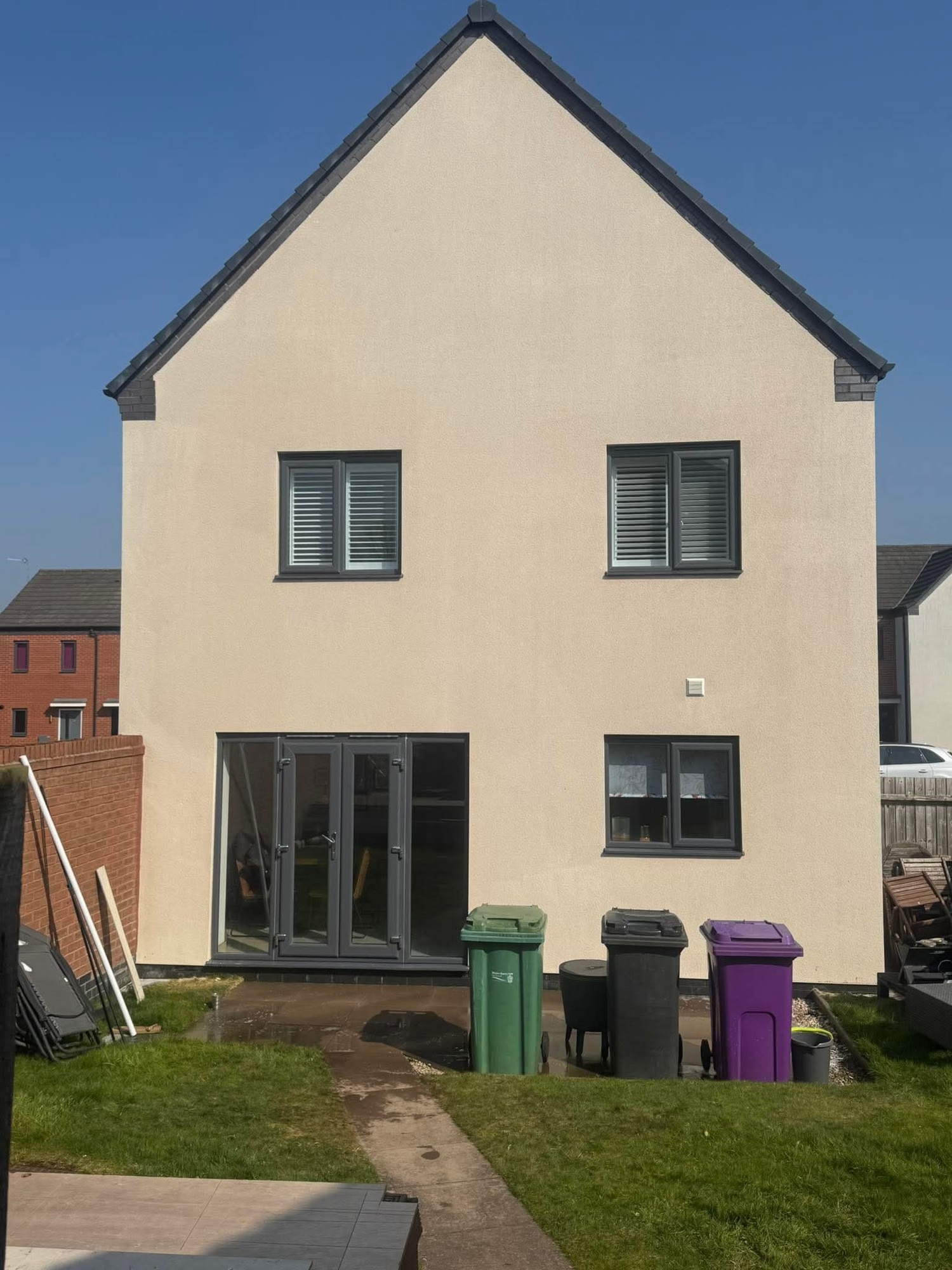
Most properties in Dorchester benefit from professional render cleaning every 3 to 5 years, although this depends on the surrounding environment. Properties near trees, woodland, busy roads or coastal areas may require more frequent cleaning due to algae, mould and airborne contaminants. Our soft washing process removes existing growth and helps keep your render cleaner for longer.
Yes. Soft washing is specifically designed for delicate surfaces such as K-Rend, silicone render, monocouche render and painted render. Unlike high-pressure washing, it cleans at low pressure while treating biological growth at its source, reducing the risk of damage to the render finish.
We clean virtually all external render finishes, including K-Rend, Monocouche, Weber, Sto, silicone render, acrylic render, painted render, roughcast and pebble dash. Every cleaning method is tailored to the specific render type to achieve the best possible results.
Yes. Our specialist soft washing treatments are highly effective at removing green algae, red algae, black mould, mildew, lichen and other organic staining. We also apply professional biocide treatments to kill spores and slow down regrowth.
Because our process targets the biological growth rather than simply washing the surface, results typically last much longer than pressure washing alone. The exact lifespan depends on weather conditions, surrounding vegetation and the property’s location.
No. Our soft washing process is specifically designed to clean render safely. We use low-pressure application methods and specialist cleaning solutions that remove contamination without damaging the render surface when carried out by trained professionals.
The UK’s damp climate provides ideal conditions for algae, mould and other biological growth to develop on rendered surfaces. Areas with limited sunlight, nearby trees or persistent moisture are especially susceptible. Professional soft washing safely removes these contaminants and restores your property’s appearance.






































WhatsApp us