There is a strip of render on almost every building that has never been cleaned and rarely been seen: the narrow band behind a downpipe. It sits within an inch or two of the wall, never receives direct rainfall, never dries in a breeze, and holds growth that is frequently denser than anything on the open elevation. Our render cleaning services treat it as a distinct element rather than as part of the surrounding wall. Solution has to be delivered into a gap rather than sprayed across a face, which takes a different technique and a good deal more time per metre than the panel around it. Where a downpipe can be eased away from the wall, the strip behind it is treated properly. Where it cannot, the work is done as thoroughly as the access allows and we will say plainly that a shadow may remain. The brackets are the other consideration. Fixings behind a downpipe are frequently corroding out of sight, and render algae removal on that strip often reveals iron bleed nobody knew was there. The same applies at gutter level, where the render behind a fascia line and the top of any hopper collect debris permanently. Render moss removal there is slow and awkward and is the part of a job most often skipped. Professional render cleaning of a house in East Stour includes those strips or it has cleaned around the problem, and house render cleaning that leaves dark lines down an otherwise clean wall has stopped short. Exterior render cleaning has to reach the places nobody can see.
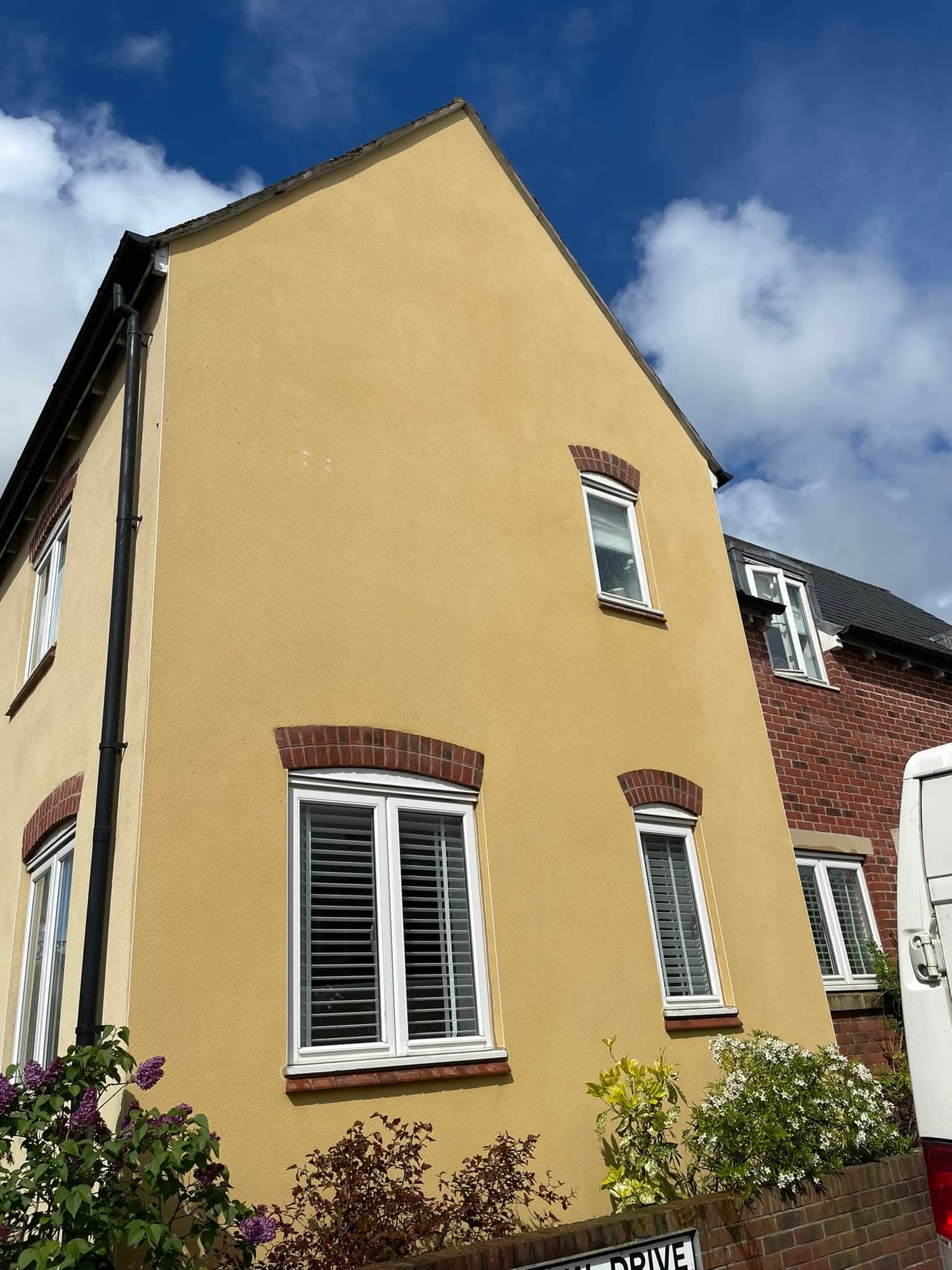
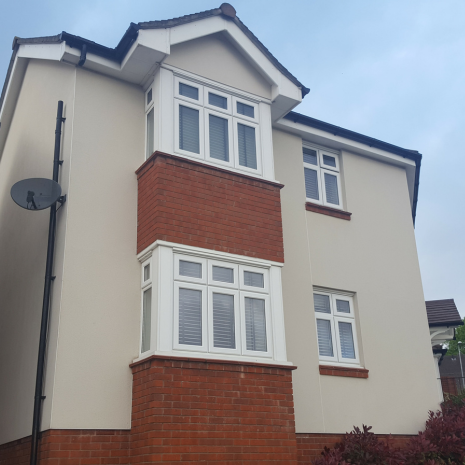

On modern housing the strip behind a downpipe is often the only badly affected area on an otherwise clean silicone elevation. The panels shed water and stay clear; the concealed band does neither. Softwashing UK treats those strips as a named element in every K Rend quotation rather than assuming them. There is a second reason for paying attention there. A downpipe fixed through a thin-coat system means fixings penetrating the base coat and the mesh beneath, and any that have not been sealed properly allow water behind the render. The resulting staining bleeds outward from the bracket and will not clean off while the source is active. The treatment is otherwise standard. Soft wash render cleaning applies a biocidal solution at a pressure barely above hose flow, dwells long enough to destroy algae and lichen at root level, then rinses gently with the flow directed down the face rather than into any junction. Nothing mechanical touches the surface, since pigment runs through the material and abrasion removes it permanently. Silicone render cleaning needs generous volume in a confined strip, which is delivered rather than sprayed. Accuracy in a narrow gap takes considerably longer than covering an open face. Render stain removal at those points is quoted separately with an expected outcome stated. Iron bleed from a bracket, cement residue at a fixing and dark runs from a leaking joint each need a specific product and a test patch first. On an East Stour property the marks behind rainwater goods are among the most common we price individually. Each carries a stated outcome rather than a general hope.
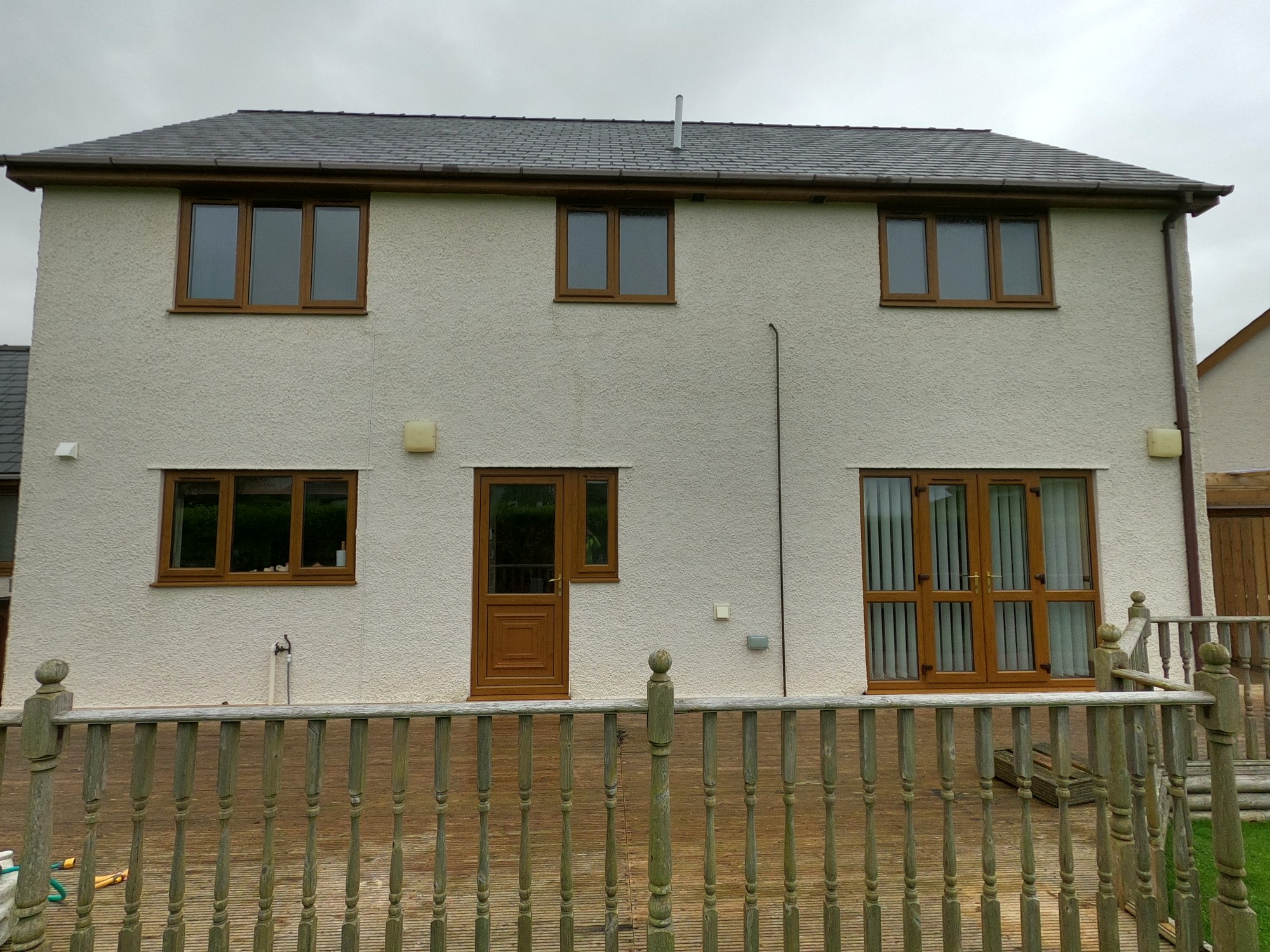
On monocouche the concealed strip behind a downpipe is usually the worst render on the building. The scraped texture holds growth wherever moisture lingers, and a band that never dries and never gets rained on accumulates deposits several years ahead of the surrounding wall. Monocouche render cleaning of that strip takes disproportionate time. It is also the most delicate work on the elevation. Applying solution into a narrow gap without touching anything requires care, and no equipment is ever braced against the render or the pipe to reach it. Where a downpipe can be eased clear, the strip is treated as a normal face; where it cannot, volume and patience do what access will not. A shadow reduced to a faint line is a fair outcome in that situation. Render pressure washing in a confined strip is the worst possible approach. The lance is close to the surface by necessity, which flattens the scrape immediately, exposes the paler aggregate beneath and leaves tracking in the one place it cannot be blended, and coloured render cleaning offers no top coat to renew over it. The wider method is unchanged: low-pressure application in enough volume to soak the texture through, a long dwell to kill growth at root level, a repeat application where deposits are heaviest, then a soft even rinse. Done properly, render wall cleaning of monocouche leaves no vertical shadow anywhere. On buildings around East Stour where those strips had gone dark against a recovered elevation, treating them is what completes a render restoration rather than half of one. A single missed strip undoes the impression of the whole elevation.
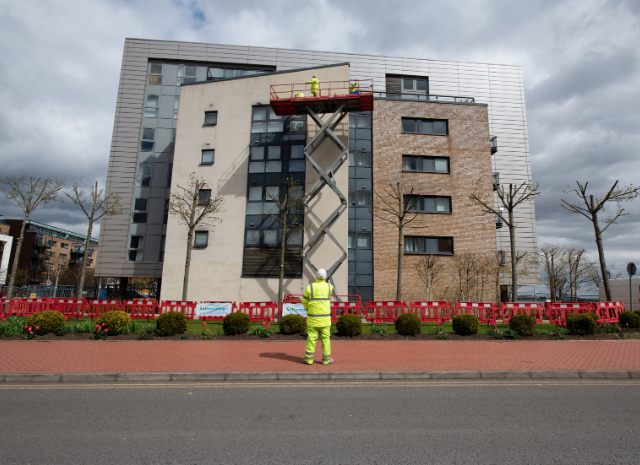

Commercial elevations carry a great deal of concealed render. Rainwater goods, service pipework, cable runs, ducting and fixed signage all sit close to the wall with a strip behind each, and on a long frontage that adds up to a considerable area nobody can see and everybody will notice once the rest is clean. Commercial render cleaning has to account for it in the programme rather than treating it as incidental. The survey records how many such runs there are and whether anything can be eased clear, since that decides the time required far more than the elevation area does. Access is then established — powered platforms, tower scaffold or extended pole systems according to height and standing ground — with the programme written around trading hours, deliveries and staff movement, and method statements and risk assessments issued in advance. Render soft washing is what makes concealed strips workable at all. Solution can be delivered into a narrow gap at low pressure without drift, water volumes stay low so nothing runs where it should not, run-off remains directable clear of entrances and parking, and coverage across the open flank stays even from one end to the other. Render facade cleaning that leaves vertical shadows behind every downpipe along a parade is worse than not cleaning it, since the lines are more obvious than uniform soiling was. On a parade they repeat at regular intervals along the whole run. Render mould removal in those strips is the recurring item and sets the render maintenance interval for premises in East Stour. Those strips are checked first at every return visit.
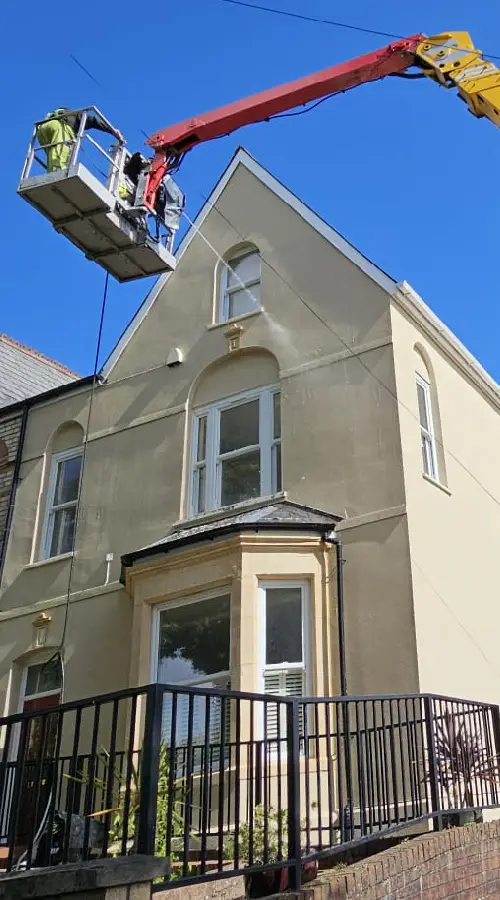
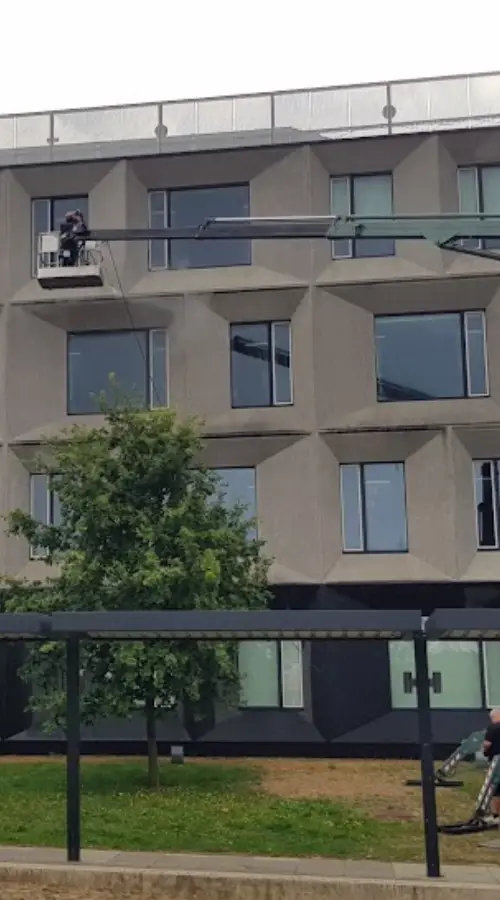
Whether those strips are included is worth asking about specifically, because they are the commonest quiet omission in this trade. A wall cleaned to either side of a downpipe and left behind it will show a vertical dark line from the road within a fortnight of drying. That line is more obvious than the soiling it replaced. Render cleaning prices are established at an assessment from elevation count, working height, access arrangements and the extent of the growth, with the number of downpipes and hoppers noted since each adds time to the day. The written render cleaning cost then holds. Affordable render cleaning is not achieved by treating the easy ninety per cent of an elevation. The crews are render cleaning specialists rather than general exterior cleaners, and this is exactly the sort of detail that separates the two. Knowing how to deliver solution into a confined gap, recognising a bracket that is corroding, and identifying where a leaking joint above has been feeding a strip for years all come from doing the work constantly. None of it can be improvised on the morning. Everything used is an eco friendly render cleaning product chosen because it breaks down safely once its work is complete, which matters where a confined strip concentrates run-off at one point rather than spreading it across a border. Anyone comparing firms in search of the best render cleaning service should ask what happens behind the downpipes. It is a small question and the answer is usually decisive. K Rend cleaning and every other finish are judged on the same detail.
The one thing checked at every assessment across this patch is whether the back of the building can actually be reached, since it decides how a day is organised more than anything else about the property. Residential render cleaning at East Orchard and West Orchard frequently involves properties with a side passage or a gate giving straightforward access to the rear, and those are simple to arrange — an unlocked gate is generally all that is needed on the day, and nobody has to be present for any of it. West Stour brings more properties where the rear can only be reached through the house, or where a boundary, an outbuilding or dense planting restricts what equipment can be brought round. Those are established at the quotation stage rather than on the day, and where a route needs clearing we will say so in advance so it is not a surprise on the morning. Occasionally a rear elevation can only be treated from a position on adjoining land, which has to be agreed with whoever owns it before anything is booked rather than sorted out on the day. We will raise that rather than assuming permission. Most owners agree readily once they have been asked properly. There is no travel charge, no minimum job size and no charge for the assessment. Anyone searching render cleaning near me should expect a local render cleaning company to walk to the back of the building before quoting for the front of it. The rear is where most of the work usually turns out to be.
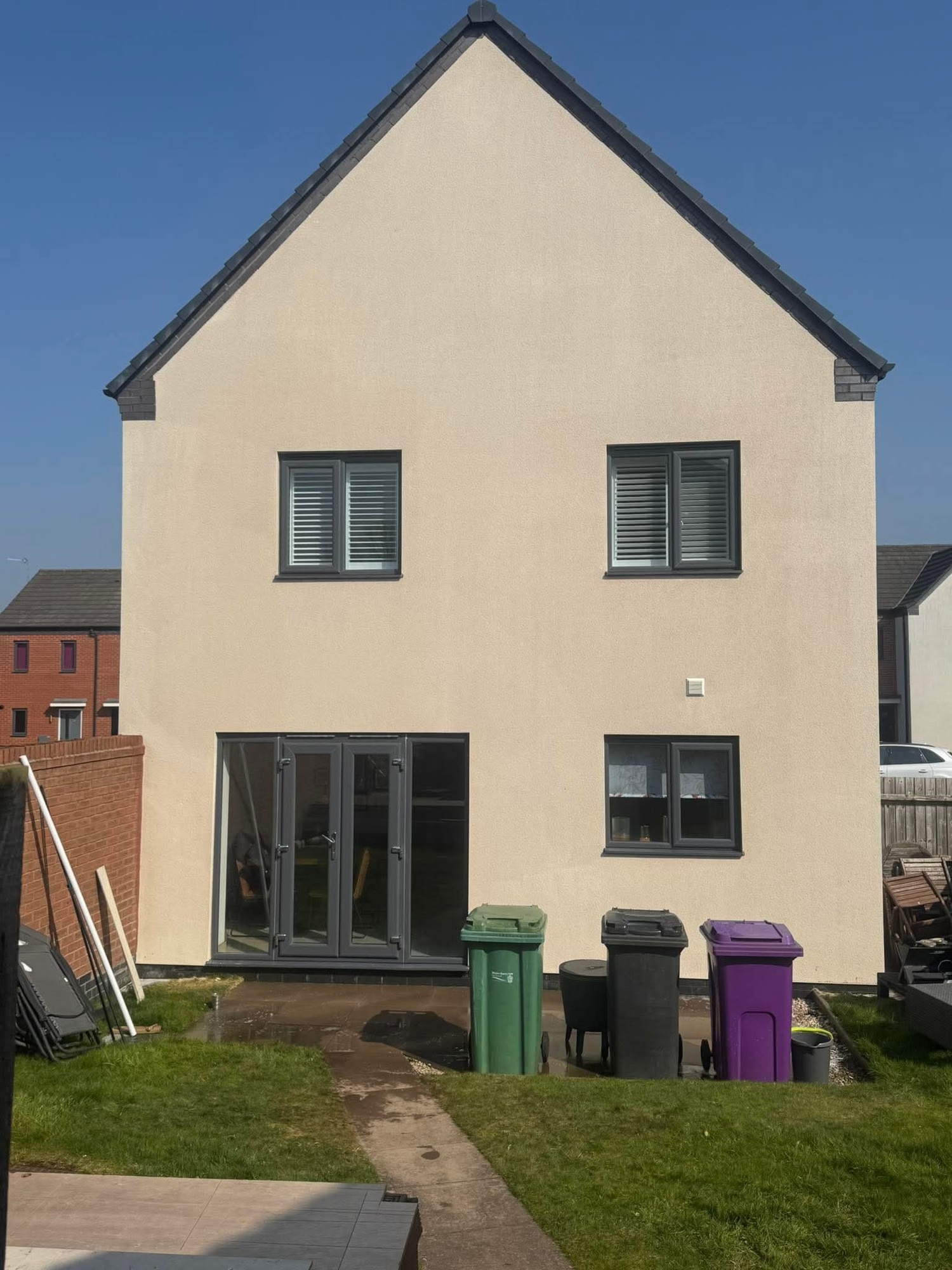
Most properties in East Stour benefit from professional render cleaning every 3 to 5 years, although this depends on the surrounding environment. Properties near trees, woodland, busy roads or coastal areas may require more frequent cleaning due to algae, mould and airborne contaminants. Our soft washing process removes existing growth and helps keep your render cleaner for longer.
Yes. Soft washing is specifically designed for delicate surfaces such as K-Rend, silicone render, monocouche render and painted render. Unlike high-pressure washing, it cleans at low pressure while treating biological growth at its source, reducing the risk of damage to the render finish.
We clean virtually all external render finishes, including K-Rend, Monocouche, Weber, Sto, silicone render, acrylic render, painted render, roughcast and pebble dash. Every cleaning method is tailored to the specific render type to achieve the best possible results.
Yes. Our specialist soft washing treatments are highly effective at removing green algae, red algae, black mould, mildew, lichen and other organic staining. We also apply professional biocide treatments to kill spores and slow down regrowth.
Because our process targets the biological growth rather than simply washing the surface, results typically last much longer than pressure washing alone. The exact lifespan depends on weather conditions, surrounding vegetation and the property’s location.
No. Our soft washing process is specifically designed to clean render safely. We use low-pressure application methods and specialist cleaning solutions that remove contamination without damaging the render surface when carried out by trained professionals.
The UK’s damp climate provides ideal conditions for algae, mould and other biological growth to develop on rendered surfaces. Areas with limited sunlight, nearby trees or persistent moisture are especially susceptible. Professional soft washing safely removes these contaminants and restores your property’s appearance.







































WhatsApp us