Dilution and application rate are the two numbers that decide whether a render clean works, and they are almost never discussed. It is worth setting out what they mean. Dilution is the strength of the treatment. Too weak and it will not reach root structures, so the wall clears superficially and greens over within a season. Too strong and it is wasteful, harder on surrounding planting, and no more effective, because beyond a certain concentration dwell time rather than strength is doing the work. The right figure depends on which organisms are present: fungal colonisation responsible for black spotting generally needs a stronger mix than algal filming, and lichen stronger again. Application rate is how much goes onto a given area of wall. This matters most on textured finishes, where product applied thinly bridges across the high points and never reaches the base of the profile where growth is actually rooted. A deeply scraped elevation needs materially more per square metre than a smooth one to achieve the same result. Getting either wrong produces the same outcome: a wall that looks acceptable for a few months and then returns. Our render cleaning services set both at survey against the organisms present and the texture involved, and dosing is controlled at source rather than mixed by eye, which is what keeps the strength consistent across a whole elevation. Render algae removal, render moss removal and render mould removal are all specified with those two figures rather than by a single standard approach. Exterior render cleaning on properties around Fladbury varies considerably in both, even between walls on the same building.
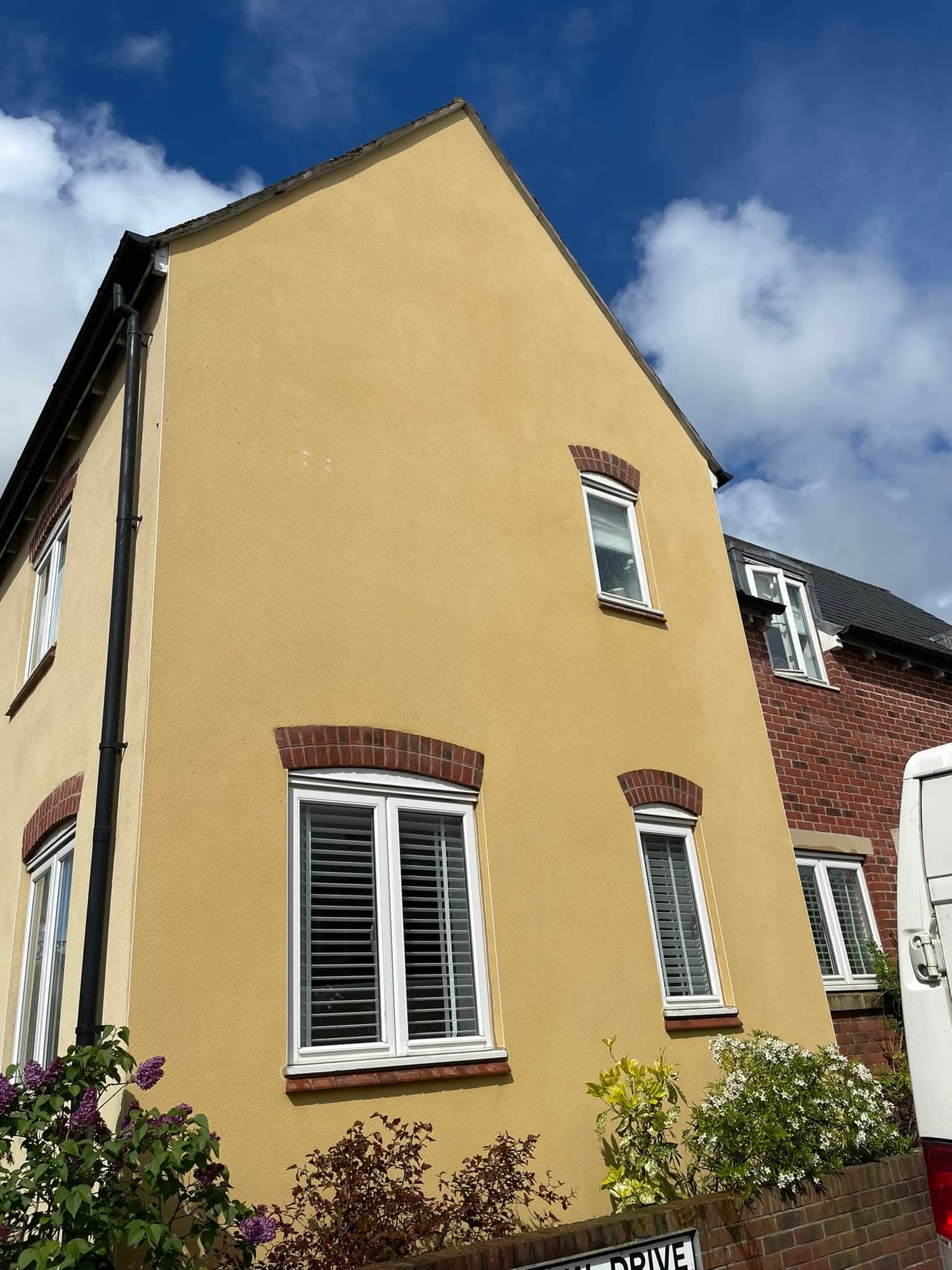
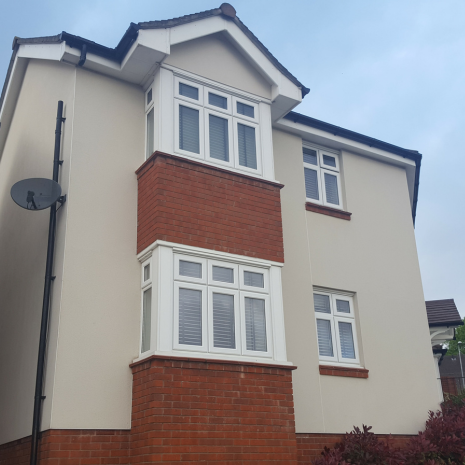

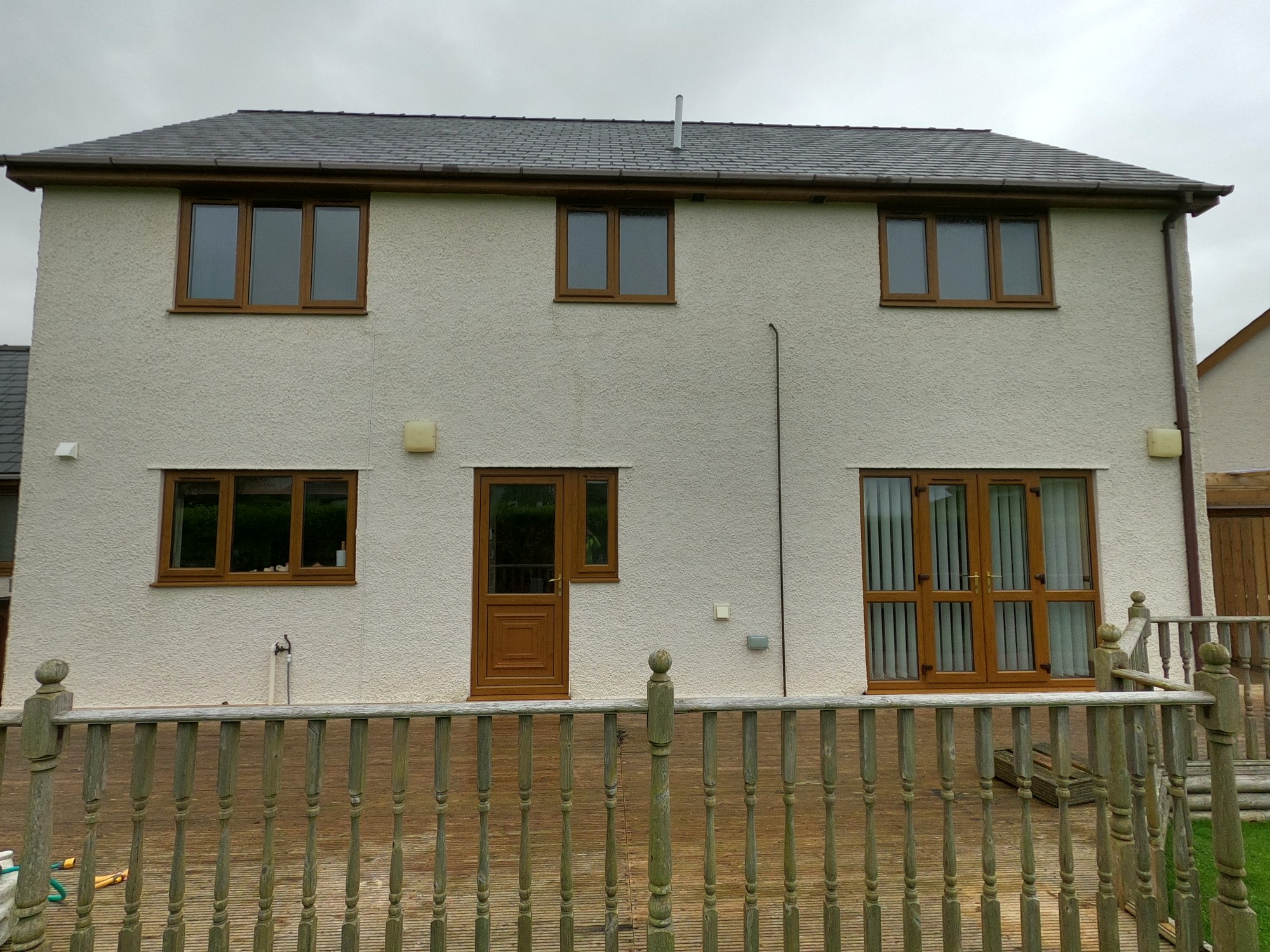
Texture grade on silicone render varies far more than the general description suggests, and matching treatment to it is one of the more consequential judgements made at survey. At one end, a finely finished thin-coat elevation presents a shallow, relatively uniform surface. Water runs off readily, the wall dries comparatively quickly, and growth sits close to the surface. Treatment applied at a standard rate reaches root level without difficulty, and dwell periods can be moderate. At the other end, a heavily scraped or coarse-aggregate finish has genuine depth. Effective surface area is several times greater, moisture is retained in the profile long after the flat plane has dried, and colonies establish at the base of the texture rather than on top. Treatment applied at the same rate as on a fine finish bridges the high points and never reaches them. Between those extremes there is a continuous range, and the same manufacturer supplies several grades. Two properties finished in the same branded system can therefore need meaningfully different specifications. K Rend cleaning here is specified against the actual texture in front of us. Volume applied per square metre rises with depth, and dwell periods extend accordingly. It is one of the reasons two apparently similar houses carry different figures. Silicone render cleaning otherwise stays constant regardless of grade: very low pressure, nothing brushed or agitated, complete elevations worked with a live wet edge at consistent dilution, since the colour is integral and any inconsistency records itself permanently. House render cleaning judged on a deeply textured wall is the fairest test of whether an application rate was right.
Deciding between cleaning a coloured render and having a new coating applied over it comes up regularly, and the arithmetic usually favours cleaning by a considerable margin. Applying a film coating over a rendered elevation means preparation, access across the full area, materials and labour, and then a surface that requires renewal on a cycle for the rest of the building’s life. It also permanently changes the nature of the finish. A through-coloured monocouche carrying a film over it is no longer a through-coloured render; it is a coated wall, and that film will eventually chalk, flake and need redoing. Cleaning restores the existing finish instead. Monocouche pigment is mineral, distributed through the body of the render and stable across decades, so a wall that looks tired is almost always a sound wall carrying growth and atmospheric deposit. Removing that layer returns the original colour, and the finish remains what it was designed to be. Monocouche render cleaning achieves it chemically: treatment applied at low pressure and in volume so it reaches the base of the scraped texture, a full dwell period so growth is destroyed at root level, then gentle rinsing with nothing brushed or agitated. There is a maintenance argument alongside the cost one. A cleaned monocouche wall needs nothing further for several years and can be treated again identically. A coated wall enters a renewal cycle instead. We say plainly where a new coating is the right answer, which is generally where the render has genuinely failed rather than simply soiled. Where the coating is sound, render restoration through cleaning is a fraction of the cost and preserves the finish rather than replacing it.
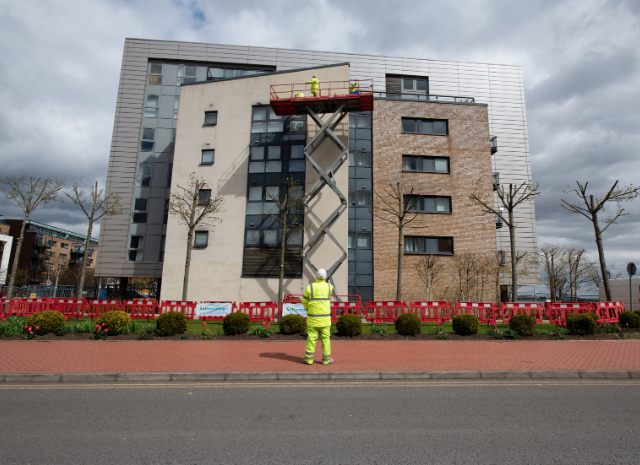

Farm shops, garden centres and rural retail premises with rendered buildings combine long opening hours, high seasonal footfall and elevations that soil faster than most because of the surrounding environment. Softwashing UK plan commercial render cleaning at these sites around the trading calendar. Spring and the run up to peak season are exactly when the building most needs to present well and least wants disruption, so the work usually goes into a quieter period or into early mornings before opening. Most premises of this scale are completed within a single visit. Customer areas are the operational consideration. Outdoor displays, plant stock, seating and parking all sit close to the elevations that need treating, and anything within reach is moved or protected before we start. Where plant stock cannot be relocated, we cover it thoroughly and control dilution to what the growth requires rather than mixing strong, which is the most effective protection there is. Exclusion zones are agreed and signed so customers stay clear without entrances being obstructed. Insurance, method statements and risk assessments are supplied ahead of attendance, and operatives hold current working at height certification. Access on these sites is generally good, with hard standing available and buildings standing clear, and our hose runs mean the vehicle does not need to be brought close to each elevation. Technically these are usually single-storey or low two-storey buildings with long continuous walls. Render facade cleaning holds identical dilution and live wet edges across the full run so the elevation reads uniformly. For rural retail premises around Fladbury, treating all buildings in one visit during a quiet period is generally the most economical arrangement.
A good proportion of our work is repeat business, and it shapes how we quote in a way that is worth explaining. Once a property has been treated properly, the next visit is typically several years away. There is far less to clear, the specification is already known, the survey is quicker and the visit is shorter. That means the second clean costs less than the first, and we price it that way rather than repeating the original figure. It also means we have no interest in recommending work that is not needed. A contractor whose income depends on annual returns has an incentive to suggest them. Ours does not, because a property treated properly does not need one and saying otherwise would be obvious the following year. So interval advice is given honestly, per elevation, based on what we saw at the property. Where a wall will not need attention for four or five years, that is what the quotation says. Where a shaded gable with planting against it will need it sooner, we say that too. Render cleaning cost on a maintained property is a modest recurring item rather than an occasional large one, and it is the cheapest way to keep a rendered building looking as it should. Full public liability cover and current working at height certification sit behind every job. Render cleaning prices are fixed at survey, and preparation, treatment, dwell, rinsing and clearing down are all included. As a local render cleaning company working the same area continuously, returning to properties we treated years earlier is the normal pattern of the work rather than an exception.
Coverage takes in Fladbury together with Charlton, Cropthorne and Hill Furze, all on identical terms with no travel loading applied. Aspect and exposure vary considerably across these settlements, and it is the single most useful thing to understand about how properties here are quoted. Buildings sit at different orientations, some enclosed by mature planting and others standing more openly, and the resulting differences between walls on the same house are frequently substantial. The pattern is consistent once you look for it. An elevation receiving several hours of direct sun and reasonable air movement dries quickly after rain and carries comparatively little growth. A shaded wall, or one sheltered from air movement by hedging or an adjacent structure, stays damp far longer and colonises heavily. On many properties one wall accounts for the majority of the work while the others need very little. We survey and quote per elevation for exactly that reason. Applying a single rate across a building either overcharges for the clean walls or underspecifies the dirty one, and the itemised quotation shows which is which. Where an elevation genuinely does not need doing yet, the quotation says so rather than including it silently. Properties in Charlton, Cropthorne and Hill Furze are typically individual rather than uniform, so nothing transfers between jobs and each is assessed on its own terms. Access is rarely a constraint, since our hose runs allow the vehicle to remain clear while treatment reaches every wall. Surveys take around twenty minutes, can be carried out unattended provided all elevations are reachable, and produce an itemised written quotation by email.
Most properties in Fladbury benefit from professional render cleaning every 3 to 5 years, although this depends on the surrounding environment. Properties near trees, woodland, busy roads or coastal areas may require more frequent cleaning due to algae, mould and airborne contaminants. Our soft washing process removes existing growth and helps keep your render cleaner for longer.
Yes. Soft washing is specifically designed for delicate surfaces such as K-Rend, silicone render, monocouche render and painted render. Unlike high-pressure washing, it cleans at low pressure while treating biological growth at its source, reducing the risk of damage to the render finish.
We clean virtually all external render finishes, including K-Rend, Monocouche, Weber, Sto, silicone render, acrylic render, painted render, roughcast and pebble dash. Every cleaning method is tailored to the specific render type to achieve the best possible results.
Yes. Our specialist soft washing treatments are highly effective at removing green algae, red algae, black mould, mildew, lichen and other organic staining. We also apply professional biocide treatments to kill spores and slow down regrowth.
Because our process targets the biological growth rather than simply washing the surface, results typically last much longer than pressure washing alone. The exact lifespan depends on weather conditions, surrounding vegetation and the property’s location.
No. Our soft washing process is specifically designed to clean render safely. We use low-pressure application methods and specialist cleaning solutions that remove contamination without damaging the render surface when carried out by trained professionals.
The UK’s damp climate provides ideal conditions for algae, mould and other biological growth to develop on rendered surfaces. Areas with limited sunlight, nearby trees or persistent moisture are especially susceptible. Professional soft washing safely removes these contaminants and restores your property’s appearance.














































WhatsApp us