


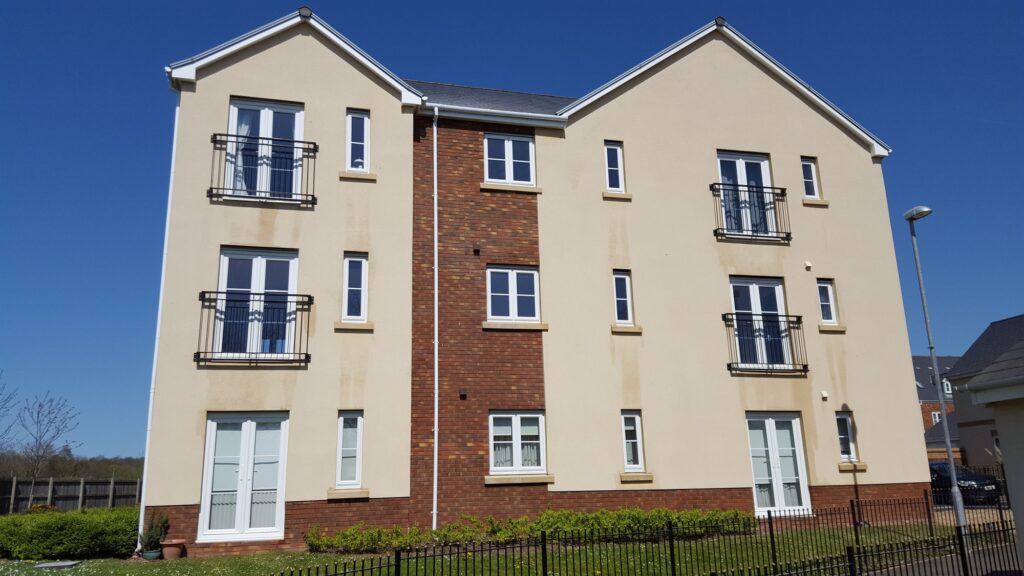
When the render on a block of flats becomes stained, discoloured or affected by biological growth, one of the first questions residents often ask is simple: who is responsible for getting it cleaned?
With a detached house, responsibility is usually relatively straightforward. With flats, it can be more complicated because the person living inside an individual property may not be responsible for maintaining the exterior of the building.
Depending on the ownership and management structure, responsibility could sit with a freeholder, landlord, managing agent, Right to Manage company or residents’ management company. Leaseholders may then contribute towards eligible exterior maintenance costs through their service charges, depending on the terms of their leases.
For rendered blocks that require professional exterior cleaning, Softwashing UK provides specialist low-pressure render cleaning for domestic and commercial properties.
Start With the Lease
For leasehold flats in England, the lease is one of the most important documents when establishing responsibility.
It sets out the obligations of the leaseholder and landlord, including responsibility for repairs and maintenance and how relevant costs may be recovered.
In many blocks of flats, individual leaseholders are responsible for the interior of their flats while the landlord or responsible management body deals with the structure and exterior of the building. However, arrangements vary, so the lease should always be checked rather than assuming every development operates in the same way.
That distinction becomes particularly important with render because the external walls usually form part of the wider building rather than one individual flat.
| Party | Possible Role in Render Cleaning |
|---|---|
| Freeholder/landlord | May hold responsibility for maintaining the exterior |
| Managing agent | May organise cleaning on behalf of the responsible party |
| Leaseholder | May contribute towards eligible costs through service charges |
| Tenant | Usually reports concerns to landlord or property manager |
| Residents’ management company | May arrange maintenance where it holds management responsibilities |
| Right to Manage company | May take responsibility for organising building maintenance |
The precise arrangement depends on the individual building and its leases.
Does the Freeholder Have to Arrange Render Cleaning?
Not necessarily every time the walls look slightly dirty.
There is a difference between an obligation to maintain or repair the exterior and a resident wanting cosmetic cleaning carried out.
The lease needs to be examined carefully to understand what services the landlord or management body is required or permitted to provide.
However, where exterior cleaning forms part of appropriate maintenance, the party responsible for the exterior may be the one that needs to organise the work.
This is particularly relevant where contamination affects large sections of a building rather than an isolated area outside one flat.
What Does the Managing Agent Do?
Managing agents are frequently the first point of contact for residents living in larger blocks.
A managing agent may organise maintenance on behalf of the freeholder, landlord, residents’ management company or Right to Manage company.
If the render has become heavily contaminated, residents might therefore report the issue to the managing agent.
The agent can then establish:
- who has responsibility under the lease;
- whether cleaning falls within the building’s maintenance arrangements;
- whether quotations need to be obtained;
- whether residents need to be consulted;
- how access will be managed;
- how the work will be scheduled;
- whether the cost can be recovered through service charges.
For larger developments, having one party coordinate exterior cleaning also avoids individual residents attempting to clean isolated sections themselves.
Can One Flat Owner Arrange Cleaning Themselves?
This is where caution is required.
A leaseholder may look at the wall outside their flat and assume that because the staining is directly beside their window, they can simply arrange for somebody to clean it.
That may not be permitted.
The exterior wall could belong to or fall under the control of the freeholder or management body. Carrying out unauthorised work could potentially conflict with the terms of the lease.
There is also the practical problem of appearance.
Imagine a block containing ten flats where one resident has a small rectangle of render cleaned around their windows while the rest of the elevation remains contaminated. The result could look extremely patchy.
For this reason, render cleaning on flats is often better considered at building or elevation level rather than flat by flat.
Service Charges and Exterior Cleaning
Leaseholders commonly contribute towards the cost of maintaining shared parts and the exterior of their building through service charges where their lease allows it.
Whether render cleaning can be included depends upon the lease and the circumstances surrounding the work.
Residents should therefore avoid assuming either that the freeholder must personally absorb the entire cost or that leaseholders must automatically pay whatever amount is requested.
The contractual arrangements matter.
| Question | Where to Look |
|---|---|
| Who maintains exterior walls? | Lease |
| Who organises contractors? | Lease/management arrangements |
| Can costs be recovered? | Lease and service-charge provisions |
| How is each flat’s share calculated? | Lease |
| Is consultation required? | Depends on the nature and cost of the works |
| Who should residents contact? | Freeholder, landlord or managing agent as appropriate |
For leaseholders, understanding these arrangements before substantial exterior maintenance takes place can prevent confusion later.
What If You Rent Your Flat?
Tenants generally have a different relationship with the building than leaseholders.
If you rent a flat and notice that the outside render is becoming heavily stained, your first step will normally be to report it to your landlord or relevant property manager rather than commissioning exterior work yourself.
The landlord can then determine whether they need to contact the freeholder or managing agent.
This is especially important in developments where an individual landlord owns one flat but does not own the overall building.
Your landlord might therefore have responsibility towards you as their tenant while still needing the building’s management organisation to deal with the exterior.
Why Flats Develop Significant Render Contamination
Blocks of flats can provide ideal conditions for visible exterior contamination simply because their elevations are large and continuously exposed to the British climate.
Some walls receive very little direct sunlight, particularly where neighbouring buildings create shade.
Green algae and red algae may develop where moisture persists, while atmospheric pollution can contribute to darker staining.
Other common causes include:
- leaking gutters;
- defective downpipes;
- overflowing drainage;
- window run-off;
- shaded elevations;
- nearby trees;
- atmospheric pollution;
- general weather exposure;
- staining from external fixtures.
On a large rendered elevation, even relatively moderate contamination can become visually prominent.
Upper Floors Create Additional Access Challenges
Cleaning a ground-floor rendered wall is very different from cleaning a five-storey elevation.
Access therefore becomes a significant part of planning render cleaning for flats.
Professional contractors need to consider how every required section of the building can be reached safely without unnecessarily damaging the surface or surrounding property.
Potential obstacles can include balconies, entrance canopies, conservatories, extensions, parked vehicles, landscaping and restricted access around the building.
This is another reason why residents should avoid independently commissioning small sections of work without approval from whoever manages the wider building.
Balconies Can Create Distinctive Staining
Balconies significantly influence how rainwater travels across a rendered block.
Water can run from balcony edges, drainage points and architectural features, creating repeated vertical streaks.
Areas beneath balconies may also receive less sunlight and remain damp for longer.
The result can be obvious differences across the elevation.
| Building Feature | Potential Effect on Render |
|---|---|
| Balcony | Run-off and shaded areas |
| Window sill | Vertical water streaking |
| Downpipe | Localised staining if leaking |
| Roof edge | Repeated water exposure |
| External bracket | Rust or run-off staining |
| Architectural ledge | Dirt accumulation |
| Shaded elevation | Slower drying and biological growth |
Understanding why contamination has developed can help determine whether other maintenance issues need addressing alongside cleaning.
Why Pressure Washing Flats Can Be Problematic
Render should not automatically be treated as a surface that needs increasingly high pressure whenever staining becomes stubborn.
Excessive pressure can potentially damage the finish, create visible cleaning lines and leave inconsistent patches.
On a block of flats, those mistakes can be particularly obvious because elevations are often large and uninterrupted.
Softwashing UK uses specialist low-pressure softwashing methods designed to treat exterior contamination while protecting the underlying surface.
Rather than simply blasting visible dirt away, the approach should take account of the render system, condition of the surface and type of contamination present.
Why Whole-Elevation Cleaning Often Makes Sense
Where contamination covers a significant section of a block, cleaning an entire elevation can often produce a more consistent appearance than treating small isolated patches.
Imagine one resident complains about staining around a third-floor window.
Cleaning only that section could leave a visibly cleaner rectangle surrounded by older, weathered render.
The management company may therefore want to assess the broader elevation rather than focusing solely on the area where the complaint originated.
That does not automatically mean the entire building always needs cleaning. Different elevations can experience very different environmental conditions.
One side may be heavily contaminated while another remains relatively clean.
A professional assessment can help determine the appropriate scope.
Communicating With Residents Before Work Starts
Flat cleaning projects involve more people than a typical detached house.
Residents may need advance information about when work is taking place and whether access around particular areas will temporarily be affected.
Windows and balconies may also need consideration.
Clear communication can cover:
- proposed working dates;
- areas being treated;
- access requirements;
- parking considerations;
- balconies and personal belongings;
- windows and doors;
- communal entrances;
- garden or landscaping areas.
For managing agents, good communication can make the project considerably easier to coordinate.
Residents’ Management Companies and Right to Manage Companies
Not every block is controlled directly by an external freeholder and managing agent.
Some leaseholders collectively participate in managing their building through a residents’ management company, while others may have acquired the Right to Manage.
In these situations, the relevant company may hold responsibility for arranging maintenance.
That means decisions about render cleaning may ultimately be made by directors who are themselves residents or leaseholders.
The same fundamental principles still apply: check the leases, understand the repairing and management obligations, assess the building properly and select a suitable contractor.
Is Dirty Render a Maintenance Problem or Cosmetic Problem?
This can be an important distinction when residents request cleaning.
A small amount of general weathering may primarily be cosmetic.
Heavy biological contamination, extensive staining or persistent water marks may indicate that closer investigation is appropriate.
For example, a dark vertical mark beneath guttering could suggest that water is repeatedly escaping onto the elevation.
Likewise, concentrated contamination around a particular drainage point could indicate an underlying issue.
Cleaning can address the appearance, but it cannot repair defective guttering or drainage.
The source of recurring staining should therefore be considered alongside the cleaning itself.
Flats Near Busy Roads Can Become Dirtier
Blocks situated beside busy roads can accumulate atmospheric contamination.
The effects are often particularly noticeable on pale render.
Because apartment blocks have large vertical elevations, there is also a substantial surface area exposed to airborne particles.
Over time, the building may begin to look grey or uneven even where biological growth is not particularly severe.
Professional cleaning needs to distinguish between different forms of contamination rather than assuming every dark area has the same cause.
Should Residents Report Green Algae and Red Algae?
If green algae and red algae are becoming increasingly obvious on communal exterior walls, residents can report the issue to whoever manages the building.
Photographs can be useful because they demonstrate the extent and location of the contamination.
When reporting the problem, provide useful information such as:
- which elevation is affected;
- approximately how extensive the contamination is;
- whether it appears to be spreading;
- whether there is obvious water run-off;
- whether guttering or drainage appears defective;
- whether the affected wall remains heavily shaded.
This gives the managing party more information when considering what action is appropriate.
Why Consistency Matters Across a Block
The visual appearance of communal buildings affects everybody.
Cleaning random areas independently can create substantial variations across the exterior.
A coordinated programme enables the responsible party to consider the building as a whole.
That could mean treating one heavily contaminated elevation, several elevations or the complete building depending on its condition.
Softwashing UK can assess rendered buildings and determine an appropriate low-pressure cleaning approach based on the surface and contamination present.
What Managing Agents Should Consider
For managing agents and property managers, arranging render cleaning involves more than obtaining a date for the work.
The condition of the building, access arrangements and residents all need consideration.
Before commissioning cleaning, it is useful to establish:
| Consideration | Why It Matters |
|---|---|
| Render type | Influences appropriate treatment |
| Surface condition | Existing defects should be identified |
| Height | Determines access requirements |
| Building layout | Balconies and extensions may affect access |
| Contamination | Helps determine suitable treatment |
| Resident communication | Reduces disruption |
| Surrounding property | Cars, gardens and entrances need consideration |
| Water staining | May indicate maintenance defects |
A detailed assessment at the beginning can help avoid surprises once work is underway.
Check Responsibility Before Booking Render Cleaning
The most important point for anyone living in a flat is not to assume responsibility based purely on where the staining appears.
A dirty wall outside your lounge window does not necessarily mean that section of render is yours to maintain.
Start with the lease and the building’s management arrangements.
Leaseholders can contact the freeholder, landlord or managing agent as appropriate, while tenants can usually begin by reporting the issue to their landlord or property manager.
Once responsibility has been established, the relevant party can arrange for the building to be assessed and determine the appropriate scope of work.
For freeholders, managing agents, property managers, Right to Manage companies and residents’ management companies looking after rendered blocks, Softwashing UK provides specialist exterior cleaning designed around the requirements of the individual building rather than treating every block as though it presents the same challenges.
Render Cleaning for Flats: Who Is Responsible?
When the render on a block of flats becomes stained, discoloured or affected by biological growth, one of the first questions residents often ask is simple: who is responsible for getting it cleaned?
With a detached house, responsibility is usually relatively straightforward. With flats, it can be more complicated because the person living inside an individual property may not be responsible for maintaining the exterior of the building.
Depending on the ownership and management structure, responsibility could sit with a freeholder, landlord, managing agent, Right to Manage company or residents’ management company. Leaseholders may then contribute towards eligible exterior maintenance costs through their service charges, depending on the terms of their leases.
For rendered blocks that require professional exterior cleaning, Softwashing UK provides specialist low-pressure render cleaning for domestic and commercial properties.
Start With the Lease
For leasehold flats in England, the lease is one of the most important documents when establishing responsibility.
It sets out the obligations of the leaseholder and landlord, including responsibility for repairs and maintenance and how relevant costs may be recovered.
In many blocks of flats, individual leaseholders are responsible for the interior of their flats while the landlord or responsible management body deals with the structure and exterior of the building. However, arrangements vary, so the lease should always be checked rather than assuming every development operates in the same way.
That distinction becomes particularly important with render because the external walls usually form part of the wider building rather than one individual flat.
| Party | Possible Role in Render Cleaning |
|---|---|
| Freeholder/landlord | May hold responsibility for maintaining the exterior |
| Managing agent | May organise cleaning on behalf of the responsible party |
| Leaseholder | May contribute towards eligible costs through service charges |
| Tenant | Usually reports concerns to landlord or property manager |
| Residents’ management company | May arrange maintenance where it holds management responsibilities |
| Right to Manage company | May take responsibility for organising building maintenance |
The precise arrangement depends on the individual building and its leases.
Does the Freeholder Have to Arrange Render Cleaning?
Not necessarily every time the walls look slightly dirty.
There is a difference between an obligation to maintain or repair the exterior and a resident wanting cosmetic cleaning carried out.
The lease needs to be examined carefully to understand what services the landlord or management body is required or permitted to provide.
However, where exterior cleaning forms part of appropriate maintenance, the party responsible for the exterior may be the one that needs to organise the work.
This is particularly relevant where contamination affects large sections of a building rather than an isolated area outside one flat.
What Does the Managing Agent Do?
Managing agents are frequently the first point of contact for residents living in larger blocks.
A managing agent may organise maintenance on behalf of the freeholder, landlord, residents’ management company or Right to Manage company.
If the render has become heavily contaminated, residents might therefore report the issue to the managing agent.
The agent can then establish:
- who has responsibility under the lease;
- whether cleaning falls within the building’s maintenance arrangements;
- whether quotations need to be obtained;
- whether residents need to be consulted;
- how access will be managed;
- how the work will be scheduled;
- whether the cost can be recovered through service charges.
For larger developments, having one party coordinate exterior cleaning also avoids individual residents attempting to clean isolated sections themselves.
Can One Flat Owner Arrange Cleaning Themselves?
This is where caution is required.
A leaseholder may look at the wall outside their flat and assume that because the staining is directly beside their window, they can simply arrange for somebody to clean it.
That may not be permitted.
The exterior wall could belong to or fall under the control of the freeholder or management body. Carrying out unauthorised work could potentially conflict with the terms of the lease.
There is also the practical problem of appearance.
Imagine a block containing ten flats where one resident has a small rectangle of render cleaned around their windows while the rest of the elevation remains contaminated. The result could look extremely patchy.
For this reason, render cleaning on flats is often better considered at building or elevation level rather than flat by flat.
Service Charges and Exterior Cleaning
Leaseholders commonly contribute towards the cost of maintaining shared parts and the exterior of their building through service charges where their lease allows it.
Whether render cleaning can be included depends upon the lease and the circumstances surrounding the work.
Residents should therefore avoid assuming either that the freeholder must personally absorb the entire cost or that leaseholders must automatically pay whatever amount is requested.
The contractual arrangements matter.
| Question | Where to Look |
|---|---|
| Who maintains exterior walls? | Lease |
| Who organises contractors? | Lease/management arrangements |
| Can costs be recovered? | Lease and service-charge provisions |
| How is each flat’s share calculated? | Lease |
| Is consultation required? | Depends on the nature and cost of the works |
| Who should residents contact? | Freeholder, landlord or managing agent as appropriate |
For leaseholders, understanding these arrangements before substantial exterior maintenance takes place can prevent confusion later.
What If You Rent Your Flat?
Tenants generally have a different relationship with the building than leaseholders.
If you rent a flat and notice that the outside render is becoming heavily stained, your first step will normally be to report it to your landlord or relevant property manager rather than commissioning exterior work yourself.
The landlord can then determine whether they need to contact the freeholder or managing agent.
This is especially important in developments where an individual landlord owns one flat but does not own the overall building.
Your landlord might therefore have responsibility towards you as their tenant while still needing the building’s management organisation to deal with the exterior.
Why Flats Develop Significant Render Contamination
Blocks of flats can provide ideal conditions for visible exterior contamination simply because their elevations are large and continuously exposed to the British climate.
Some walls receive very little direct sunlight, particularly where neighbouring buildings create shade.
Green algae and red algae may develop where moisture persists, while atmospheric pollution can contribute to darker staining.
Other common causes include:
- leaking gutters;
- defective downpipes;
- overflowing drainage;
- window run-off;
- shaded elevations;
- nearby trees;
- atmospheric pollution;
- general weather exposure;
- staining from external fixtures.
On a large rendered elevation, even relatively moderate contamination can become visually prominent.
Upper Floors Create Additional Access Challenges
Cleaning a ground-floor rendered wall is very different from cleaning a five-storey elevation.
Access therefore becomes a significant part of planning render cleaning for flats.
Professional contractors need to consider how every required section of the building can be reached safely without unnecessarily damaging the surface or surrounding property.
Potential obstacles can include balconies, entrance canopies, conservatories, extensions, parked vehicles, landscaping and restricted access around the building.
This is another reason why residents should avoid independently commissioning small sections of work without approval from whoever manages the wider building.
Balconies Can Create Distinctive Staining
Balconies significantly influence how rainwater travels across a rendered block.
Water can run from balcony edges, drainage points and architectural features, creating repeated vertical streaks.
Areas beneath balconies may also receive less sunlight and remain damp for longer.
The result can be obvious differences across the elevation.
| Building Feature | Potential Effect on Render |
|---|---|
| Balcony | Run-off and shaded areas |
| Window sill | Vertical water streaking |
| Downpipe | Localised staining if leaking |
| Roof edge | Repeated water exposure |
| External bracket | Rust or run-off staining |
| Architectural ledge | Dirt accumulation |
| Shaded elevation | Slower drying and biological growth |
Understanding why contamination has developed can help determine whether other maintenance issues need addressing alongside cleaning.
Why Pressure Washing Flats Can Be Problematic
Render should not automatically be treated as a surface that needs increasingly high pressure whenever staining becomes stubborn.
Excessive pressure can potentially damage the finish, create visible cleaning lines and leave inconsistent patches.
On a block of flats, those mistakes can be particularly obvious because elevations are often large and uninterrupted.
Softwashing UK uses specialist low-pressure softwashing methods designed to treat exterior contamination while protecting the underlying surface.
Rather than simply blasting visible dirt away, the approach should take account of the render system, condition of the surface and type of contamination present.
Why Whole-Elevation Cleaning Often Makes Sense
Where contamination covers a significant section of a block, cleaning an entire elevation can often produce a more consistent appearance than treating small isolated patches.
Imagine one resident complains about staining around a third-floor window.
Cleaning only that section could leave a visibly cleaner rectangle surrounded by older, weathered render.
The management company may therefore want to assess the broader elevation rather than focusing solely on the area where the complaint originated.
That does not automatically mean the entire building always needs cleaning. Different elevations can experience very different environmental conditions.
One side may be heavily contaminated while another remains relatively clean.
A professional assessment can help determine the appropriate scope.
Communicating With Residents Before Work Starts
Flat cleaning projects involve more people than a typical detached house.
Residents may need advance information about when work is taking place and whether access around particular areas will temporarily be affected.
Windows and balconies may also need consideration.
Clear communication can cover:
- proposed working dates;
- areas being treated;
- access requirements;
- parking considerations;
- balconies and personal belongings;
- windows and doors;
- communal entrances;
- garden or landscaping areas.
For managing agents, good communication can make the project considerably easier to coordinate.
Residents’ Management Companies and Right to Manage Companies
Not every block is controlled directly by an external freeholder and managing agent.
Some leaseholders collectively participate in managing their building through a residents’ management company, while others may have acquired the Right to Manage.
In these situations, the relevant company may hold responsibility for arranging maintenance.
That means decisions about render cleaning may ultimately be made by directors who are themselves residents or leaseholders.
The same fundamental principles still apply: check the leases, understand the repairing and management obligations, assess the building properly and select a suitable contractor.
Is Dirty Render a Maintenance Problem or Cosmetic Problem?
This can be an important distinction when residents request cleaning.
A small amount of general weathering may primarily be cosmetic.
Heavy biological contamination, extensive staining or persistent water marks may indicate that closer investigation is appropriate.
For example, a dark vertical mark beneath guttering could suggest that water is repeatedly escaping onto the elevation.
Likewise, concentrated contamination around a particular drainage point could indicate an underlying issue.
Cleaning can address the appearance, but it cannot repair defective guttering or drainage.
The source of recurring staining should therefore be considered alongside the cleaning itself.
Flats Near Busy Roads Can Become Dirtier
Blocks situated beside busy roads can accumulate atmospheric contamination.
The effects are often particularly noticeable on pale render.
Because apartment blocks have large vertical elevations, there is also a substantial surface area exposed to airborne particles.
Over time, the building may begin to look grey or uneven even where biological growth is not particularly severe.
Professional cleaning needs to distinguish between different forms of contamination rather than assuming every dark area has the same cause.
Should Residents Report Green Algae and Red Algae?
If green algae and red algae are becoming increasingly obvious on communal exterior walls, residents can report the issue to whoever manages the building.
Photographs can be useful because they demonstrate the extent and location of the contamination.
When reporting the problem, provide useful information such as:
- which elevation is affected;
- approximately how extensive the contamination is;
- whether it appears to be spreading;
- whether there is obvious water run-off;
- whether guttering or drainage appears defective;
- whether the affected wall remains heavily shaded.
This gives the managing party more information when considering what action is appropriate.
Why Consistency Matters Across a Block
The visual appearance of communal buildings affects everybody.
Cleaning random areas independently can create substantial variations across the exterior.
A coordinated programme enables the responsible party to consider the building as a whole.
That could mean treating one heavily contaminated elevation, several elevations or the complete building depending on its condition.
Softwashing UK can assess rendered buildings and determine an appropriate low-pressure cleaning approach based on the surface and contamination present.
What Managing Agents Should Consider
For managing agents and property managers, arranging render cleaning involves more than obtaining a date for the work.
The condition of the building, access arrangements and residents all need consideration.
Before commissioning cleaning, it is useful to establish:
| Consideration | Why It Matters |
|---|---|
| Render type | Influences appropriate treatment |
| Surface condition | Existing defects should be identified |
| Height | Determines access requirements |
| Building layout | Balconies and extensions may affect access |
| Contamination | Helps determine suitable treatment |
| Resident communication | Reduces disruption |
| Surrounding property | Cars, gardens and entrances need consideration |
| Water staining | May indicate maintenance defects |
A detailed assessment at the beginning can help avoid surprises once work is underway.
Check Responsibility Before Booking Render Cleaning
The most important point for anyone living in a flat is not to assume responsibility based purely on where the staining appears.
A dirty wall outside your lounge window does not necessarily mean that section of render is yours to maintain.
Start with the lease and the building’s management arrangements.
Leaseholders can contact the freeholder, landlord or managing agent as appropriate, while tenants can usually begin by reporting the issue to their landlord or property manager.
Once responsibility has been established, the relevant party can arrange for the building to be assessed and determine the appropriate scope of work.
For freeholders, managing agents, property managers, Right to Manage companies and residents’ management companies looking after rendered blocks, Softwashing UK provides specialist exterior cleaning designed around the requirements of the individual building rather than treating every block as though it presents the same challenges.
What Happens When Responsibility Is Disputed?
Sometimes the difficulty is not identifying that the render needs attention, but getting agreement over who should organise the work.
A leaseholder may believe the freeholder is responsible because the render forms part of the exterior. The freeholder or managing agent may take the view that the issue is cosmetic rather than essential maintenance. In other cases, residents may disagree over whether the cleaning is necessary at all.
The starting point should remain the lease and the management arrangements for the block. If responsibility is unclear, residents can ask the managing agent or freeholder to explain which lease provisions they are relying on.
It is useful to separate two questions:
- who has the authority to arrange work to the exterior; and
- who ultimately pays for that work.
Those answers are not always the same.
The freeholder or management company may organise the project, while qualifying costs are later recovered from leaseholders through the service charge where the lease permits it.
Why Communal Ownership Makes DIY Cleaning Risky
Rendered blocks can look straightforward from ground level, particularly where staining affects only one or two areas. However, exterior walls are commonly part of the shared structure of the building.
A leaseholder attempting to clean a section without approval can create several problems.
The method used may not be suitable for the render. Water or cleaning products could affect windows, balconies or areas belonging to neighbours. The cleaned section might also look visibly different from the rest of the building.
More importantly, individual residents may not have permission to alter or treat the exterior at all.
For this reason, reporting the issue through the proper management route is usually the sensible first step.
Ground-Floor Flats Are Not Necessarily Responsible for Lower Walls
One common misunderstanding is that the leaseholder or tenant in a ground-floor flat must be responsible for the render immediately outside their home.
Location alone does not determine legal or contractual responsibility.
The wall may still form part of the exterior structure controlled by the freeholder or management company, even if it runs directly beside a private patio or garden.
Ground-floor residents can often be the first to notice problems because they have easier access to the affected area. They may see splashback, biological contamination, cracked render or staining around drainage before people living on upper floors are aware of it.
Reporting those issues early can help the building manager assess whether cleaning, repair or further investigation is appropriate.
Private Balconies Can Complicate Responsibility
Balconies are another area where responsibility can be confusing.
A leaseholder may have exclusive use of a balcony while structural or exterior elements remain the responsibility of the landlord or management body.
For example, the resident might be responsible for keeping the usable balcony area tidy, but that does not automatically mean they are responsible for the rendered wall, balcony edge or external face.
The lease needs to be checked carefully.
| Area Around a Flat | Responsibility May Depend On |
|---|---|
| Render beside a balcony | Lease definition of exterior/common parts |
| Balcony floor | Lease obligations and demise |
| External balcony face | Building maintenance provisions |
| Window surrounds | Lease wording and management structure |
| Private patio boundary wall | Whether it forms part of the demise or common structure |
| Render around entrance doors | Lease and responsibility for external fabric |
This is another reason why assumptions based purely on physical proximity can be misleading.
Render Cleaning Can Be Part of Planned Maintenance
Managing agents often find it easier to deal with exterior cleaning as part of a planned maintenance programme rather than waiting until residents complain about heavily stained elevations.
Periodic inspections can identify areas where contamination is developing and highlight associated maintenance concerns such as defective gutters or water run-off.
Planning also gives the management team time to consider access, contractor availability and resident communication.
For larger blocks, combining render cleaning with an organised maintenance schedule can reduce the likelihood of repeated short-notice interventions.
It can also help keep the building looking consistent rather than allowing one elevation to become severely contaminated before any action is taken.
What About Housing Association or Local Authority Flats?
Responsibility can be different again where a building is owned or managed by a housing association or local authority.
Tenants should normally report exterior maintenance concerns through the landlord’s established repairs or housing-management process.
Leaseholders in mixed-tenure blocks may have separate service-charge and lease arrangements even though the landlord remains responsible for organising certain works to the structure and exterior.
Mixed-tenure buildings can therefore involve several groups of residents, but the exterior should still be managed through the appropriate building-management route rather than individuals independently commissioning work.
Large Blocks Need Careful Access Planning
The larger the block, the more important access planning becomes.
Some rendered elevations may sit directly above car parks, communal gardens, pedestrian paths or entrances. Others may include balconies, projecting roofs or restricted areas that make straightforward access difficult.
Before work begins, consideration may need to be given to:
- keeping entrances accessible;
- temporarily restricting parking spaces;
- protecting landscaped areas;
- working around balconies;
- avoiding unnecessary disruption to residents;
- ensuring upper elevations can be safely reached;
- coordinating with site managers or caretakers.
This is why professional render cleaning on flats should be viewed as a building-management project rather than simply a larger version of cleaning a house.
Resident Complaints Can Help Identify Patterns
Individual reports from residents can be useful when assessing a block.
If several leaseholders on the same elevation report staining beneath windows, for example, that pattern could indicate repeated water run-off rather than isolated dirt.
Likewise, complaints concentrated on one shaded side of the building may point towards environmental conditions that are encouraging green algae and red algae.
Managing agents can use these reports alongside a visual inspection to understand whether the issue is localised or building-wide.
Photographs taken from different positions can also make it easier to compare changes over time.
Cleaning May Reveal Repairs and Colour Differences
Apartment blocks are often repaired in stages rather than all at once.
One elevation might contain older patch repairs, areas of replaced render or sections that have been repainted after previous maintenance work.
When heavy contamination is removed, these underlying differences can become more noticeable.
That does not necessarily mean the cleaning has produced an inconsistent result. The wall may simply contain materials of different ages and colours.
Managing agents should be aware of this possibility before cleaning begins so expectations can be communicated clearly to residents.
Why Repeated Water Run-Off Should Be Investigated
A building may be professionally cleaned and look dramatically better, yet the same staining can return if the underlying cause remains.
Repeated run-off from gutters, balcony drainage or defective joints can keep one area of render wetter than surrounding sections.
Over time, contamination can re-establish in exactly the same place.
| Recurring Stain | Possible Issue to Check |
|---|---|
| Dark mark below gutter | Blockage, overflow or leaking joint |
| Streak beneath balcony | Drainage or run-off pattern |
| Dirty section below window | Water tracking from sill |
| Persistent contamination around downpipe | Leakage or poor connection |
| Repeated damp-looking area | Ongoing moisture source |
Cleaning and maintenance work can therefore complement each other. Cleaning improves the appearance, while correcting defects can reduce the likelihood of the same pattern returning quickly.
Property Managers Should Record the Condition Before Work
For larger residential developments, it can be useful to document the condition of the render before cleaning starts.
This can include photographs showing existing stains, cracks, repairs and damaged areas.
Recording the starting condition helps distinguish between pre-existing defects and the results of cleaning. It also provides a useful reference for future maintenance planning.
Where a block has several elevations, photographs can help demonstrate why one side required more attention than another.
Residents May Need to Prepare Balconies and Windows
Depending on the location and extent of the work, residents may need to take simple preparatory steps before render cleaning begins.
This could include removing personal items from balconies, keeping windows closed or moving possessions away from areas where contractors require access.
The management team should explain any requirements clearly and give residents reasonable notice.
Advance communication is particularly important in blocks with many flats because even a small misunderstanding can affect access to several areas of the building.
Why a Building-Wide View Produces Better Decisions
The biggest difference between render cleaning on flats and render cleaning on an individual house is the number of interests involved.
A single resident may be concerned about one stain outside one window. The managing agent must consider the complete elevation. The freeholder or management company may also need to think about the condition of the entire building, contractual responsibilities and future maintenance.
Taking a building-wide view makes it easier to decide whether a local treatment, one-elevation clean or broader programme is appropriate.
Softwashing UK works with property managers, freeholders and organisations responsible for exterior maintenance, providing specialist low-pressure render cleaning that can be planned around the scale, access requirements and condition of the individual block.