Rinse water quality is an unglamorous detail that shows up plainly in the finished wall, and it is worth understanding why we use purified water for the final stage. Ordinary mains water carries dissolved minerals. When it is sprayed onto a wall and left to evaporate, those minerals stay behind on the surface. On glass the result is obvious as spotting. On a textured render it is subtler but still present, showing as a faint haze or a slightly chalky cast across an elevation that has just been treated. On pale finishes it is particularly noticeable, and it partially undoes the improvement the treatment achieved. Purified water has had those minerals removed. Rinsing with it leaves nothing behind as the wall dries, so the surface that emerges is the render itself rather than the render plus a thin deposit. The difference matters most on the elevations where it is least convenient: large uninterrupted walls that dry unevenly, and shaded areas that dry slowly enough for deposit to concentrate. Our render cleaning services carry purified water on board for exactly this reason, along with the treatment itself, which also means we are not dependent on an outside tap at the property. Rinsing is otherwise carried out at low pressure and worked systematically down each elevation so no area is left part-rinsed. Render algae removal and render mould removal are largely complete by this stage, with dead material continuing to weather off over the following weeks. Exterior render cleaning finished this way leaves nothing on the wall, which on properties around Great Malvern with substantial pale elevations is exactly the point.
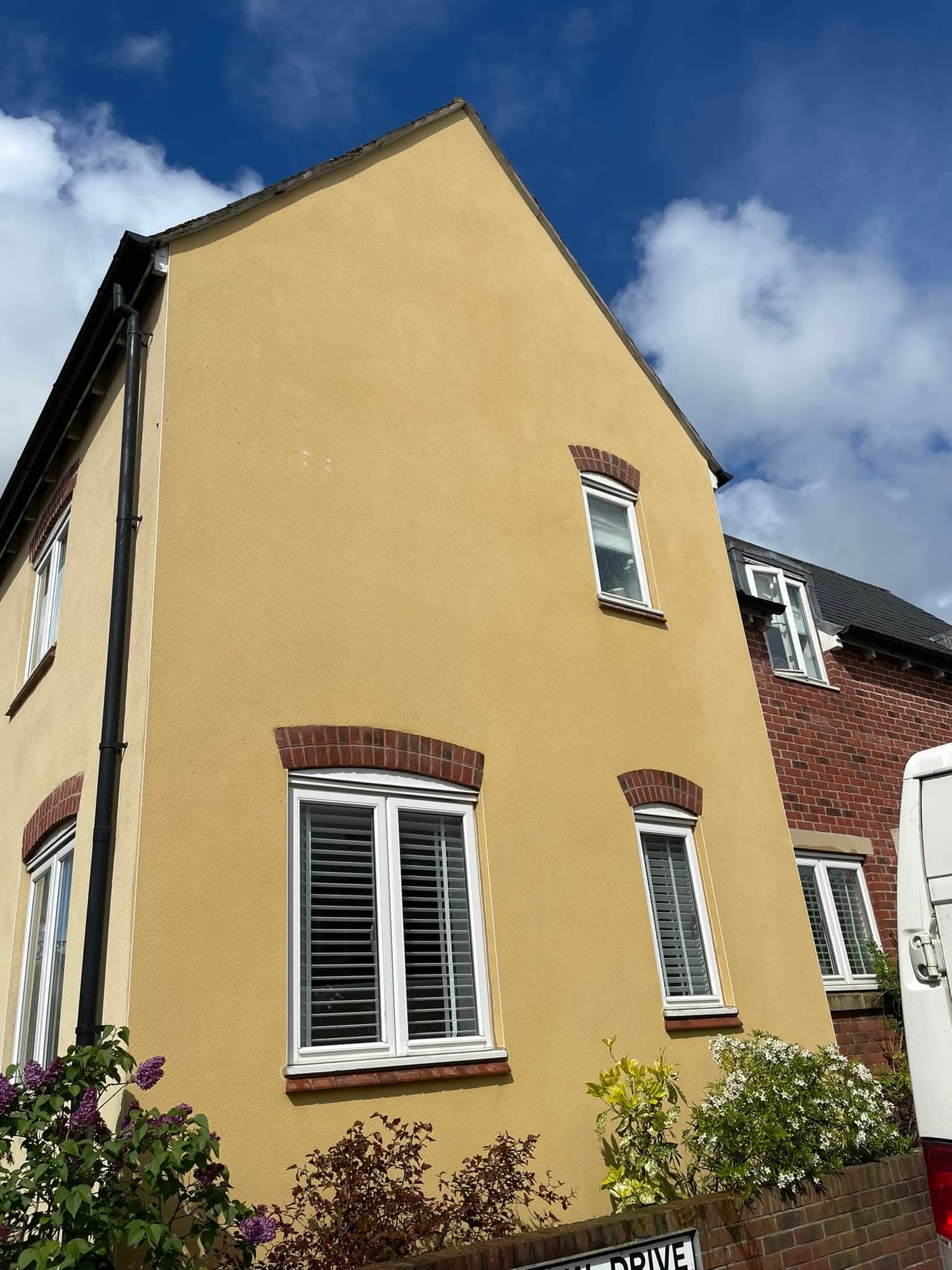
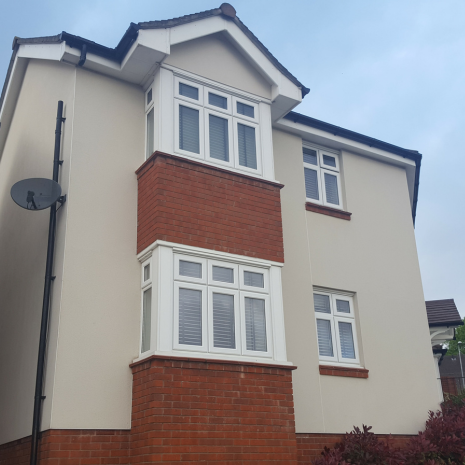

Larger and older properties finished in silicone render present a specific combination worth planning for. The elevations are substantial, the render is frequently applied over an existing substrate as part of a refurbishment, and the building often has detailing that a modern estate house does not. Scale is the first consideration. Large uninterrupted walls have to be treated as single continuous units, because any break shows as banding once dry on a through-coloured finish. That requires enough operatives, enough product carried to finish without a change of batch, and access resolved so no part of the elevation is awkward to reach. Substrate is the second. Where render has been applied over an older wall during refurbishment, absorbency can vary across a single elevation depending on what lies beneath and how the base coat was built up. Treatment behaves differently across those variations, and it is worth identifying at survey rather than discovering mid-application. Detailing is the third. Deeper reveals, string courses, projecting features and complex corners all concentrate water, colonise heavily and need deliberate treatment rather than being caught in passing. K Rend cleaning across a property of this kind is therefore specified elevation by elevation with detailing itemised separately, and the sequence planned before anything starts. Silicone render cleaning remains chemical throughout: very low pressure, nothing brushed or agitated, live wet edges maintained, dilution held consistent. Render stain removal is frequently required alongside on older buildings, since rain tracking below projecting details is common. House render cleaning that addresses both leaves an elevation reading uniformly rather than merely free of growth.
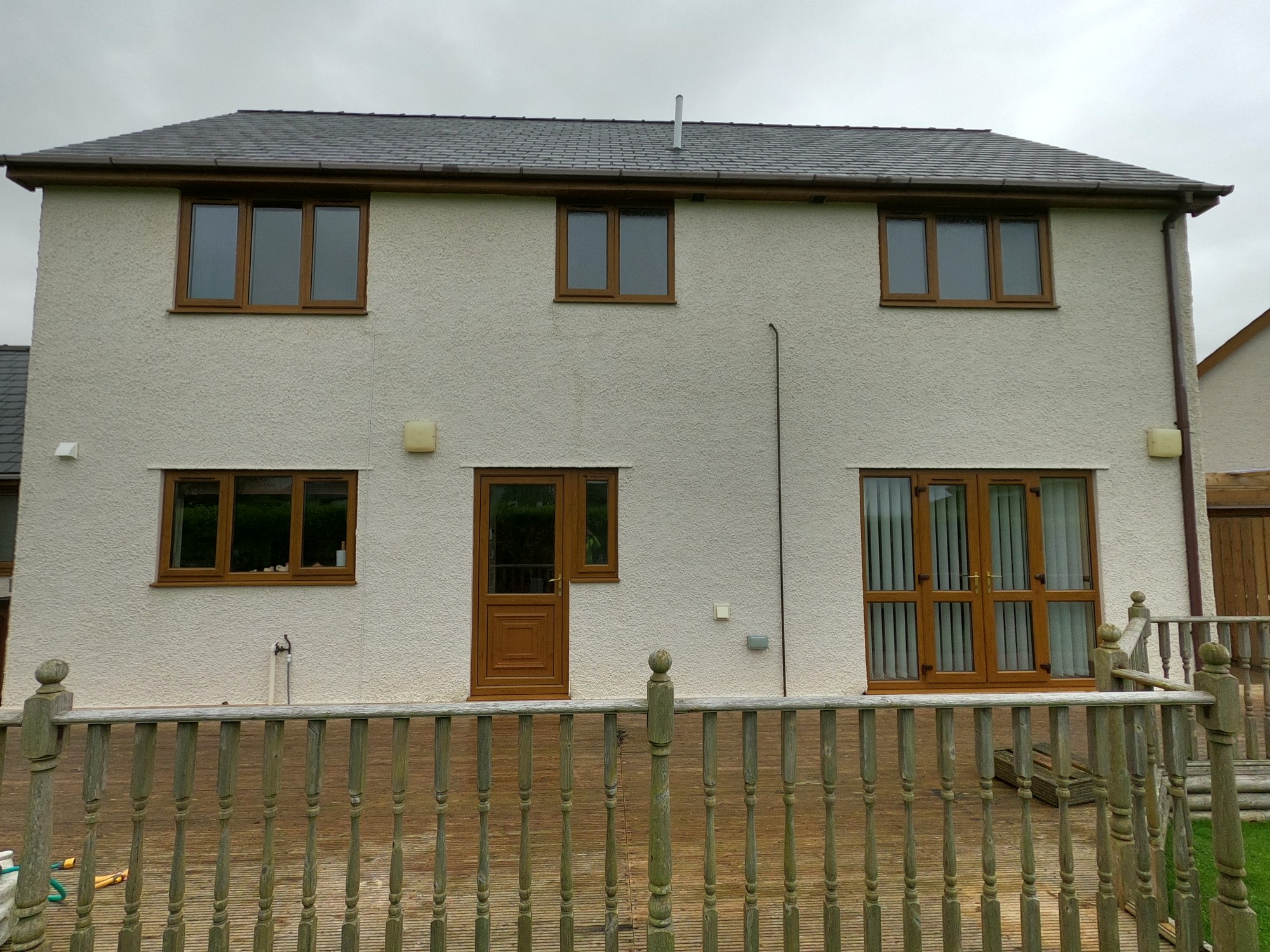
Softwashing UK are called most often to monocouche elevations that face the road, and it is worth explaining why prominent walls deserve particular care rather than simply more attention. A frontage is seen constantly and from a distance, usually across open ground, which means it is read as a whole rather than examined in detail. That has two consequences. Overall tone matters enormously, since a slight general dulling registers even when no individual area looks dirty. And any inconsistency in treatment is fully exposed, because there is nothing to break up the plane and the wall is viewed from far enough away to take it in at once. Monocouche render cleaning on a prominent elevation therefore has to be uniform above everything else. Dilution is held identical from the first section to the last, wet edges stay live throughout, and the wall is completed as a single continuous operation rather than across sessions. Access is resolved at survey so no part of the elevation is reached awkwardly and consequently underserved. The method itself is unchanged. Treatment applied at low pressure and in volume so it reaches the base of the scraped texture, a full dwell period so growth is destroyed at root level, then gentle rinsing with nothing brushed or agitated, since exposed aggregate detaches permanently under abrasion. Detailing is treated deliberately, since outlined openings on a frontage are more conspicuous than anywhere else on the building. Render restoration on a prominent monocouche wall usually produces the most noticeable result of any elevation, and residential render cleaning planned around it changes how the whole property reads.
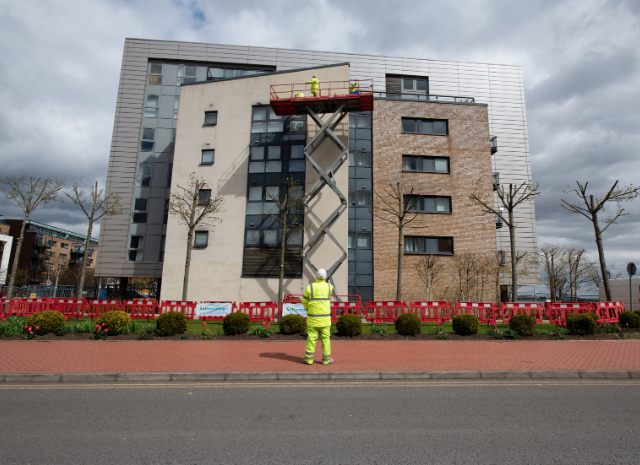

Hotels and guest houses with rendered elevations are judged on the exterior before a guest reaches reception, and increasingly before they arrive at all, since the building appears in every photograph used to sell the rooms. Commercial render cleaning at these premises has to work around continuous occupancy. Guests are in the building overnight and often through the day, arrivals and departures are concentrated at fixed times, and windows on the elevation being treated need to be closed. We survey first, phase the work so only one elevation is affected at a time, and schedule around the quietest part of the week or season. Guests need notice, and we supply the information management needs to circulate rather than leaving it to be assembled. Parking is cleared in stages, entrances stay usable throughout, and anything within the working area at ground level is protected or moved. The low pressure method is well suited to occupied accommodation. There is no machine running continuously, minimal noise, and no spray drifting across an entrance or terrace. Insurance, method statements and risk assessments are supplied ahead of attendance, and operatives hold current working at height certification. Technically these buildings often present tall elevations with substantial uninterrupted areas. Render facade cleaning must hold identical dilution and continuous wet edges from top to bottom, because banding on a multi-storey frontage is highly visible and difficult to remedy without treating the whole face again. Timing is worth planning around photography. A treated wall continues improving for several weeks, so booking ahead of a season or a new set of images gives the elevation time to reach its best.
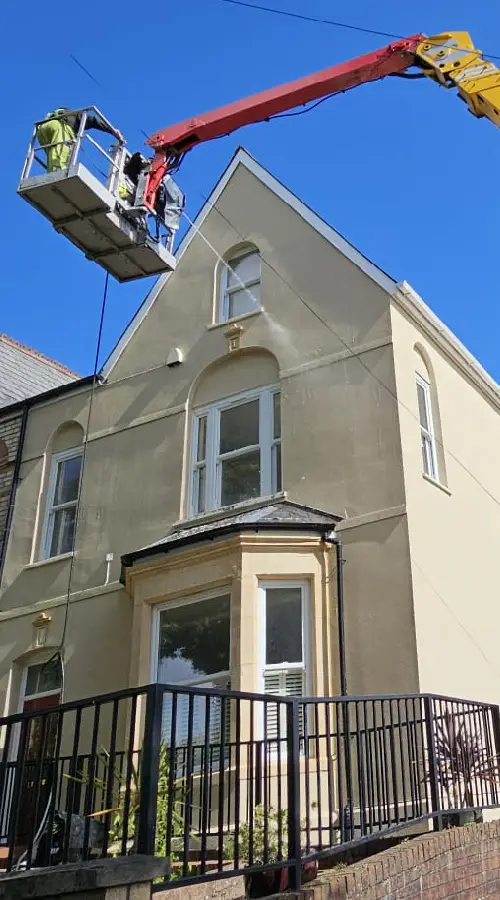
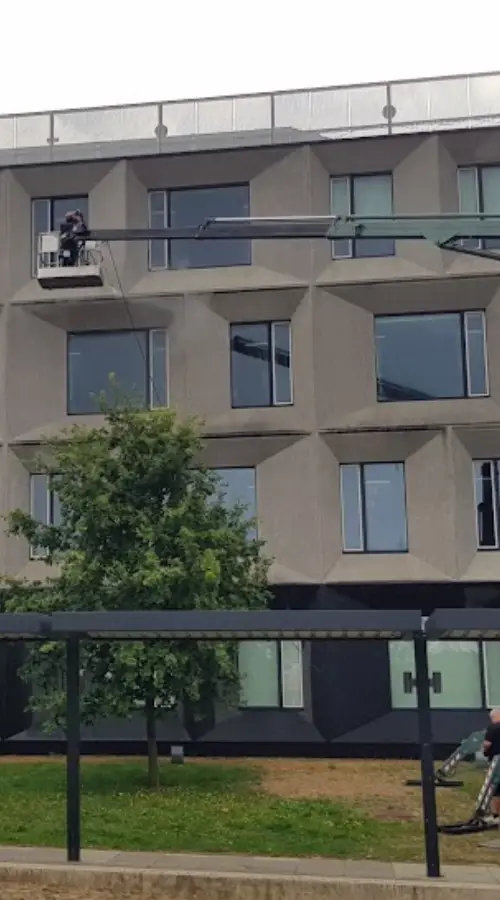
Working across a wide range of property types is what builds judgement in this trade, and it is worth being specific about what that range includes. Modest terraced and semi-detached frontages with straightforward ground-level access. Larger detached houses with three-storey gables and elevations facing every direction. Properties where an extension in a modern system meets original walls in something quite different. Older buildings carrying traditional coatings that have been repaired and made good over many decades. Insulated systems where the render sits on boarding rather than directly on blockwork. Commercial elevations running to considerable length. Buildings where the render covers the entire envelope including detailing. Each of those presents different questions, and the answers are not interchangeable. What suits a five-year-old silicone elevation is not what suits a thirty-year-old painted wall, and treating them alike damages at least one. Our render cleaning specialists work on rendered elevations exclusively, which is what allows that judgement to be made quickly and reliably at survey rather than guessed at on the day. It also means we are honest about limits. Where a coating is chalking, debonded or cracked, we say so rather than proceeding. Where previous aggressive cleaning has lifted pigment, we explain that cleaning will reveal it rather than correct it. Render cleaning cost is then quoted per elevation against a specification written for that particular wall, fixed at survey and inclusive of preparation, treatment, dwell, rinsing and any access identified. Professional render cleaning is mostly accurate assessment followed by patient execution. Render cleaning prices reflect the first as much as the second.
Coverage takes in Great Malvern together with Beacon Heath, Hillside, Link Top and West Malvern, all on identical terms with no travel loading applied. Property scale is the most useful thing to understand about how work here is planned. There is a considerable amount of larger housing, with three-storey elevations, substantial gables and buildings that have been extended or altered at various points. Rendered areas are correspondingly large, and access needs proper assessment rather than assumption. Our approach is to resolve access at survey. Telescopic delivery reaches the majority of domestic elevations from ground level, including gables at three storeys, which is safer, faster and removes access equipment from the figure entirely. Where reach is genuinely insufficient, the equipment required is identified and included in the quotation rather than raised afterwards. Large elevations also need sequencing rather than simply cleaning. Each wall must be treated, dwelled and rinsed as a continuous operation, since any break shows as banding once dry. On a property with several substantial elevations that means planning the order, resourcing the job properly and carrying enough water and product to finish each wall without interruption. All of that is built into the quoted figure. Properties in Beacon Heath, Hillside, Link Top and West Malvern vary widely in both size and finish, so every address is surveyed individually and quoted per elevation rather than by area. Larger properties are frequently a full day or more, and we say so at the quotation stage rather than arriving and running out of time. Surveys take around twenty minutes and produce an itemised written figure by email.
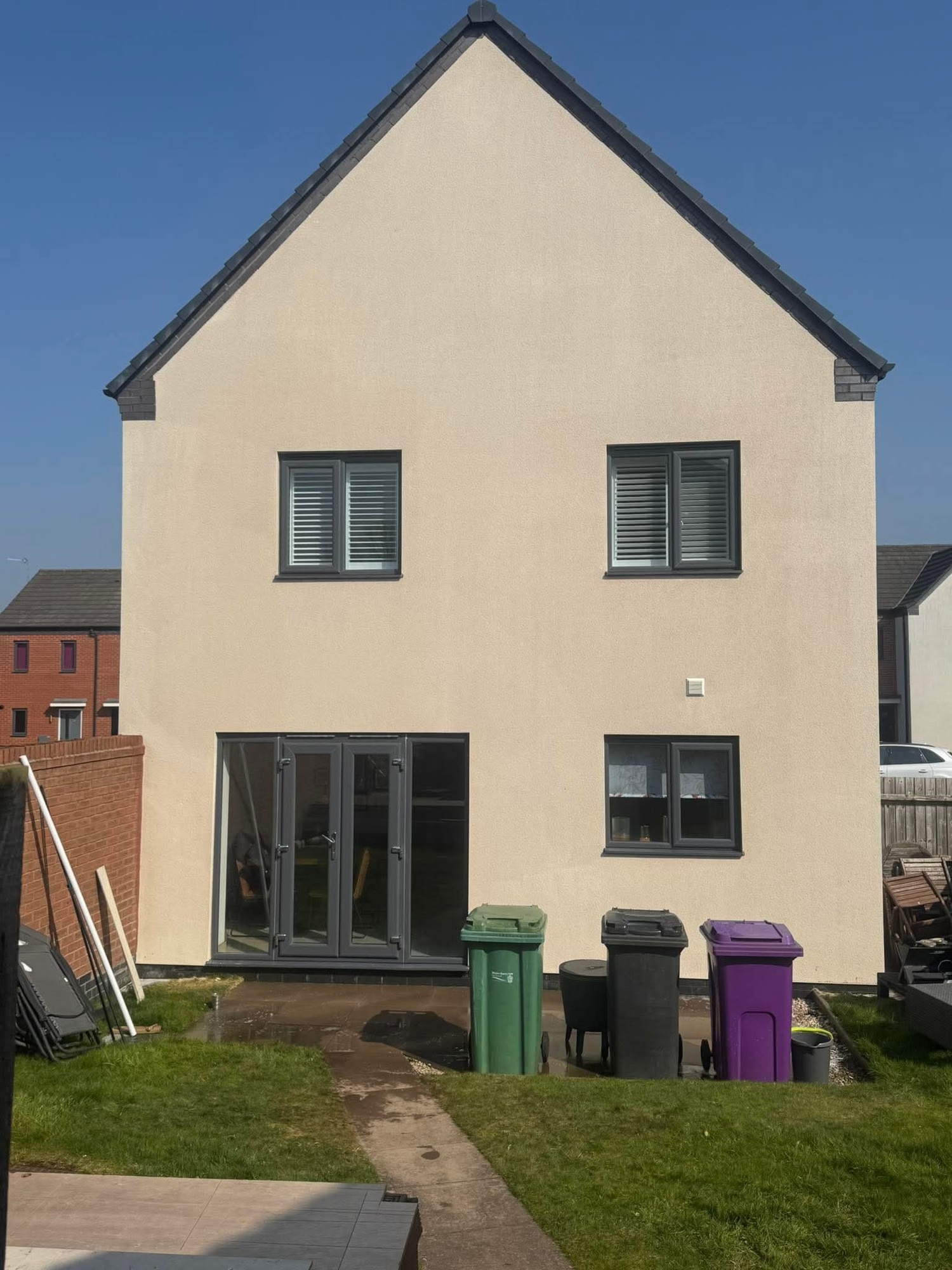
Most properties in Great Malvern benefit from professional render cleaning every 3 to 5 years, although this depends on the surrounding environment. Properties near trees, woodland, busy roads or coastal areas may require more frequent cleaning due to algae, mould and airborne contaminants. Our soft washing process removes existing growth and helps keep your render cleaner for longer.
Yes. Soft washing is specifically designed for delicate surfaces such as K-Rend, silicone render, monocouche render and painted render. Unlike high-pressure washing, it cleans at low pressure while treating biological growth at its source, reducing the risk of damage to the render finish.
We clean virtually all external render finishes, including K-Rend, Monocouche, Weber, Sto, silicone render, acrylic render, painted render, roughcast and pebble dash. Every cleaning method is tailored to the specific render type to achieve the best possible results.
Yes. Our specialist soft washing treatments are highly effective at removing green algae, red algae, black mould, mildew, lichen and other organic staining. We also apply professional biocide treatments to kill spores and slow down regrowth.
Because our process targets the biological growth rather than simply washing the surface, results typically last much longer than pressure washing alone. The exact lifespan depends on weather conditions, surrounding vegetation and the property’s location.
No. Our soft washing process is specifically designed to clean render safely. We use low-pressure application methods and specialist cleaning solutions that remove contamination without damaging the render surface when carried out by trained professionals.
The UK’s damp climate provides ideal conditions for algae, mould and other biological growth to develop on rendered surfaces. Areas with limited sunlight, nearby trees or persistent moisture are especially susceptible. Professional soft washing safely removes these contaminants and restores your property’s appearance.








































WhatsApp us