Render above roof level is a category of its own. Chimney stacks, parapets, dormer cheeks and the upper reaches of a gable are frequently rendered, almost always the most weather-beaten surfaces on a building, and almost never included in a quotation produced from the pavement. They are also the most exposed. Nothing shelters a stack or a parapet, driving rain reaches them from every direction, and the horizontal surfaces at the top of a parapet or the flashing line at a dormer collect debris that holds moisture permanently. Our render cleaning services find the heaviest colonisation of any building at exactly those points. Reaching them is the whole difficulty. A chimney stack is beyond any pole system, and a parapet or dormer cheek usually needs a platform positioned with more care than a straightforward elevation would require. That is established at the assessment and priced properly rather than attempted from a ladder. Render algae removal at high level uses the same chemistry as anywhere else, applied with more attention to where the run-off goes, since anything applied to a stack runs down the roof beneath it and then onto the elevation below. Render moss removal on parapet copings is the slowest work on any building, because those deposits are the thickest and the least accessible. Professional render cleaning of a house in Hazelbury Bryan includes whatever is rendered above the eaves or it has not covered the building, and house render cleaning that stops at gutter level leaves the worst of it. Exterior render cleaning has to go as high as the render does.
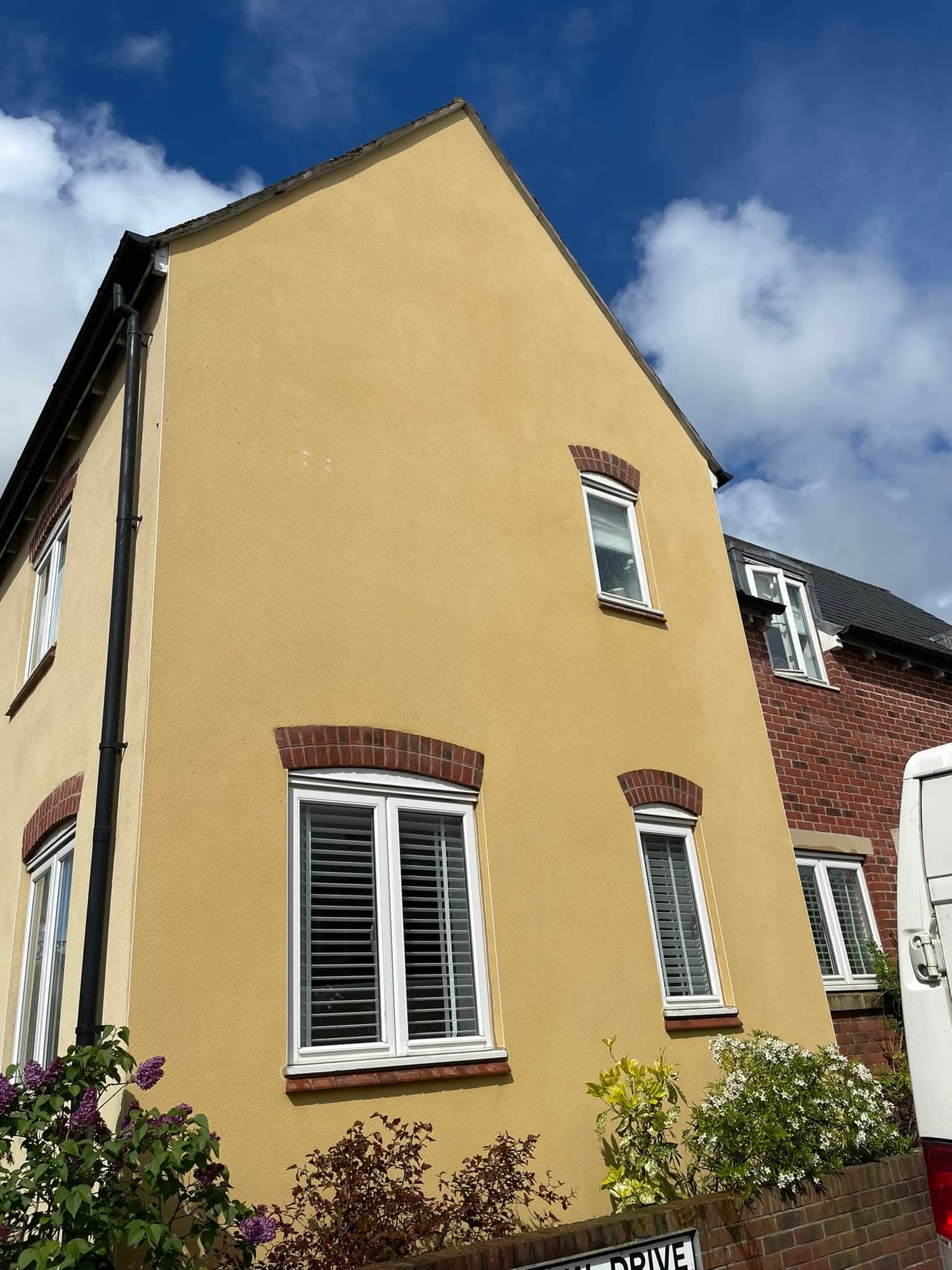
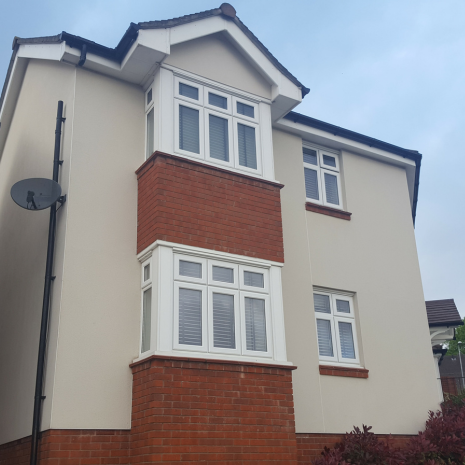

Silicone systems appear at high level on modern housing more than people expect — rendered dormer cheeks, upper gable panels and occasionally a stack finished to match the walls below. K Rend cleaning at those levels is technically identical to anything lower down and practically rather harder. Everything takes longer once an operator is not standing on the ground. Access is the whole difference. Pole systems reach a two-storey gable comfortably but not a dormer set back behind a roof slope, and applying enough volume accurately at full extension is considerably more difficult than at head height. Where a platform is the sensible answer, that is established before quoting. The method does not change. Soft wash render cleaning applies a biocidal solution at a pressure barely above hose flow, dwells long enough to destroy algae and lichen at root level, then rinses gently with the flow directed down the face. Nothing mechanical touches the surface, since pigment runs through the material and abrasion removes it permanently. Silicone render cleaning needs generous volume, and delivering that at height is the part that takes the time. High-level panels are also where growth is heaviest on an otherwise clean modern house, because they catch weather from every side and never sit in shelter. Ignoring them leaves the obvious part of the building untreated. Render stain removal at those levels usually involves marks around flashings, fixings and junctions rather than open panels. Iron bleed, cement residue and dark runs beneath a joint each need a specific product and a test patch first. On a Hazelbury Bryan property those are quoted with the access they require rather than as a general item.
Monocouche on a parapet or a stack is the most vulnerable render on any building, and Softwashing UK treats those areas with more care than anything at ground level. The coating is fully exposed, frequently thinner at a coping than on a wall, and the beads at every arris have taken decades of weather. Monocouche render cleaning up there follows exactly the same chemistry as below: solution applied at low pressure in enough volume to soak through the scraped texture, a long dwell to kill growth at root level, a repeat application on the heaviest deposits, then a soft even rinse. Nothing is worked at, and no equipment rests against a bead or a coping edge. Render pressure washing at high level is where much of the worst damage in this trade occurs, partly because operators reach for it when a deposit will not shift and partly because nobody is looking closely at a parapet from the ground. It flattens the scrape, exposes the paler aggregate beneath and leaves permanent tracking, and coloured render cleaning offers no top coat to renew over it. Run-off is the other consideration. Anything applied at parapet level travels down the elevation beneath, so the wall below is wetted first and rinsed afterwards as part of the same operation. Treated properly, render wall cleaning of monocouche at high level brings a parapet or dormer back to the same tone as the walls below. On buildings around Hazelbury Bryan where those areas had been left untouched for years, that is the part of a render restoration which changes how the whole building reads.
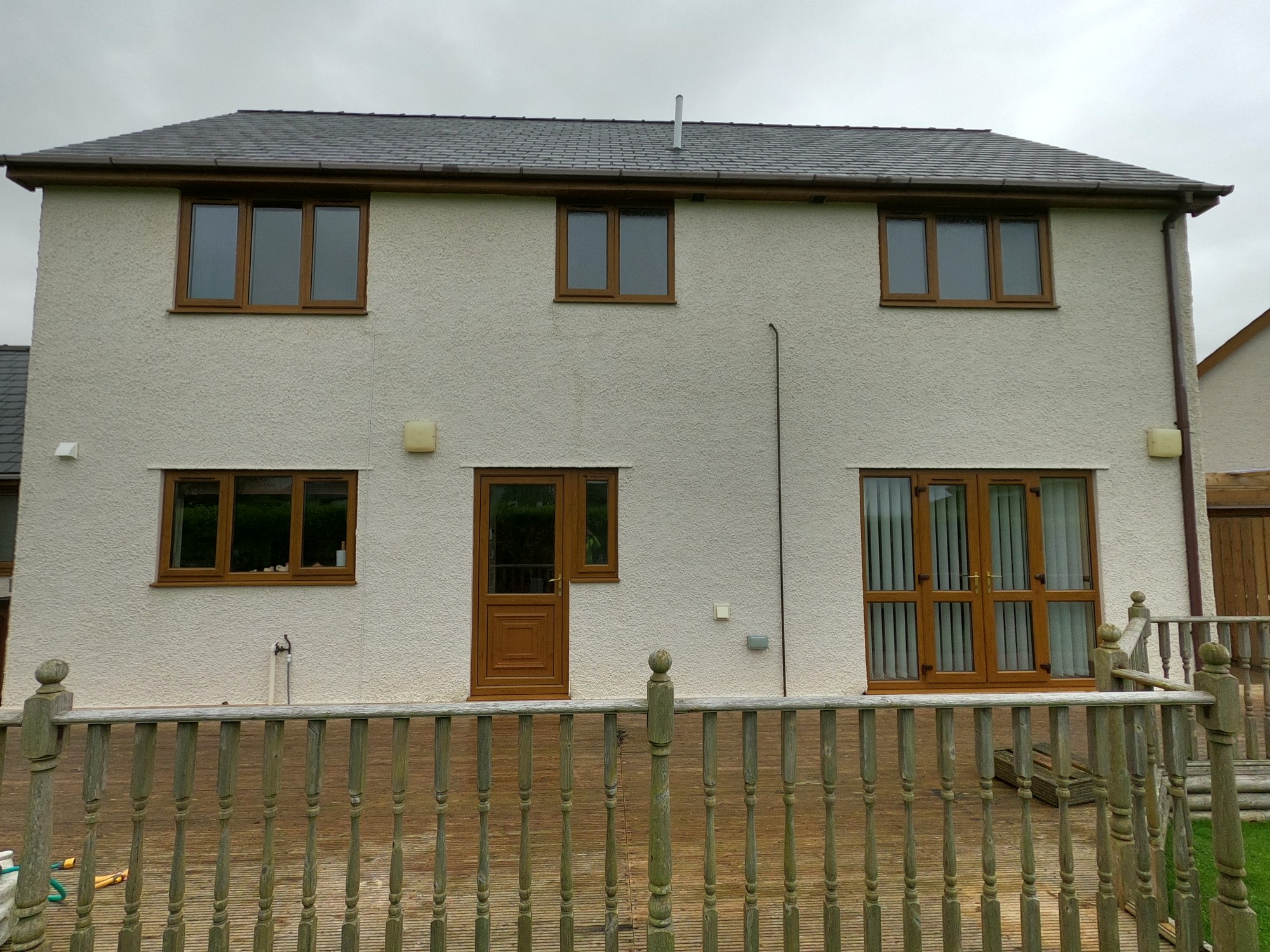
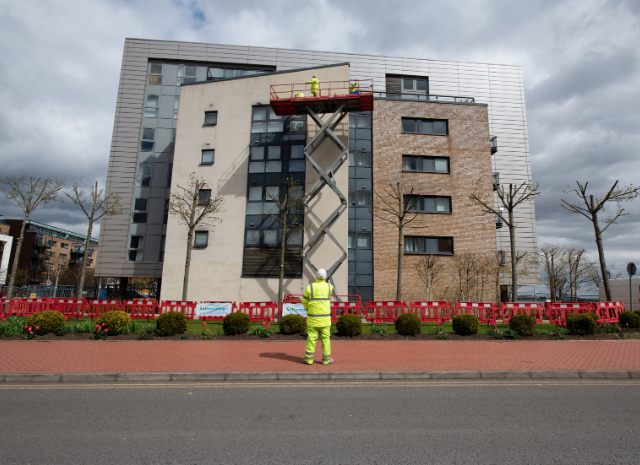

Parapets dominate commercial render. Flat-roofed units, retail parades and office buildings frequently carry a rendered upstand running the full length of the frontage, and it is simultaneously the most visible element from the approach and the most exposed to weather. Commercial render cleaning on that sort of building is largely a high-level job, with the elevations beneath taking a modest share of the programme. Access governs everything. A parapet needs a platform or a tower positioned along the full run, and the programme is built around moving that safely rather than around the treatment, which is comparatively quick once in position. Most of a day goes on positioning rather than on applying anything. Access is established first — powered platforms, tower scaffold or extended pole systems according to height and standing ground — with the programme written around trading hours, deliveries and staff movement, and method statements and risk assessments issued in advance. Render soft washing is the only sensible method at that height, since low pressure means no reaction force for an operator on a platform, very low water volumes limit what falls to the ground below, run-off stays directable clear of entrances and parking, and drift near occupied doorways is negligible. None of that is achievable with pressure equipment at height. Render facade cleaning that treats the elevations and leaves a blackened parapet above them achieves very little, since the parapet is what people see from a distance. It is also the element photographed for any listing. Render mould removal on the shaded side of a parapet is the recurring item and sets the render maintenance interval for premises in Hazelbury Bryan.
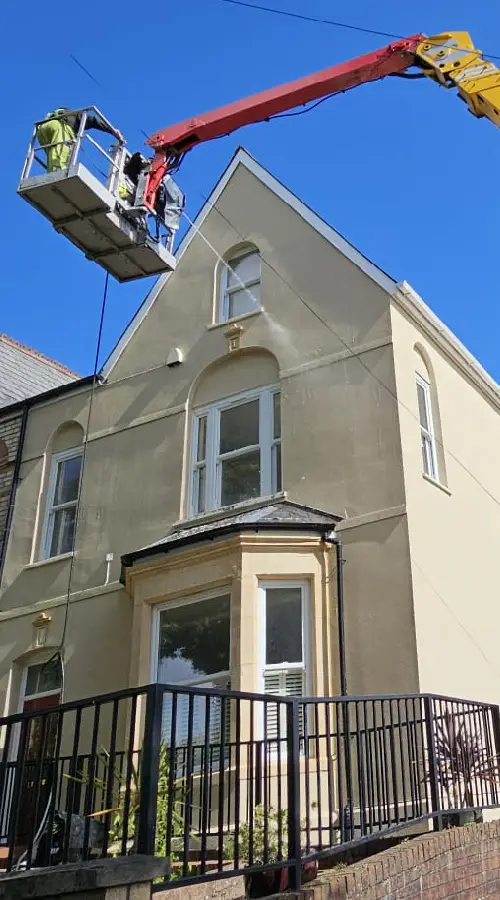
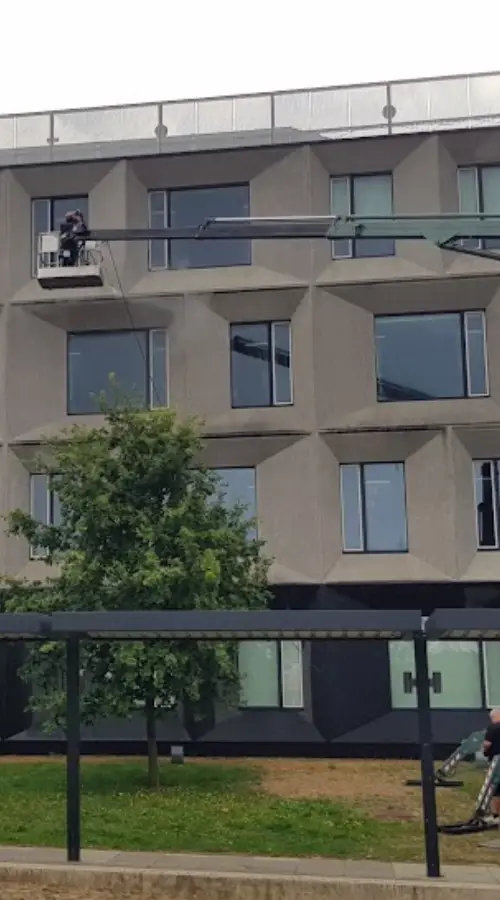
High-level work is where quotations differ most, and it is worth checking specifically what a figure includes. A price covering the main elevations and quietly omitting a rendered stack or a parapet is not a cheaper quotation for the same job; it is a quotation for a different one. Render cleaning prices here are built element by element at an assessment from elevation count, working height, access arrangements and the extent of the growth, with anything above roof level listed as its own line. That way it can be included, deferred or declined with the cost of each option visible. The written render cleaning cost then holds. Affordable render cleaning sometimes means doing the main elevations now and the high-level work when access equipment is on site for another reason. We will say when that makes sense rather than pressing for everything at once. Phasing high-level work is entirely reasonable. The crews are render cleaning specialists rather than general exterior cleaners, and at height that matters twice over. Judging what a weather-beaten stack will tolerate, recognising a coating that has already begun to fail, and working safely from a platform are all part of the same job. Everything used is an eco friendly render cleaning product chosen because it breaks down safely once its work is complete. Anyone comparing firms in search of the best render cleaning service should ask directly whether the chimney is in the price. It is the commonest omission in this trade and the easiest to check. Ask, and compare the answers rather than the totals.
Hazelbury Bryan sits within our regular working patch, and one enquiry comes up often enough to be worth addressing directly: what to do about a wall that keeps greening up faster than it should. The first thing is to establish whether the previous work was a treatment or a wash. Growth that has been rinsed off rather than killed returns within a year as a matter of course, and no amount of repeating it changes that. Residential render cleaning done chemically should hold three to five years. Anything shorter is worth investigating rather than repeating. The second is to look for a source. An outlet discharging onto a face, a filled drip groove on a sill, a blocked gully at the base of a wall, planting held tight against an elevation, or debris accumulating on a coping will all restart a colony within a season regardless of how well the treatment was carried out. The third is aspect, which cannot be changed but can be planned around. A permanently shaded face will always need attention sooner than the rest of the building, and treating that elevation on a shorter cycle is cheaper than treating everything more often. Most buildings settle onto two different intervals rather than one. We will come out and go through all three at no charge, whether or not the original work was ours. There is no travel charge, no minimum job size and no charge for the assessment. Anyone searching render cleaning near me should expect a local render cleaning company to look for the cause before quoting for the symptom.
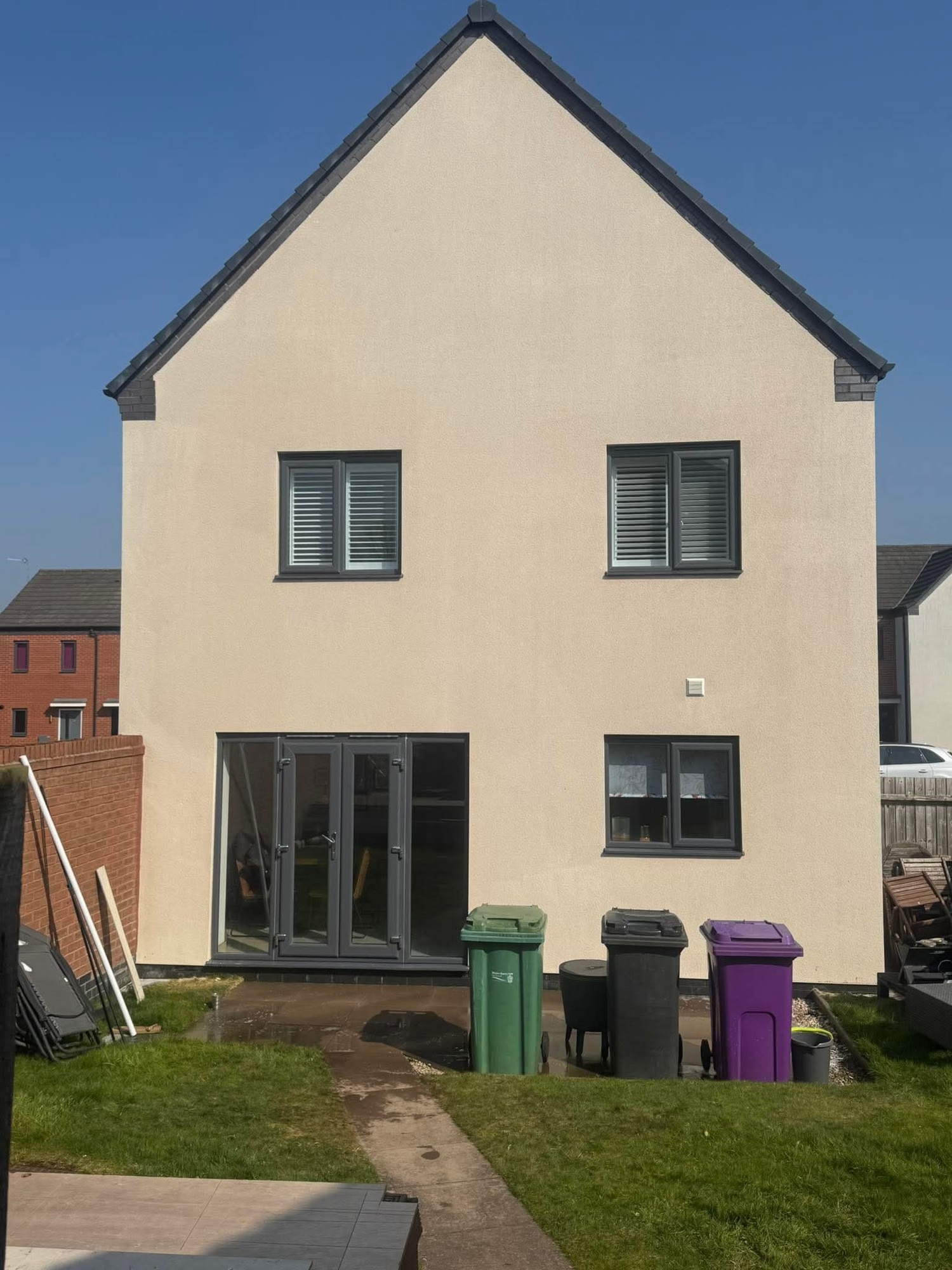
Most properties in Hazelbury Bryan benefit from professional render cleaning every 3 to 5 years, although this depends on the surrounding environment. Properties near trees, woodland, busy roads or coastal areas may require more frequent cleaning due to algae, mould and airborne contaminants. Our soft washing process removes existing growth and helps keep your render cleaner for longer.
Yes. Soft washing is specifically designed for delicate surfaces such as K-Rend, silicone render, monocouche render and painted render. Unlike high-pressure washing, it cleans at low pressure while treating biological growth at its source, reducing the risk of damage to the render finish.
We clean virtually all external render finishes, including K-Rend, Monocouche, Weber, Sto, silicone render, acrylic render, painted render, roughcast and pebble dash. Every cleaning method is tailored to the specific render type to achieve the best possible results.
Yes. Our specialist soft washing treatments are highly effective at removing green algae, red algae, black mould, mildew, lichen and other organic staining. We also apply professional biocide treatments to kill spores and slow down regrowth.
Because our process targets the biological growth rather than simply washing the surface, results typically last much longer than pressure washing alone. The exact lifespan depends on weather conditions, surrounding vegetation and the property’s location.
No. Our soft washing process is specifically designed to clean render safely. We use low-pressure application methods and specialist cleaning solutions that remove contamination without damaging the render surface when carried out by trained professionals.
The UK’s damp climate provides ideal conditions for algae, mould and other biological growth to develop on rendered surfaces. Areas with limited sunlight, nearby trees or persistent moisture are especially susceptible. Professional soft washing safely removes these contaminants and restores your property’s appearance.






































WhatsApp us