Openings are where most of the staining on a rendered wall originates. A window creates a sill that sheds water outward, a reveal that stays in permanent shade, a head above that interrupts anything running down, and a sealed junction at every edge that will eventually need attention. Almost every dark streak on an elevation can be traced back to one of them. Openings are where a wall stops behaving as a flat surface. Sills are the usual culprit. Where a drip groove has been filled, or where a sill throws water back against the face instead of clear of it, the render immediately below stays wet for hours longer than the wall around it and colonises first. Our render cleaning services concentrate on those bands rather than treating an elevation as a uniform surface. Reveals are the other. A recessed reveal never dries properly, particularly on a shaded elevation, and growth establishes there while the open wall stays clear. Render algae removal in a reveal needs a heavier application and a longer dwell simply because the surface is never dry to begin with. Heads and the underside of any projecting detail collect debris rather than water, and render moss removal along those edges is common on older properties. Professional render cleaning of a house in Iwerne Minster is judged on how the areas around openings look, since those are seen from a metre away rather than from the road, and house render cleaning that treats the panels and skips the reveals leaves the obvious part undone. Exterior render cleaning is finished at the windows. Everything else on an elevation is comparatively straightforward.
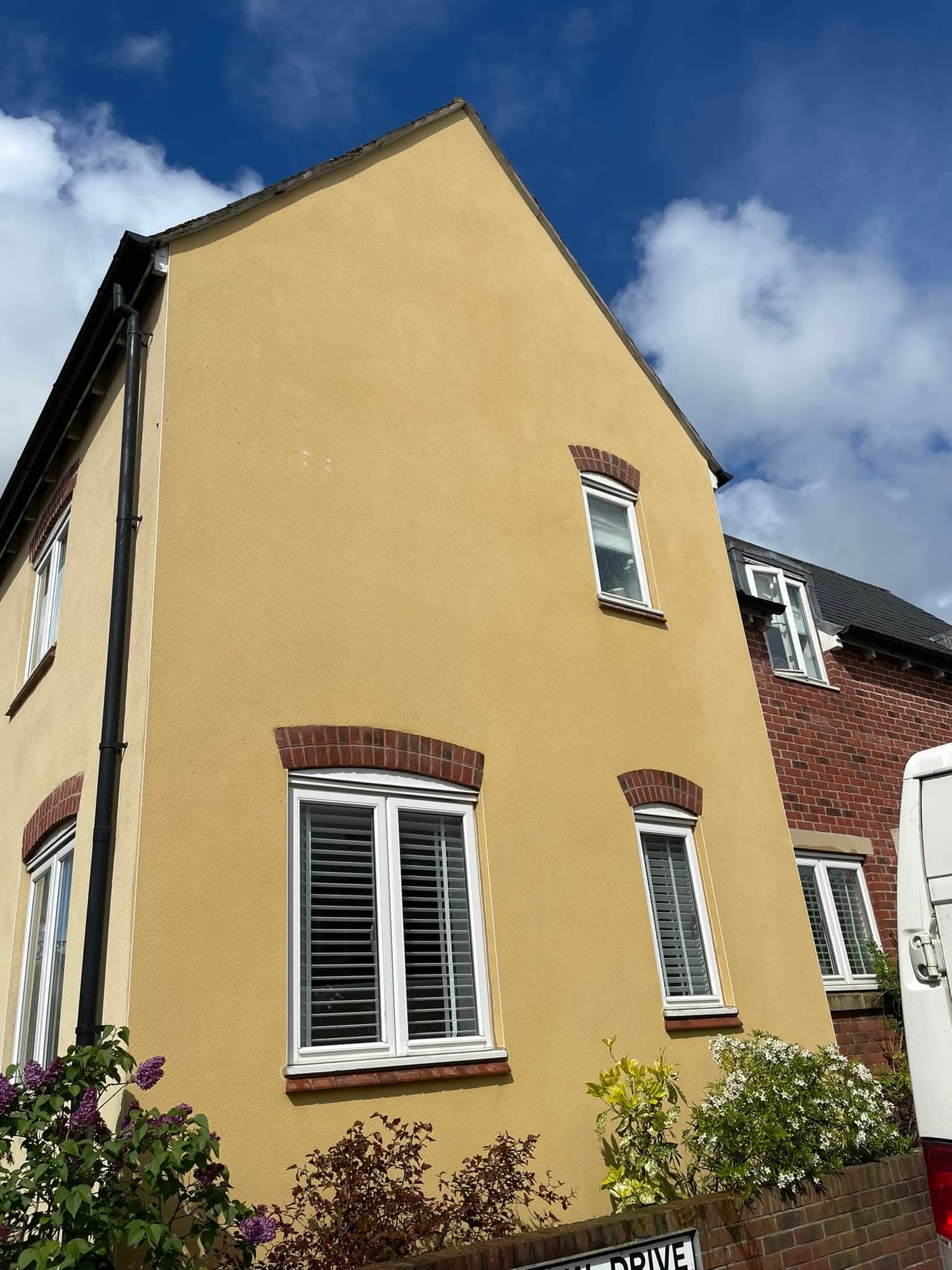
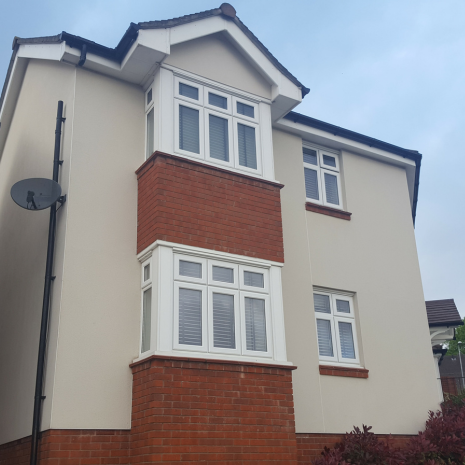

On a silicone system the junction between render and window is one of the few genuine weak points. The seal at every reveal and head is what keeps water out of the base coat and the mesh beneath, and where one has failed the resulting staining appears on the surface but originates behind it. K Rend cleaning will not remove a mark fed from that source. Saying so at the assessment saves an argument at the end. Identifying which is which is done at the assessment. A stain that begins at a corner and spreads downward usually indicates water tracking in; one that follows a sill line evenly is generally surface growth and clears readily. The pattern is usually enough to tell the two apart. The treatment is unchanged: soft wash render cleaning applies a biocidal solution at a pressure barely above hose flow, dwells long enough to destroy algae and lichen at root level, then rinses gently with the flow directed down the face rather than into any junction. Nothing mechanical touches the surface, since pigment runs through the material and abrasion removes it permanently. Silicone render cleaning also needs generous volume in a reveal, which never dries and therefore holds the heaviest growth on the elevation. Render stain removal covers the rest. Iron bleed from a fixing at a reveal, cement residue left when a window was fitted, and dark runs beneath a failed head joint each need a specific product and a test patch first. On an Iwerne Minster property those are quoted separately from the general treatment. Marks around openings are the commonest separate item we price.
Monocouche runs into a reveal and up to a bead at every opening, which makes windows the most delicate part of the elevation to work around. The stop bead at a reveal is a thin section of coating over a formed profile, and it chips more readily than anything else on the building. Monocouche render cleaning around openings is deliberately slow for that reason. Nothing about a reveal rewards being hurried. Treatment is applied generously into reveals and along sill lines where growth is heaviest, given a longer dwell than the open panels need, and repeated where deposits are thick. Nothing is worked at, scraped or brushed, and no equipment is rested against a bead at any point. Poles are held clear rather than braced on the wall. Render pressure washing causes its worst damage at exactly these points. A lance directed into a reveal blows the bead edge within seconds, exposes the aggregate beneath and leaves tracking around an opening that will be visible from inside the room as well as outside it. Coloured render cleaning offers no top coat to renew over that. Damage at an opening is seen from both sides of it. Handled carefully, render wall cleaning of monocouche leaves every reveal, sill and head as clean as the panels around them and every bead undamaged. On properties around Iwerne Minster where the areas around openings had darkened well beyond the rest of the wall, bringing them back to the specified tone is the part of a render restoration that shows most from close range. Reveals are looked at from a metre rather than a hundred.
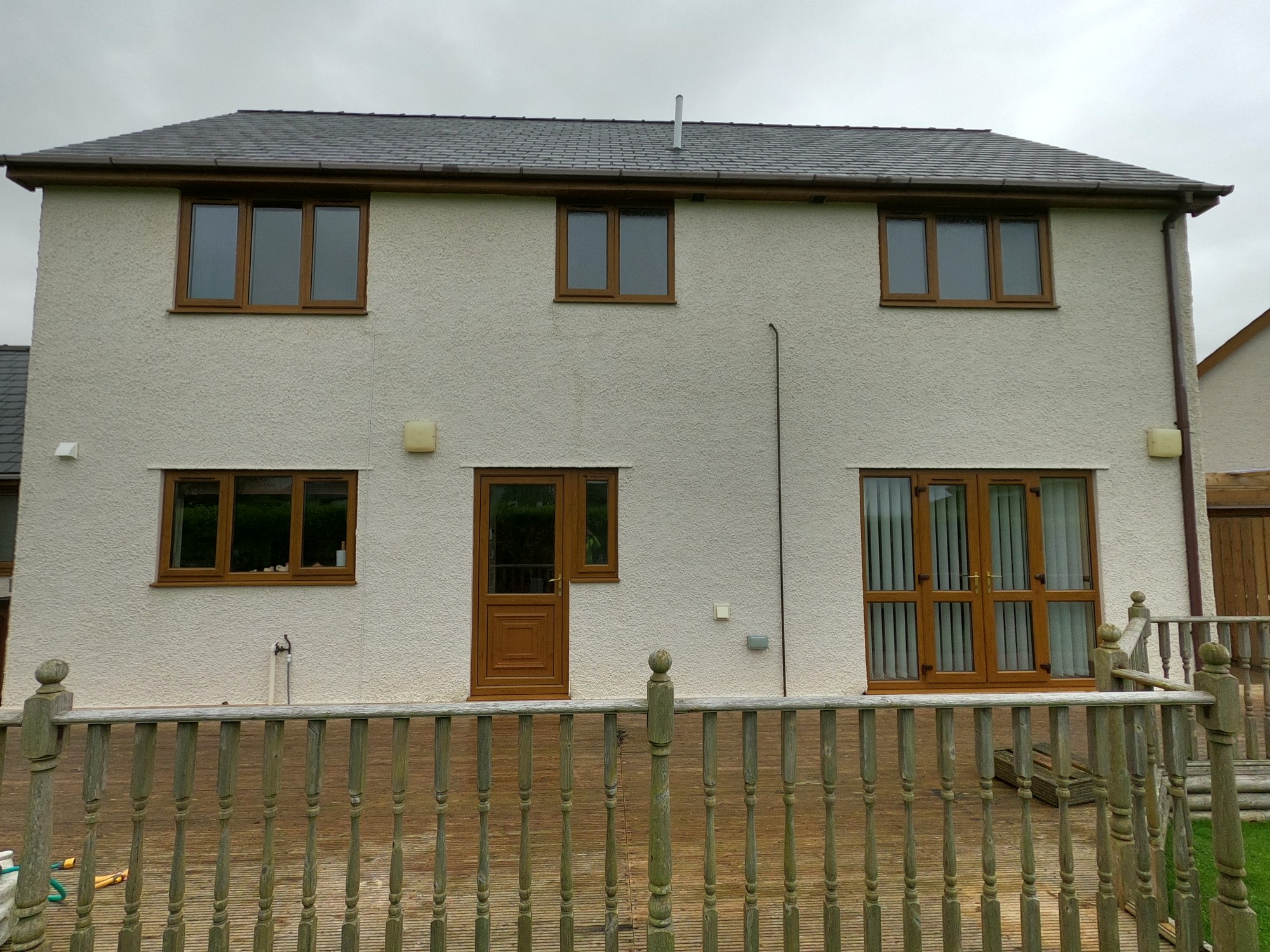
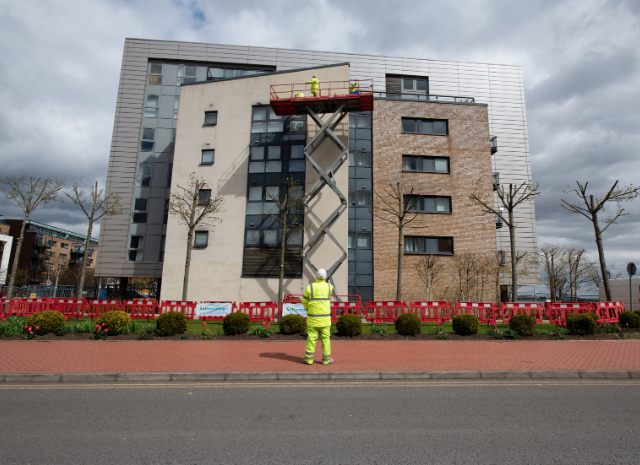

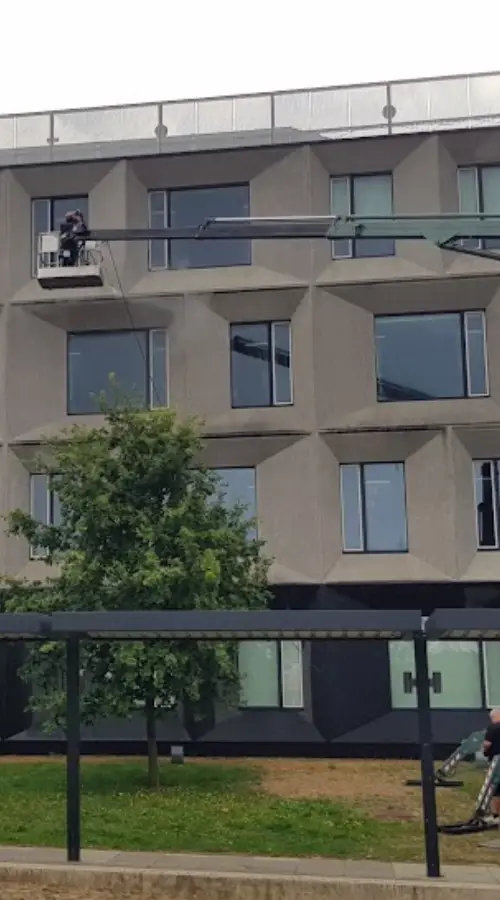
Commercial elevations are dominated by glazing, and the render between and around it is usually a smaller area than the openings themselves. Curtain walling, shopfronts, ribbon windows and repeated punched openings all mean commercial render cleaning is largely a job of working carefully around glass rather than covering large plain surfaces. The render is often the smaller half of the elevation. Protection is the bulk of the preparation. Glazing, frames, seals, trickle vents and any signage or fitting at a reveal are covered before treatment begins, across the full working area rather than only where overspray seems likely. Assumptions about where drift will land are usually wrong. Access is established first — powered platforms, tower scaffold or extended pole systems according to height and standing ground — with the programme written around trading hours, deliveries and staff movement, and method statements and risk assessments issued in advance. Nothing is left to be agreed once a platform is already up. Render soft washing is the only practical method near that much glass. Low pressure produces droplets rather than mist so there is very little airborne, very low water volumes keep run-off controllable, and coverage stays even along a full flank. Consistency between bays of glazing is what people notice. Render facade cleaning attempted with pressure equipment across a glazed elevation creates marking that then has to be dealt with separately. Cleaning glass afterwards is a second job nobody costed. Render mould removal is heaviest in reveals and beneath sills on shaded elevations, and those areas set the render maintenance interval for premises in Iwerne Minster. Those areas also settle more slowly than the panels around them.
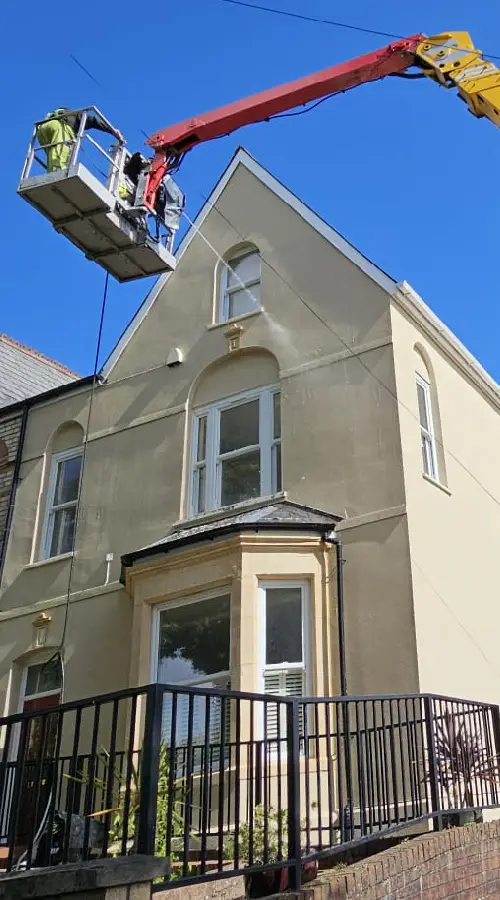
Softwashing UK protects glazing, frames and any seal within the working area before a drop of solution is applied, and that preparation takes longer around openings than anywhere else on a building. It is included in the figure rather than added to it. Preparation is never a variable on a quotation. Render cleaning prices are established at an assessment from elevation count, working height, access arrangements, the extent of the growth and how much detailing there is to work around. A property with many openings takes longer than one with few, whatever the wall area suggests. Counting openings is a better guide to duration than measuring a wall. The written render cleaning cost then holds. Affordable render cleaning comes from allowing for that at the outset rather than discovering it halfway through an afternoon. Time is the thing most often underestimated on a detailed elevation. The crews are render cleaning specialists rather than general exterior cleaners, which shows around openings more than anywhere. Recognising where a seal has failed, where a sill is throwing water back onto the face, or where cracking at the corner of a reveal would carry solution behind the coating is the difference between treating a symptom and pointing out a cause. Both are recorded, and only one of them is ours to fix. Everything used is an eco friendly render cleaning product chosen because it breaks down safely once its work is complete. Anyone comparing firms in search of the best render cleaning service should ask how the reveals will be handled. It is a small question and it separates a thorough quotation from a quick one. Reveals are where a rushed job stops.
Iwerne Minster sits within our regular working patch, and a fair number of the visits we make here are second opinions rather than first enquiries. We are entirely happy with that. Nobody should feel awkward about asking. Somebody has been quoted a figure that seems high, or has been told the wall needs recoating, or has had two contractors describe the same elevation in completely different terms. Coming out to look and giving a straight answer costs nothing and takes about twenty minutes. There is no obligation attached to it in either direction. Sometimes the answer confirms what has already been said, in which case we say so plainly and there is no reason to change contractors. Confirming somebody else’s figure is a perfectly useful outcome. Sometimes the answer is that residential render cleaning would resolve what has been described as a much larger problem, which is worth knowing before committing to anything. The difference in cost between the two is usually substantial. Occasionally it goes the other way and we advise against the work altogether, because a coating is failing or a defect is feeding the growth and cleaning would achieve very little. That is a less welcome conversation and a more useful one. There is no travel charge, no minimum job size and no charge for the assessment, whether or not any work follows. Anyone searching render cleaning near me should feel free to ask a local render cleaning company for a view on somebody else’s quotation, and a firm unwilling to give one probably has a reason. An opinion is cheap and occasionally saves a great deal.
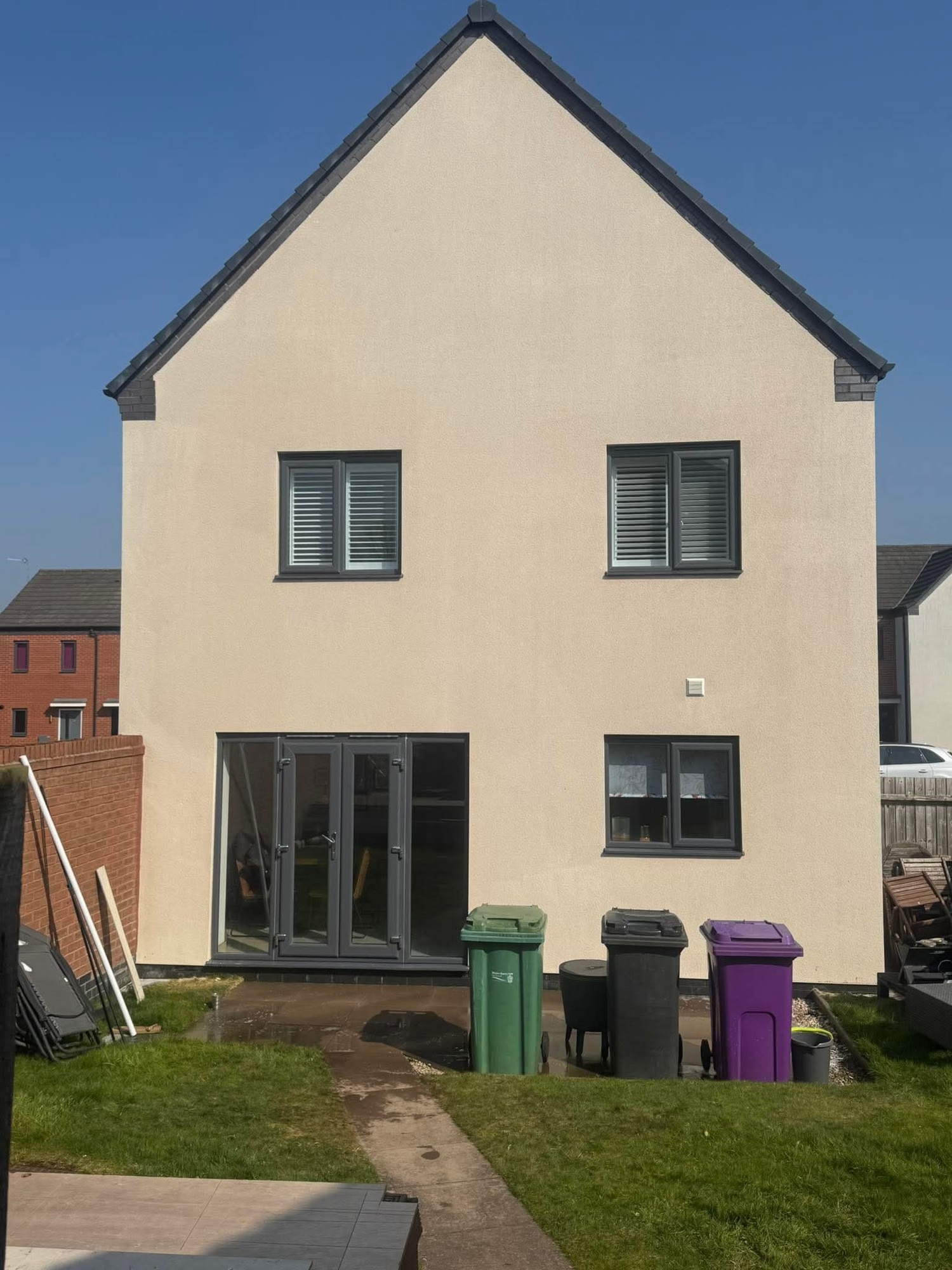
Most properties in Iwerne Minster benefit from professional render cleaning every 3 to 5 years, although this depends on the surrounding environment. Properties near trees, woodland, busy roads or coastal areas may require more frequent cleaning due to algae, mould and airborne contaminants. Our soft washing process removes existing growth and helps keep your render cleaner for longer.
Yes. Soft washing is specifically designed for delicate surfaces such as K-Rend, silicone render, monocouche render and painted render. Unlike high-pressure washing, it cleans at low pressure while treating biological growth at its source, reducing the risk of damage to the render finish.
We clean virtually all external render finishes, including K-Rend, Monocouche, Weber, Sto, silicone render, acrylic render, painted render, roughcast and pebble dash. Every cleaning method is tailored to the specific render type to achieve the best possible results.
Yes. Our specialist soft washing treatments are highly effective at removing green algae, red algae, black mould, mildew, lichen and other organic staining. We also apply professional biocide treatments to kill spores and slow down regrowth.
Because our process targets the biological growth rather than simply washing the surface, results typically last much longer than pressure washing alone. The exact lifespan depends on weather conditions, surrounding vegetation and the property’s location.
No. Our soft washing process is specifically designed to clean render safely. We use low-pressure application methods and specialist cleaning solutions that remove contamination without damaging the render surface when carried out by trained professionals.
The UK’s damp climate provides ideal conditions for algae, mould and other biological growth to develop on rendered surfaces. Areas with limited sunlight, nearby trees or persistent moisture are especially susceptible. Professional soft washing safely removes these contaminants and restores your property’s appearance.














































WhatsApp us