Products sold for treating exterior walls are widely available, and it is worth being straightforward about what they will and will not achieve on render. Most retail treatments are supplied ready-diluted at a strength suited to general use and to being applied by hand. On a smooth surface carrying light filming they can help. On a textured render carrying established colonisation they generally do not, and the reasons are practical rather than a matter of brand. Coverage is the first problem. Treating a full elevation evenly requires enough volume to wet the surface thoroughly and, on a textured face, to flow into the profile. Applied by hand from a container, coverage is patchy and quantity is inadequate, so growth survives wherever the product did not reach. Strength is the second. Ready-diluted retail products are generally weaker than a specification written for established fungal colonisation, so the green may clear while the black spotting remains. Reach is the third, and it is the one that matters most. The worst growth is nearly always at high level on shaded gables and upper elevations, which is exactly where nobody can safely apply anything by hand. Our render cleaning services address all three: controlled dilution set against the organisms present, volumes measured in hundreds of litres, and telescopic delivery reaching most elevations at three storeys from ground level. Render algae removal at low level with a retail product occasionally makes sense. Exterior render cleaning of a whole property in Lower Broadheath realistically does not, and the difference is equipment rather than chemistry.
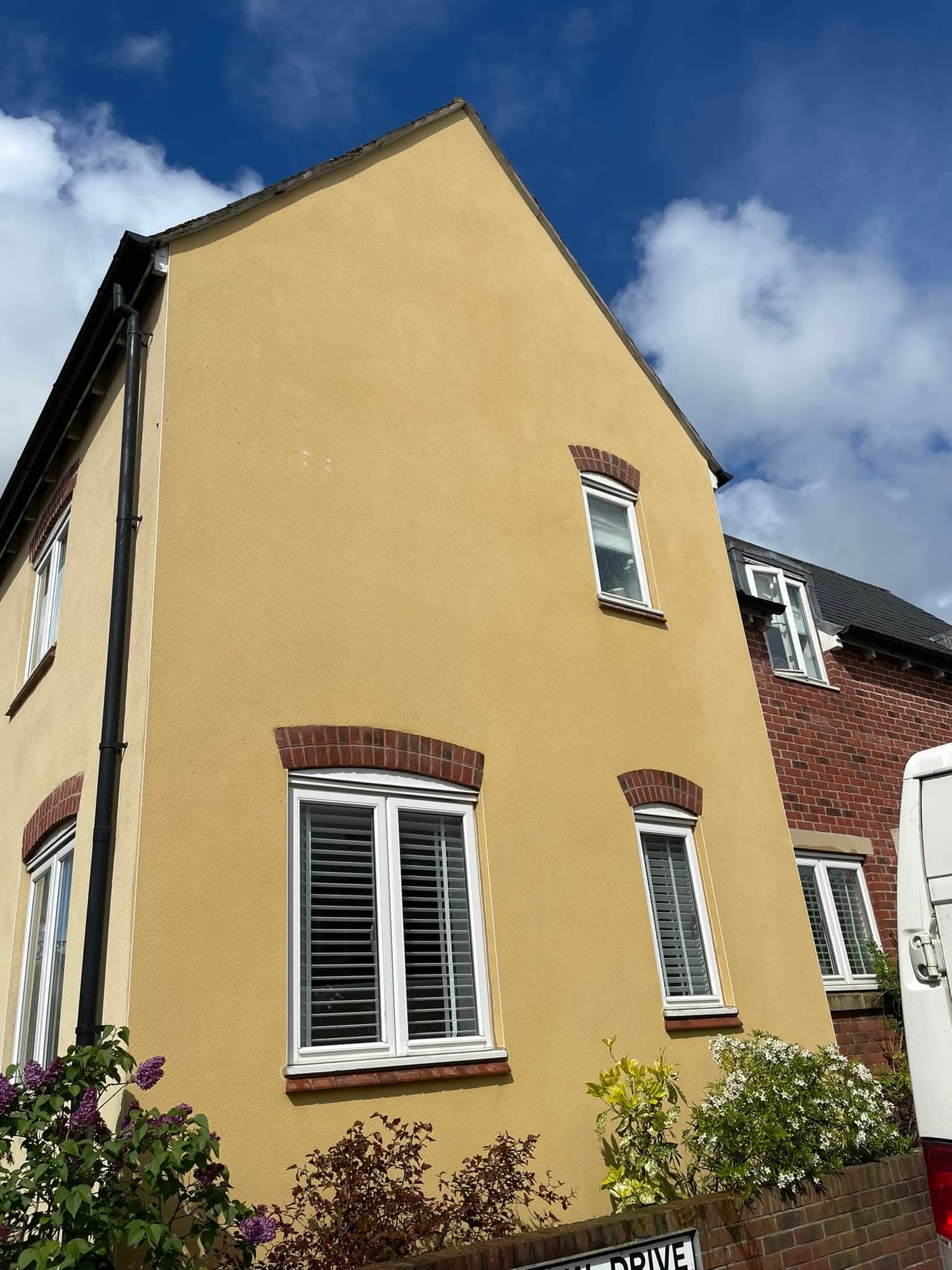
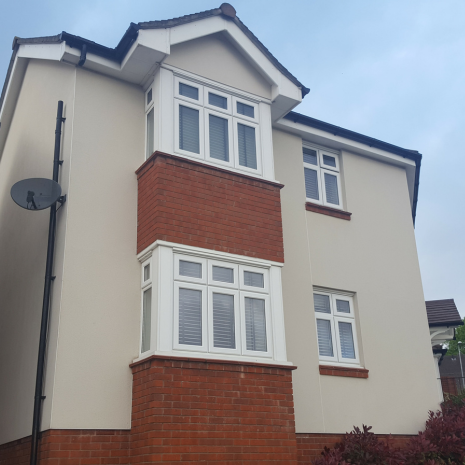

Deciding whether a silicone render actually needs cleaning yet is a more useful question than it sounds, because treating too early wastes money and leaving it too long makes the job considerably bigger. The signs worth acting on are specific. A general loss of depth in the colour, most easily judged by comparing the open wall against a sheltered area such as beneath a deep sill. Vertical streaking below sills, bead terminations or anywhere water is shed, which indicates the concentration points have established. A clear difference in appearance between one elevation and another, particularly a shaded gable against a frontage. Visible dark specking at close range, which is fungal rather than dirt. And anything raised or crusty, which means lichen has taken hold. The signs worth waiting on are equally specific. A wall that looks slightly less crisp than when it was new but shows no streaking, no specking at close range and no difference between elevations is generally still years away from needing treatment. We give that answer honestly at survey, including where it means no work for us. There is no advantage in treating a wall early, since the interval afterwards is governed by the elevation rather than by how recently it was cleaned. K Rend cleaning carried out when the earlier signs appear is a smaller, cheaper job than the same wall five years later, which is the argument for looking properly rather than waiting for it to become obvious. Silicone render cleaning is chemical throughout: very low pressure, nothing brushed, full dwell, complete elevations.
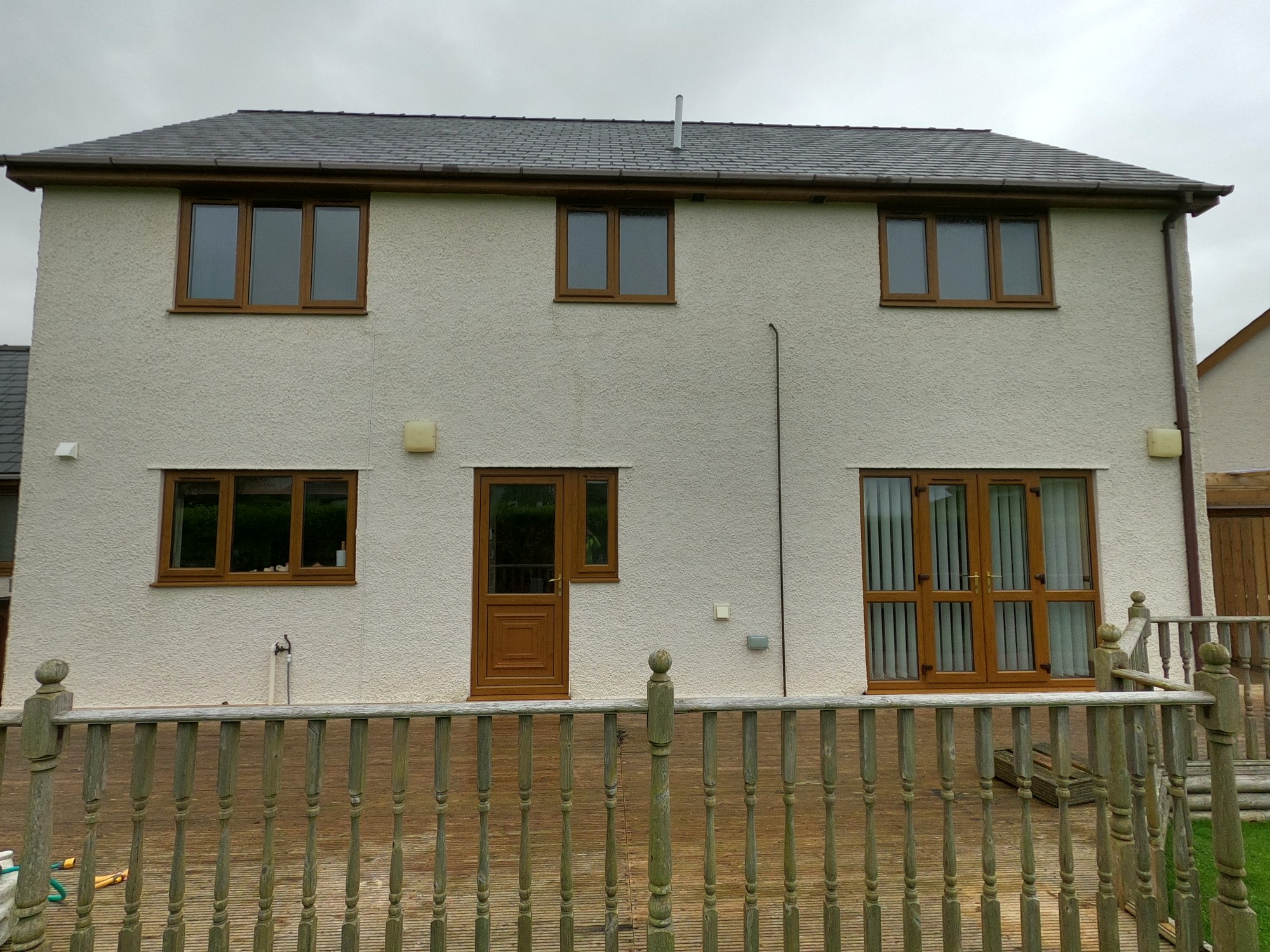
There are a few things worth checking on a monocouche elevation before booking any cleaning work, and they take five minutes. Look along the base course, where the render terminates above ground level. Check that soil or planting has not built up against or above it, since render in permanent contact with damp ground will never dry properly and the growth there will return quickly whatever is done. Look at the junctions where the render meets openings, and at any sealant. Where it has failed or shrunk back, water is tracking into places it should not, and that is worth addressing before water is introduced deliberately. Look for hairline cracking, particularly at corners of openings where movement concentrates. Fine crazing is generally cosmetic. Anything that has genuinely opened means treatment should wait. Tap the surface lightly in a few places. A hollow sound suggests the coating has debonded from what is behind it, which is a different problem entirely. Look at what is stored against the wall and whether any foliage is in contact, both of which hold moisture permanently and shorten the interval after any clean. None of this requires expertise, and we check all of it at survey regardless. Where something means treatment is inadvisable, we say so rather than proceeding. Where the wall is sound, monocouche render cleaning is straightforward: low pressure, generous volume to reach the base of the scraped texture, full dwell, gentle rinsing, nothing brushed or agitated. Render restoration on a sound elevation is repeatable across the life of the coating, and residential render cleaning is far cheaper than the alternative.
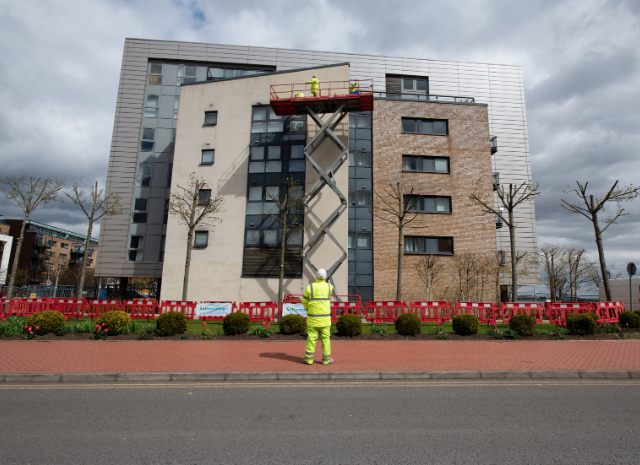

Small production premises, micro-breweries, workshops and craft manufacturers operating from rendered buildings increasingly receive visitors, whether for collection, tours or direct sales, and the exterior does more work than it used to. Commercial render cleaning at these premises is usually straightforward technically and needs planning around production. Batches, deliveries and dispatch all run to schedules that cannot easily move, and external doors and loading areas need to stay usable. We survey first, phase the work so only one elevation is affected at a time, and agree timings that avoid interference. Intakes, extraction, external plant and any opening on the working elevation are identified at survey and masked or isolated before anything is applied, which matters particularly where production is sensitive to airborne material. Exclusion zones are agreed and signed, and vehicle routes across yards are maintained rather than closed. Insurance, method statements and risk assessments are supplied ahead of attendance, and operatives hold current working at height certification. The low pressure method suits these premises: no high pressure spray, minimal noise, controlled run-off directed away from drainage that matters, and dilution set to what the growth requires rather than mixed strong. Most buildings of this scale present single-storey or low two-storey elevations that can be treated from ground level, so jobs are frequently completed in a single visit. Render facade cleaning holds identical dilution and live wet edges so each elevation reads uniformly. For small production premises around Lower Broadheath, a clean every few years is a modest cost that keeps the building presenting properly and protects the coating from permanent damp.
Payment terms are worth stating plainly, since they are another area where this trade varies more than it should. We take no deposit. Nothing is paid before the work is carried out, and there is no booking fee to secure a date. That means there is nothing at risk if a date has to move for weather, and nothing to recover if circumstances change at your end. Invoicing follows completion rather than preceding it. The invoice matches the quoted figure exactly, because render cleaning prices are fixed at survey and do not change. There are no additions for preparation, protection, access identified at survey or the time the treatment needed to dwell. Softwashing UK also do not ask for payment before the result has developed where an elevation was heavily colonised. A soft washed wall continues improving for two to four weeks, and where we have said a return visit may be needed, that is completed before the account is settled. If an area has genuinely not responded within four to six weeks, we come back and treat it again at no charge, and that applies whether or not the invoice has been paid. Full public liability cover and current working at height certification are available on request before booking, and our render cleaning specialists work on rendered elevations exclusively. Anyone asked for a substantial deposit before any work has been done is entitled to ask why. Professional render cleaning does not require it, and as a local render cleaning company we are considerably easier to find afterwards than a firm passing through would be.
Lower Broadheath is covered in full, with the same survey process and pricing basis applied to every property and no travel loading regardless of position. We keep a written record of every property we treat, and it is worth explaining what that means for anyone likely to need the work again. The record sets out, elevation by elevation, what coating was identified, the texture grade found, the condition of the surface, which organisms were present and at what density, the dilution and volume applied, the dwell allowed, how each wall was reached and anything excluded or flagged at the time. When a property comes round again, that removes most of the survey and all of the guesswork. More importantly it means the return visit is genuinely a smaller job, because the earlier treatment destroyed colonies at root level rather than removing them from view, so whatever has returned is shallow and recent. Volume, dwell and time on site all reduce, and the figure reflects it. It also helps where a property has changed hands. New owners frequently have no idea what render they have or when it was last treated, and if we have worked on the building before, both questions are answered immediately. Second visits within four to six weeks of a first treatment are a separate matter and carry no charge. Where an area has genuinely not responded, we return and treat it again. Surveys take around twenty minutes, can be carried out unattended provided all elevations are reachable, and produce an itemised written quotation by email.
Most properties in Lower Broadheath benefit from professional render cleaning every 3 to 5 years, although this depends on the surrounding environment. Properties near trees, woodland, busy roads or coastal areas may require more frequent cleaning due to algae, mould and airborne contaminants. Our soft washing process removes existing growth and helps keep your render cleaner for longer.
Yes. Soft washing is specifically designed for delicate surfaces such as K-Rend, silicone render, monocouche render and painted render. Unlike high-pressure washing, it cleans at low pressure while treating biological growth at its source, reducing the risk of damage to the render finish.
We clean virtually all external render finishes, including K-Rend, Monocouche, Weber, Sto, silicone render, acrylic render, painted render, roughcast and pebble dash. Every cleaning method is tailored to the specific render type to achieve the best possible results.
Yes. Our specialist soft washing treatments are highly effective at removing green algae, red algae, black mould, mildew, lichen and other organic staining. We also apply professional biocide treatments to kill spores and slow down regrowth.
Because our process targets the biological growth rather than simply washing the surface, results typically last much longer than pressure washing alone. The exact lifespan depends on weather conditions, surrounding vegetation and the property’s location.
No. Our soft washing process is specifically designed to clean render safely. We use low-pressure application methods and specialist cleaning solutions that remove contamination without damaging the render surface when carried out by trained professionals.
The UK’s damp climate provides ideal conditions for algae, mould and other biological growth to develop on rendered surfaces. Areas with limited sunlight, nearby trees or persistent moisture are especially susceptible. Professional soft washing safely removes these contaminants and restores your property’s appearance.






































WhatsApp us