Timing a render clean around other work on a property saves money and avoids having to do it twice, and the sequencing is worth thinking about early. The general rule is that render cleaning goes last. Any work that generates dust, involves cutting, requires equipment against the walls or brings traffic past an elevation will soil the render, and much of that material is driven into a textured face and held there. Cleaning beforehand simply means paying to have it done again. That applies to construction and alteration work in particular. Dust settles across every elevation, splashes and overspray find their way onto adjacent render, and equipment leaned against a wall marks it. Once all trades have left, a clean returns the whole building to a consistent finish and makes the project look finished rather than nearly finished. Landscaping and ground works are the same. Soil movement, hard surfacing and planting all raise material against the lower part of a wall, and the base course takes the worst of it. The one exception is where a wall is being assessed. Cleaning first shows the true condition of the render, including any cracking, patch repairs or debonded areas that established growth has been disguising, which is useful before deciding what else needs doing. Our render cleaning services are quoted with that sequencing in mind, and we are happy to schedule around other trades. Render stain removal for construction residue and render algae removal for whatever growth is present are specified together where both apply. Exterior render cleaning on a property in South Littleton is best carried out once everything else is complete.
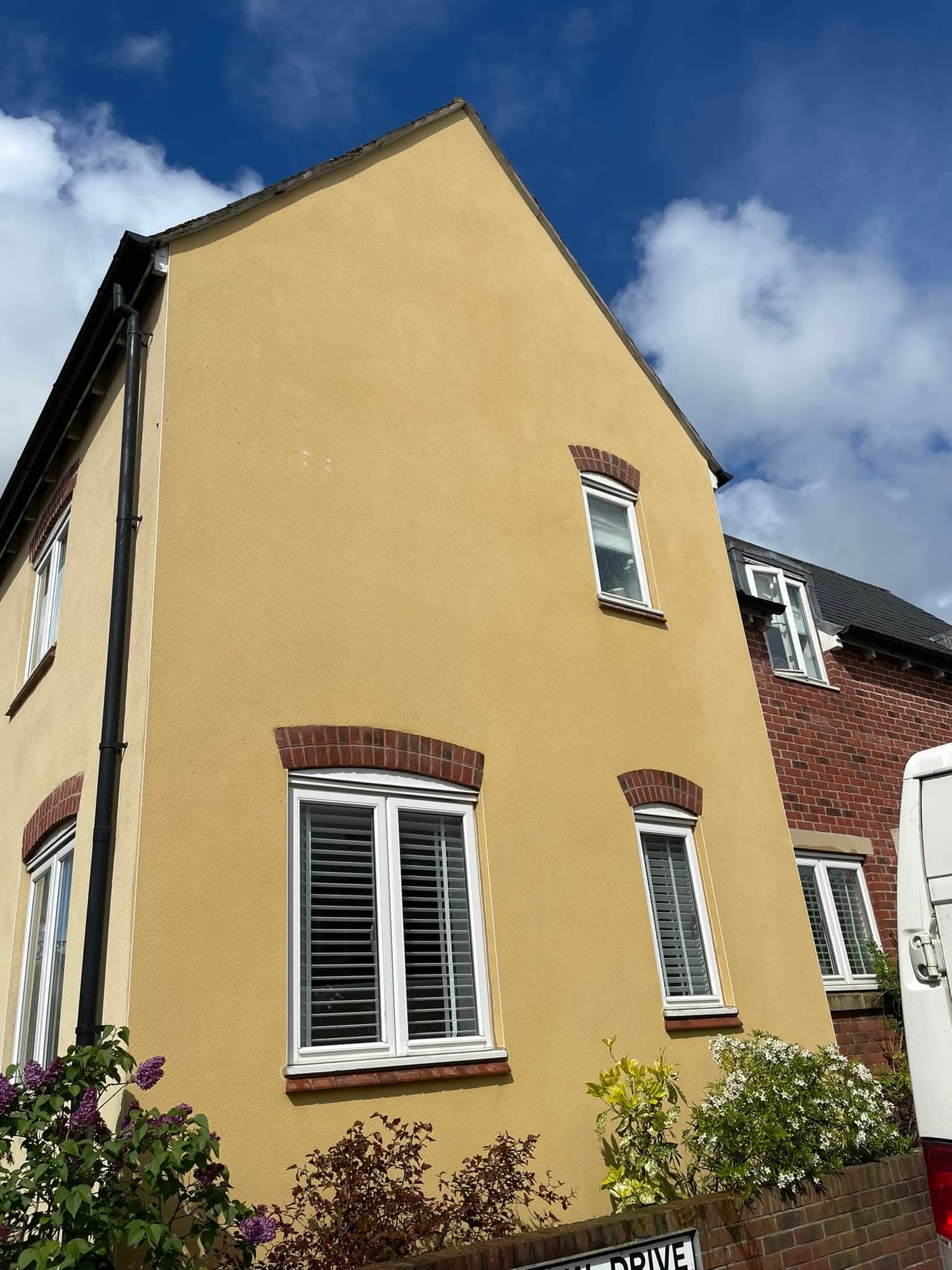
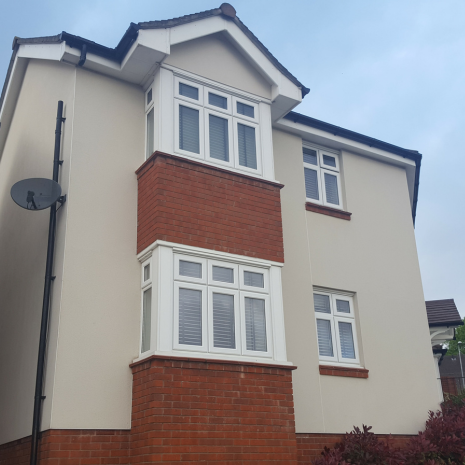

Silicone render on a property being prepared for letting has a slightly different set of priorities from one being sold, and it is worth distinguishing them. For a letting, the building has to present well repeatedly rather than once. Photographs are reused across multiple tenancies, viewings happen at intervals over years, and the exterior needs to look maintained throughout rather than for a single marketing period. That argues for treating the whole envelope rather than the marketing elevations alone. A rear or side wall that has never been touched will continue deteriorating and will eventually need a considerably larger job, while the frontage is kept presentable. It also argues for accurate interval advice. Where a landlord holds several properties, knowing that one shaded gable needs attention every three years while the rest of the building holds for five allows the maintenance to be budgeted rather than reacted to. K Rend cleaning is well suited to this because the result holds for years when growth is destroyed at root level, and returning visits on a maintained property are genuinely smaller and cheaper jobs. Where several properties are held in the same area, programming them together shares mobilisation and reduces the cost per building. Silicone render cleaning is chemical throughout: very low pressure, nothing brushed or agitated, complete elevations worked with a live wet edge at consistent dilution. Render mould removal and render algae removal are specified per wall, and the written record of what was applied makes the next visit faster and cheaper. Where a landlord wants the marketing images to last, treating the whole envelope rather than the front elevation alone is the more economical decision over time.
Monocouche on rental and managed property benefits from being treated as a scheduled item rather than a reactive one, and the arithmetic supports it clearly. The finish covers the whole building as a continuous surface, so its condition determines how the property presents more than any other single element. It is also mineral pigmented and extremely stable, which means cleaning restores rather than approximates the original appearance and can be repeated across the life of the coating. The risk in managed property is neglect between tenancies. Nobody living in the building is responsible for the exterior, changeovers are busy, and rendered walls decline gradually enough that they are noticed only when a viewing goes badly or a photograph looks wrong. Putting it on a defined interval avoids that. Each subsequent visit is shorter and cheaper than the first, because the earlier treatment destroyed colonies at root level and whatever has returned is shallow and recent. Monocouche render cleaning is unchanged in method: low pressure, generous volume to reach the base of the scraped texture, full dwell so growth is destroyed at root level, gentle rinsing, nothing brushed or agitated, since exposed aggregate detaches permanently. We give interval advice per elevation, which lets a landlord or agent budget properly rather than treating the whole building each time. Render maintenance planned that way is a modest recurring cost, and render restoration remains achievable indefinitely because nothing is ever taken off the wall. Where an agent manages several rendered properties, programming them together shares the mobilisation and reduces the figure on each.
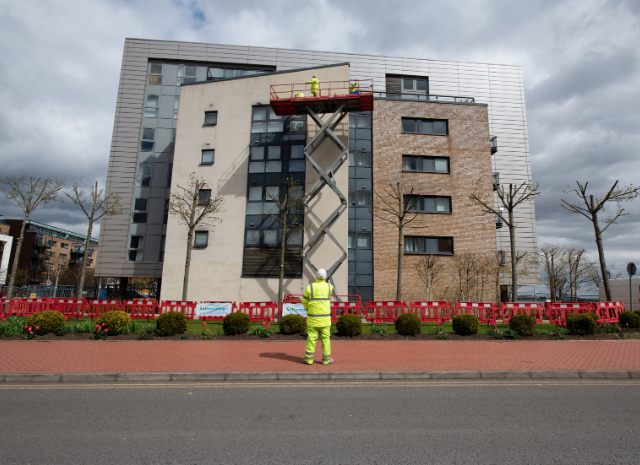

Architects’ practices, design studios and creative businesses working from rendered buildings are judged on visual standards by the nature of what they do, and a soiled exterior is an awkward advertisement. Commercial render cleaning at these premises is generally straightforward technically and needs planning around client visits and studio hours. Meetings happen through the day, often in rooms at the front of the building, and parking is usually limited. We survey first, agree which elevations can be treated when, and schedule around the diary, which commonly means an early start. The low pressure method matters here: no machine running continuously, minimal noise carrying into a working studio, and no spray drifting across an entrance. Anything at ground level within the working area is protected or moved, and external fittings and any opening on the elevation are masked or isolated. Exclusion zones are agreed and signed so arriving clients are kept clear without entrances being obstructed. Insurance, method statements and risk assessments are supplied ahead of attendance, and operatives hold current working at height certification. Most premises of this size are completed within a single visit. Technically these buildings often combine glazing with plain rendered sections, and treatment must not be allowed to run down glass and dry, so glazing on the working elevation is protected or rinsed as we go. Render facade cleaning maintains consistent dilution and live wet edges so the rendered sections read uniformly. For studios around South Littleton, a clean every few years keeps the building consistent with the standards the business trades on. Where a practice occupies part of a larger building, we coordinate with the other occupiers so the whole elevation is treated to one standard.
Softwashing UK are asked what makes one contractor’s approach different from another’s, and the honest answer is that most of it comes down to a handful of decisions made before anyone arrives. We survey every property without exception, because coating type, texture depth, condition, organism and access are all close-range judgements that cannot be made from a description or a photograph. We use soft washing exclusively on render, because pressure removes material from a textured face and lifts pigment from a through-coloured finish, and that damage cannot be corrected. We allow the dwell period each elevation actually requires rather than the time available, because that is what determines whether the result holds for years or months. We quote per elevation, because buildings do not soil evenly and an averaged rate misrepresents both the clean walls and the dirty one. We include preparation, protection, access identified at survey and any anticipated second application in the fixed figure, so nothing appears later. We decline work where a wall should not be treated, and we say when an elevation does not need doing yet. And we give honest interval advice per wall rather than selling annual returns. None of that is complicated, and all of it is checkable. Render cleaning prices are itemised and fixed at survey, our render cleaning specialists work on rendered elevations exclusively, and full public liability cover and current working at height certification are available on request before booking. Where a property has been cleaned before by someone else, we assess what was done rather than assuming, since the previous method determines how the wall behaves now.
South Littleton is covered in full, with the same survey process and pricing basis applied to every property and no travel loading regardless of position. Interval advice and repeat visits are worth explaining, since they are what makes render cleaning a manageable recurring item rather than an occasional large expense. We give an expected interval for each elevation rather than for the property, because walls on the same building genuinely behave differently. A well-lit frontage with reasonable air movement will commonly hold four to six years after proper dwell-based treatment. A shaded gable enclosed by planting may need attention in two to three. Quoting a single figure for the property would be inaccurate for both. We also explain what would extend the interval: cutting back foliage in contact with a wall, lowering soil built up against the base course, and moving stored items clear of an elevation all make a measurable difference. What we do not do is propose annual returns. A properly treated wall does not need one, and it would be obvious the following year if it did. Returning customers are quoted lower than first-time ones, because a maintained wall is genuinely a smaller job. There is less to clear, the specification is already recorded from the previous visit, and both the survey and the work take less time. Surveys take around twenty minutes, can be carried out without anyone at home provided every elevation is reachable, and produce an itemised written figure by email. Where several properties in the village arrange together, the mobilisation is shared and each individual quotation reduces accordingly.
Most properties in South Littleton benefit from professional render cleaning every 3 to 5 years, although this depends on the surrounding environment. Properties near trees, woodland, busy roads or coastal areas may require more frequent cleaning due to algae, mould and airborne contaminants. Our soft washing process removes existing growth and helps keep your render cleaner for longer.
Yes. Soft washing is specifically designed for delicate surfaces such as K-Rend, silicone render, monocouche render and painted render. Unlike high-pressure washing, it cleans at low pressure while treating biological growth at its source, reducing the risk of damage to the render finish.
We clean virtually all external render finishes, including K-Rend, Monocouche, Weber, Sto, silicone render, acrylic render, painted render, roughcast and pebble dash. Every cleaning method is tailored to the specific render type to achieve the best possible results.
Yes. Our specialist soft washing treatments are highly effective at removing green algae, red algae, black mould, mildew, lichen and other organic staining. We also apply professional biocide treatments to kill spores and slow down regrowth.
Because our process targets the biological growth rather than simply washing the surface, results typically last much longer than pressure washing alone. The exact lifespan depends on weather conditions, surrounding vegetation and the property’s location.
No. Our soft washing process is specifically designed to clean render safely. We use low-pressure application methods and specialist cleaning solutions that remove contamination without damaging the render surface when carried out by trained professionals.
The UK’s damp climate provides ideal conditions for algae, mould and other biological growth to develop on rendered surfaces. Areas with limited sunlight, nearby trees or persistent moisture are especially susceptible. Professional soft washing safely removes these contaminants and restores your property’s appearance.




































WhatsApp us