Different render finishes hold their appearance for different lengths of time, and knowing roughly what to expect from yours makes maintenance far easier to plan. A smooth or lightly textured finish sheds water freely and dries quickly, so colonisation proceeds slowly. On a well-lit elevation these walls can go five or six years between treatments without looking tired. A medium-textured thin-coat system sits in the middle. There is enough relief to shelter spores and retain some moisture, and most elevations need attention on a four to five year rhythm depending on aspect. A deeply scraped finish, whether monocouche or a coarse thin-coat, holds moisture in its profile long after the flat plane has dried and offers far more sheltered surface. Intervals shorten accordingly, and on a shaded wall of this type two to three years is realistic. Painted render behaves differently again, since the film has its own condition to consider and may not tolerate repeated treatment as well as a bare through-coloured surface. Aspect then modifies all of it, often by more than the finish does. A shaded gable in a deeply textured render enclosed by planting is the shortest interval on any property, and a well-lit smooth frontage the longest. Our render cleaning services are quoted with an expected interval stated per elevation rather than for the building, based on finish, texture grade, aspect and surroundings together. Render algae removal and render moss removal both hold considerably longer where growth has been destroyed at root level. Exterior render cleaning on a property in Stoke Prior is easiest to budget for once those intervals are known.
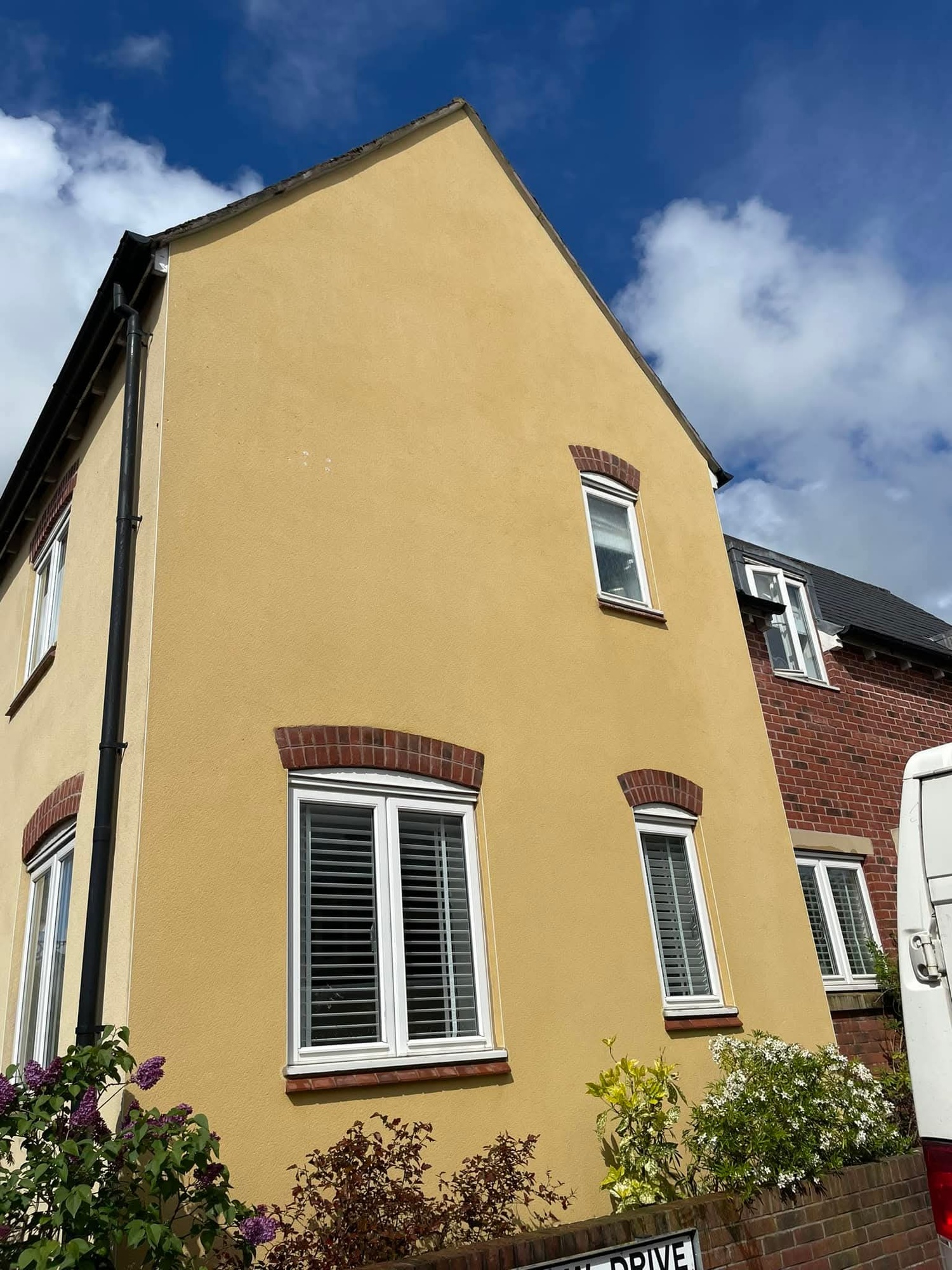
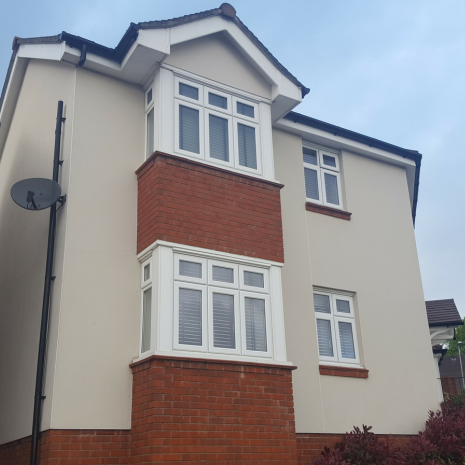

The first five years of a silicone render’s life follow a fairly predictable course, and knowing it helps owners judge whether anything is wrong. For the first two years, most elevations look essentially as they did at handover. The surface is at its least absorbent, water beads and runs off, and although spores are landing continuously nothing has established sufficiently to be visible. Through the third and fourth years, change begins on whichever elevation dries slowest. Concentration lines beneath sills and bead terminations darken first, since those areas stay wet longest after every shower. General filming follows on the shaded aspect. By the fifth year, a shaded gable on many properties reads as noticeably different from the frontage, and at close range fungal specking has usually established somewhere on the building. None of that indicates a defect in the render. Water repellency prevents rain penetrating the coating; it does nothing to stop spores germinating in surface moisture on a textured face. K Rend cleaning at this stage is comparatively straightforward and inexpensive. Colonisation is shallow, the coating is still at its least absorbent, and treatment applied at low pressure with a proper dwell clears it readily. Manufacturer guidance is the constraint worth respecting, particularly where a warranty remains live, and it excludes high pressure and abrasive methods entirely. Silicone render cleaning at our specification sits within it: chemical throughout, nothing brushed or agitated, complete elevations worked with a live wet edge at consistent dilution. Treating a wall at that stage is also considerably cheaper than waiting until the whole building has caught up with the shaded gable.
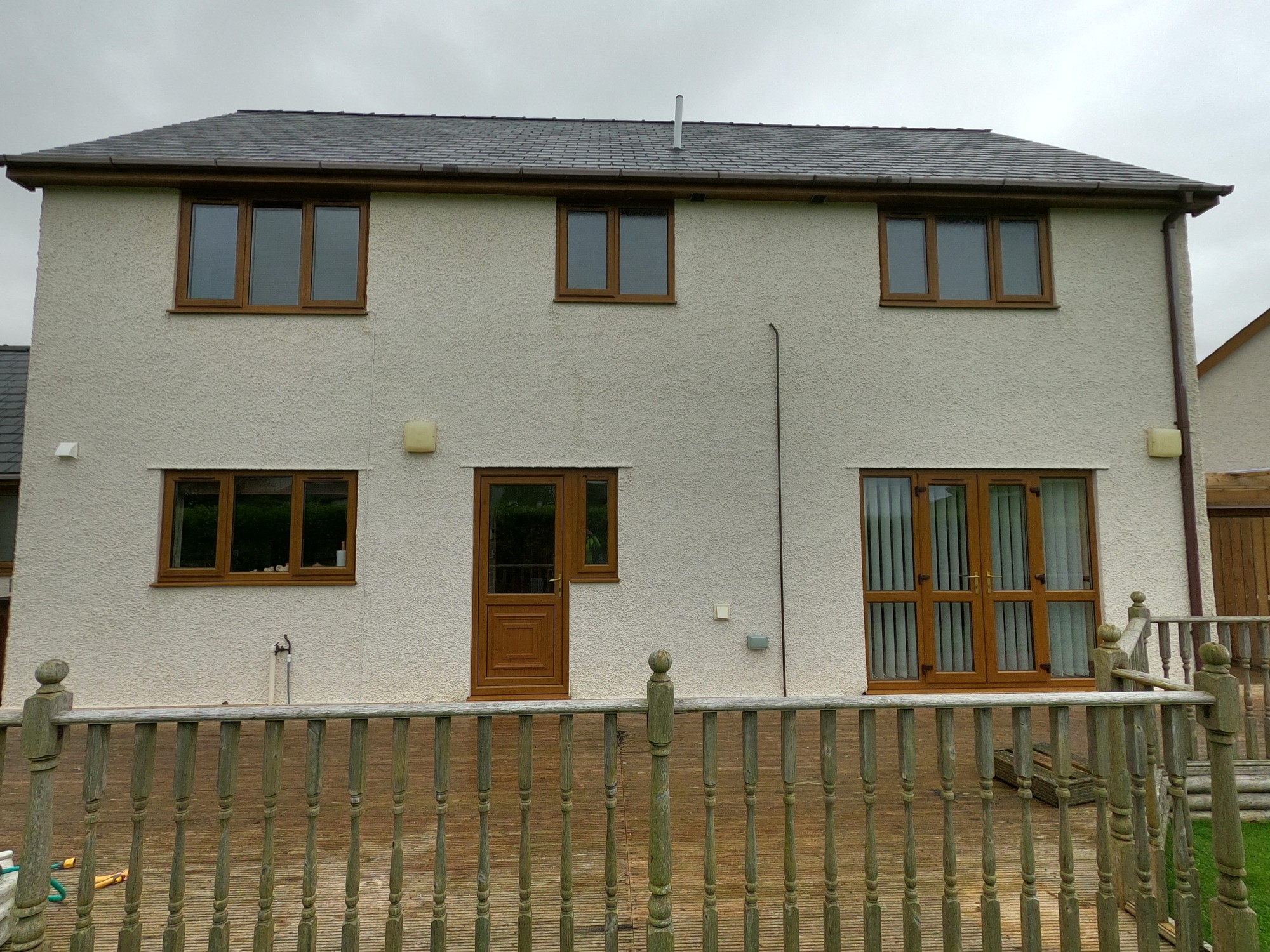
Softwashing UK are asked how monocouche intervals compare with thinner render systems, and the honest answer is that they are generally shorter, for reasons entirely to do with texture. Monocouche is applied thickly and scraped back to expose fine aggregate, producing a genuinely deep profile. That depth gives the finish its character and its visual quality, and it also creates several times the effective surface area of a smooth wall along with thousands of sheltered points where moisture lingers after the flat plane has dried. Spores landing on that surface find both shelter and retained damp, which is all germination requires. Growth then establishes at the base of the profile rather than on top of it, protected from wind and from the scouring effect of heavy rain. So a monocouche elevation will typically need attention sooner than a smooth or lightly textured wall in the same position. On a well-lit frontage four to five years is common. On a shaded gable enclosed by planting, two to three is more realistic. That is not a criticism of the material, which is durable, breathable and holds its colour remarkably well. It is simply a consequence of the finish. Monocouche render cleaning done properly maximises whatever interval the elevation is capable of, since growth destroyed at root level means recolonisation starts from a sterile surface. The method is fixed by the material: low pressure, generous volume to reach the base of the texture, full dwell, gentle rinsing, nothing brushed or agitated. Render maintenance planned around realistic intervals is cheaper than reacting to a wall that has gone too far.
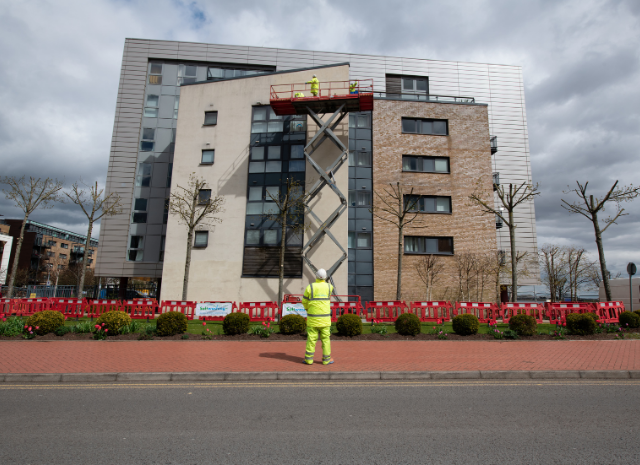

Tyre centres, exhaust specialists and fast-fit premises with rendered elevations soil faster than almost any other commercial building, and much of what accumulates has nothing to do with growth. Rubber dust, brake residue, exhaust particulate and general traffic film deposit continuously on the elevations facing the forecourt and the road. On a textured render that material works into the profile and stays, building into a grey cast that biocidal treatment alone will not touch. Commercial render cleaning here therefore uses a dual specification: render stain removal with appropriate chemistry for the deposit, alongside biocidal treatment for whatever growth has established. Treating only one leaves the building visibly half done. Operationally, bays run continuously and customer vehicles arrive throughout the day. We survey first, phase the work so only one elevation is affected at a time, and schedule into whatever window causes least interruption, usually early morning or a closing day. Vehicles within reach of a working elevation are moved or fully sheeted, and extraction, compressors and external plant are masked or isolated before anything is applied. Exclusion zones are agreed and signed, with forecourt routes maintained rather than closed. Insurance, method statements and risk assessments are supplied ahead of attendance, and operatives hold current working at height certification. Technically these buildings present long low elevations, often with large door openings. Soft wash render cleaning holds identical dilution and continuous wet edges across each run so the finished wall reads uniformly. For fast-fit premises around Stoke Prior, a planned interval is realistically the only way to keep the building presenting properly.
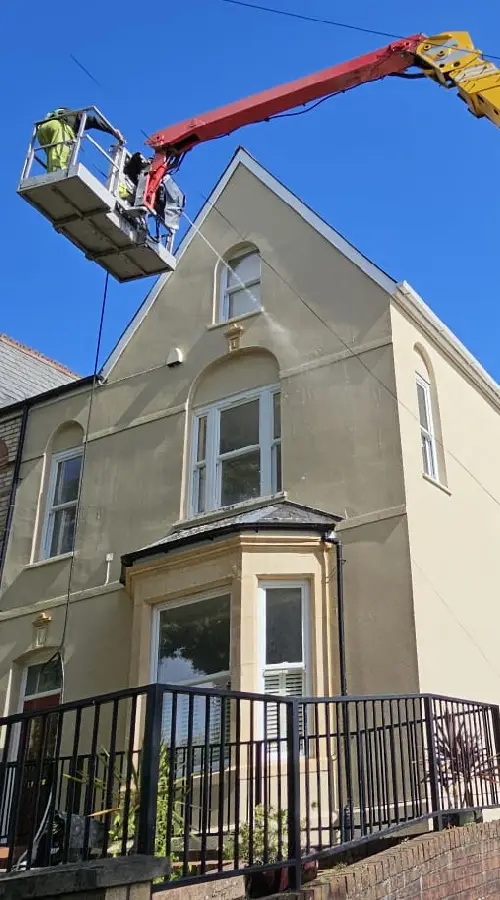
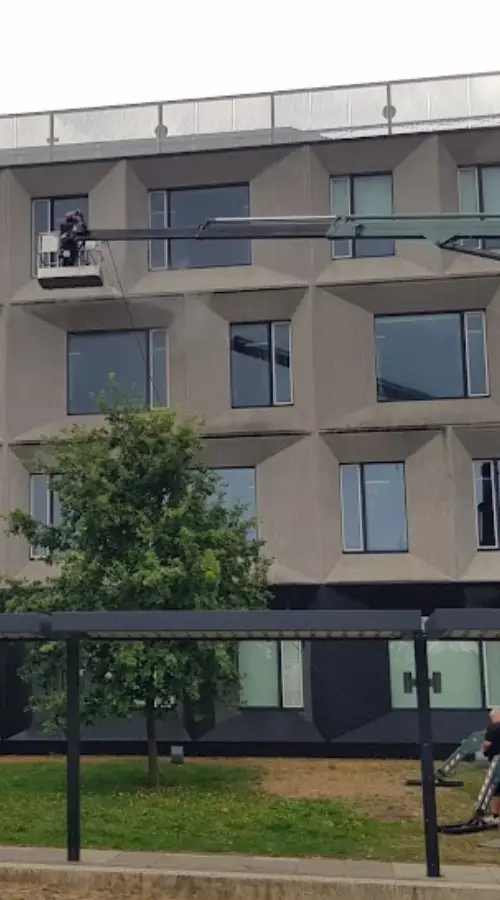
A written quotation should tell you what was found as well as what it costs, and ours is structured to do exactly that. Each elevation appears separately. For each one we state the coating identified, the texture grade assessed, the surface condition including any defects or previous repairs noted, which organisms are present and at what density, the treatment specified with its dilution and expected dwell, and how the wall will be reached. Where a second application is anticipated, it says so and it is included in the figure. Where an elevation genuinely does not need attention yet, it says that too rather than being listed silently to inflate a total. Exclusions appear in writing. If a particular stain is unlikely to clear entirely, if paintwork has begun to chalk, if a patch repair will become visible once growth is removed, or if a wall should not be treated at all, that is stated before any date is agreed rather than explained afterwards. Access equipment identified at survey is in the price. Preparation, protection, treatment, dwell, rinsing and clearing down are all covered. The figure holds for a stated period and does not change. That structure also makes competing quotations comparable, which a single lump sum does not. Render cleaning cost varies legitimately between contractors, but only some of that variation reflects the work included. Render cleaning prices set out this way are checkable, and our render cleaning specialists work on rendered elevations exclusively rather than fitting this in around other exterior maintenance. Anything not covered by the figure is stated in the same document, which is the only way two quotations can be compared honestly.
Stoke Prior and Lower Bentley are both within our standard coverage, surveyed and priced on identical terms with no travel loading and no minimum job value. Clustering bookings is worth raising when you enquire, because it changes the figure rather than simply being convenient for us. Work is programmed by area rather than property by property. When several jobs accumulate in one locality, we work through them in sequence across a full day or more, so travel, set-up and equipment positioning are costs incurred once across the group instead of being carried by each property individually. That saving is passed on. Where three or four households on the same road or lane book within the same period, each individual quotation is lower than any of them would be alone. On roads where properties share construction and finish, the specification often transfers as well, which shortens both the survey and the visit. We are happy to survey several addresses in one visit and quote each separately, with no requirement for anyone to commit on behalf of anyone else and no obligation on any of them. There is a second benefit worth mentioning. On a through-coloured render, one cleaned property in a run of similar houses reads differently from those either side, so treating several together produces a noticeably better result as well as a cheaper one. Properties in Lower Bentley are surveyed on exactly the same basis, individually and quoted per elevation. Surveys take around twenty minutes and produce an itemised written figure by email. Surveys are usually available within the week and produce an itemised written quotation by email.
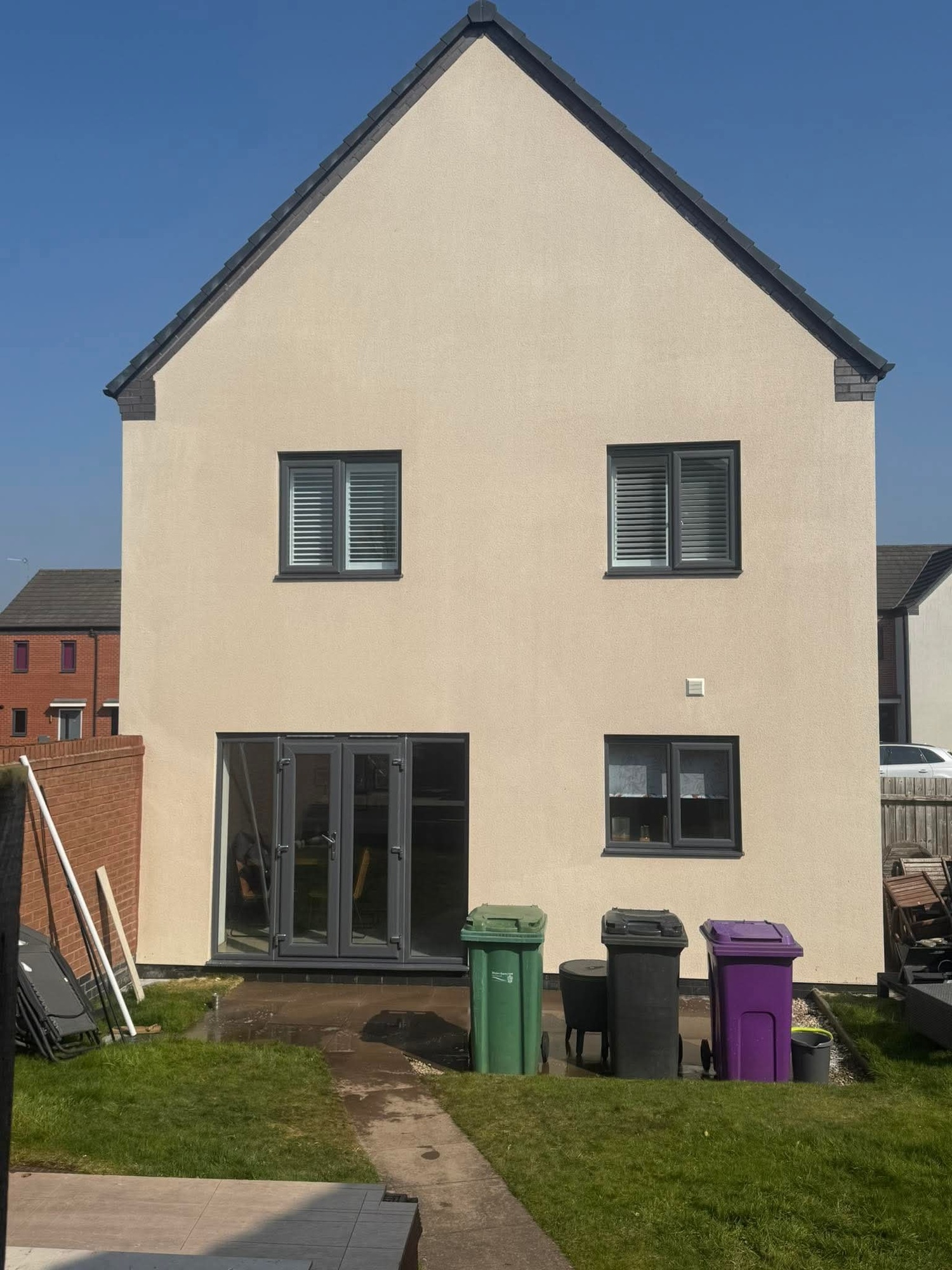
Most properties in Stoke Prior benefit from professional render cleaning every 3 to 5 years, although this depends on the surrounding environment. Properties near trees, woodland, busy roads or coastal areas may require more frequent cleaning due to algae, mould and airborne contaminants. Our soft washing process removes existing growth and helps keep your render cleaner for longer.
Yes. Soft washing is specifically designed for delicate surfaces such as K-Rend, silicone render, monocouche render and painted render. Unlike high-pressure washing, it cleans at low pressure while treating biological growth at its source, reducing the risk of damage to the render finish.
We clean virtually all external render finishes, including K-Rend, Monocouche, Weber, Sto, silicone render, acrylic render, painted render, roughcast and pebble dash. Every cleaning method is tailored to the specific render type to achieve the best possible results.
Yes. Our specialist soft washing treatments are highly effective at removing green algae, red algae, black mould, mildew, lichen and other organic staining. We also apply professional biocide treatments to kill spores and slow down regrowth.
Because our process targets the biological growth rather than simply washing the surface, results typically last much longer than pressure washing alone. The exact lifespan depends on weather conditions, surrounding vegetation and the property’s location.
No. Our soft washing process is specifically designed to clean render safely. We use low-pressure application methods and specialist cleaning solutions that remove contamination without damaging the render surface when carried out by trained professionals.
The UK’s damp climate provides ideal conditions for algae, mould and other biological growth to develop on rendered surfaces. Areas with limited sunlight, nearby trees or persistent moisture are especially susceptible. Professional soft washing safely removes these contaminants and restores your property’s appearance.













































WhatsApp us