A fair proportion of the work Softwashing UK is called to began as somebody’s weekend project, and it is worth setting out what usually goes wrong. The equipment hired for the job is almost always a pressure washer, because that is what is available and it appears to work. It removes the visible growth, leaves the anchoring structures in the coating, saturates the wall, and on a textured or through-coloured finish takes the surface with it. The second problem is the product. Household bleach, patio cleaner and general-purpose exterior chemicals are all reached for and none is formulated for render. Some lighten a through-coloured finish permanently, some leave residue that changes how the surface sheds water, and some do nothing at all. Our render cleaning services use a purpose-formulated biocide at a dilution matched to the substrate, which is not something available off a shelf. The third is height. Render algae removal is worst on upper elevations and gables, and reaching those from a ladder while holding equipment is where people get hurt. Render moss removal on copings tends to be attempted with a brush or scraper, which takes the deposit and a little of the coating with it every time. Professional render cleaning of a house in Three Legged Cross costs less than the accumulated hire, product and remedial work of doing it badly twice, and house render cleaning is one of the few exterior jobs where the wrong approach causes permanent damage. Exterior render cleaning is not a difficult job, but it is a specific one. Almost everything that makes it specific is invisible until it has gone wrong.
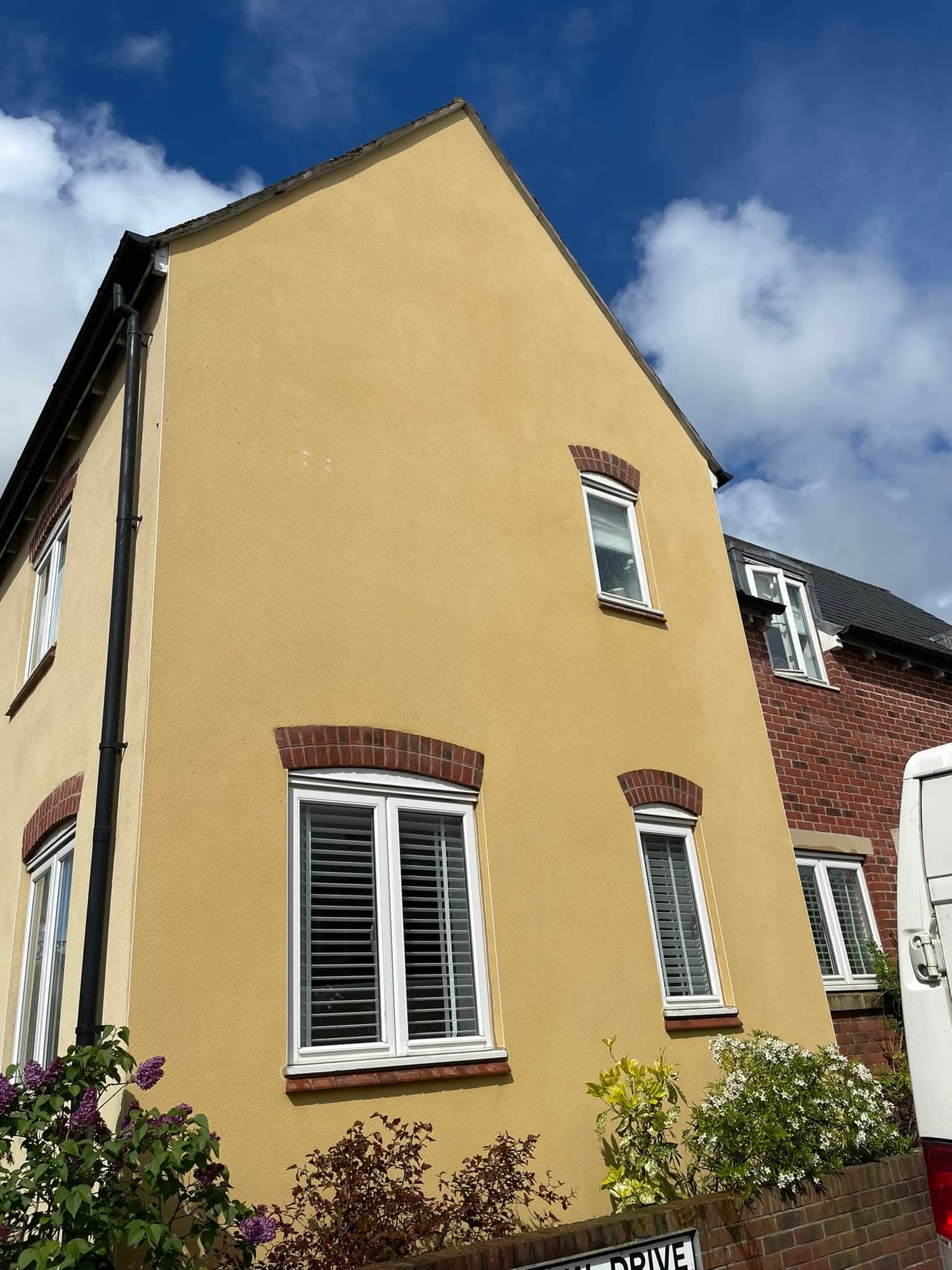
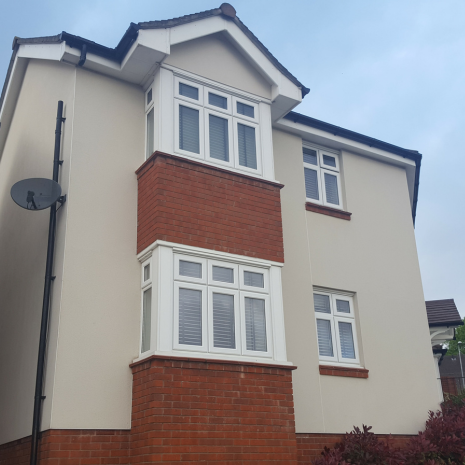

K Rend is the finish most often damaged by a well-intentioned owner, because it feels hard and looks robust. Neither is a guide to how it behaves under pressure. The pigment runs through the material, so a lance removes colour along with growth and leaves a pale patch visible from the road for the life of the building. K Rend cleaning has to be entirely chemical, and there is no domestic equipment that achieves it. Hiring something more powerful moves the job further from the right answer rather than closer. The correct method is soft wash render cleaning: a biocidal solution applied at a pressure barely above hose flow, given a long dwell so it destroys algae and lichen at root level, then rinsed with a gentle controlled flow. Nothing is brushed, scrubbed or scraped at any point. Silicone render cleaning also needs more product than people expect, because a hydrophobic surface sheds solution before the chemistry finishes. Applying a thin domestic mix from a garden sprayer generally produces a patchy result that gets blamed on the wall rather than on the method. Volume is the variable most people underestimate by a wide margin. Render stain removal is where improvisation does the most lasting harm. Acidic products bought for masonry will etch a silicone finish, and once that has happened nothing restores it. Iron bleed from ties and brackets, cement residue at fixing points and dark runs beneath a leaking joint each need a specific product and a test patch first. On a Three Legged Cross property those marks are quoted separately, and we will say plainly which will clear and which will only lighten.
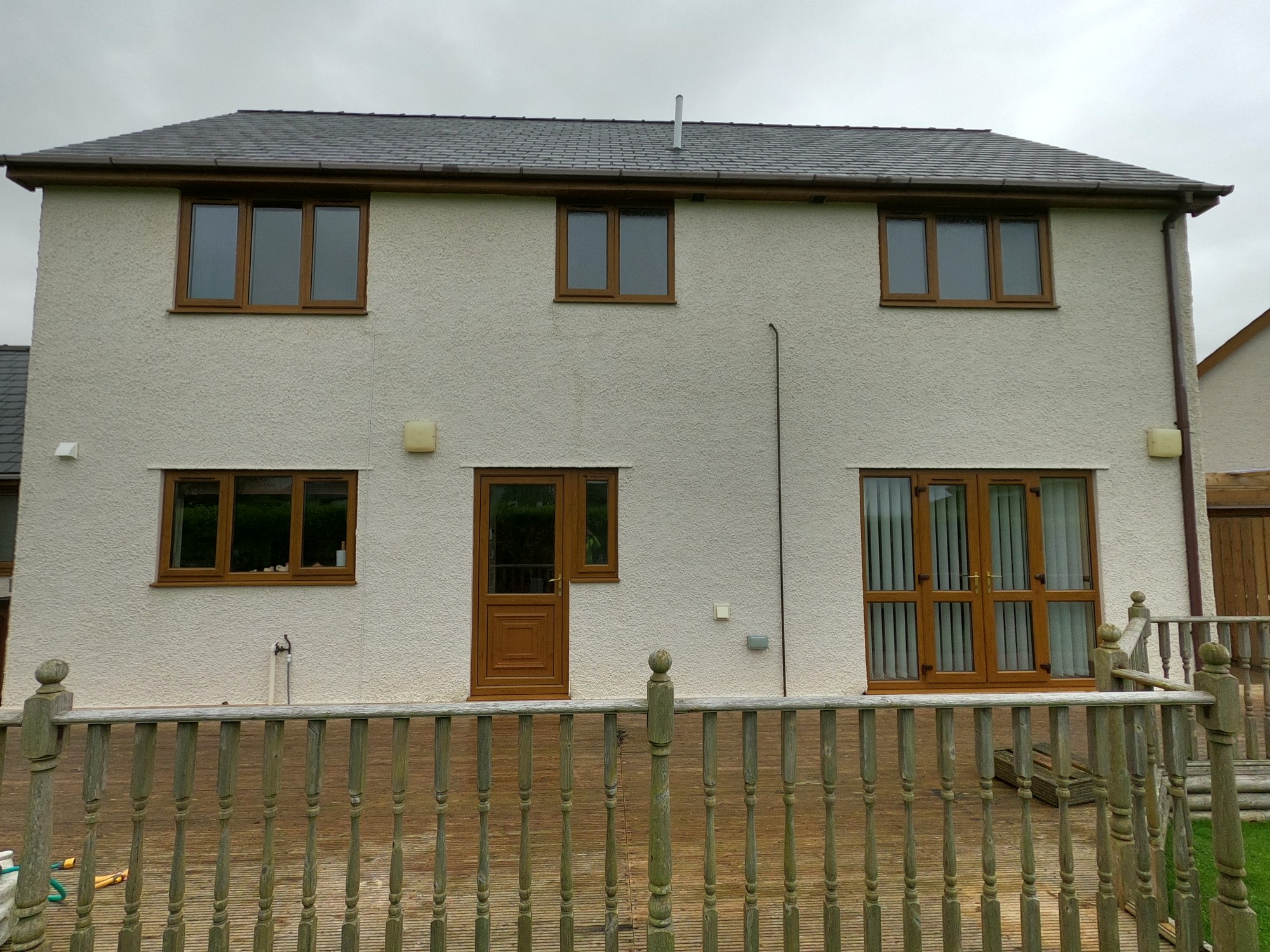
If there is one finish nobody should attempt themselves, it is monocouche. It combines everything that makes render vulnerable: a scraped open texture holding growth deep inside the profile, integral colour with no sacrificial layer, and fragile beads at every edge and at the base. Monocouche render cleaning carried out with hired equipment is the most expensive mistake available on a domestic building. The hire costs very little; the consequence costs a great deal. Render pressure washing shears the scrape flat in seconds, exposes the paler aggregate beneath and leaves lance tracking that catches every angle of low sun. Coloured render cleaning offers no top coat to renew over any of it, and a patch repair on a through-coloured finish never matches, so the correction is recoating an entire elevation in a matched batch with scaffold and several days of labour. Very few owners expect that outcome when they set out on a Saturday morning. The correct process is unglamorous and entirely achievable, but it depends on the right product and a great deal of patience. Solution applied at low pressure in enough volume to soak through the depth of the texture, a long dwell to kill growth at root level, a repeat application on the heaviest deposits along copings and projecting bands, and a soft even rinse across each full face. Done that way, render wall cleaning of monocouche leaves the texture and the pigment exactly as they were. On buildings around Three Legged Cross where years of growth had obscured the original colour, the tone returning over the following weeks is a genuine render restoration rather than an approximation of one.
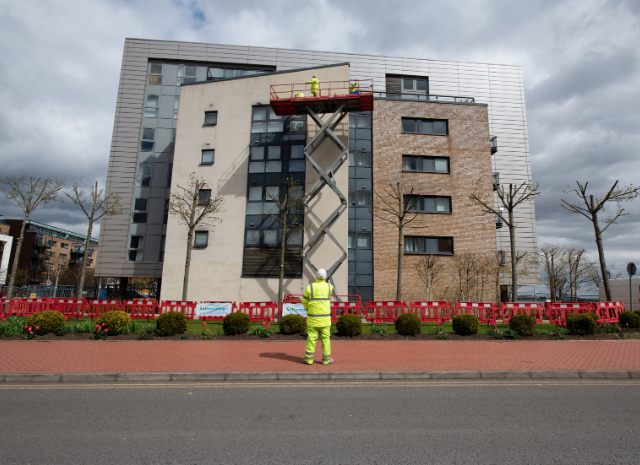

The commercial equivalent of the weekend project is an in-house maintenance team with a pressure washer bought for hard surfaces. The reasoning is sound enough — the equipment exists, the elevations look poor, and nobody wants to raise a purchase order. The outcome is a coating that has been damaged in exchange for eighteen months of improvement, and commercial render cleaning that then costs more than it would have. The saving is real on the day and disappears entirely within two years. Specifying it properly is straightforward. Access is established first — powered platforms, tower scaffold or extended pole systems according to height and standing ground — and the programme is written around trading hours, deliveries and staff movement, with method statements, risk assessments and product data sheets issued in advance. Render soft washing is the method throughout, and its practical advantages are exactly the ones an in-house attempt cannot replicate: even coverage along a full flank, very low water volumes, run-off that can be directed clear of entrances and parking, and negligible drift near occupied doorways. Render facade cleaning at height also brings work-at-height obligations that a general maintenance team is rarely equipped or trained to meet. Render mould removal on shaded and north-facing elevations is the element most often attacked hardest in-house and the one that returns fastest, because rinsing growth away leaves it viable. Treating it chemically and then putting the building onto a render maintenance cycle turns it from a recurring irritation into a scheduled item, and premises in Three Legged Cross stay presentable without anybody reaching for a lance. In-house teams are usually relieved to hand the elevations over.
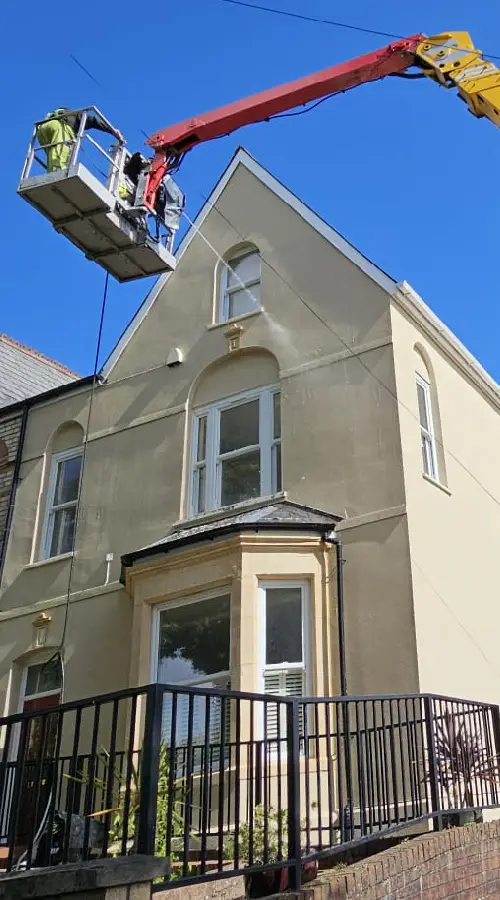
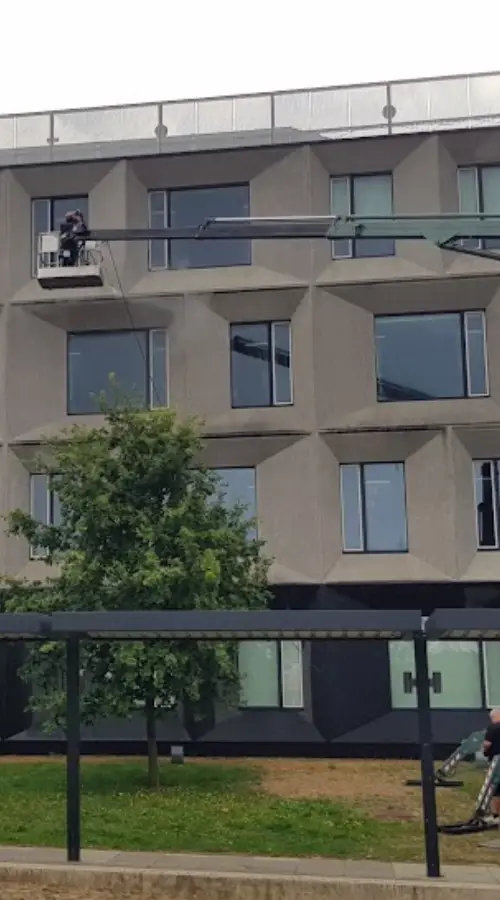
Where a wall has already been damaged there is a limit to what can be done, and we would rather say so than take the work. Lance tracking on a scraped finish, pale scouring on a through-coloured system and blown beads at a corner are permanent, and no cleaning process recovers them. What can be improved is everything else on the building, and often the damaged area becomes considerably less noticeable once the rest of the elevation is properly clean. That is frequently the most useful thing available to somebody who has already paid once. That assessment is free and carries no obligation. Render cleaning prices are then established from elevation count, working height, access arrangements and the extent of the growth, with any damaged sections identified and excluded from what is promised. The written render cleaning cost holds, and affordable render cleaning here usually means treating the sound elevations well rather than attempting to disguise the ones that are not. The crews are render cleaning specialists rather than general exterior cleaners, which is the whole reason they can tell damage from dirt at a glance. A flattened patch, a light band at working height and vertical streaking are all recognisable signatures rather than mysteries. Naming what happened is usually the first thing an owner actually wants. Everything used is an eco friendly render cleaning product chosen because it breaks down safely once its work is done. Anyone comparing firms in search of the best render cleaning service after a poor experience should ask specifically what will not improve. A contractor prepared to say that has no interest in repeating the disappointment. Setting an expectation low and beating it is better than the reverse.
Three Legged Cross sits within our regular working patch, and a proportion of the residential render cleaning we are asked about here follows an attempt that did not go well — either somebody’s own or a contractor who should have known better. The first thing worth doing is establishing what is actually wrong. A wall that looks patchy after a bad clean may simply have been treated unevenly, in which case a proper application across the whole elevation will even it out completely. A wall that has been physically damaged is a different matter, and no amount of further cleaning will recover a flattened texture or scoured pigment. We will look and say which it is, at no charge and with no obligation. Where the news is good the work is quoted normally. Where it is not, we will explain exactly what will improve and what will not, and quote only for the part that genuinely will. There is nothing to be gained from taking money for a result that cannot be delivered. It is a short conversation and it saves everybody a longer one later. Where a previous contractor is involved, the assessment is often useful in its own right, since knowing precisely what was done to a wall helps in any conversation that follows. There is no travel charge and no minimum job size. A single damaged elevation is looked at on exactly the same basis as a whole property. Anyone searching render cleaning near me after a disappointing experience should expect an honest opinion first and a quotation second, which is the order a local render cleaning company ought to be working in anyway.
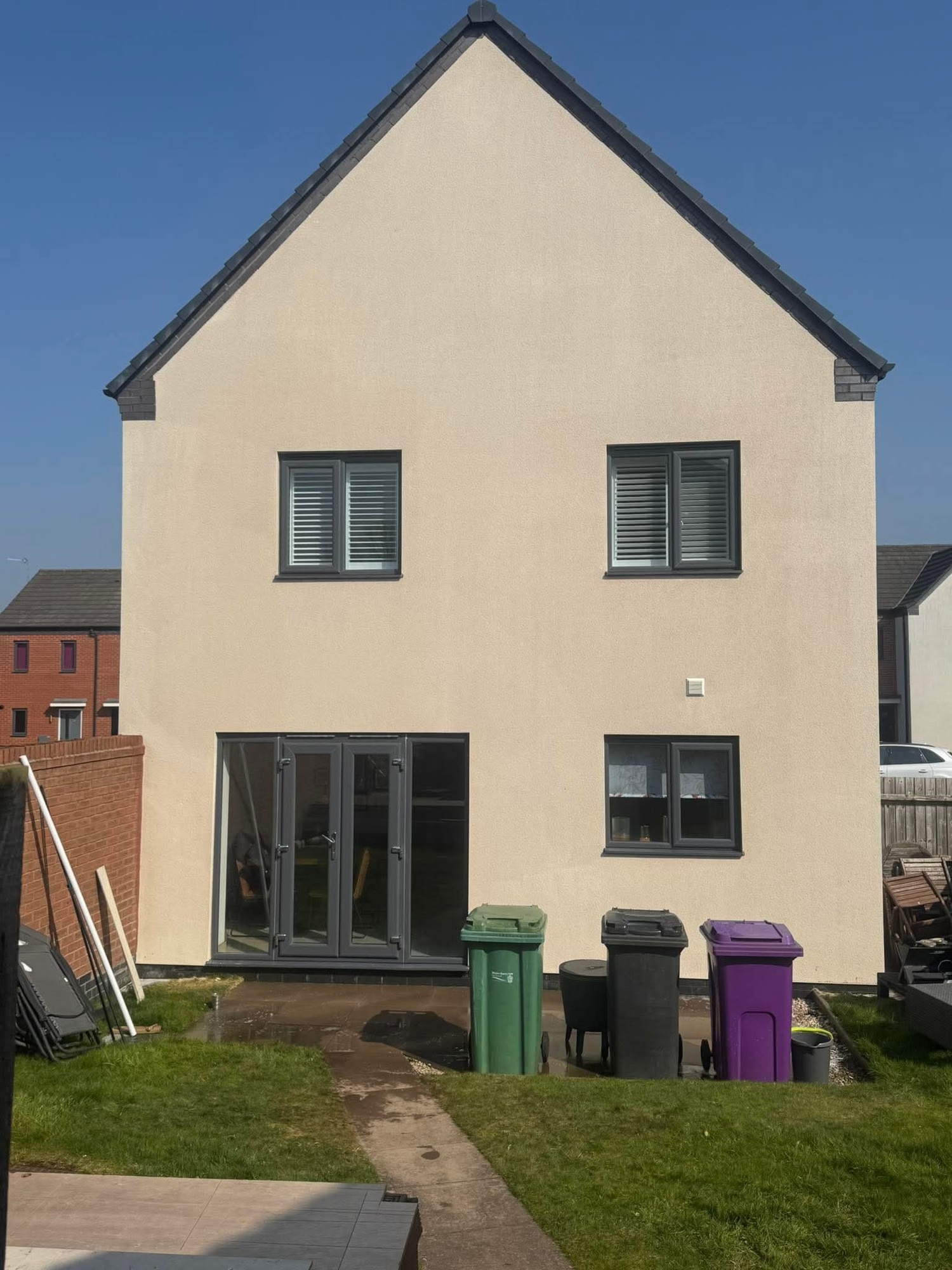
Most properties in Three Legged Cross benefit from professional render cleaning every 3 to 5 years, although this depends on the surrounding environment. Properties near trees, woodland, busy roads or coastal areas may require more frequent cleaning due to algae, mould and airborne contaminants. Our soft washing process removes existing growth and helps keep your render cleaner for longer.
Yes. Soft washing is specifically designed for delicate surfaces such as K-Rend, silicone render, monocouche render and painted render. Unlike high-pressure washing, it cleans at low pressure while treating biological growth at its source, reducing the risk of damage to the render finish.
We clean virtually all external render finishes, including K-Rend, Monocouche, Weber, Sto, silicone render, acrylic render, painted render, roughcast and pebble dash. Every cleaning method is tailored to the specific render type to achieve the best possible results.
Yes. Our specialist soft washing treatments are highly effective at removing green algae, red algae, black mould, mildew, lichen and other organic staining. We also apply professional biocide treatments to kill spores and slow down regrowth.
Because our process targets the biological growth rather than simply washing the surface, results typically last much longer than pressure washing alone. The exact lifespan depends on weather conditions, surrounding vegetation and the property’s location.
No. Our soft washing process is specifically designed to clean render safely. We use low-pressure application methods and specialist cleaning solutions that remove contamination without damaging the render surface when carried out by trained professionals.
The UK’s damp climate provides ideal conditions for algae, mould and other biological growth to develop on rendered surfaces. Areas with limited sunlight, nearby trees or persistent moisture are especially susceptible. Professional soft washing safely removes these contaminants and restores your property’s appearance.































WhatsApp us