


Render is one of the most popular exterior finishes for modern homes across the UK, offering a clean, contemporary appearance while protecting the building from the elements. However, many homeowners become concerned when dark streaks, green marks or uneven discolouration begin appearing across the walls.
Render streaking is one of the most common issues affecting rendered properties. While it can make a home look neglected, the streaks are usually a symptom of an underlying issue rather than the problem itself. Understanding what causes render streaking is the first step towards restoring your property’s appearance and preventing the issue from returning.
At SoftWashing UK, specialist render cleaning is designed to safely remove stubborn streaking while treating the cause of the staining rather than simply washing the surface.
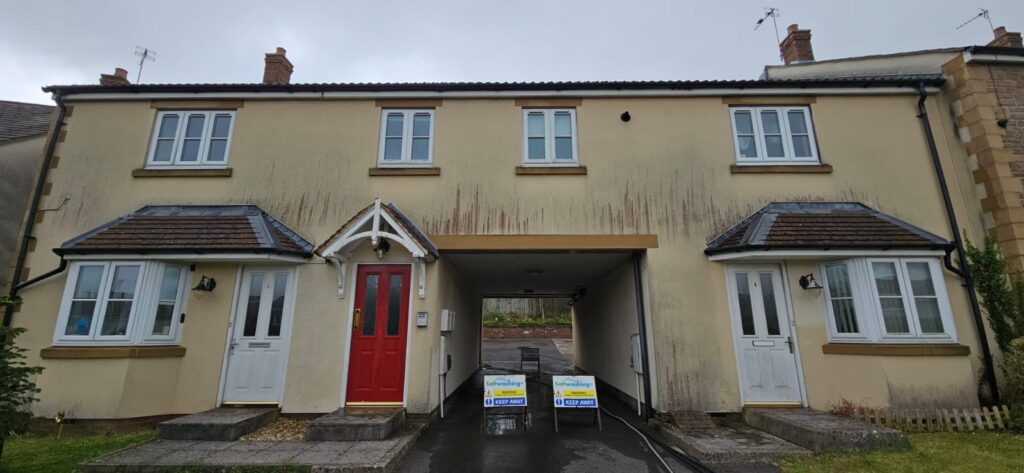
What Is Render Streaking?
Render streaking refers to vertical marks or uneven staining that develops on rendered walls over time.
The streaks may appear:
- Dark grey
- Black
- Green
- Red
- Brown
- Yellow
They often run vertically from rooflines, windows, gutters or other areas where water regularly flows over the render.
Some streaks are simply dirt deposits, while others indicate biological growth or drainage issues.
Why Does Render Streaking Happen?
Render is exposed to the weather every day.
Rainwater running over the surface collects contaminants before depositing them lower down the wall.
Common causes include:
- Rainwater run-off
- Overflowing gutters
- Leaking downpipes
- Green algae
- Red algae
- Black mould
- Atmospheric pollution
- Tree debris
- Dust
- Bird droppings
- Roof contamination
Many properties suffer from several of these issues at the same time.
The Most Common Causes of Render Streaking
| Cause | Typical Appearance |
|---|---|
| Overflowing gutters | Dark vertical lines |
| Green algae | Green staining |
| Red algae | Pink or red streaks |
| Black mould | Black patches and streaks |
| Pollution | Grey or black staining |
| Roof run-off | Dirty vertical marks |
| Window drips | Narrow streaks below sills |
| Metal corrosion | Rust-coloured marks |
Correctly identifying the cause allows the appropriate cleaning method to be chosen.
Water Is Usually the Main Culprit
Almost every form of render streaking involves water.
Rainwater may appear clean, but as it travels across roofs and walls it collects:
- Organic matter
- Dust
- Pollution
- Moss particles
- Algae spores
These contaminants are gradually deposited onto the render, creating visible streaks.
If water repeatedly follows the same path, the staining often becomes more noticeable over time.
Overflowing Gutters
One of the most common causes of streaking is overflowing guttering.
Blocked gutters allow dirty water to spill over the edge instead of flowing through downpipes.
This water repeatedly washes the same section of render, carrying:
- Moss debris
- Dirt
- Organic material
- Roof contamination
The result is dark vertical streaking directly beneath the gutter.
Keeping gutters maintained can significantly reduce future staining.
Leaking Downpipes
Small leaks may not appear serious.
However, a constantly dripping downpipe can keep one section of render permanently damp.
This creates ideal conditions for:
- Green algae
- Red algae
- Black mould
These organisms thrive where moisture remains for extended periods.
Repairing the leak is often just as important as cleaning the wall.
Green Algae and Red Algae
Biological growth is responsible for many render streaks across the UK.
Green algae usually develops on:
- North-facing walls
- Shaded areas
- Damp elevations
Red algae often appears as:
- Pink streaks
- Orange-red patches
- Rust-like discolouration
Although both are forms of algae, they behave differently and often require tailored treatment using specialist cleaning products.
Black Mould
Black mould creates some of the darkest streaks found on render.
Unlike simple dirt, mould is a living organism that continues growing while moisture remains.
It frequently develops:
- Behind downpipes
- Beneath gutters
- Around window reveals
- On permanently shaded walls
Removing the visible staining without treating the mould itself often leads to rapid regrowth.
Pollution Staining
Homes located near busy roads frequently develop pollution streaking.
Vehicle emissions gradually settle on rendered surfaces before rainwater washes them into vertical lines.
Pollution staining often appears:
- Grey
- Black
- Brown
Professional cleaning removes these deposits without damaging delicate render finishes.
Different Render Types React Differently
Not every render system stains in exactly the same way.
| Render Type | Likelihood of Streaking |
|---|---|
| Silicone render | Low to Medium |
| Monocouche render | Medium |
| Acrylic render | Medium |
| Mineral render | Higher |
| Painted render | Medium |
| Traditional render | Higher |
Surface texture and porosity both influence how quickly contamination becomes visible.
Why Pressure Washing Often Makes Streaking Worse
Many homeowners assume pressure washing will solve the problem.
Unfortunately, excessive pressure can:
- Damage protective coatings
- Force water into the render
- Remove surface colour
- Create uneven cleaning
- Leave visible pressure marks
Professional render cleaning relies on specialist soft washing techniques rather than aggressive pressure.
The Professional Cleaning Process
Specialist render cleaning generally follows several stages.
Initial Inspection
The render is inspected for:
- Existing damage
- Biological growth
- Previous repairs
- Water ingress
- Access requirements
Surface Preparation
Nearby areas requiring protection include:
- Windows
- Doors
- Plants
- Paving
- Decking
Specialist Cleaning
Appropriate cleaning solutions are selected based on:
- Type of staining
- Severity
- Render material
- Environmental conditions
Gentle Rinsing
Low-pressure rinsing removes contamination while protecting the render.
Why Soft Washing Works So Well
Soft washing removes much more than visible dirt.
It also helps eliminate:
- Green algae
- Red algae
- Black mould
- Organic spores
This reduces the likelihood of streaking returning shortly after cleaning.
Can DIY Cleaning Remove Streaks?
Sometimes.
Very light surface dirt may respond to careful DIY maintenance.
However, DIY cleaning often struggles with:
- Deep biological staining
- Heavy pollution
- Long-term streaking
- High-level access
- Extensive algae growth
Using incorrect chemicals or excessive pressure can also create permanent damage.
Weather Has a Big Impact
Certain weather conditions increase the likelihood of streaking.
These include:
| Weather Condition | Effect on Render |
|---|---|
| Heavy rainfall | Increased run-off |
| High humidity | Encourages algae |
| Frost | Traps moisture |
| Long wet periods | Biological growth |
| Storms | Dirt washed onto walls |
Properties exposed to frequent rainfall often require more regular maintenance.
Areas Most Likely to Develop Streaks
Some sections of a property are much more vulnerable.
These include:
- Beneath gutters
- Around downpipes
- Under window sills
- North-facing elevations
- Behind trees
- Near overflowing roofs
- Around roof valleys
Regular inspections help identify early staining before it becomes severe.
Rust Streaking
Not every brown streak is biological.
Rust staining can occur where:
- Metal brackets corrode
- Wall fixings deteriorate
- Steel components become exposed
Professional assessment helps distinguish rust staining from red algae, ensuring the correct treatment is selected.
Preventing Render Streaking
Good maintenance can significantly reduce future staining.
Simple preventative measures include:
- Cleaning gutters regularly
- Repairing leaking downpipes
- Removing roof moss
- Trimming overhanging branches
- Improving airflow around walls
- Inspecting render annually
Small maintenance tasks often prevent major cleaning work later.
Common Misconceptions About Render Streaking
| Myth | Reality |
|---|---|
| Streaks are just dirt. | Many are caused by living organisms. |
| Pressure washing is safest. | Excessive pressure may damage render. |
| Bleach removes every stain. | Different stains require different treatments. |
| Streaks only affect old houses. | New render can also develop staining. |
| Once cleaned, they never return. | Ongoing maintenance is still important. |
Understanding the true cause of streaking helps homeowners make better maintenance decisions.
When Should You Arrange Professional Cleaning?
Professional cleaning is usually recommended if you notice:
- Large black streaks
- Extensive green algae
- Widespread red algae
- Heavy mould growth
- Multiple stained elevations
- Failed DIY cleaning
- Two-storey access
- Delicate render systems
Professional assessment helps determine the safest cleaning approach for your property.
Why Early Treatment Produces Better Results
The longer streaking is left untreated, the more difficult it often becomes to remove.
Early intervention offers several advantages:
| Early Cleaning | Delayed Cleaning |
|---|---|
| Easier stain removal | Heavier contamination |
| Less biological growth | More established algae |
| Lower risk of permanent marks | Greater chance of long-term discolouration |
| Faster cleaning process | More extensive treatment required |
| Better kerb appeal | Property continues to deteriorate visually |
Acting when streaks first appear often reduces both the time required for cleaning and the likelihood of long-term staining.
The Value of Professional Assessment
Many different problems can produce similar-looking streaks, which is why guessing the cause often leads to disappointing results.
An experienced render cleaning specialist will assess:
- The type of render installed
- The source of the water causing the streaking
- Whether staining is biological or environmental
- The safest cleaning products to use
- Any maintenance issues contributing to the problem
This thorough approach ensures the cleaning process addresses the underlying cause rather than simply improving the appearance temporarily.
If your render has developed dark streaks, green algae, red algae, black mould or heavy water staining, the experienced team at SoftWashing UK can safely assess your property and recommend a specialist soft washing solution designed to restore the appearance of your render while helping to reduce future streaking.
How Roof Design Can Contribute to Render Streaking
The design of a property’s roof plays a significant role in how water flows across the exterior.
Features that can contribute to streaking include:
- Roof valleys
- Dormer windows
- Flat roof junctions
- Chimneys
- Parapet walls
- Poorly positioned downpipes
When rainwater repeatedly follows the same route, contaminants become concentrated in specific areas, creating the familiar dark vertical streaks seen on many rendered properties.
Professional inspections often begin at roof level because the source of the staining may actually be several metres above where the marks appear.
Why North-Facing Walls Usually Look Worse
Homeowners frequently notice that one side of the house becomes dirty much faster than the others.
This is usually because north-facing elevations receive:
- Less direct sunlight
- Longer periods of dampness
- Slower drying after rainfall
- Cooler temperatures
These conditions provide an ideal environment for green algae, red algae and black mould to establish themselves.
By contrast, south-facing walls generally dry more quickly, although they may still develop pollution staining and general dirt deposits over time.
The Role of Nearby Trees
Trees can make render streaking significantly worse.
While they provide welcome shade, they also introduce additional contaminants.
Common problems include:
| Tree-Related Issue | Effect on Render |
|---|---|
| Falling leaves | Organic staining |
| Pollen | Surface discolouration |
| Tree sap | Sticky marks attracting dirt |
| Constant shade | Encourages algae growth |
| Moss on branches | Organic debris washed onto walls |
Properties surrounded by mature trees often require more frequent maintenance than homes in open locations.
Why New Render Can Still Develop Streaks
Some homeowners are surprised when render installed only a few years ago begins showing signs of staining.
Modern render is highly durable, but no exterior finish is completely immune to the UK’s weather.
Factors affecting newer render include:
- Local climate
- Building orientation
- Air pollution
- Drainage design
- Moisture retention
- Lack of routine maintenance
Even premium render systems benefit from periodic cleaning to preserve their appearance.
How Professionals Avoid Patchy Cleaning
One concern many homeowners have is whether cleaning will leave obvious lighter patches.
Professional render cleaners minimise this risk by:
- Cleaning complete elevations where appropriate
- Applying products evenly
- Maintaining consistent dwell times
- Using controlled rinsing techniques
- Assessing the finish throughout the process
This method helps create a uniform appearance across the wall rather than isolated clean sections surrounded by stained render.
Why Household Bleach Isn’t Always the Solution
Bleach is often suggested online as a quick way to remove streaking.
While it may temporarily improve the appearance of some biological staining, it isn’t suitable for every render type.
Potential problems include:
- Uneven colour changes
- Damage to surrounding plants
- Streaking caused by incorrect dilution
- Reduced effectiveness against established growth
- Potential surface damage on sensitive finishes
Professional render cleaning products are specifically selected for compatibility with exterior render systems rather than general household cleaning.
How Moisture Affects Long-Term Appearance
Moisture is one of the biggest factors influencing how quickly render becomes stained.
Sources of excess moisture include:
- Leaking gutters
- Faulty downpipes
- Poor drainage
- Condensation
- Roof defects
- Overflowing hoppers
Where moisture remains for long periods, biological growth becomes much more likely.
Resolving the moisture source is often essential for preventing repeat streaking.
Seasonal Changes in Render Staining
Render doesn’t become dirty at the same rate throughout the year.
Different seasons create different challenges.
| Season | Common Issues |
|---|---|
| Spring | Pollen, algae growth begins |
| Summer | Dust and pollution build-up |
| Autumn | Leaves, organic debris and increased rainfall |
| Winter | Damp conditions, moss and mould development |
Understanding these seasonal patterns helps homeowners recognise when maintenance may be beneficial.
Why Regular Inspections Matter
You don’t need to wait until the render looks heavily stained before checking its condition.
A simple visual inspection every few months can identify:
- Early green algae
- Red algae beginning to develop
- Overflowing gutters
- Leaking joints
- Minor cracks
- Water streaks beneath windows
Addressing these issues early often prevents much larger cleaning projects later.
Commercial Buildings and Render Streaking
Streaking doesn’t only affect domestic properties.
Commercial buildings frequently experience:
- Greater pollution exposure
- Larger wall surfaces
- More complicated drainage systems
- Higher visibility to customers
Maintaining clean render can contribute to a more professional appearance while helping protect the building’s exterior.
Professional soft washing allows large rendered elevations to be cleaned efficiently without relying on damaging high-pressure methods.
Why Colour Can Influence Visibility
The colour of the render affects how noticeable streaking becomes.
Generally:
| Render Colour | Streak Visibility |
|---|---|
| White | Very noticeable |
| Light cream | High visibility |
| Light grey | Moderate visibility |
| Dark grey | Lower visibility |
| Beige | Moderate visibility |
Although darker render may hide staining slightly better, biological growth can still become established if left untreated.
Signs That Streaking Is Becoming More Serious
While some streaks are largely cosmetic, others may indicate maintenance issues requiring attention.
Look out for:
- Increasingly dark streaks after rainfall
- Persistent damp patches
- Staining spreading rapidly
- Water running down walls during light rain
- Moss growing beneath gutters
- Cracking around stained areas
These signs may suggest that cleaning alone won’t solve the problem and that drainage repairs should also be considered.
Frequently Asked Questions
Does every property experience render streaking?
Most rendered buildings will develop some level of staining over time. The speed at which it appears depends on environmental conditions, building design and ongoing maintenance.
Can streaking permanently damage render?
The streaks themselves are usually cosmetic, but allowing biological growth to remain for long periods may contribute to premature deterioration if moisture becomes trapped or existing defects worsen.
How often should render be inspected?
A visual inspection once or twice a year is usually sufficient for most homes, particularly after autumn and winter when rainfall and organic debris are at their highest.
Is every dark streak mould?
No. Dark streaks can result from pollution, water run-off, dirt deposits or black mould. Correct identification is important because different causes require different treatment methods.
Protecting Your Investment
Modern render represents a significant investment in both the appearance and protection of your home.
Regular maintenance helps preserve:
- Kerb appeal
- Property value
- Uniform colour
- Long-term durability
- Overall appearance
Allowing staining to build up year after year often makes restoration more difficult and increases the likelihood of more extensive cleaning being required.
Why Professional Soft Washing Remains the Preferred Solution
As render systems have become more advanced, cleaning methods have evolved too.
Professional soft washing is widely regarded as the safest approach because it focuses on treating contamination without unnecessarily stressing the render surface.
By combining specialist cleaning products, careful assessment and controlled application techniques, experienced professionals can safely remove dirt, pollution, green algae, red algae and black mould while preserving the finish of the render.
If your property has developed persistent streaking, water marks or biological staining, SoftWashing UK offers specialist render cleaning tailored to your property’s specific render type and condition, helping restore a clean, even appearance while addressing the underlying causes of the staining.