


Storms are becoming an increasingly common part of UK weather, bringing heavy rain, strong winds and prolonged damp conditions that can leave rendered properties looking dirty, stained and neglected. While render is designed to withstand the elements, severe weather often leaves behind debris, biological growth and moisture-related staining that affects both the appearance and condition of your home’s exterior.
After a storm, many homeowners notice black streaks, muddy splashes, green algae, red algae or moss appearing on previously clean walls. Although these marks may seem permanent, they are usually the result of environmental contamination rather than damage to the render itself.
At Softwashing UK, we specialise in professional render cleaning using softwashing techniques that safely remove biological growth and weather-related staining without the risks associated with high-pressure cleaning.
How Storms Affect Render
Render provides an excellent protective finish for external walls, but every storm subjects it to a combination of moisture, wind and airborne contaminants.
During severe weather, render may be exposed to:
- Heavy rainfall
- Wind-driven rain
- Mud splashback
- Leaves and organic debris
- Tree sap
- Airborne dirt
- Moss spores
- Pollution particles
Although modern render systems are highly durable, repeated exposure to these conditions can quickly affect their appearance.
Common Signs of Storm-Related Render Problems
Not all storm damage involves cracks or structural issues.
Many problems are cosmetic but still require attention.
| Storm Effect | Visible Signs |
|---|---|
| Heavy rain | Dark staining |
| Wind | Dirt deposits |
| Flooding | Mud splashback |
| Tree debris | Organic staining |
| Overflowing gutters | Water streaks |
| Damp conditions | Green algae and red algae growth |
| Moss spores | New biological growth |
| Pollution | Grey discolouration |
Early cleaning prevents these contaminants becoming more deeply established.
Why Heavy Rain Leaves Stains
Rain itself is clean enough to rinse loose dust from render.
However, stormwater rarely reaches walls without first collecting contamination.
Rainwater can carry:
- Soil
- Organic matter
- Roof debris
- Atmospheric pollution
- Dust
- Moss fragments
- Bird droppings
- Tree pollen
As the water evaporates, these materials remain behind, gradually creating visible staining.
Wind-Driven Rain Causes Uneven Staining
Unlike normal rainfall, storms often produce wind-driven rain that strikes walls horizontally.
This creates concentrated wet areas on exposed elevations.
Properties facing prevailing winds often experience heavier staining on one side of the building than the other.
This explains why many homeowners notice one wall becoming dirty much faster.
The Hidden Impact of Damp After Storms
The storm may last only a few hours, but the moisture can remain for days.
Shaded walls dry particularly slowly.
Extended dampness creates ideal conditions for:
- Green algae
- Red algae
- Mould
- Fungi
- Moss
- Lichen
These organisms begin colonising microscopic pores within the render, gradually becoming visible over the following weeks.
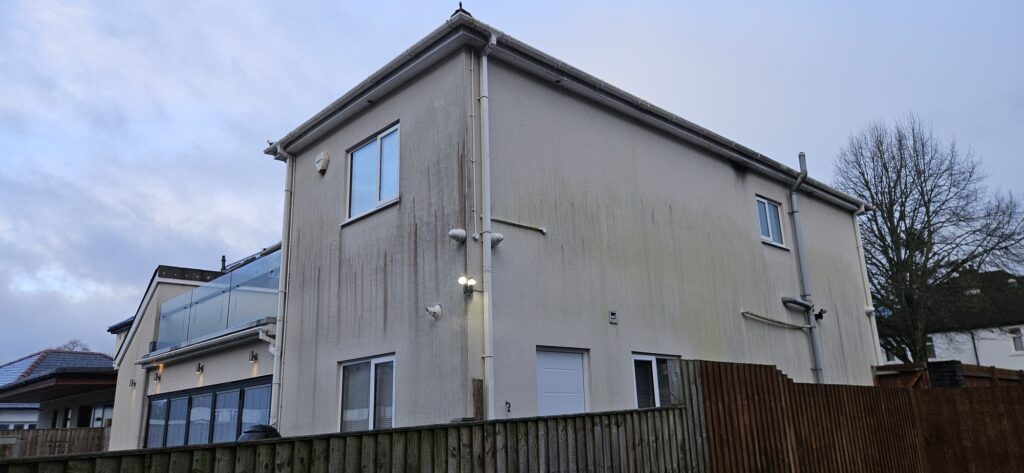
Why Green Algae and Red Algae Often Appear After Stormy Weather
Storms provide exactly the conditions biological growth requires.
Moisture, mild temperatures and airborne spores combine to encourage rapid colonisation.
Green algae commonly develops on permanently shaded elevations.
Red algae has become increasingly common across the UK and frequently appears as pink, orange or reddish staining that homeowners initially mistake for rust.
Both types should be professionally treated to remove the biological contamination rather than simply cleaning the visible surface.
Debris Left Behind After High Winds
Strong winds carry surprising amounts of material.
Common debris includes:
| Debris | Potential Effect |
|---|---|
| Leaves | Organic staining |
| Twigs | Surface marks |
| Seeds | Blocked drainage |
| Dust | General dirt |
| Moss fragments | Biological growth |
| Bird debris | Localised staining |
| Tree sap | Sticky marks |
Removing debris promptly helps reduce longer-term staining.
Should You Clean Render Immediately After a Storm?
Not always.
Immediately after severe weather, surfaces are usually saturated.
Cleaning at this stage can be less effective because:
- The render remains wet.
- Biological treatments become diluted.
- Existing damage may not yet be visible.
- Loose debris should be removed first.
A professional inspection allows any storm-related issues to be identified before cleaning begins.
Checking Your Property Safely
Following a storm, homeowners can perform a simple visual inspection from ground level.
Look for:
- Cracks in render
- Detached downpipes
- Overflowing gutters
- Broken roof tiles
- New staining
- Mud deposits
- Areas remaining damp
- Moss accumulation
Avoid climbing ladders or walking on roofs following storm damage.
The Importance of Gutters
Storms place enormous strain on guttering systems.
Overflowing gutters are one of the biggest causes of render staining.
When gutters overflow, water repeatedly runs down the same section of wall.
This creates:
- Black streaks
- Dirt deposits
- Damp patches
- Green algae
- Red algae
- Water marks
Repairing gutter problems prevents future staining returning quickly after cleaning.
Splashback Damage Around the Base of Walls
Heavy rainfall often causes muddy water to splash onto render.
Lower sections of walls receive repeated impacts from:
- Gravel
- Soil
- Mulch
- Lawn edging
- Flower beds
This creates a distinctive band of staining close to ground level.
Good drainage and landscaping help minimise future splashback.
Can Storms Damage the Render Itself?
Most storms cause cosmetic issues rather than structural damage.
However, exceptionally severe weather may contribute to:
| Problem | Possible Cause |
|---|---|
| Hairline cracks | Structural movement |
| Loose render | Existing defects |
| Water ingress | Damaged joints |
| Surface erosion | Long-term exposure |
| Staining | Moisture retention |
Professional cleaning should always be carried out using methods suitable for the specific render type.
Why Pressure Washing Isn’t the Answer
Many homeowners consider pressure washing after storms because dirt appears heavily embedded.
Unfortunately, high-pressure cleaning can create additional problems.
These include:
- Surface erosion
- Water penetration
- Damaged finishes
- Increased cracking
- Reduced render lifespan
Professional softwashing provides a much gentler solution.
Rather than relying on pressure, specialist cleaning solutions remove biological growth while protecting the render surface.
How Softwashing Restores Storm-Affected Render
Softwashing has become the preferred cleaning method for many rendered properties.
The process focuses on eliminating the biological contamination responsible for staining rather than simply removing surface dirt.
Typical stages include:
- Property inspection.
- Identification of storm-related contamination.
- Removal of loose debris.
- Application of professional softwashing treatments.
- Appropriate dwell time.
- Gentle rinsing where required.
This approach helps restore the appearance of rendered walls while minimising the risk of damage.
Different Types of Render React Differently
Not all render finishes behave the same after storms.
Some absorb moisture more readily than others.
| Render Type | Typical Storm Response |
|---|---|
| Silicone render | Excellent water repellence |
| Monocouche render | Can develop biological staining |
| Acrylic render | Dirt may adhere to surface |
| Mineral render | Requires appropriate maintenance |
Understanding the render system helps determine the safest cleaning method.
Trees Increase Storm-Related Staining
Properties surrounded by mature trees often experience greater contamination following storms.
Trees contribute:
- Fallen leaves
- Branch debris
- Sap
- Moss spores
- Shade
- Reduced airflow
This combination allows moisture to remain trapped against rendered walls for much longer.
Regular maintenance becomes increasingly important for heavily landscaped gardens.
How Often Should Storm-Exposed Properties Be Cleaned?
There is no universal cleaning schedule.
Several factors influence maintenance frequency:
- Local weather patterns
- Tree coverage
- Building orientation
- Previous biological growth
- Nearby vegetation
- Drainage performance
Properties in exposed coastal or rural areas may require more frequent cleaning than those in sheltered urban locations.
Preventing Future Storm Staining
Although storms cannot be prevented, homeowners can reduce the impact they have on rendered walls.
| Preventative Measure | Benefit |
|---|---|
| Clean gutters regularly | Prevents overflow |
| Trim overhanging branches | Improves drying |
| Remove moss from roofs | Reduces contamination |
| Maintain drainage | Minimises splashback |
| Inspect after storms | Early problem detection |
| Arrange periodic softwashing | Controls biological growth |
Preventative maintenance is generally more cost-effective than allowing staining to become severe.
Insurance and Storm Damage
Most cosmetic staining caused by storms will not be covered under standard home insurance policies.
However, if severe weather causes physical damage such as cracked render resulting from falling trees or structural impact, homeowners should photograph the affected areas before arranging repairs.
Cleaning should only take place after any insurance inspections have been completed where necessary.
Why Early Cleaning Delivers Better Results
Fresh storm staining is generally easier to remove than contamination left for several months.
The longer biological growth remains on render, the deeper it can establish itself within the surface.
Prompt maintenance helps:
- Restore kerb appeal.
- Reduce long-term staining.
- Slow future biological growth.
- Preserve the decorative finish.
- Protect the overall appearance of the property.
For homeowners looking to safely restore storm-affected render, Softwashing UK provides specialist softwashing services designed to remove dirt, storm residue, green algae, red algae and other biological staining without exposing delicate render to unnecessary pressure. Their professional approach helps keep rendered homes looking clean while supporting the long-term condition of the exterior finish.
Why Coastal Storms Create Different Render Problems
Properties located near the coast experience additional challenges after storms compared to inland homes.
Strong sea winds carry microscopic salt particles that settle on rendered surfaces. During periods of wet weather, these deposits mix with rainwater, creating a film that attracts further dirt and airborne pollution.
Although salt itself does not necessarily damage quality render, the combination of moisture and contamination can make walls appear dull much more quickly.
Coastal homes are also exposed to:
- Higher wind speeds
- More frequent driving rain
- Increased airborne moisture
- Greater levels of salt spray
- Longer periods of damp conditions
As a result, many coastal properties require more frequent exterior maintenance than similar homes further inland.
How Storms Affect Different Elevations of a Property
It is rare for every wall of a property to weather equally.
The direction each elevation faces has a significant impact on how much storm damage or staining develops.
| Elevation | Typical Storm Exposure |
|---|---|
| North-facing | Longest drying times and increased biological growth |
| South-facing | Faster drying but still vulnerable to heavy rain |
| East-facing | Exposed to morning moisture and prevailing weather in some areas |
| West-facing | Often receives the strongest wind-driven rain |
Understanding which walls are most exposed helps homeowners identify where maintenance is likely to be needed first.
Why Storm Debris Should Be Removed Promptly
Leaves and organic debris trapped against render continue holding moisture long after the storm has passed.
This creates ideal conditions for biological growth.
Organic material can also stain render as it begins to break down naturally.
Common problem areas include:
- Window ledges
- Decorative features
- External light fittings
- Pipe brackets
- Roof junctions
- Garden walls attached to the property
Removing debris shortly after storms helps reduce the risk of permanent staining developing.
How Overflowing Gutters Leave Long-Term Marks
Many homeowners notice vertical black lines running down rendered walls after periods of heavy rainfall.
These streaks are usually caused by overflowing gutters or leaking joints rather than problems with the render itself.
Every rainfall carries dirt and organic matter through the gutter system.
If water escapes repeatedly from the same location, contamination is deposited onto the wall below.
Over time these marks become increasingly noticeable.
Regular gutter maintenance is therefore an important part of keeping rendered properties looking clean.
The Importance of Airflow Around Your Property
Good airflow allows render to dry quickly after rainfall.
Poor ventilation has the opposite effect.
Areas with restricted airflow often remain damp for much longer following storms.
Several factors reduce natural drying:
| Cause | Effect |
|---|---|
| Dense hedges | Traps humidity |
| Tall fences | Restricts airflow |
| Large shrubs | Increases moisture retention |
| Narrow side passages | Slower evaporation |
| Closely built neighbouring properties | Reduced wind circulation |
Simple garden maintenance can significantly improve drying conditions around rendered walls.
Identifying the Difference Between Storm Staining and Structural Damage
Following severe weather, homeowners are often unsure whether marks on the render represent cosmetic staining or genuine damage.
Some warning signs require further investigation.
Cosmetic Issues
- Dirt deposits
- Green algae
- Red algae
- Black streaks
- Mud splashback
- Surface discolouration
Potential Structural Issues
- Wide cracks
- Bulging render
- Hollow sounding areas
- Loose sections
- Water entering the property
- Detached render
Where structural damage is suspected, repairs should be completed before professional cleaning takes place.
Why Biological Growth Returns Without Proper Treatment
Many people are disappointed when render appears clean immediately after washing, only for staining to return several months later.
This happens because visible growth represents only part of the problem.
Microscopic spores remain attached to the render unless they are treated properly.
These spores rapidly recolonise damp surfaces after future rainfall.
Professional softwashing focuses on treating the biological contamination responsible for regrowth rather than simply improving appearance for a short period.
Storms Can Affect Garden Walls Too
Render staining isn’t limited to houses.
Storms frequently leave contamination on:
- Boundary walls
- Rendered garages
- Garden offices
- Outbuildings
- Rendered retaining walls
- Entrance pillars
Because these structures are often surrounded by planting and receive less sunlight, they may actually develop biological growth faster than the main house.
Maintaining these areas helps create a consistent appearance throughout the property.
The Financial Benefits of Preventative Maintenance
Although many homeowners only think about cleaning once staining becomes obvious, preventative maintenance often represents better long-term value.
Allowing heavy contamination to build over many years can increase the amount of restoration work required.
| Maintenance Approach | Long-Term Benefit |
|---|---|
| Regular inspections | Early identification of issues |
| Prompt gutter repairs | Reduced water staining |
| Periodic softwashing | Slower biological regrowth |
| Vegetation management | Better airflow |
| Drainage maintenance | Less splashback contamination |
Looking after render throughout the year helps preserve kerb appeal and may reduce future maintenance costs.
Frequently Asked Questions
Will every storm leave visible staining?
No. Minor rainfall often causes little or no noticeable change. Prolonged periods of heavy rain combined with strong winds and damp conditions are much more likely to leave contamination behind.
Is render permanently stained once algae appears?
In most cases, no. Green algae and red algae are biological growths that can usually be safely removed using appropriate softwashing methods.
Can cleaning be carried out in damp weather?
Professional cleaning companies assess weather conditions carefully before treatment. Extremely heavy rain may reduce the effectiveness of specialist cleaning products, so work is generally scheduled when suitable drying conditions are expected.
Does every type of render require the same treatment?
No. Silicone, acrylic, monocouche and traditional mineral renders all have different characteristics. Cleaning methods should always be matched to the specific render system installed.
Why do stains often return in exactly the same place?
The underlying cause often remains unchanged. Overflowing gutters, constant shade, poor drainage or restricted airflow continue creating damp conditions that encourage biological growth.
Choosing a Professional Approach
Cleaning storm-affected render is about much more than simply making the walls look cleaner.
An experienced specialist will assess:
- The age of the render.
- The type of staining present.
- Whether green algae or red algae is involved.
- Any storm-related defects.
- Moisture sources contributing to future growth.
- The safest cleaning method for the particular render finish.
By identifying both the visible staining and the environmental conditions responsible for it, homeowners can enjoy longer-lasting results while protecting the appearance of their property.
For professionally cleaned rendered properties that have been affected by storms, prolonged rainfall and damp conditions, Softwashing UK offers specialist softwashing services designed to remove biological contamination safely and effectively. Their gentle cleaning techniques help restore the appearance of render while avoiding the unnecessary risks associated with high-pressure cleaning, making them an ideal solution for maintaining modern rendered homes throughout the UK’s changing weather conditions.