


Render above a conservatory can be one of the more awkward areas of a property to clean. What looks like a relatively straightforward section of exterior wall from ground level can become considerably more challenging once access, fragile conservatory roofs, glazing, gutters and surrounding surfaces are taken into account.
Over time, rendered walls can become affected by organic growth, staining and general atmospheric dirt. Green algae and red algae, along with mould, mildew, lichen and other biological contamination, can leave an otherwise attractive property looking tired and poorly maintained.
However, cleaning render above a conservatory is not simply a matter of finding a way to reach it. The cleaning method itself is equally important.
For many rendered surfaces, a controlled softwashing approach can provide an effective alternative to aggressive pressure washing. Professional companies such as Softwashing UK can assess the render, contamination and access requirements before deciding on the most appropriate treatment.
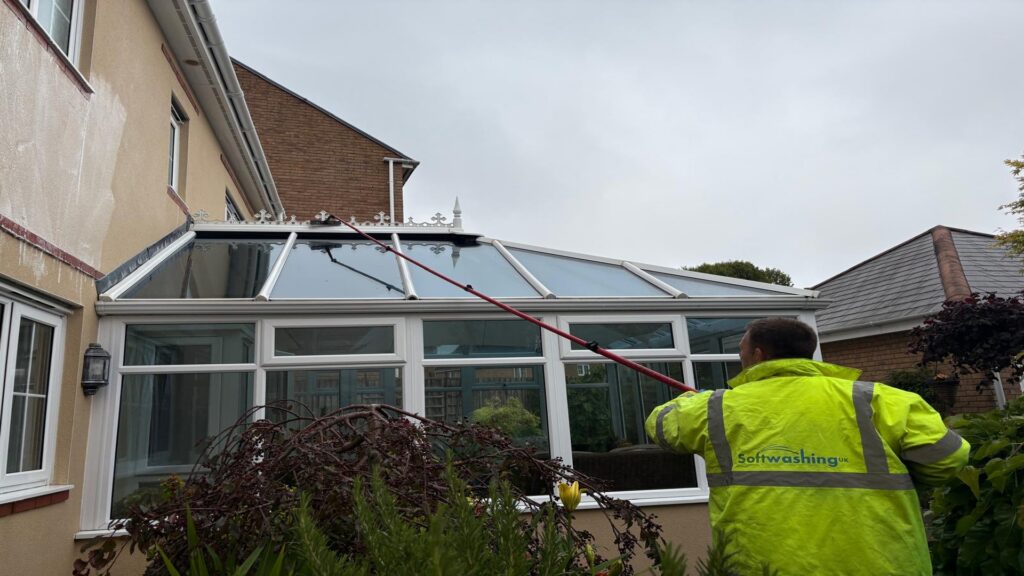
Why Is Render Above a Conservatory Difficult to Clean?
The obvious problem is access.
A conservatory may extend several metres away from the main building, meaning the rendered wall cannot necessarily be reached safely from a ladder positioned at ground level.
The conservatory roof itself may also prevent equipment from being positioned directly beneath the wall.
More importantly, conservatory roofs should never simply be treated as convenient working platforms. Depending on their construction, they may contain glass or polycarbonate panels that are not designed to support a person’s weight.
This creates several considerations:
| Challenge | Why It Matters |
|---|---|
| Conservatory roof | May be fragile or unsuitable for standing on |
| Limited access | The wall may be several metres from a safe working position |
| Glass panels | Cleaning solution and debris need to be carefully controlled |
| Gutters | Run-off may enter conservatory guttering |
| Render condition | Older or damaged render may require gentler treatment |
| Height | Appropriate access equipment may be required |
| Nearby planting | Plants and landscaping may require protection |
For this reason, the best render-cleaning method needs to consider both how the wall will be reached and how it will be cleaned.
Should You Pressure Wash Render Above a Conservatory?
Pressure washing may seem like the obvious solution. A long lance can potentially reach areas that would otherwise be difficult to access.
However, high-pressure cleaning is not automatically suitable for rendered walls.
Applying excessive pressure can potentially damage vulnerable render, particularly where the surface is already cracked, weathered or deteriorating.
There is also another issue.
If the staining is biological, simply removing the visible surface contamination does not necessarily deal with the underlying microorganisms responsible for it.
This is where softwashing differs.
Rather than relying primarily on mechanical pressure, softwashing uses carefully selected cleaning treatments to target organic contamination.
| Pressure Washing | Softwashing |
|---|---|
| Relies mainly on water pressure | Relies mainly on appropriate treatment |
| Can create considerable spray | Uses a controlled application |
| May be unsuitable for vulnerable render | Can be appropriate for many rendered surfaces |
| Removes visible dirt rapidly | Targets biological contamination |
| Higher risk of forcing water into defects | Uses considerably less mechanical force |
Every property is different, so the render should be inspected before choosing a cleaning method.
Why Does Render Become Green or Red?
Rendered walls can provide favourable conditions for biological growth.
Moisture is one of the biggest contributing factors.
Areas receiving less sunlight may remain damp for longer after rain, while nearby trees and vegetation can increase shade and humidity.
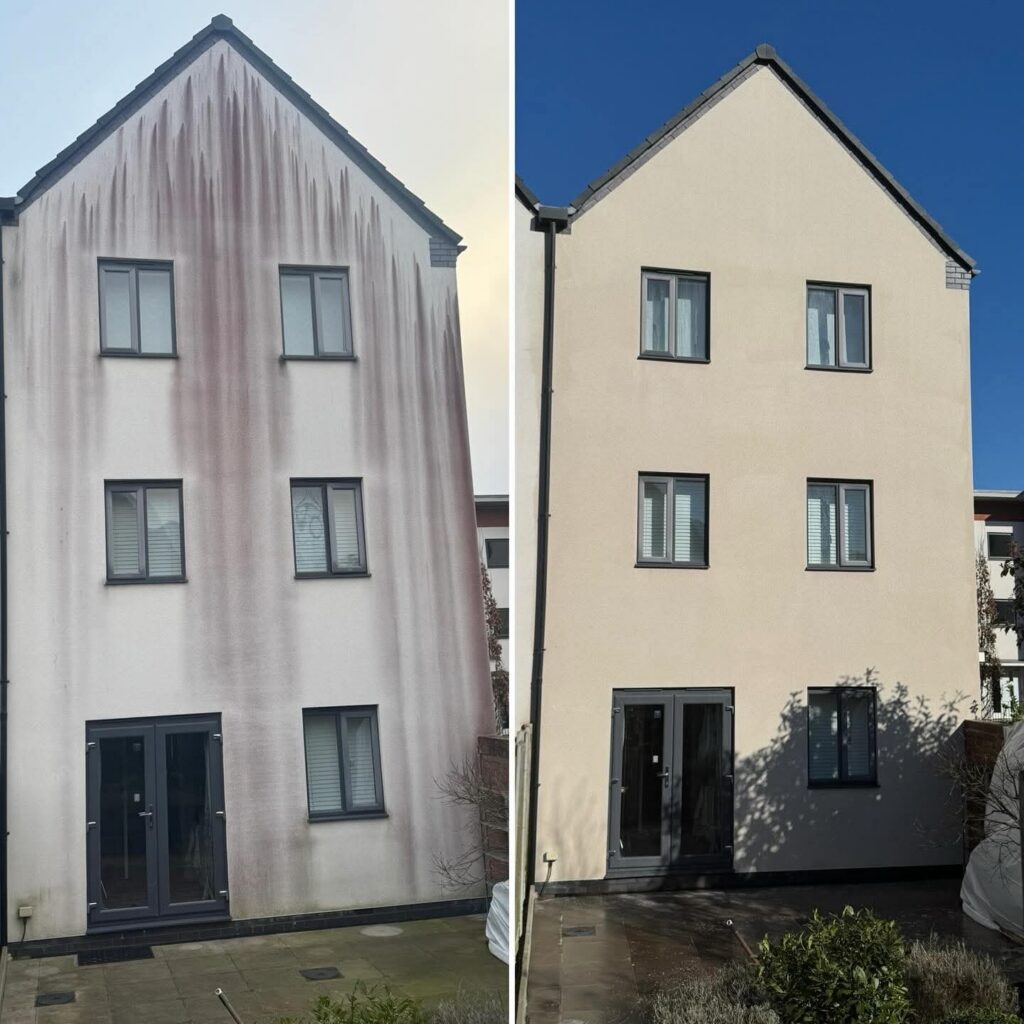
Green algae and red algae can both affect rendered elevations, creating discolouration that becomes increasingly noticeable over time.
Other factors can include:
- North-facing walls receiving less direct sunlight
- Poor airflow around parts of the building
- Water overflowing from gutters
- Leaking downpipes
- Nearby trees and vegetation
- Persistent dampness
- General environmental pollution
The section immediately above a conservatory can sometimes be particularly noticeable because homeowners are able to see it clearly from gardens, upstairs windows or neighbouring parts of the property.
Why Softwashing Can Be Suitable for Render
Softwashing takes a different approach to exterior cleaning.
Instead of trying to blast contamination away using very high water pressure, an appropriate cleaning solution is applied to the affected surface.
The treatment works on the organic contamination before the surface is appropriately rinsed or allowed to weather naturally, depending on the system being used and the condition of the surface.
This can make softwashing particularly useful for rendered walls where excessive mechanical pressure would be undesirable.
Professional render cleaning may be suitable for various types of exterior finishes, although the exact process should always be determined after inspecting the property.
You can find more information about professional exterior cleaning from Softwashing UK.
Accessing Render Above a Conservatory
Cleaning the render is only half of the job.
The contractor must first establish how the area can be accessed safely without placing unnecessary weight or equipment on the conservatory.
Depending on the property, access might involve specialist equipment or a cleaning system capable of reaching the wall from a suitable working position.
A professional assessment should consider:
| Access Consideration | What Should Be Assessed? |
|---|---|
| Conservatory projection | Distance from accessible ground to the wall |
| Roof construction | Glass, polycarbonate or other materials |
| Building height | Height of the render requiring treatment |
| Ground conditions | Whether equipment can be safely positioned |
| Side access | Whether equipment can reach the rear garden |
| Obstacles | Fences, extensions, sheds and landscaping |
| Overhead hazards | Cables, trees and other restrictions |
There is no single access method that will be correct for every property.
A small conservatory beneath a first-floor wall presents a very different challenge from a large orangery extending across the entire rear elevation of a three-storey property.
Protecting the Conservatory During Render Cleaning
The conservatory needs to be considered as part of the cleaning process rather than simply being viewed as an obstruction.
Before treatment begins, contractors may need to assess glazing, frames, seals, guttering and any decorative features.
Surrounding areas may also need to be thoroughly wetted or otherwise protected depending on the cleaning products being used.
Particular attention should be given to:
- Conservatory glass
- Polycarbonate panels
- uPVC or aluminium frames
- Lead flashing
- Gutters and downpipes
- Painted surfaces
- Patio areas
- Outdoor furniture
- Plants and lawns
Controlling run-off is also important.
Cleaning solution applied several metres above a conservatory will naturally travel downwards, so the entire area beneath the render should be considered before treatment starts.
Can Render Be Cleaned Without Standing on the Conservatory?
In many circumstances, yes.
A professional exterior cleaning company should assess alternative access methods rather than assuming that somebody needs to climb onto the conservatory.
Standing or walking on a conservatory roof can present obvious safety and damage risks.
Even if a particular section appears strong, that does not necessarily mean it has been designed as a load-bearing working platform.
Professional cleaning is therefore about creating a safe working method as much as achieving a clean wall.
How Much Does It Cost to Clean Render Above a Conservatory?
There is no universal price because access requirements can have a major influence on the cost.
A relatively small section of first-floor render with straightforward access could be considerably cheaper than a large elevation above a deep conservatory requiring specialist access arrangements.
As a broad illustration only:
| Type of Work | Indicative Cost |
|---|---|
| Small accessible rendered section | £300–£600 |
| Larger first-floor rendered area | £500–£900 |
| Render above a large conservatory | £700–£1,500+ |
| Extensive multi-elevation render cleaning | £1,000–£2,500+ |
| Complex specialist-access project | Individually quoted |
These figures should only be treated as general examples rather than fixed prices.
Factors affecting the quotation can include the size of the area, height, severity of contamination, render type, access restrictions, protection requirements and the equipment needed.
The cheapest quotation is not necessarily the best option when fragile surfaces and difficult access are involved.
Does Softwashing Remove Black, Green and Red Staining?
Different stains can have different causes.
Green algae and red algae are biological growths commonly associated with exterior surfaces, while black discolouration may potentially involve mould, fungi, atmospheric contamination or other microorganisms.
Identifying what has caused the staining helps determine the most appropriate treatment.
This is another reason why immediately reaching for a pressure washer is not always the best approach.
A professional cleaner can inspect the surface and select a treatment based on the type of contamination present.
Will Render Stay Clean Permanently?
No exterior surface can realistically be guaranteed to remain perfectly clean forever.
Rendered walls are continuously exposed to rain, airborne spores, pollution, shade and changing weather conditions.
However, dealing properly with biological contamination rather than simply removing its visible appearance can help provide a more thorough clean.
Future regrowth will depend heavily on the property’s environment.
A shaded wall surrounded by trees may experience new growth sooner than an open south-facing elevation receiving plenty of sunlight.
Maintenance cleaning can therefore be useful before contamination becomes heavily established again.
Signs Your Render May Need Professional Cleaning
Some discolouration develops gradually enough that homeowners become accustomed to it.
Typical signs that render may benefit from cleaning include:
| Sign | Possible Cause |
|---|---|
| Green staining | Green algae and other organic growth |
| Red or pink staining | Red algae or related biological contamination |
| Black patches | Mould, fungi or environmental contamination |
| Dark areas beneath gutters | Persistent moisture or overflowing guttering |
| Uneven discolouration | Weather exposure and organic growth |
| Heavy staining in shaded areas | Reduced sunlight and slower drying |
It is also worth investigating the cause of unusually severe staining.
For example, if one small section repeatedly becomes dirty much faster than the rest of the elevation, a leaking gutter or downpipe could be contributing to the problem.
Cleaning the wall without addressing the moisture source could mean contamination returns more quickly.
Should Cracked Render Be Cleaned?
Cracked or damaged render requires additional care.
Water entering cracks can potentially contribute to further deterioration, particularly during periods of cold weather.
If significant defects are visible, these should be identified before cleaning starts.
This does not necessarily mean that the entire elevation cannot be cleaned, but the condition of the substrate should influence the method used.
Professional assessment becomes particularly important when difficult access is combined with damaged render.
Cleaning Render Without Damaging the Finish
The aim should not simply be to make the wall look clean on the day of treatment.
The cleaning method should respect the underlying surface.
Render can vary considerably in age, condition, composition and finish. A cleaning technique suitable for one property may therefore be inappropriate for another.
Before work begins, consideration should be given to:
- Render type
- Age and condition
- Existing cracks
- Previous repairs
- Painted or coated areas
- Type of staining
- Level of biological contamination
- Access limitations
- Nearby materials
Where appropriate, a test area may also help determine how the surface responds to treatment.
Professional Render Cleaning Above Conservatories
The combination of height, fragile surfaces and biological contamination means render above conservatories can be considerably more complicated to clean than accessible ground-floor walls.
The priority should be finding a method that cleans the render effectively while also protecting the conservatory and surrounding property.
Softwashing can provide an effective solution because it focuses on treating organic contamination without depending on aggressive high-pressure cleaning.
For professional advice on cleaning rendered walls, including areas affected by difficult access, visit Softwashing UK.
How Often Should Render Above a Conservatory Be Cleaned?
There is no fixed cleaning interval that applies to every property.
Some rendered elevations may remain presentable for years, while shaded or damp areas may begin showing organic growth considerably sooner.
Rather than automatically arranging cleaning every year, it can be better to monitor the condition of the surface.
Early signs of green algae and red algae, dark staining or widespread discolouration may indicate that maintenance treatment is becoming worthwhile.
Keeping gutters and downpipes clear can also help. If rainwater is repeatedly spilling down the render, cleaning alone will not address the underlying cause.
A combination of appropriate maintenance, good drainage and professional cleaning when required can help rendered elevations remain presentable while avoiding unnecessarily aggressive or frequent treatment.
Can You Clean Render Above a Glass Conservatory Roof?
Glass conservatory roofs can make render cleaning particularly challenging. Although modern conservatory glass can be extremely strong, it should not automatically be assumed that the roof can safely support a person or cleaning equipment.
The safest approach is generally to find a method of accessing or treating the render without placing unnecessary loads on the conservatory roof.
There is also the issue of protecting the glass itself.
Cleaning solution, loosened organic contamination and general dirt can travel down the wall and onto the conservatory. A professional cleaning process therefore needs to take account of everything underneath the area being treated.
This is why cleaning the render above a conservatory should be viewed as a complete exterior cleaning project rather than simply treating an isolated section of wall.
Why Conservatory Gutters Need Special Attention
Guttering around a conservatory can collect run-off from the cleaning process.
Before work begins, the condition and position of the guttering should be considered. Blocked gutters can cause water to overflow onto frames, glazing, patios and surrounding surfaces.
Existing gutter problems can also contribute to dirty render.
For example, a gutter overflowing close to the main house can continually introduce moisture to a particular section of rendered wall. This can create favourable conditions for green algae and red algae, mould and other biological contamination.
| Gutter Problem | Potential Effect |
|---|---|
| Blocked gutter | Water can overflow onto surrounding surfaces |
| Leaking joint | Persistent dampness in one area |
| Damaged gutter | Poor control of rainwater |
| Blocked downpipe | Water backs up during heavy rainfall |
| Incorrect fall | Standing water remains within the gutter |
| Overflow near render | Can encourage recurring biological growth |
If the same area of render repeatedly becomes heavily stained, it is therefore worth investigating whether there is an underlying moisture problem.
Why Render Type Matters
Not every rendered property has the same exterior finish.
Traditional cement render, painted render, silicone render, monocouche and other modern render systems can have different characteristics. Their condition can also vary significantly depending on age, exposure and previous maintenance.
This is important because exterior cleaning should never be approached as though every rendered wall is identical.
A relatively new rendered elevation in good condition may respond very differently from an older wall containing cracks, repairs and areas where the coating has begun to deteriorate.
Before cleaning starts, the contractor should establish as much as possible about the surface being treated.
This assessment becomes even more important above a conservatory because reaching the wall again to correct a problem may be difficult and expensive.
Professional companies such as Softwashing UK can assess the property and determine an appropriate approach based on the surface and access conditions.
Why DIY Render Cleaning Can Be Difficult
Homeowners may be tempted to clean the area themselves using an extending pole, pressure washer or ladder.
The difficulty is that render above a conservatory combines several risks in one relatively small area.
There is the height of the wall, the distance created by the conservatory, the fragile roof beneath it and the need to apply cleaning products correctly.
Using a ladder can also be problematic if the conservatory prevents it from being positioned at a suitable angle.
A long pressure-washing lance may appear to solve the access problem, but increasing pressure to compensate for the distance could introduce another risk to the render.
DIY chemical application also requires careful consideration. Exterior cleaning products need to be selected, diluted, applied and managed correctly, with surrounding surfaces appropriately protected.
For these reasons, difficult-access render is one area where professional cleaning can be particularly valuable.
What Happens Before Render Is Softwashed?
A professional cleaning project should begin before any treatment is actually applied.
The property first needs to be assessed.
This allows the contractor to identify the contamination, examine the condition of the render and determine how the wall can be reached safely.
A typical assessment may consider:
| Assessment | Reason |
|---|---|
| Render condition | Identifies cracks, damage and vulnerable areas |
| Type of contamination | Helps determine suitable treatment |
| Conservatory construction | Influences access and protection requirements |
| Height of wall | Determines access requirements |
| Surrounding plants | May require additional protection |
| Gutters and downpipes | Helps manage run-off |
| Windows and frames | Need consideration during treatment |
| Ground access | Determines where equipment can be positioned |
The actual process can then be planned around the individual property rather than using exactly the same method on every building.
What About Render Between Conservatory Roof Sections?
Some properties have particularly awkward architectural layouts.
A conservatory or orangery might wrap around part of the building, leaving narrow sections of render between rooflines, extensions and upper-floor windows.
These areas can be difficult to reach using conventional equipment.
They may also receive less sunlight and airflow than more exposed sections of the elevation, potentially allowing moisture to remain on the surface for longer.
As a result, homeowners can sometimes find that the most difficult section of render to reach is also the section that becomes dirty fastest.
Professional access planning is especially important in these situations.
Trying to improvise access using conservatory frames, roof sections or unsuitable ladders can create unnecessary risks.
Can You Clean Render Around Conservatory Flashing?
The junction between the conservatory and the main property normally includes some form of weatherproofing or flashing.
This area deserves particular care during cleaning.
High-pressure water directed towards joints, seals or flashing could potentially find its way into areas where it would not normally enter during rainfall.
Using a controlled cleaning method can help reduce unnecessary mechanical force around vulnerable junctions.
Any obvious defects should also be identified before work starts.
If flashing has lifted or seals have deteriorated, cleaning may need to be adapted until repairs have been completed.
How Weather Affects Render Cleaning
Weather conditions can influence when exterior cleaning should take place.
Very strong winds can make working at height more difficult and can also affect the controlled application of cleaning treatments.
Heavy rain may dilute products before they have had sufficient time to work, while extremely hot conditions can cause solutions to dry too quickly on some surfaces.
Professional cleaners therefore need to consider both the immediate weather and the characteristics of the building.
| Weather Condition | Why It Matters |
|---|---|
| Strong wind | Can affect access and treatment control |
| Heavy rain | May dilute cleaning solutions |
| Very hot weather | Products may dry faster |
| Freezing temperatures | Can create additional surface and access risks |
| Mild, settled conditions | Often provide better control |
This is particularly important above conservatories because overspray and run-off need to be carefully managed.
Keeping Render Cleaner After Treatment
Once the render has been professionally cleaned, basic property maintenance can help reduce conditions that encourage contamination.
Gutters should be kept clear and leaking joints repaired. Overhanging vegetation may also contribute to shade and moisture around exterior walls.
Homeowners can periodically inspect the render for early signs of staining rather than waiting until an elevation becomes heavily contaminated.
Green algae and red algae may initially appear in isolated patches before spreading across larger sections of the wall.
Addressing maintenance issues early can make future cleaning more straightforward.
Where access above a conservatory is difficult, it can also make sense to have other relevant exterior areas assessed at the same time. This can reduce the need to repeatedly arrange specialist access equipment for small individual sections.
For advice about suitable treatment methods and professional render cleaning, visit Softwashing UK.