


Soft washing has become one of the most effective and widely trusted exterior cleaning methods available in the UK. While many people focus on the impressive visual transformation that soft washing can achieve, the real power of the process lies in the science behind it. Unlike traditional cleaning methods that rely primarily on force, soft washing uses carefully formulated treatments to target contamination at a microscopic level.
From residential homes and commercial premises to schools, care facilities and industrial buildings, soft washing is increasingly being chosen because it delivers longer-lasting results while reducing the risk of surface damage. Understanding the science behind soft washing helps explain why it has become the preferred solution for removing algae, mould, mildew, lichen and other forms of biological growth.
For professional soft washing services throughout the UK, Soft Washing UK specialises in treatments that focus on eliminating contamination at its source rather than simply removing visible staining.
What Is Soft Washing?
Soft washing is a specialist cleaning method that uses low-pressure application systems combined with professional cleaning solutions designed to break down biological contamination.
Unlike pressure washing, which relies on mechanical force to remove dirt and staining, soft washing works through chemical and biological processes.
The primary objectives of soft washing are to:
- Remove biological contamination
- Kill algae growth
- Eliminate mould spores
- Destroy mildew colonies
- Treat lichen infestations
- Reduce future regrowth
The process focuses on the underlying cause of staining rather than just the visible symptoms.
Understanding Biological Contamination
Most exterior staining is not simply dirt.
In many cases, the discolouration seen on roofs, render, walls, patios and cladding is caused by living organisms.
Common biological contaminants include:
| Contaminant | Type |
|---|---|
| Green algae | Photosynthetic microorganism |
| Red algae | Photosynthetic microorganism |
| Mould | Fungus |
| Mildew | Surface fungus |
| Lichen | Symbiotic organism |
| Moss | Non-vascular plant |
| Bacteria | Single-celled microorganism |
These organisms establish colonies on exterior surfaces and continue growing as long as suitable conditions exist.
Moisture, shade, warmth and airborne nutrients all contribute to biological development.
Why Green Algae and Red Algae Thrive
Green algae and red algae are among the most common exterior contaminants found throughout the UK.
Although both are algae, they behave differently and often develop in different environmental conditions.
Green Algae
Green algae typically appears as:
- Green streaks
- Green patches
- Dark green staining
- Surface discolouration
It commonly develops on:
- North-facing walls
- Roof tiles
- Render surfaces
- Driveways
- Fences
Red Algae
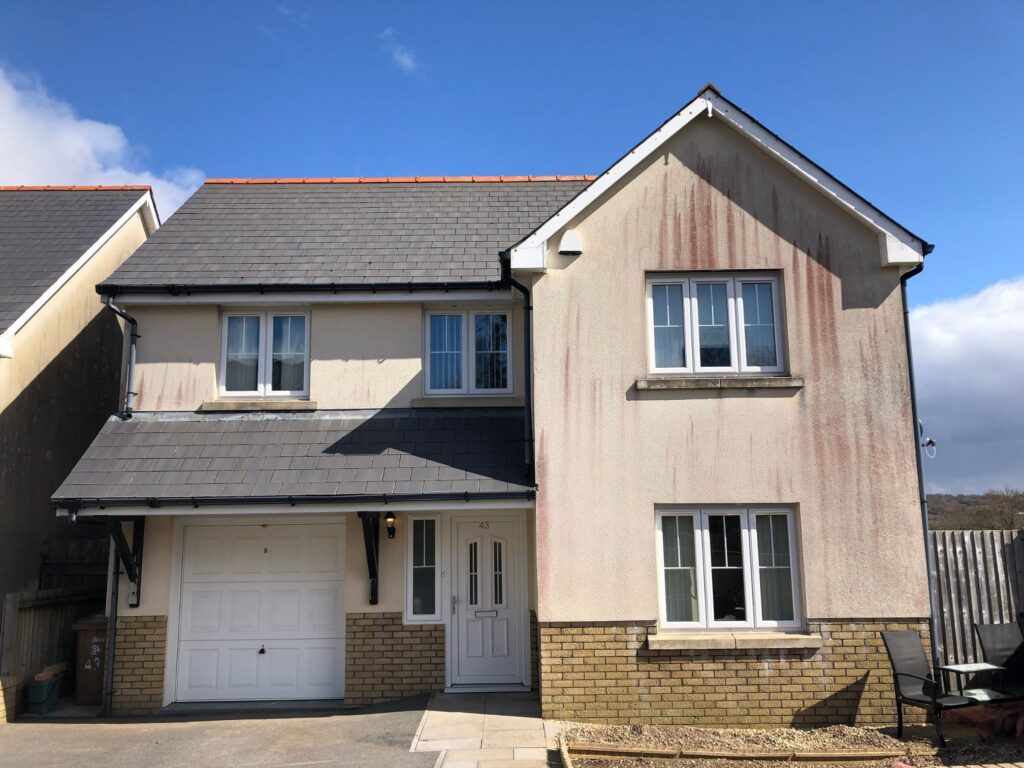
Red algae has become increasingly problematic on modern render systems.
It often appears as:
- Red streaking
- Pink staining
- Orange patches
- Rust-coloured discolouration
Red algae can be particularly difficult to remove because it forms strong surface attachments and spreads rapidly once established.
The science of soft washing focuses on destroying both green algae and red algae at a cellular level.
The Role of Microorganisms in Exterior Staining
Many property owners assume visible staining is simply dirt accumulation.
However, scientific analysis often reveals that biological growth is responsible for a significant proportion of exterior discolouration.
Microorganisms attach themselves to surfaces and begin reproducing.
As colonies expand, they:
- Trap moisture
- Retain dirt particles
- Create biofilms
- Increase surface staining
- Accelerate deterioration
Without treatment, these colonies continue growing and spreading.
This explains why surfaces can become increasingly stained over time.
What Is a Biofilm?
A biofilm is a collection of microorganisms that adhere to a surface and produce a protective layer around themselves.
Biofilms are a major factor in exterior contamination.
Characteristics of biofilms include:
| Biofilm Feature | Impact |
|---|---|
| Moisture retention | Encourages further growth |
| Protective coating | Increases resistance |
| Surface adhesion | Makes removal harder |
| Nutrient collection | Supports colony expansion |
Biofilms help microorganisms survive environmental stress and make simple washing techniques less effective.
Soft washing is specifically designed to break down these protective layers.
The Chemistry Behind Soft Washing
The effectiveness of soft washing comes from chemistry rather than force.
Professional treatments work by interacting with biological contaminants at a molecular level.
The cleaning solutions used in soft washing are designed to:
- Penetrate biofilms
- Oxidise organic material
- Disrupt cellular structures
- Break down contamination
- Neutralise microorganisms
This process achieves far more than surface cleaning.
It actively targets the root cause of biological staining.
Oxidation and Cleaning Science
One of the key scientific principles involved in soft washing is oxidation.
Oxidation occurs when molecules lose electrons through chemical reactions.
In exterior cleaning, oxidation helps:
- Destroy algae cells
- Break down mould colonies
- Eliminate mildew
- Remove organic staining
The process damages the cellular structure of microorganisms, preventing them from surviving.
Unlike physical cleaning methods, oxidation targets contamination at a microscopic level.
Why Low Pressure Matters
Many people associate effective cleaning with high pressure.
However, scientific testing has repeatedly shown that excessive pressure can damage building materials.
Soft washing uses low-pressure systems because the treatment performs the cleaning rather than the water force.
Benefits include:
- Reduced surface wear
- Lower risk of cracking
- Protection of coatings
- Preservation of render finishes
- Safer cleaning of delicate materials
The science demonstrates that chemical action can often be more effective than mechanical force.
How Soft Washing Targets Algae Cells
Algae cells contain structures necessary for survival and reproduction.
When soft washing treatments are applied:
- The solution penetrates the cell wall.
- Internal cellular functions become disrupted.
- Photosynthesis is interrupted.
- Cellular damage occurs.
- The organism dies.
This process affects both green algae and red algae, reducing the likelihood of rapid regrowth.
Because the treatment targets the organism itself, the results generally last longer than methods that simply wash away visible staining.
Understanding Mould and Mildew Removal
Mould and mildew are fungal organisms that reproduce through spores.
Spores can spread rapidly through the air and settle on nearby surfaces.
A single colony can release thousands of spores into the surrounding environment.
Soft washing treatments help by:
- Killing active colonies
- Neutralising spores
- Reducing future spread
- Breaking down organic residues
This scientific approach provides a deeper level of cleaning than surface washing alone.
Why Lichen Is Difficult to Remove
Lichen presents a unique challenge because it consists of multiple organisms living together.
A lichen colony is typically formed by:
- Fungus
- Algae
These organisms create a highly resilient structure capable of surviving harsh weather conditions.
Lichen can:
- Bond tightly to surfaces
- Penetrate microscopic pores
- Retain moisture
- Cause staining
The chemistry used in soft washing helps weaken these colonies and facilitate their removal.
The Importance of Dwell Time
One critical scientific factor in soft washing is dwell time.
Dwell time refers to the period during which the treatment remains on the surface.
This stage allows the solution to:
- Penetrate contamination
- Break down biofilms
- Destroy microorganisms
- Loosen staining
Insufficient dwell time may reduce effectiveness.
Professional operators understand how environmental conditions influence treatment performance.
Factors include:
| Variable | Effect on Dwell Time |
|---|---|
| Temperature | Influences reaction speed |
| Humidity | Affects drying rates |
| Surface type | Influences absorption |
| Contamination level | Determines treatment requirements |
Why Results Continue Improving After Treatment
One of the unique characteristics of soft washing is that surfaces often continue improving after treatment.
This occurs because biological contamination continues breaking down after application.
The process can involve:
- Gradual decomposition
- Weather-assisted rinsing
- Ongoing oxidation
- Continued biological control
This scientific mechanism helps explain why results frequently improve over time.
Surface Porosity and Contamination
Different materials have varying levels of porosity.
Porous materials include:
- Render
- Concrete
- Sandstone
- Roof tiles
- Brickwork
Microscopic pores provide ideal environments for microorganisms.
These pores can trap:
- Moisture
- Nutrients
- Organic matter
- Spores
Soft washing treatments penetrate these areas more effectively than many traditional cleaning methods.
Environmental Conditions and Biological Growth
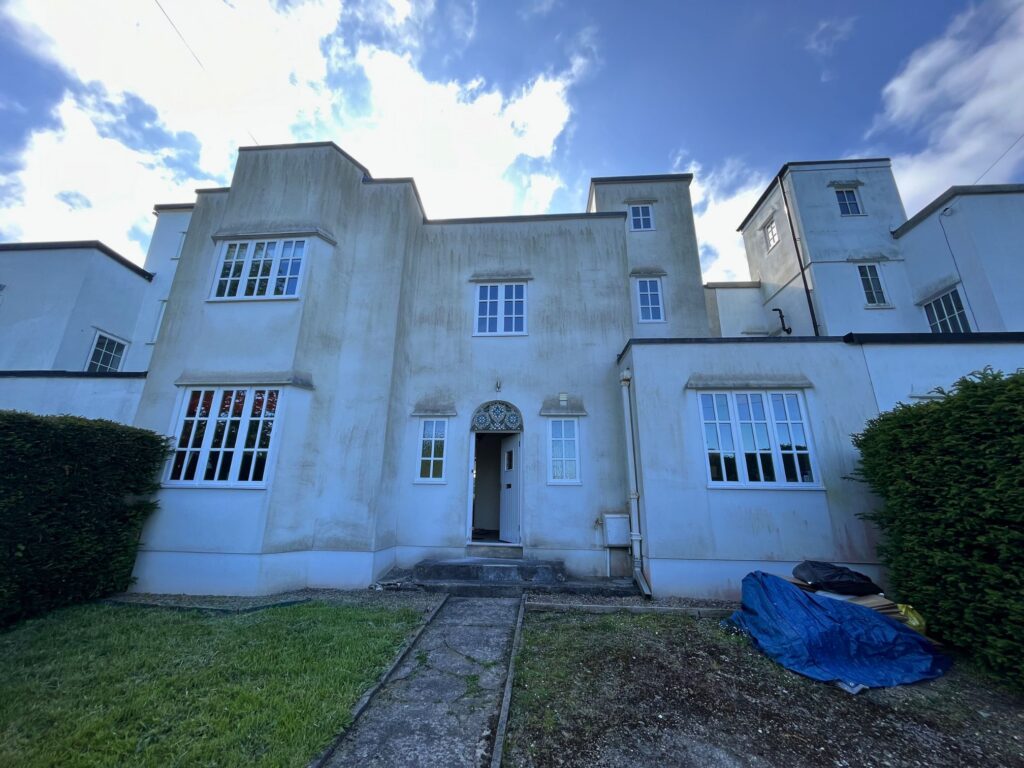
The UK climate creates ideal conditions for exterior contamination.
Frequent rainfall, humidity and moderate temperatures support biological growth throughout much of the year.
Factors that encourage contamination include:
- Persistent moisture
- Shaded areas
- Poor ventilation
- Organic debris
- Atmospheric pollution
Scientific studies consistently show that damp environments accelerate algae and fungal development.
The Relationship Between Moisture and Algae
Moisture is one of the most important factors influencing biological growth.
Without moisture, algae colonies struggle to survive.
With sufficient moisture, growth rates increase dramatically.
This explains why:
- North-facing walls often stain first
- Tree-covered properties experience greater contamination
- Coastal locations frequently develop algae growth
Understanding this relationship helps soft washing specialists identify high-risk areas.
How Soft Washing Supports Preventative Maintenance
The science of preventative maintenance focuses on addressing problems before they become severe.
Soft washing supports this approach by:
- Removing contamination early
- Reducing biological populations
- Limiting colony expansion
- Protecting building surfaces
Property owners often find preventative treatments more cost-effective than waiting until extensive contamination develops.
Cost Considerations and Long-Term Value
Exterior cleaning should be viewed as an investment rather than an expense.
Ignoring contamination can lead to:
- Premature deterioration
- Increased maintenance costs
- Reduced kerb appeal
- Potential repair work
Examples of potential expenditure include:
| Maintenance Item | Typical Cost Range |
|---|---|
| Render Repairs | £500–£5,000+ VAT |
| Exterior Repainting | £1,500–£8,000+ VAT |
| Roof Repairs | £300–£10,000+ VAT |
| Cladding Restoration | £1,000–£15,000+ VAT |
Preventative soft washing may help reduce the likelihood of such expenses by keeping surfaces cleaner and reducing biological growth.
Why Professional Application Matters
The science behind soft washing requires more than simply applying cleaning products.
Successful treatment depends on understanding:
- Surface chemistry
- Biological contamination
- Environmental conditions
- Material compatibility
- Correct dilution rates
Professional assessment ensures the most appropriate treatment strategy is used.
Improper application can reduce effectiveness and potentially compromise results.
Common Surfaces Suitable for Soft Washing
Soft washing can be used across a wide range of exterior surfaces.
| Surface Type | Suitable for Soft Washing |
|---|---|
| Render | Yes |
| Roof Tiles | Yes |
| Brickwork | Yes |
| Cladding | Yes |
| Stonework | Yes |
| Concrete | Yes |
| Painted Surfaces | Yes |
| Timber Fencing | Yes |
The versatility of the process is one reason for its growing popularity throughout the UK.
The Future of Exterior Cleaning Science
Advances in exterior cleaning continue to improve treatment performance and efficiency.
Research is helping professionals better understand:
- Microbial behaviour
- Biofilm formation
- Surface contamination patterns
- Long-term protection methods
- Environmental influences on growth
As knowledge continues to develop, soft washing remains at the forefront of scientifically driven exterior cleaning methods.
For property owners seeking a professional service built around proven cleaning principles, Soft Washing UK provides specialist soft washing solutions designed to target biological contamination at its source while protecting exterior surfaces from unnecessary damage.
Frequently Asked Questions About Soft Washing Science
Is soft washing scientifically different from pressure washing?
Yes. Pressure washing relies primarily on physical force, whereas soft washing uses chemical and biological processes to destroy contamination at a microscopic level.
Why does soft washing often last longer?
Because it targets the microorganisms responsible for staining rather than simply removing visible contamination.
Does soft washing work on green algae and red algae?
Yes. Professional soft washing treatments are designed to eliminate both green algae and red algae, helping reduce regrowth and restore exterior surfaces.
Can soft washing damage surfaces?
When performed correctly, soft washing is specifically designed to minimise the risk of damage by relying on low-pressure application methods rather than aggressive mechanical cleaning.
Why do some stains return after cleaning?
If the biological contamination responsible for the staining is not fully eliminated, regrowth can occur. This is why treatments that address the root cause often achieve longer-lasting results.
The Role of Surface Temperature in Soft Washing Effectiveness
Surface temperature plays an important role in the science behind soft washing. Chemical reactions are influenced by environmental conditions, and temperature can affect how quickly cleaning solutions interact with biological contamination.
During warmer conditions, treatment reactions may occur more rapidly because molecules move faster and interact more efficiently with contaminants. In cooler conditions, reactions may take longer, which is why experienced soft washing professionals adjust application methods and dwell times accordingly.
The temperature of the surface itself can also influence cleaning performance. Materials exposed to direct sunlight may warm significantly, while shaded elevations often remain cooler and damp for extended periods. These differences can affect both contamination levels and treatment outcomes.
| Temperature Factor | Potential Impact |
|---|---|
| Warm Surfaces | Faster chemical reactions |
| Cool Surfaces | Extended dwell time may be required |
| Shaded Areas | Increased algae growth potential |
| Sunlit Areas | Faster drying rates |
| Damp Surfaces | Greater biological activity |
Understanding these variables allows treatments to be applied more effectively and consistently.
Surface temperature also helps explain why certain areas of a property become contaminated more quickly than others. Walls that remain cool and damp provide ideal conditions for green algae and red algae to establish colonies. These microorganisms thrive when moisture remains present for prolonged periods, particularly during the UK’s wetter seasons.
By combining knowledge of temperature, moisture levels and biological growth patterns, professional soft washing treatments can be tailored to deliver optimal results while maintaining the integrity of the surface being cleaned.