


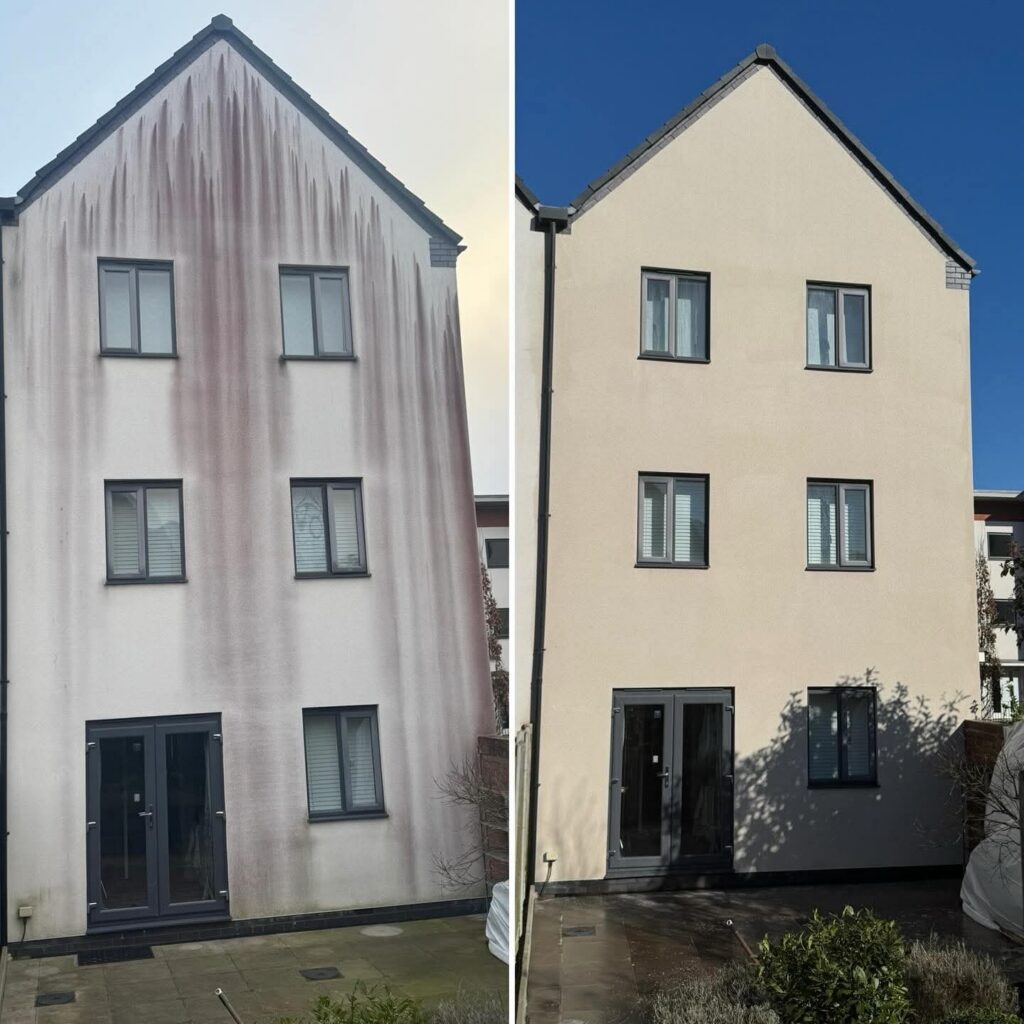
After having exterior render professionally cleaned, it is natural to want to keep it looking fresh for as long as possible. One question homeowners frequently ask is whether the render should be sealed after cleaning.
There is plenty of conflicting advice surrounding render sealers. Some products are marketed as an essential final stage, while others are promoted as a way to make a rendered wall completely waterproof. In reality, whether sealing is appropriate depends on the type of render, its condition, the product being considered and the reason for applying it.
Importantly, sealing should never be viewed as a substitute for correct cleaning, maintenance or repairs.
At Softwashing UK, the priority when cleaning render is to identify the type of contamination and use an appropriate treatment for the surface. Understanding what happens after cleaning is equally important, particularly before applying anything that could alter the behaviour or appearance of the render.
What Does Sealing Render Actually Mean?
A render sealer is a treatment applied to an exterior rendered surface after it has been cleaned and appropriately prepared.
Depending on the particular product and render system, a treatment may be intended to reduce water absorption or provide additional surface protection.
However, the term sealer can be misleading because it sometimes creates the impression that the wall is being covered with an entirely waterproof barrier.
That is not necessarily desirable.
Exterior walls need to manage moisture effectively. Applying an unsuitable product could potentially change the way moisture moves through the surface.
This is why homeowners should avoid assuming that applying the strongest or most water-resistant product available automatically provides the best protection.
Does Render Always Need Sealing After Cleaning?
No.
Cleaning render does not automatically mean that it needs to be sealed afterwards.
Many render systems are designed to perform correctly without an additional aftermarket coating being applied following every clean.
The first question should therefore be:
Why are you considering sealing the render?
Possible reasons might include:
- Reducing future water absorption
- Trying to slow down future staining
- Protecting a particularly exposed elevation
- Attempting to make maintenance easier
- Following recommendations for a specific render system
The suitability of a treatment should then be assessed against the actual render.
| Situation | Is Sealing Automatically Required? |
|---|---|
| Render has just been professionally cleaned | No |
| Green algae and red algae have been removed | No |
| Wall is exposed to frequent rainfall | Not necessarily |
| Manufacturer specifically recommends treatment | Follow relevant guidance |
| Render is cracked or defective | Repairs should be investigated first |
| Wall has persistent damp patches | Cause should be identified first |
| Homeowner wants to reduce water absorption | Suitability needs assessing |
Cleaning and sealing are two separate processes and should be treated as such.
Cleaning Must Come Before Any Suitable Protective Treatment
If a protective treatment is going to be applied, the render needs to be properly prepared.
Applying a treatment over dirt, atmospheric deposits, mould, lichen, green algae and red algae can potentially trap contamination beneath the treated surface or prevent the product from performing as intended.
The surface should therefore be appropriately cleaned first.
This is one reason professional render cleaning is about more than making a wall look brighter.
Where biological contamination is present, the cleaning process should address that contamination rather than simply removing the most visible surface staining.
Softwashing UK uses specialist softwashing techniques to treat exterior contamination while avoiding unnecessarily aggressive pressure on rendered finishes.
Why Render Must Be Allowed to Dry
Drying time is an important consideration before applying many treatments.
Immediately after cleaning, the render may contain moisture. Applying a product too soon could affect how it penetrates, adheres or performs.
Drying conditions will vary considerably depending on the property.
Factors include:
- Weather conditions
- Temperature
- Recent rainfall
- Amount of sunlight
- Orientation of the wall
- Render type
- Porosity
- Shading from buildings or vegetation
- Time of year
A sunny south-facing wall during warm weather may dry considerably faster than a north-facing elevation during autumn.
The manufacturer’s requirements for any specific treatment should always be followed rather than assuming a standard waiting period applies to every situation.
Breathability Matters
One of the most important considerations when discussing render treatments is moisture movement.
Exterior wall systems have different characteristics, and some are designed to allow water vapour to move through them.
This is commonly referred to as breathability or vapour permeability.
Applying an unsuitable coating can potentially interfere with this behaviour.
| Treatment Characteristic | Why It Matters |
|---|---|
| Vapour permeability | Helps determine how moisture vapour can move |
| Water repellency | Can reduce absorption of rainwater |
| Compatibility | Treatment needs to suit the render system |
| Appearance | Some treatments may alter the finish |
| Application conditions | Temperature and moisture levels can affect performance |
| Manufacturer approval | May be relevant to warranties or specifications |
The aim should not simply be to create the most impermeable exterior surface possible.
The treatment needs to be compatible with the wall.
Will Sealing Stop Green Algae and Red Algae?
This is where expectations need to be realistic.
Green algae and red algae are strongly influenced by environmental conditions, particularly moisture, shade and available organic material.
A suitable water-repellent treatment may reduce the amount of water absorbed by certain surfaces, but this does not mean biological contamination can never develop again.
Rain can still land on the wall. Condensation can still form. Airborne spores and organic material can still settle on exterior surfaces.
Walls that receive little sunlight may continue to remain damp at the surface for longer than sunny elevations.
Sealing should therefore not be sold as a permanent cure for green algae and red algae.
Regular inspection and appropriate maintenance remain important.
A Sealer Cannot Repair Damaged Render
Another misconception is that applying a water-repellent treatment can solve problems with cracked or deteriorating render.
It cannot replace proper repairs.
If water is entering through a significant crack, defective joint or damaged area, coating the surrounding surface does not remove the underlying defect.
Before considering any treatment, check for:
- Cracks
- Loose render
- Hollow areas
- Failed sealant
- Damaged joints
- Bulging sections
- Flaking coatings
- Water penetration around windows or doors
Any significant defect should be properly assessed.
Cleaning and surface protection should come after necessary building maintenance, not instead of it.
Sealing Is Not the Same as Waterproofing a Building
The word waterproofing is sometimes used very loosely when discussing exterior treatments.
A water-repellent surface treatment and a fully waterproof construction system are not the same thing.
Rainwater management depends on numerous elements of a property, including the roof, guttering, flashings, windows, doors, drainage and the wall construction itself.
Applying a treatment to the face of the render will not compensate for overflowing guttering, failed roof details or damaged seals.
If a property has persistent moisture problems, the cause should be identified rather than simply trying to coat over the symptoms.
What About Silicone Render?
Modern silicone renders already have water-repellent characteristics as part of their design.
This makes it particularly important not to assume that an additional treatment is automatically necessary after cleaning.
The correct approach will depend on the specific render system and its manufacturer’s guidance.
The same principle applies to other modern render systems. Just because a generic exterior treatment is available does not mean it should automatically be applied to every surface.
Professional cleaning should respect the characteristics of the existing render rather than attempting to fundamentally change them.
Can Sealing Change the Appearance of Render?
Potentially, depending on the product.
Some treatments are intended to be visually unobtrusive, but homeowners should never assume that every product will leave every render finish completely unchanged.
Possible changes can include:
- Slight colour alteration
- Darkening
- Changes in sheen
- Uneven appearance
- Visible application marks
The existing condition of the wall can also influence the finished result.
A small test area may therefore be appropriate before applying any treatment across a large elevation, particularly on highly visible walls.
When Might a Protective Treatment Be Considered?
There are circumstances where an appropriate protective treatment may be worth considering, provided it is compatible with the render.
For example, an elevation may experience particularly high levels of weather exposure or repeated moisture.
However, this should still be assessed individually.
| Property Condition | What to Consider First |
|---|---|
| Highly exposed wall | Render type and weather exposure |
| Shaded elevation | Cause of persistent moisture |
| Recently cleaned render | Whether treatment is actually necessary |
| Older porous surface | Condition and compatibility |
| Recently repaired render | Repair specifications and curing requirements |
| Modern render system | Manufacturer guidance |
| Recurring contamination | Environmental causes and maintenance |
The decision should be based on the wall rather than treating sealing as a standard add-on to every render clean.
The Problem With Sealing Over Contamination
Imagine a rendered wall that looks relatively clean from a distance but still contains areas of biological contamination.
If a coating or treatment is applied without suitable preparation, the result may be disappointing.
Visible staining could remain beneath the treatment, while uneven contamination may affect the finished appearance.
This is particularly important with pale render because relatively minor imperfections can become noticeable across a large elevation.
Correct cleaning and preparation are therefore essential before any additional surface treatment is considered.
Pressure Washing Before Sealing Can Create Additional Problems
Using excessive pressure to prepare render for sealing can be counterproductive.
Aggressive pressure washing may damage certain render finishes, remove coatings or drive water into vulnerable cracks and joints.
It can also leave the surface extremely wet immediately before a treatment is due to be applied.
Softwashing takes a different approach by focusing on treating contamination rather than relying solely on mechanical force.
For rendered properties affected by organic staining, Softwashing UK can assess the exterior surface and use cleaning methods appropriate to the contamination and substrate.
Is Regular Cleaning Better Than Automatically Sealing?
For many properties, sensible ongoing maintenance is more important than automatically applying another product after every clean.
Exterior walls will always be exposed to weather and airborne contamination. Even a treated surface still needs to be inspected and maintained.
A practical maintenance approach can include:
| Maintenance Step | Purpose |
|---|---|
| Inspect guttering | Prevent excessive water running over render |
| Check downpipes | Identify leaks and defective joints |
| Monitor cracks | Spot developing render defects |
| Trim nearby vegetation | Improve airflow and sunlight |
| Watch shaded elevations | Identify contamination early |
| Arrange suitable cleaning | Treat organic staining when required |
| Review protective treatments | Determine whether they remain suitable |
Keeping the causes of persistent moisture under control can make a considerable difference to how an exterior wall ages.
Questions to Ask Before Sealing Render
Before deciding that freshly cleaned render needs another treatment, there are several useful questions to consider.
What type of render is installed?
Different render systems behave differently and may have their own maintenance requirements.
Why is a sealer being proposed?
There should be a specific reason rather than simply applying one because the wall has been cleaned.
Is the render in good condition?
Cracks, failed joints and other defects need appropriate attention.
Has all contamination been properly treated?
Green algae and red algae, mould, lichen and other organic staining should be dealt with before an appropriate protective treatment is considered.
Is the proposed treatment compatible with the render?
Generic claims about exterior masonry do not necessarily mean a product is appropriate for every render system.
Could it affect the appearance?
The visual result needs to be considered, particularly on pale or highly visible elevations.
Professional Assessment Before Making the Decision
There is no single rule stating that every rendered wall should be sealed after cleaning.
Some surfaces may benefit from an appropriate treatment in the right circumstances, while others may require nothing more than professional cleaning and ongoing maintenance.
The key is understanding what type of render is present, why it became contaminated, whether there are any defects and what the proposed treatment is actually designed to achieve.
A rendered wall covered with years of dirt, green algae and red algae should first be cleaned appropriately so its true condition can be seen. Once the contamination has been removed, it becomes much easier to assess whether anything further is genuinely required.
For specialist render cleaning and advice on maintaining exterior rendered surfaces, visit Softwashing UK.
The Truth About Sealing Render After Cleaning
After having exterior render professionally cleaned, it is natural to want to keep it looking fresh for as long as possible. One question homeowners frequently ask is whether the render should be sealed after cleaning.
There is plenty of conflicting advice surrounding render sealers. Some products are marketed as an essential final stage, while others are promoted as a way to make a rendered wall completely waterproof. In reality, whether sealing is appropriate depends on the type of render, its condition, the product being considered and the reason for applying it.
Importantly, sealing should never be viewed as a substitute for correct cleaning, maintenance or repairs.
At Softwashing UK, the priority when cleaning render is to identify the type of contamination and use an appropriate treatment for the surface. Understanding what happens after cleaning is equally important, particularly before applying anything that could alter the behaviour or appearance of the render.
What Does Sealing Render Actually Mean?
A render sealer is a treatment applied to an exterior rendered surface after it has been cleaned and appropriately prepared.
Depending on the particular product and render system, a treatment may be intended to reduce water absorption or provide additional surface protection.
However, the term sealer can be misleading because it sometimes creates the impression that the wall is being covered with an entirely waterproof barrier.
That is not necessarily desirable.
Exterior walls need to manage moisture effectively. Applying an unsuitable product could potentially change the way moisture moves through the surface.
This is why homeowners should avoid assuming that applying the strongest or most water-resistant product available automatically provides the best protection.
Does Render Always Need Sealing After Cleaning?
No.
Cleaning render does not automatically mean that it needs to be sealed afterwards.
Many render systems are designed to perform correctly without an additional aftermarket coating being applied following every clean.
The first question should therefore be:
Why are you considering sealing the render?
Possible reasons might include:
- Reducing future water absorption
- Trying to slow down future staining
- Protecting a particularly exposed elevation
- Attempting to make maintenance easier
- Following recommendations for a specific render system
The suitability of a treatment should then be assessed against the actual render.
| Situation | Is Sealing Automatically Required? |
|---|---|
| Render has just been professionally cleaned | No |
| Green algae and red algae have been removed | No |
| Wall is exposed to frequent rainfall | Not necessarily |
| Manufacturer specifically recommends treatment | Follow relevant guidance |
| Render is cracked or defective | Repairs should be investigated first |
| Wall has persistent damp patches | Cause should be identified first |
| Homeowner wants to reduce water absorption | Suitability needs assessing |
Cleaning and sealing are two separate processes and should be treated as such.
Cleaning Must Come Before Any Suitable Protective Treatment
If a protective treatment is going to be applied, the render needs to be properly prepared.
Applying a treatment over dirt, atmospheric deposits, mould, lichen, green algae and red algae can potentially trap contamination beneath the treated surface or prevent the product from performing as intended.
The surface should therefore be appropriately cleaned first.
This is one reason professional render cleaning is about more than making a wall look brighter.
Where biological contamination is present, the cleaning process should address that contamination rather than simply removing the most visible surface staining.
Softwashing UK uses specialist softwashing techniques to treat exterior contamination while avoiding unnecessarily aggressive pressure on rendered finishes.
Why Render Must Be Allowed to Dry
Drying time is an important consideration before applying many treatments.
Immediately after cleaning, the render may contain moisture. Applying a product too soon could affect how it penetrates, adheres or performs.
Drying conditions will vary considerably depending on the property.
Factors include:
- Weather conditions
- Temperature
- Recent rainfall
- Amount of sunlight
- Orientation of the wall
- Render type
- Porosity
- Shading from buildings or vegetation
- Time of year
A sunny south-facing wall during warm weather may dry considerably faster than a north-facing elevation during autumn.
The manufacturer’s requirements for any specific treatment should always be followed rather than assuming a standard waiting period applies to every situation.
Breathability Matters
One of the most important considerations when discussing render treatments is moisture movement.
Exterior wall systems have different characteristics, and some are designed to allow water vapour to move through them.
This is commonly referred to as breathability or vapour permeability.
Applying an unsuitable coating can potentially interfere with this behaviour.
| Treatment Characteristic | Why It Matters |
|---|---|
| Vapour permeability | Helps determine how moisture vapour can move |
| Water repellency | Can reduce absorption of rainwater |
| Compatibility | Treatment needs to suit the render system |
| Appearance | Some treatments may alter the finish |
| Application conditions | Temperature and moisture levels can affect performance |
| Manufacturer approval | May be relevant to warranties or specifications |
The aim should not simply be to create the most impermeable exterior surface possible.
The treatment needs to be compatible with the wall.
Will Sealing Stop Green Algae and Red Algae?
This is where expectations need to be realistic.
Green algae and red algae are strongly influenced by environmental conditions, particularly moisture, shade and available organic material.
A suitable water-repellent treatment may reduce the amount of water absorbed by certain surfaces, but this does not mean biological contamination can never develop again.
Rain can still land on the wall. Condensation can still form. Airborne spores and organic material can still settle on exterior surfaces.
Walls that receive little sunlight may continue to remain damp at the surface for longer than sunny elevations.
Sealing should therefore not be sold as a permanent cure for green algae and red algae.
Regular inspection and appropriate maintenance remain important.
A Sealer Cannot Repair Damaged Render
Another misconception is that applying a water-repellent treatment can solve problems with cracked or deteriorating render.
It cannot replace proper repairs.
If water is entering through a significant crack, defective joint or damaged area, coating the surrounding surface does not remove the underlying defect.
Before considering any treatment, check for:
- Cracks
- Loose render
- Hollow areas
- Failed sealant
- Damaged joints
- Bulging sections
- Flaking coatings
- Water penetration around windows or doors
Any significant defect should be properly assessed.
Cleaning and surface protection should come after necessary building maintenance, not instead of it.
Sealing Is Not the Same as Waterproofing a Building
The word waterproofing is sometimes used very loosely when discussing exterior treatments.
A water-repellent surface treatment and a fully waterproof construction system are not the same thing.
Rainwater management depends on numerous elements of a property, including the roof, guttering, flashings, windows, doors, drainage and the wall construction itself.
Applying a treatment to the face of the render will not compensate for overflowing guttering, failed roof details or damaged seals.
If a property has persistent moisture problems, the cause should be identified rather than simply trying to coat over the symptoms.
What About Silicone Render?
Modern silicone renders already have water-repellent characteristics as part of their design.
This makes it particularly important not to assume that an additional treatment is automatically necessary after cleaning.
The correct approach will depend on the specific render system and its manufacturer’s guidance.
The same principle applies to other modern render systems. Just because a generic exterior treatment is available does not mean it should automatically be applied to every surface.
Professional cleaning should respect the characteristics of the existing render rather than attempting to fundamentally change them.
Can Sealing Change the Appearance of Render?
Potentially, depending on the product.
Some treatments are intended to be visually unobtrusive, but homeowners should never assume that every product will leave every render finish completely unchanged.
Possible changes can include:
- Slight colour alteration
- Darkening
- Changes in sheen
- Uneven appearance
- Visible application marks
The existing condition of the wall can also influence the finished result.
A small test area may therefore be appropriate before applying any treatment across a large elevation, particularly on highly visible walls.
When Might a Protective Treatment Be Considered?
There are circumstances where an appropriate protective treatment may be worth considering, provided it is compatible with the render.
For example, an elevation may experience particularly high levels of weather exposure or repeated moisture.
However, this should still be assessed individually.
| Property Condition | What to Consider First |
|---|---|
| Highly exposed wall | Render type and weather exposure |
| Shaded elevation | Cause of persistent moisture |
| Recently cleaned render | Whether treatment is actually necessary |
| Older porous surface | Condition and compatibility |
| Recently repaired render | Repair specifications and curing requirements |
| Modern render system | Manufacturer guidance |
| Recurring contamination | Environmental causes and maintenance |
The decision should be based on the wall rather than treating sealing as a standard add-on to every render clean.
The Problem With Sealing Over Contamination
Imagine a rendered wall that looks relatively clean from a distance but still contains areas of biological contamination.
If a coating or treatment is applied without suitable preparation, the result may be disappointing.
Visible staining could remain beneath the treatment, while uneven contamination may affect the finished appearance.
This is particularly important with pale render because relatively minor imperfections can become noticeable across a large elevation.
Correct cleaning and preparation are therefore essential before any additional surface treatment is considered.
Pressure Washing Before Sealing Can Create Additional Problems
Using excessive pressure to prepare render for sealing can be counterproductive.
Aggressive pressure washing may damage certain render finishes, remove coatings or drive water into vulnerable cracks and joints.
It can also leave the surface extremely wet immediately before a treatment is due to be applied.
Softwashing takes a different approach by focusing on treating contamination rather than relying solely on mechanical force.
For rendered properties affected by organic staining, Softwashing UK can assess the exterior surface and use cleaning methods appropriate to the contamination and substrate.
Is Regular Cleaning Better Than Automatically Sealing?
For many properties, sensible ongoing maintenance is more important than automatically applying another product after every clean.
Exterior walls will always be exposed to weather and airborne contamination. Even a treated surface still needs to be inspected and maintained.
A practical maintenance approach can include:
| Maintenance Step | Purpose |
|---|---|
| Inspect guttering | Prevent excessive water running over render |
| Check downpipes | Identify leaks and defective joints |
| Monitor cracks | Spot developing render defects |
| Trim nearby vegetation | Improve airflow and sunlight |
| Watch shaded elevations | Identify contamination early |
| Arrange suitable cleaning | Treat organic staining when required |
| Review protective treatments | Determine whether they remain suitable |
Keeping the causes of persistent moisture under control can make a considerable difference to how an exterior wall ages.
Questions to Ask Before Sealing Render
Before deciding that freshly cleaned render needs another treatment, there are several useful questions to consider.
What type of render is installed?
Different render systems behave differently and may have their own maintenance requirements.
Why is a sealer being proposed?
There should be a specific reason rather than simply applying one because the wall has been cleaned.
Is the render in good condition?
Cracks, failed joints and other defects need appropriate attention.
Has all contamination been properly treated?
Green algae and red algae, mould, lichen and other organic staining should be dealt with before an appropriate protective treatment is considered.
Is the proposed treatment compatible with the render?
Generic claims about exterior masonry do not necessarily mean a product is appropriate for every render system.
Could it affect the appearance?
The visual result needs to be considered, particularly on pale or highly visible elevations.
Professional Assessment Before Making the Decision
There is no single rule stating that every rendered wall should be sealed after cleaning.
Some surfaces may benefit from an appropriate treatment in the right circumstances, while others may require nothing more than professional cleaning and ongoing maintenance.
The key is understanding what type of render is present, why it became contaminated, whether there are any defects and what the proposed treatment is actually designed to achieve.
A rendered wall covered with years of dirt, green algae and red algae should first be cleaned appropriately so its true condition can be seen. Once the contamination has been removed, it becomes much easier to assess whether anything further is genuinely required.
For specialist render cleaning and advice on maintaining exterior rendered surfaces, visit Softwashing UK.
How Location Can Influence Whether Extra Protection Is Worth Considering
The environment surrounding a property can have a major influence on how its render behaves after cleaning. Two houses with the same type of render can experience very different levels of weathering simply because of where they are positioned.
Properties in exposed locations may receive frequent wind-driven rain, while homes surrounded by mature trees can experience greater shade and reduced airflow. Urban properties may be affected by atmospheric dirt and traffic-related deposits, while rural buildings can accumulate organic material from nearby vegetation.
These differences matter when deciding how best to maintain freshly cleaned render. Rather than assuming every wall requires the same treatment, it is better to consider the conditions the surface faces throughout the year.
| Property Environment | Typical Challenge |
|---|---|
| Exposed countryside | Wind-driven rain and weathering |
| Heavily wooded area | Shade, moisture and organic debris |
| Busy urban location | Atmospheric deposits and general grime |
| Sheltered property | Reduced airflow and slower drying |
| Coastal or highly exposed area | Frequent harsh weather exposure |
| Property with large overhanging trees | Organic deposits and persistent shade |
A professional assessment can help determine whether additional protection has a genuine purpose or whether appropriate cleaning and routine maintenance are sufficient.
Why Timing Matters After a Render Clean
Even when an additional treatment has been identified as suitable, timing should not be rushed.
Freshly cleaned render needs appropriate conditions before anything further is applied. The wall may look dry on the surface while still retaining moisture within more porous areas. Weather forecasts also matter because rain shortly after application could interfere with certain products before they have had sufficient time to perform as intended.
Cold temperatures can present another issue. Products designed for exterior use commonly have specific application requirements, and applying them outside those conditions can affect the result.
For this reason, homeowners should avoid treating sealing as something that must automatically happen immediately after cleaning. The correct sequence, drying period and application conditions should be established for the particular surface and treatment involved.
Older Render Requires Particular Care
Older rendered properties deserve careful consideration because the surface may have undergone decades of weathering, repairs and previous decorative treatments.
It is not unusual to find an older elevation containing several different materials. One section may be original while another has been repaired. Areas around windows may have been altered, and previous owners may have applied paints or coatings that are no longer immediately identifiable.
This can create differences in porosity across the same wall.
Applying one treatment across the entire elevation without understanding these variations can therefore produce inconsistent results.
Older render may also have fine cracks or weakened areas that become much easier to identify once dirt and staining have been removed. A professional clean can consequently provide an opportunity to see the actual condition of the surface before deciding what should happen next.
Why a Clean Wall Is Easier to Inspect Properly
Heavy exterior contamination can disguise defects.
Dark staining, lichen, dirt and green algae and red algae can make it difficult to see subtle changes in the render beneath. Once this contamination has been treated and the wall has cleaned up, cracks, previous repairs and variations in the finish can become much more apparent.
This is another reason why decisions about additional treatments are often better made after cleaning rather than beforehand.
Homeowners can then assess the wall itself rather than making decisions based on a surface covered with years of contamination.
Things that may become easier to identify include:
- Hairline cracking
- Previous patch repairs
- Colour variations
- Areas of worn coating
- Small impact damage
- Deteriorated joints around openings
- Differences between original and repaired render
Cleaning can therefore be useful not only aesthetically but also as part of understanding the condition of an exterior elevation.
Sealing Should Not Be Used to Hide Poor Cleaning Results
A protective treatment should never be considered a way of disguising staining that has not been properly dealt with.
If marks remain after cleaning, it is important to understand what they are. Some discolouration may be embedded staining, while other marks could relate to previous repairs, weathering or variations in the render itself.
Simply covering the surface with another product does not necessarily improve these issues and could make future maintenance more complicated.
The objective of professional render cleaning should be to treat appropriate contamination while preserving the underlying surface. Once that process has taken place, any remaining marks can be assessed individually.
What Happens If You Choose Not to Seal Render?
Choosing not to apply a sealer does not mean freshly cleaned render has been left unfinished or unprotected.
Many render systems are intended to function without an additional treatment. If the render is in good condition and no compatible protective product is required, ongoing maintenance may simply involve keeping an eye on the surface and arranging cleaning when necessary.
Homeowners can also reduce avoidable moisture exposure by maintaining gutters, downpipes, roof drainage and vegetation around the property.
The important point is that render maintenance should be based on what the wall actually needs rather than on the assumption that another product must always be applied.
How Future Cleaning May Be Affected by Previous Treatments
Knowing whether render has previously been sealed or coated can be useful when future cleaning is required.
An additional treatment may alter how the surface absorbs moisture or responds to cleaning solutions. It can also weather unevenly, particularly if different sections of the wall receive different amounts of sunlight and rainfall.
Where possible, keeping records of products applied to exterior render can therefore make future maintenance easier.
Useful information to retain includes:
| Information | Why Keep It? |
|---|---|
| Product used | Helps identify what is already on the surface |
| Date applied | Gives an indication of age |
| Areas treated | Useful if only certain elevations were covered |
| Manufacturer information | Helps with future compatibility checks |
| Previous cleaning details | Provides useful maintenance history |
This can be particularly helpful when a property changes ownership, as the next homeowner may otherwise have no idea what has previously been applied.
Beware of One-Size-Fits-All Advice
Render is a broad term covering numerous exterior finishes, which is why universal advice about sealing should be treated cautiously.
A recommendation that is appropriate for one substrate may not be suitable for another. The age of the wall, previous coatings, exposure levels and condition of the render can all influence the decision.
The same applies to cleaning. A method suitable for a robust masonry surface should not automatically be transferred to a more delicate rendered finish.
This is where specialist knowledge becomes particularly valuable. Softwashing UK works with exterior surfaces affected by organic contamination and can approach render cleaning according to the characteristics and condition of the individual property.
Signs Your Render Needs Attention Again
After a professional clean, periodically looking over the exterior can help homeowners identify changes before staining becomes extensive.
Pay particular attention to elevations that receive little sunlight, areas beneath guttering and walls surrounded by vegetation.
Changes worth watching include new dark streaks, recurring patches, developing green algae and red algae, lichen, dirt accumulation and visible defects in the render itself.
If contamination begins returning, it does not automatically mean a previous clean or treatment has failed. Exterior surfaces remain exposed to changing weather conditions every day, so some future maintenance is inevitable.
Keeping on top of small changes can make it easier to maintain the appearance of the property without waiting until the entire elevation becomes heavily stained.
For homeowners considering what their render needs after cleaning, Softwashing UK can provide specialist exterior cleaning based on the condition of the surface rather than assuming that every rendered wall requires exactly the same follow-up treatment.