


Rendered walls can give a property a smart, modern and uniform appearance, but they are constantly exposed to the British weather. Over time, homeowners may begin to notice darker patches that look damp, particularly after rainfall or during the colder months.
Sometimes these patches disappear once the weather improves. In other cases, they remain visible for days or gradually become more noticeable. They may also be accompanied by staining, mould, lichen, or green algae and red algae.
The important thing to understand is that a dark or damp-looking patch does not automatically mean that the render has failed. There are several possible causes, ranging from simple surface moisture to drainage problems, cracks or biological contamination.
Identifying the likely cause is therefore the first step towards deciding whether the wall needs cleaning, maintenance or further investigation.
At Softwashing UK, we regularly work with rendered exterior surfaces affected by organic staining and contamination, using specialist cleaning methods designed to protect the render rather than subjecting it to unnecessarily aggressive pressure.
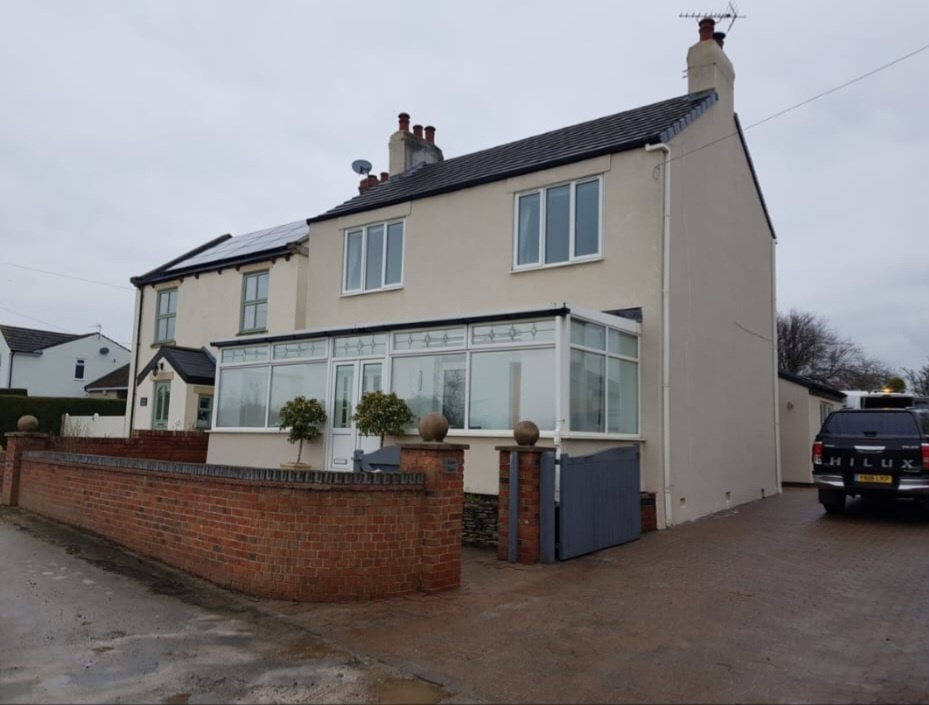
What Does a Damp Patch on Render Look Like?
Moisture usually changes the appearance of render because a wet surface reflects light differently from a dry one. On pale render in particular, this can produce obvious grey, brown or dark patches.
Common signs include:
- Dark areas beneath windowsills
- Vertical streaks running down walls
- Patches beneath guttering
- Dark staining around downpipes
- Damp-looking areas close to ground level
- Large patches on shaded elevations
- Marks beneath coping stones or roof edges
- Green algae and red algae developing in persistently damp areas
- Black mould or spotting
- Areas that remain darker long after surrounding render has dried
The location and shape of the patch can provide useful clues about what is causing it.
| Appearance | Possible Cause | What to Check |
|---|---|---|
| Vertical dark streak | Rainwater run-off | Sills, coping and roof drainage |
| Patch below gutter | Overflowing or leaking gutter | Gutter joints and outlets |
| Patch around downpipe | Leak or defective joint | Downpipe connections |
| Dark area near ground | Splashback or persistent moisture | Drainage and ground levels |
| Green/red staining | Green algae and red algae | Shading and moisture levels |
| Dark patches below cracks | Possible water penetration | Condition of render |
| Large shaded patch | Slow drying | Orientation, trees and vegetation |
| Black spotting | Mould or organic contamination | Surface condition and moisture |
Rainwater Is One of the Most Common Causes
Rendered walls are designed to cope with normal exposure to rain. However, this does not mean that every part of a rendered elevation dries at exactly the same speed.
Certain areas receive considerably more water than others.
For example, water may repeatedly run down one section of wall because of the shape of the roof, windowsills or architectural details. During prolonged periods of wet weather, these areas can remain visibly darker.
The problem can become particularly noticeable during autumn and winter when temperatures are lower and there is less sunlight available to dry exterior walls.
A patch that appears immediately after heavy rain and gradually disappears as the wall dries may simply be associated with normal weather exposure. However, an area that remains wet substantially longer than the surrounding render deserves closer attention.
Leaking and Overflowing Gutters
Guttering plays an important role in keeping large volumes of rainwater away from exterior walls.
A relatively small gutter problem can create a surprisingly large damp-looking area on render.
Potential problems include:
- Blocked gutters
- Loose gutter joints
- Cracked sections
- Incorrect gutter falls
- Blocked outlets
- Overflow during heavy rainfall
- Defective downpipe connections
When water repeatedly runs down the same section of render, the wall may develop a persistent dark streak.
Eventually, the additional moisture can also create favourable conditions for biological growth.
This is why cleaning the visible staining without dealing with the source of the water may only provide a temporary improvement.
Problems Around Windowsills
Windowsills should encourage rainwater to move away from the face of a building.
However, water can sometimes track back towards the wall or repeatedly run down particular sections beneath a window.
You might notice two distinctive dark streaks beneath the corners of a sill or a larger patch directly below the window.
Dirt and atmospheric contamination carried by rainwater can make these marks even more obvious.
Over time, repeatedly damp areas can also become suitable environments for green algae and red algae, making what originally appeared to be a simple water mark increasingly noticeable.
Why Shaded Walls Often Look Damper
Have you noticed that one side of your house looks significantly worse than another?
Orientation can make a substantial difference.
North-facing elevations generally receive less direct sunlight, meaning rainwater and morning moisture can take longer to evaporate. Walls shaded by neighbouring buildings, trees, fences or dense vegetation can experience similar conditions.
| Wall Condition | Likely Drying Speed | Risk of Organic Staining |
|---|---|---|
| Sunny and exposed | Faster | Lower |
| North-facing | Slower | Higher |
| Shaded by trees | Slower | Higher |
| Surrounded by dense planting | Slower | Higher |
| Protected from airflow | Slower | Higher |
| Regularly exposed to run-off | Variable | Higher |
A wall does not necessarily need to have a structural damp problem to appear darker. Sometimes it is simply remaining wet for much longer than another elevation.
However, prolonged surface moisture can encourage contamination to establish itself.
Green Algae and Red Algae Can Look Like Damp
One particularly important distinction is the difference between actual moisture and biological staining.
Render can become contaminated with green algae and red algae, along with mould, mildew, moss, lichen and other organic growth.
During the early stages, contamination may simply make sections of render appear darker. From a distance, homeowners can easily mistake this for damp.
Once established, biological growth can also retain moisture at the surface, making affected sections slower to dry.
This can create a cycle:
Moisture → biological growth → increased surface moisture retention → further growth and staining.
Professional render cleaning is therefore not simply about making a wall brighter. Where the discolouration is biological, the organisms responsible for the staining need to be properly treated.
Softwashing UK uses specialist softwashing methods designed to treat organic contamination while avoiding the unnecessary risks associated with aggressive high-pressure cleaning.
Trees and Vegetation Can Contribute
A beautifully planted garden can unfortunately create favourable conditions for staining on exterior walls.
Large trees and shrubs can:
- Block sunlight
- Reduce airflow
- Increase local humidity
- Deposit organic debris
- Encourage surface moisture to remain for longer
Render immediately behind dense vegetation may consequently stay damp considerably longer after rainfall.
Branches touching or overhanging the building can make matters worse.
This does not mean that trees need to be removed simply because a rendered wall is becoming stained. However, understanding how the immediate environment affects the wall can help explain why one particular area repeatedly develops damp-looking patches.
Cracks in Render Need to Be Investigated
Not every damp patch is cosmetic.
Cracks should always receive appropriate attention because they can potentially provide a route for moisture to enter areas it would not normally reach.
Small cracks may develop because of movement, weathering, impact or problems elsewhere within the building.
Warning signs include:
- Damp patches directly beneath cracks
- Cracks that are widening
- Loose or hollow-sounding render
- Bulging sections
- Repeated moisture staining in exactly the same location
- Internal damp corresponding with an external defect
Cleaning will not repair defective render.
This distinction is extremely important. Professional cleaning can address organic contamination and staining, but underlying building defects need to be rectified separately.
Failed Sealant Around Openings
Doors, windows, vents, pipes and other penetrations create junctions within rendered elevations.
These areas often rely on suitable detailing and sealants to prevent unwanted water penetration.
As materials age, sealants can shrink, crack or separate from surrounding surfaces. Water may then enter around the opening.
If a persistent damp patch appears around a window, door, external fitting or pipe penetration, the condition of the surrounding joints should be inspected rather than assuming that the render simply needs cleaning.
Roof and Coping Problems
Sometimes the apparent render problem actually begins much higher up the building.
Rainwater may reach the wall because of defects involving:
- Roof coverings
- Flashings
- Parapets
- Coping stones
- Fascias
- Guttering
- Roof junctions
Water can then travel across or behind building materials before becoming visible elsewhere.
This is another reason why the position of a damp patch does not always reveal the exact location of the underlying problem.
Ground-Level Splashback
The bottom section of a rendered wall frequently experiences different conditions from areas higher up.
When rain strikes paving, concrete, gravel or soil, water can splash onto the lower render.
Repeated splashback can leave a band of dark staining around the base of a property.
Mud, soil and other contaminants may also be deposited onto the surface.
Properties with poor drainage immediately alongside the building can experience particularly persistent moisture around ground level.
Checking whether rainwater is draining away effectively can therefore be useful when investigating recurring low-level staining.
Is It Damp or Just Dirty Render?
This is one of the most common questions when homeowners first notice darker patches.
A simple visual assessment can sometimes provide clues.
| Sign | More Likely Moisture Related | More Likely Surface Contamination |
|---|---|---|
| Appears immediately after rain | ✓ | |
| Disappears completely when dry | ✓ | |
| Gradually becomes green/red | ✓ | |
| Remains visible during dry weather | ✓ | |
| Concentrated below leaking gutter | ✓ | |
| Spreads slowly over months | ✓ | |
| Associated with black spotting | ✓ | |
| Corresponds with visible crack | ✓ | |
| Worse on shaded elevation | ✓ | ✓ |
In reality, the two issues frequently overlap.
A wall may initially remain damp because it receives little sunlight. Green algae and red algae can then establish themselves because of that moisture. The resulting contamination makes the wall look permanently stained even when the render itself is dry.
Why Pressure Washing Damp-Looking Render Can Be a Mistake
When homeowners see dark staining, the natural reaction can be to reach for a pressure washer.
This can be risky.
Render is not simply another hard surface like a concrete driveway. Excessive pressure can potentially erode the finish, damage coatings or force water into vulnerable areas.
If there are already cracks or defects, introducing large amounts of water at high pressure can make matters worse.
Pressure washing also focuses primarily on physically removing visible material. Where staining is caused by biological contamination, simply blasting the surface does not necessarily address the organisms responsible for the problem.
Softwashing takes a different approach.
Rather than depending on extreme pressure, specialist treatments are used to target organic contamination. This makes it particularly suitable for rendered surfaces where preservation of the finish is important.
Different Render Types Can Behave Differently
Not every rendered wall responds to moisture in exactly the same way.
Modern and traditional properties can have a variety of finishes, including:
- K-Rend
- Monocouche render
- Silicone render
- Acrylic render
- Painted render
- Traditional sand and cement render
- Roughcast and textured finishes
Some systems are more water-repellent, while others are naturally more porous.
Age, condition, previous repairs and coatings can also affect how evenly a wall becomes wet and how quickly it subsequently dries.
This is why professional assessment before cleaning is important. The correct method should be based on the actual substrate and its condition rather than assuming every rendered property can be treated identically.
When Does a Damp Patch Need Further Investigation?
Not every mark requires urgent action, but persistent or unusual moisture should not simply be ignored.
Further investigation is sensible when:
- The patch never fully dries.
- It repeatedly appears in exactly the same location.
- There are visible cracks nearby.
- Render is loose, bulging or damaged.
- There is corresponding damp internally.
- Guttering or drainage appears defective.
- Water is visibly running down the wall.
- Sealant around windows or doors has failed.
- Staining rapidly returns after cleaning.
- The affected area is becoming progressively larger.
The objective should always be to identify the cause before deciding on the remedy.
Cleaning After the Moisture Problem Has Been Addressed
Even after a leaking gutter, defective seal or drainage problem has been repaired, the evidence can remain on the render.
Months or years of repeated moisture exposure may have allowed green algae and red algae, mould, mildew or lichen to become established.
Fixing the water source does not automatically remove this contamination.
This is where specialist render cleaning can become an important part of restoring the building’s appearance.
Softwashing UK provides professional cleaning for rendered exterior surfaces, using methods selected according to the render type, its condition and the nature of the contamination.
Preventing Damp-Looking Render from Returning
There is no way to prevent exterior walls from being exposed to British weather, but sensible property maintenance can reduce persistent moisture problems.
| Maintenance Task | Why It Helps |
|---|---|
| Keep gutters clear | Reduces overflowing water |
| Inspect downpipes | Identifies leaks and failed joints |
| Check render for cracks | Helps identify possible entry points |
| Maintain window sealants | Reduces water penetration around openings |
| Manage dense vegetation | Improves airflow and sunlight |
| Check ground drainage | Reduces persistent low-level moisture |
| Treat organic contamination | Helps control green algae and red algae, mould and lichen |
| Arrange appropriate render cleaning | Removes established surface staining |
It is also worth observing the property during heavy rainfall. This can reveal problems that may be impossible to spot on a dry day.
You may discover that a gutter is overflowing, water is pouring from a roof junction or a windowsill is directing rainwater onto one particular section of render.
Why Early Attention Makes Sense
A small dark patch can be easy to ignore, particularly if it is located on the side or rear of a property.
However, monitoring changes can help distinguish temporary weather-related moisture from a developing maintenance issue.
Photographing the affected area every few months can be useful. If the patch becomes larger, changes colour or develops obvious green algae and red algae, you will have a clearer record of how quickly the problem is progressing.
For widespread organic staining, professional cleaning can restore the appearance of the render without immediately resorting to repainting or replacement.
For specialist advice on cleaning stained, discoloured or algae-affected exterior render, visit Softwashing UK.
Why Damp Patches Can Become More Noticeable in Winter
Rendered walls can look noticeably different during the colder months. A property that appears relatively clean throughout spring and summer may suddenly develop much darker areas once autumn and winter arrive.
This is often because moisture remains on exterior surfaces for longer. Lower temperatures, shorter daylight hours and reduced direct sunlight all slow down the drying process. Frequent rainfall can also mean that certain parts of a rendered wall do not completely dry before they become wet again.
Morning dew adds another source of moisture. Even when there has been no rain overnight, condensation can develop on cold external surfaces. Where staining is already present, this additional moisture can make it look significantly darker.
If green algae and red algae have started developing, damp winter conditions can make the discolouration particularly noticeable. A wall that looked only slightly marked during a dry summer may therefore look dramatically different several months later.
Seasonal changes do not necessarily mean that the render itself has suddenly deteriorated. However, one area consistently remaining wetter than the surrounding wall can indicate that something is contributing to the problem.
The Pattern of the Damp Patch Can Tell You a Lot
Rather than looking only at the colour of a damp patch, consider its shape and location.
Different patterns can point towards different potential causes.
| Pattern on the Render | Possible Explanation |
|---|---|
| Thin vertical streak | Concentrated rainwater run-off |
| Dark patch below guttering | Leaking or overflowing gutter |
| Marks beneath windows | Water running from windowsills |
| Large mottled areas | Uneven drying or organic contamination |
| Dark band at ground level | Rainwater splashback |
| Staining around a crack | Possible moisture penetration |
| Heavy staining behind shrubs | Poor airflow and increased shade |
| Green/red patches | Green algae and red algae growth |
For example, a narrow streak directly beneath a gutter joint would suggest something very different from widespread staining across an entire shaded elevation.
Looking at the complete wall can therefore help homeowners understand whether they are dealing with general weather exposure, biological contamination or a more localised maintenance issue.
New Render Can Develop Damp-Looking Patches Too
Damp-looking staining is sometimes assumed to be a problem associated only with older buildings.
That is not necessarily the case.
New and relatively modern render systems remain exposed to rain, airborne dirt, shade and biological growth just like older exterior surfaces.
The surroundings of the property can be particularly important.
A newly rendered wall positioned behind mature trees or facing an area that receives very little sunlight may begin developing organic staining much sooner than an older wall located in an open, sunny environment.
The design of the building can also influence where moisture collects. Balconies, parapets, rooflines, windowsills and other features can alter the way rainwater travels across an elevation.
Age alone is therefore not a reliable indicator of whether rendered walls will remain free from staining.
Can You Simply Paint Over Damp-Looking Render?
Painting over the affected area may initially seem like an easy solution, particularly where staining is making a pale rendered property look tired.
However, covering the visible marks without first understanding what caused them can be counterproductive.
If green algae and red algae or other biological contamination are present, applying a decorative coating directly over them does not properly deal with the contamination beneath.
Likewise, if a gutter is leaking onto the wall, repainting the render will do nothing to prevent that area from repeatedly becoming wet.
Cleaning and appropriate preparation should therefore come before considering a new decorative coating.
In some circumstances, professional cleaning may reveal that the render itself is still in good condition and that repainting is not necessary. A surface that initially appears faded or badly deteriorated may simply be covered by years of accumulated dirt and biological staining.
Why Damp Patches Sometimes Return After DIY Cleaning
One of the most frustrating situations for homeowners is cleaning a rendered wall, seeing an immediate improvement and then watching the dark patches gradually reappear.
This can happen for several reasons.
Perhaps the source of the moisture has never been corrected. If water continues overflowing from guttering or running repeatedly from a windowsill, the affected area will continue experiencing the same conditions.
Another possibility is that the cleaning method has removed visible surface contamination without effectively treating the biological growth responsible for it.
Environmental conditions also remain important. A permanently shaded elevation will continue drying more slowly than a sunny wall regardless of how clean it is.
This is why identifying the cause of the staining is so important rather than simply concentrating on its appearance.
Why the Condition of Render Should Be Checked Before Cleaning
Before cleaning takes place, it is sensible to assess the general condition of the rendered surface.
An intact wall affected by green algae and red algae can require a very different approach from render that is already cracked or deteriorating.
Potential concerns can include:
- Cracks around windows and doors
- Loose areas of render
- Previous patch repairs
- Flaking coatings
- Failed sealant
- Exposed substrate
- Areas experiencing constant rainwater run-off
Cleaning cannot repair structural or building defects. Where these issues are present, they may need to be dealt with separately.
The condition, age and type of render should also influence the cleaning method used.
Softwashing UK specialises in exterior cleaning methods designed around the surface being treated and the type of contamination present, rather than relying on unnecessarily aggressive pressure.
Why Small Damp Patches Can Make a Whole Property Look Dirty
Even a relatively small amount of staining can dramatically change the appearance of a rendered property.
This is particularly noticeable on white, cream and other pale finishes where dark marks create a strong visual contrast.
Vertical streaks beneath windows, irregular patches around guttering and areas affected by green algae and red algae can make otherwise attractive render look older and poorly maintained.
Once several sections become affected, the appearance of the entire elevation can change.
This is one reason homeowners sometimes assume that their render needs repainting when professional cleaning may be a more appropriate first step.
What Should You Check Before Booking Render Cleaning?
A simple ground-level inspection can help establish whether the problem appears to be surface contamination or something requiring additional investigation.
There is no need to climb ladders or attempt to inspect inaccessible areas yourself.
Instead, consider:
- Does the patch only appear after rainfall?
- Does it remain visible during several days of dry weather?
- Is there guttering immediately above the stain?
- Is the wall heavily shaded?
- Are there cracks in the affected area?
- Can you see green algae and red algae?
- Is water visibly running across the render when it rains?
- Is there corresponding dampness inside the property?
Taking photographs during wet weather and comparing them with photographs taken after several dry days can also be useful.
If the dark area disappears completely, moisture may primarily be responsible. If significant staining remains when the wall is dry, organic contamination could be contributing to its appearance.
Where the underlying building is sound and the issue is established exterior contamination, professional treatment from Softwashing UK can help remove the staining while using a method suitable for rendered surfaces.