


Many homeowners notice that their render looks significantly dirtier during the winter months. Walls that appeared bright and clean in late summer can quickly become stained with green, red and black patches once colder weather arrives.
This isn’t simply because of rain or bad weather. Winter creates the perfect environment for biological growth, moisture retention and airborne contamination, all of which combine to make render look tired and neglected.
Understanding why render becomes dirtier during winter can help you protect your property and decide when professional cleaning is needed.
At Softwashing UK, we regularly clean render throughout the year, removing biological contamination safely using professional soft washing techniques designed to protect delicate render finishes.
Why Winter Creates the Perfect Conditions
Winter brings together several environmental factors that encourage contamination.
These include:
- Increased rainfall
- Higher humidity
- Reduced sunshine
- Lower temperatures
- Longer periods of damp weather
- Shorter daylight hours
Unlike summer, where render often dries quickly after rain, winter moisture can remain on walls for days.
| Winter Condition | Effect on Render |
|---|---|
| Frequent rainfall | Constant dampness |
| Cold temperatures | Slower evaporation |
| High humidity | Moisture remains longer |
| Short daylight hours | Reduced drying |
| Limited sunshine | Encourages biological growth |
These conditions create the ideal environment for algae, mould and other organisms.
Moisture Is the Biggest Cause
Render itself doesn’t become dirty overnight.
Instead, moisture allows contaminants to establish themselves.
When walls remain damp for prolonged periods:
- Green algae develops
- Red algae spreads
- Black mould forms
- Lichen becomes established
- Dirt sticks more easily
The longer render stays wet, the faster contamination grows.
Why North-Facing Walls Always Look Worse
Many homeowners notice one side of the property becoming dirtier than the others.
This is usually the north-facing elevation.
Because it receives very little direct sunlight during winter, moisture evaporates much more slowly.
This creates ideal conditions for:
- Green algae
- Red algae
- Moss
- Lichen
- Black mould
South-facing walls usually dry faster because they receive more sunlight.
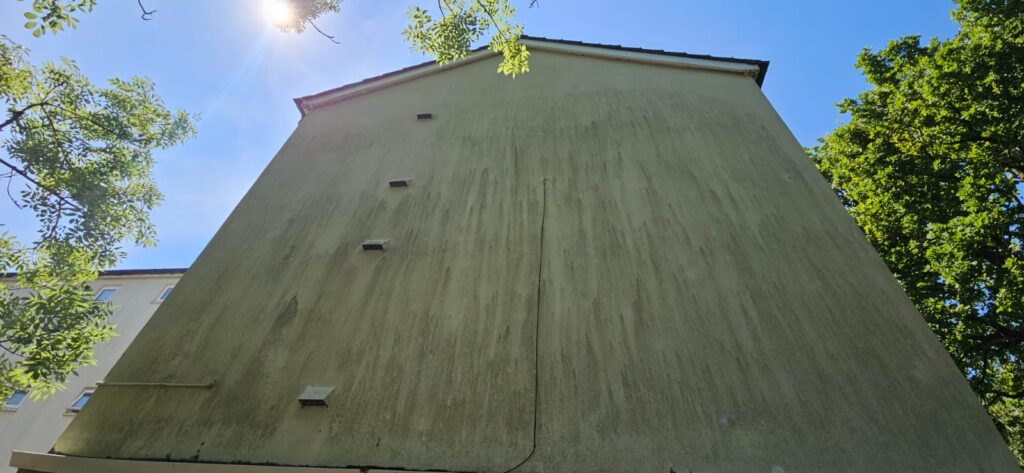
Green Algae Thrives in Winter
Green algae is one of the most common causes of render staining.
It prefers:
- Damp surfaces
- Shade
- Cool temperatures
- Poor airflow
It often begins as faint green patches before gradually spreading across larger areas.
Without treatment, it continues growing throughout much of the winter.
Red Algae Is Becoming More Common
Red algae is increasingly affecting rendered properties across the UK.
Unlike green algae, it often appears as:
- Pink staining
- Orange streaks
- Rust-coloured patches
- Red discolouration
It commonly develops on modern coloured renders and can become extremely difficult to remove if left untreated.
Professional soft washing treats both green algae and red algae while helping reduce future regrowth.
Rain Doesn’t Wash Render Clean
Many people assume frequent winter rain naturally cleans exterior walls.
Unfortunately, the opposite is usually true.
Rainwater often carries:
- Air pollution
- Dust
- Organic debris
- Spores
- Tree residue
These contaminants settle on damp render where they become trapped.
Over time this creates increasingly visible staining.
| Rainfall Effect | Result |
|---|---|
| Washes airborne dirt onto render | More staining |
| Keeps walls damp | More algae |
| Carries spores | Biological growth |
| Increases moisture | Slower drying |
Trees Make Winter Contamination Worse
Properties surrounded by trees often suffer the greatest winter staining.
Trees contribute:
- Shade
- Falling leaves
- Organic debris
- Moisture retention
- Reduced airflow
Even evergreen trees can significantly slow drying after rainfall.
The result is a perfect environment for biological growth.
Poor Airflow Slows Drying
Some properties remain damp far longer than others.
Reasons include:
- High fences
- Close neighbouring buildings
- Dense hedges
- Large shrubs
- Narrow alleyways
Without good airflow, moisture evaporates much more slowly.
The longer moisture remains, the dirtier render becomes.
Mould Loves Winter Conditions
Black mould frequently develops alongside algae.
It commonly appears:
- Around windows
- Beneath gutters
- Behind downpipes
- On shaded elevations
Besides looking unsightly, mould holds moisture against the render and can contribute to further staining.
Lichen Becomes More Noticeable
Lichen grows slowly but becomes highly visible during winter.
Unlike algae, it cannot simply be rinsed away.
Professional treatment is usually needed to remove it safely.
Older rendered properties often develop extensive lichen colonies after years of moisture exposure.
Atmospheric Pollution Adds to Winter Dirt
Even rural properties collect airborne pollution.
Urban locations often experience even greater contamination.
Sources include:
- Vehicle emissions
- Industrial pollution
- Smoke particles
- Dust
- Organic debris
These particles adhere much more readily to damp render than dry surfaces.
Why Older Render Gets Dirtier Faster
As render ages, it often becomes:
- More porous
- Rougher
- Less water repellent
These changes allow contaminants to attach more easily.
Older render therefore tends to stain much faster during winter.
| Older Render Characteristic | Effect |
|---|---|
| Increased porosity | Greater moisture absorption |
| Rough texture | Dirt traps more easily |
| Weathering | Faster biological growth |
| Small cracks | Moisture retention |
Blocked Gutters Make Things Worse
Overflowing gutters constantly wet nearby render.
This creates ideal growing conditions for:
- Green algae
- Red algae
- Black mould
- Moss
Water staining beneath gutter joints often indicates drainage problems rather than render defects.
Regular gutter maintenance helps reduce winter staining.
Why Window Areas Become Dirty
Render surrounding windows frequently develops staining first.
Reasons include:
- Condensation
- Reduced airflow
- Window drip marks
- Dirt accumulation
- Rainwater concentration
These areas often require additional attention during professional cleaning.
Does Render Colour Matter?
Yes.
Lighter coloured render generally shows contamination more clearly.
White and cream finishes quickly reveal:
- Green algae
- Red algae
- Black mould
- Pollution staining
Darker render hides dirt slightly better but still suffers from biological growth.
Winter Humidity Is Often Overlooked
Many people focus only on rainfall.
Humidity is equally important.
Even on dry winter days, high humidity slows evaporation.
Render therefore remains damp for much longer than homeowners realise.
The surface may appear dry while moisture remains beneath.
Frost Doesn’t Kill Algae
It’s easy to assume freezing temperatures solve biological problems.
In reality, many organisms simply become dormant before continuing to grow once temperatures rise.
This explains why stained render often looks even worse during early spring.
Professional cleaning removes contamination rather than waiting for weather to deal with it naturally.
Can Dirt Damage Render?
Most contamination begins as a cosmetic issue.
However, prolonged biological growth can contribute to:
- Moisture retention
- Surface staining
- Increased maintenance
- Paint adhesion problems
- Greater cleaning difficulty
Regular maintenance helps prevent long-term deterioration.
Signs Your Render Needs Cleaning
Winter often makes contamination much easier to identify.
Look for:
- Green staining
- Red staining
- Black mould
- Lichen
- General discolouration
- Patchy appearance
- Dirty streaks beneath gutters
Early cleaning is generally simpler than removing years of established growth.
Why DIY Cleaning Often Falls Short
Many homeowners attempt to clean render using domestic pressure washers.
Unfortunately, this often causes more harm than good.
High-pressure cleaning may:
- Damage render finishes
- Force water into cracks
- Remove protective coatings
- Leave biological spores behind
- Create uneven cleaning patterns
Professional soft washing uses carefully controlled cleaning solutions with low-pressure application to remove contamination while protecting the render surface.
| DIY Cleaning | Professional Soft Washing |
|---|---|
| High pressure | Low pressure |
| Greater risk of damage | Gentle on render |
| May only remove surface staining | Treats biological growth |
| Uneven results | Consistent finish |
| Limited long-term control | Helps reduce regrowth |
Winter Maintenance Tips
Keeping render cleaner throughout winter starts with regular property maintenance.
Helpful measures include:
- Keeping gutters clear
- Repairing leaking downpipes
- Trimming back trees and shrubs
- Improving airflow around walls
- Removing moss from nearby roofs
- Inspecting shaded elevations regularly
These simple tasks reduce the amount of moisture that remains against rendered surfaces.
Why Professional Cleaning Restores Render Safely
Render is designed to withstand years of exposure to the British weather, but winter creates conditions that accelerate the build-up of dirt and biological growth. Once green algae, red algae, mould and lichen become established, they rarely disappear without treatment.
Professional soft washing offers an effective solution by:
- Removing green algae and red algae safely
- Treating mould and lichen
- Reducing the risk of damaging delicate render finishes
- Using significantly lower pressure than conventional pressure washing
- Helping restore the original appearance of the render
- Providing a cleaner surface that’s easier to maintain
Whether your render is white, coloured, silicone, acrylic, monocouche or traditional cement, regular maintenance helps preserve its appearance throughout the winter months. Professional cleaning from Softwashing UK provides a safe and effective way to tackle winter contamination while protecting the long-term condition of your property’s exterior.
Why Coastal Properties Often Get Dirtier in Winter
Homes located near the coast face additional challenges during the winter months.
Strong winds carry salt particles, sand and moisture onto exterior surfaces, where they combine with existing dirt and biological growth. Although salt itself doesn’t cause algae, it contributes to a harsher environment that leaves render looking weathered more quickly.
Coastal properties are also exposed to:
- Driving rain
- Higher wind speeds
- Increased airborne debris
- Greater moisture exposure
- Salt deposits
These conditions mean render often benefits from more regular maintenance than similar properties located inland.
| Property Location | Typical Winter Contamination |
|---|---|
| Coastal | Salt, algae, dirt and weather staining |
| Rural | Organic debris, algae and lichen |
| Urban | Pollution, dirt and biological growth |
| Woodland | Heavy green algae, red algae and moss |
Why New Build Estates Can Experience Rapid Algae Growth
Many homeowners are surprised when relatively new properties begin showing green or red staining after only a few winters.
This isn’t necessarily due to poor-quality render.
Modern housing developments often include:
- Closely spaced properties
- Young landscaping that traps moisture as it matures
- North-facing plots
- Limited airflow between homes
Combined with the UK’s wet climate, these conditions allow green algae and red algae to establish surprisingly quickly.
Regular soft washing helps maintain the clean appearance that new render is intended to provide.
The Cost of Leaving Render Untreated
Initially, winter staining is largely cosmetic.
However, delaying cleaning for several years can increase maintenance costs.
Problems may include:
| Issue | Potential Cost Implication |
|---|---|
| Heavy biological growth | Longer, more intensive cleaning |
| Extensive staining | More specialist treatment required |
| Repainting sooner than expected | Hundreds or even thousands of pounds depending on property size |
| Repairs to damaged render | Additional labour and materials |
Preventative maintenance is usually far more cost-effective than waiting until contamination becomes severe.
Frequently Asked Questions
Will the algae disappear on its own in summer?
No. Although hot, dry weather may slow growth temporarily, green algae and red algae usually remain on the render until they’re professionally treated and removed.
Does every rendered house need cleaning?
Not necessarily. The frequency depends on factors such as location, surrounding vegetation, weather exposure and the type of render. Some properties remain clean for years, while others benefit from maintenance every few years.
Is winter the wrong time to arrange cleaning?
Not at all. As long as temperatures are suitable and conditions are safe, winter can be an excellent time to remove biological contamination before it becomes more established.
Can cleaning improve kerb appeal?
Absolutely. Removing green algae, red algae, mould and general winter staining can dramatically improve the appearance of a property, making it look brighter, cleaner and better maintained.
A Proactive Approach to Winter Render Care
Rather than waiting until render looks heavily stained, regular inspections throughout autumn and winter can help identify problems early.
Look out for:
- Faint green patches beginning to appear
- Pink or reddish streaks developing
- Dark staining beneath window sills
- Areas that remain damp long after rainfall
- Organic debris collecting behind downpipes or around gutters
Addressing these signs before they become widespread makes maintenance simpler and helps preserve the appearance of your home’s exterior.
Professional soft washing from Softwashing UK provides an effective way to remove green algae, red algae and other winter contamination while protecting the render itself. By combining safe cleaning methods with preventative treatment, homeowners can keep rendered properties looking their best throughout the changing seasons.