


Schools are among the busiest buildings in the UK, welcoming hundreds or even thousands of pupils, staff and visitors every day. While considerable attention is given to maintaining classrooms, sports facilities and communal areas, the exterior of the building is equally important. Clean, well-maintained render creates a positive first impression, protects the building’s appearance and helps preserve the investment made in school facilities.
Over time, school buildings become exposed to rain, pollution, biological growth and everyday environmental contamination. Without regular maintenance, rendered walls can quickly develop staining from green algae, red algae, dirt and organic matter, making the entire site appear tired and neglected.
At Softwashing UK, we provide specialist render cleaning using professional softwashing techniques designed to safely restore rendered school buildings without the risks associated with high-pressure cleaning.
Why School Buildings Become Dirty So Quickly
Educational buildings experience unique environmental pressures.
Unlike many commercial properties, schools operate almost continuously throughout the academic year, with large numbers of people using entrances, playgrounds and surrounding areas every day.
External render is exposed to:
- Rainfall
- Air pollution
- Wind-blown dust
- Organic debris
- Green algae
- Red algae
- Moss spores
- Bird droppings
- Tree sap
- General environmental dirt
These contaminants gradually build up across rendered walls.
First Impressions Matter
The condition of a school’s exterior influences how pupils, parents, governors and visitors perceive the establishment.
A clean building reflects:
- Pride in the premises.
- Professional standards.
- Effective site management.
- Investment in the learning environment.
- Attention to detail.
Maintaining attractive school buildings contributes positively to the overall appearance of the campus.
Common Areas That Become Stained
Not every section of a school becomes dirty at the same rate.
Certain locations are more susceptible than others.
| Area | Common Cause of Staining |
|---|---|
| Main entrances | High footfall and pollution |
| Playground walls | Dirt and splashback |
| North-facing elevations | Green algae and red algae |
| Sports halls | Weather exposure |
| Dining areas | General environmental contamination |
| Rear service yards | Organic debris |
Regular inspections allow these areas to be monitored before staining becomes severe.
How Weather Affects School Render
School buildings remain exposed to changing weather throughout the year.
Rain, wind and damp conditions all contribute to render staining.
Common weather-related issues include:
| Weather Condition | Effect on Render |
|---|---|
| Heavy rain | Water staining |
| Wind | Dirt deposits |
| Frost | Moisture retention |
| Humidity | Slower drying |
| Storms | Organic debris |
| Mild winters | Continued biological growth |
Weather affects every educational building regardless of its age.
Green Algae and Red Algae on School Buildings
One of the most common forms of render staining is biological growth.
Green algae frequently develops on shaded walls where moisture remains for prolonged periods.
Red algae has become increasingly common across the UK and often appears as pink, orange or reddish staining.
Both organisms thrive on damp rendered surfaces.
If left untreated they gradually spread across larger areas, making buildings appear poorly maintained.
Professional softwashing treats the biological contamination rather than simply washing away the visible staining.
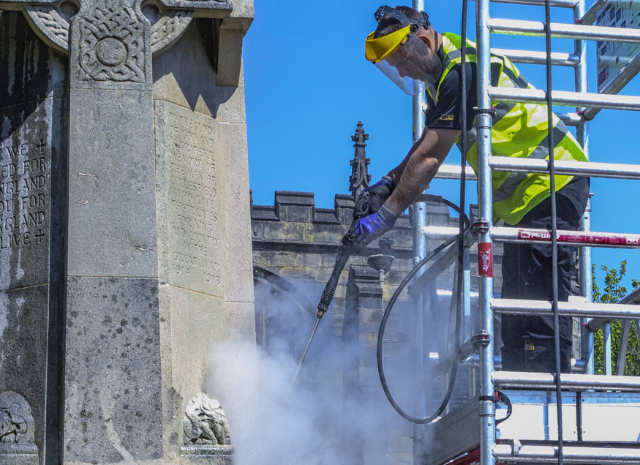
Why Schools Should Avoid Pressure Washing
It may seem tempting to use pressure washing on heavily stained render.
However, high-pressure cleaning can damage many render systems.
Potential risks include:
| Risk | Possible Consequence |
|---|---|
| Surface erosion | Decorative finish damaged |
| Water ingress | Moisture enters render |
| Uneven cleaning | Patchy appearance |
| Existing cracks worsen | Increased maintenance |
| Reduced lifespan | Earlier repairs required |
Professional softwashing offers a much gentler approach.
What Is Softwashing?
Softwashing is a specialist cleaning method developed for delicate exterior surfaces.
Rather than relying on force, specialist treatments remove biological growth safely.
Typical stages include:
- Building inspection.
- Risk assessment.
- Identification of staining.
- Application of specialist cleaning solutions.
- Appropriate dwell time.
- Gentle rinsing where required.
This approach helps restore render while protecting its finish.
Benefits for Pupils and Staff
Although render cleaning is primarily an exterior maintenance task, maintaining an attractive school environment offers wider benefits.
A clean campus creates:
- A welcoming atmosphere.
- Improved staff pride.
- Better visitor impressions.
- Enhanced appearance during inspections.
- More attractive surroundings for learning.
Well-maintained educational facilities demonstrate ongoing care for the entire site.
School Types That Benefit
Professional render cleaning is suitable for many educational settings.
Examples include:
- Primary schools
- Secondary schools
- Academies
- Colleges
- Universities
- Independent schools
- Nurseries
- Special educational facilities
- Sixth-form colleges
Any rendered educational building benefits from regular maintenance.
Seasonal Maintenance
Every season creates different maintenance requirements.
| Season | Priority |
|---|---|
| Spring | Remove winter biological growth |
| Summer | Inspect render during holidays |
| Autumn | Remove leaves and debris |
| Winter | Monitor damp areas |
Planning maintenance throughout the year helps reduce long-term staining.
Why School Holidays Are Ideal
Many schools arrange external maintenance during holiday periods.
This offers several advantages.
Cleaning can be completed with:
- Reduced pedestrian traffic.
- Fewer vehicle movements.
- Easier equipment access.
- Minimal disruption to lessons.
- Greater flexibility for contractors.
Summer holidays are particularly popular for planned exterior works.
Trees Around School Grounds
Many schools benefit from mature landscaping.
While attractive, trees also increase the likelihood of render staining.
Trees contribute:
- Shade
- Organic debris
- Sap
- Moss spores
- Reduced airflow
- Leaf accumulation
This creates favourable conditions for both green algae and red algae.
Managing Large Campuses
Schools often consist of multiple buildings.
These may include:
- Main teaching blocks
- Sports halls
- Libraries
- Administration buildings
- Sixth-form centres
- Dining facilities
- Drama studios
Each building may require different cleaning schedules depending on age, orientation and surrounding vegetation.
Health and Safety During Cleaning
Educational environments require careful planning.
Professional contractors consider:
- Safe pedestrian routes.
- Emergency access.
- Vehicle segregation.
- Working at height.
- Protection of landscaped areas.
- Weather conditions.
Careful preparation helps ensure work is completed safely.
Preventing Future Staining
Although render naturally becomes dirty over time, several measures help slow contamination.
| Maintenance Activity | Benefit |
|---|---|
| Clean gutters | Reduce overflow |
| Trim trees | Improve airflow |
| Remove moss nearby | Reduce biological contamination |
| Inspect drainage | Prevent splashback |
| Schedule professional softwashing | Maintain appearance |
Routine maintenance helps preserve the exterior between professional cleans.
Budgeting for School Maintenance
Exterior maintenance should form part of planned facilities management.
Allowing staining to become severe often results in larger restoration projects later.
Regular maintenance provides:
- Better budgeting.
- Predictable maintenance costs.
- Improved appearance.
- Longer-lasting render.
- Easier property management.
A proactive approach often delivers better long-term value.
Environmental Factors Around Schools
Every school is different.
Several factors influence how quickly render becomes stained.
| Environmental Factor | Impact |
|---|---|
| Busy roads | Pollution |
| Playing fields | Dust |
| Trees | Organic debris |
| Sheltered courtyards | Damp conditions |
| High rainfall | Moisture retention |
| North-facing walls | Green algae and red algae growth |
Understanding these conditions helps determine maintenance priorities.
Signs Render Needs Cleaning
Routine inspections help identify developing problems.
Common warning signs include:
- Green algae
- Red algae
- Black streaks
- Water staining
- Moss growth
- Dirty entrance areas
- Uneven colouring
- General dull appearance
Early intervention often makes cleaning simpler and more effective.
Why Professional Assessment Matters
Every rendered school building is different.
Cleaning methods should always take into account:
- The render type.
- Building age.
- Existing condition.
- Height.
- Access requirements.
- Surrounding environment.
A tailored approach helps achieve the best results while protecting the building’s exterior.
Supporting Long-Term Building Maintenance
Render cleaning forms an important part of a wider property maintenance strategy.
Alongside roof inspections, gutter clearing, drainage maintenance and external repairs, keeping rendered walls clean allows facilities teams to identify developing defects before they become costly problems.
Professional cleaning also helps maintain the overall appearance of the school estate, ensuring buildings continue to present a welcoming environment for pupils, staff and visitors throughout the year.
For schools looking to protect their rendered buildings, Softwashing UK provides specialist softwashing services designed to safely remove dirt, pollution, green algae and red algae while preserving the integrity of modern render systems. Their professional approach helps educational facilities maintain clean, attractive buildings with minimal disruption to day-to-day operations.
Creating a Planned Render Maintenance Programme for Schools
Rather than waiting until staining becomes obvious, many schools benefit from introducing a planned exterior maintenance programme.
Routine inspections allow facilities managers and site teams to identify developing issues before they spread across large areas of render.
A simple maintenance schedule may include:
| Frequency | Recommended Action |
|---|---|
| Monthly | Visual inspection of rendered elevations |
| Each School Holiday | Check gutters, drainage and biological growth |
| Twice Yearly | Inspect all external walls for staining |
| Annually | Arrange a full professional assessment where required |
This proactive approach helps maintain a consistently clean appearance throughout the academic year.
How Different School Locations Affect Render
No two schools are exposed to identical environmental conditions.
The surrounding environment has a major influence on how quickly rendered walls become stained.
For example:
- Rural schools may experience more moss spores and organic debris.
- Urban schools often accumulate traffic pollution more quickly.
- Coastal schools can be exposed to salt-laden air and stronger winds.
- Schools surrounded by woodland usually experience slower drying times due to increased shade.
These environmental differences mean cleaning schedules should always be based on the individual site rather than following a fixed timetable.
Why Entrances Deserve Special Attention
The main entrance creates the first impression for everyone arriving at the school.
Parents, pupils, prospective families, governors and visitors all pass through this area.
Because entrances receive constant use, they are also exposed to:
- Increased foot traffic.
- Vehicle pollution.
- Mud during wet weather.
- Splashback from surrounding paving.
- General environmental dirt.
Keeping entrance areas clean helps present the entire school in a positive light.
Protecting Investment in School Buildings
Modern school buildings represent a significant financial investment.
Render is chosen not only because it looks attractive but also because it provides long-lasting weather protection.
Like any external finish, however, it performs best when properly maintained.
Routine cleaning supports wider maintenance by allowing site teams to identify:
- Small cracks.
- Failed sealants.
- Damaged gutters.
- Overflowing downpipes.
- Areas of persistent dampness.
Spotting these issues early often prevents larger repair projects in the future.
Managing Biological Growth Around School Grounds
Many educational sites feature extensive landscaping including lawns, mature trees, flower beds and sports fields.
Although these create attractive surroundings, they also contribute to biological growth on nearby render.
Common sources include:
| Source | Effect |
|---|---|
| Trees | Shade and falling organic debris |
| Grassed areas | Increased moisture |
| Flower beds | Splashback during rainfall |
| Hedges | Restricted airflow |
| Moss on nearby roofs | Spore transfer |
Managing surrounding vegetation helps reduce the conditions that encourage green algae and red algae.
Cleaning Multi-Building School Campuses
Larger educational sites often contain buildings of different ages and construction types.
These may include:
- Teaching blocks.
- Sports centres.
- Libraries.
- Technology buildings.
- Dining halls.
- Administrative offices.
- Sixth-form facilities.
Some buildings may require attention sooner than others depending on their orientation, height and surrounding landscape.
A phased maintenance programme allows work to be prioritised efficiently.
Frequently Asked Questions
How often should school render be professionally cleaned?
There is no universal schedule. Factors such as local weather, nearby trees, pollution levels and the amount of biological growth all influence how frequently cleaning may be beneficial.
Can green algae and red algae spread across the building?
Yes. Both are living biological organisms that can gradually expand across damp rendered surfaces if left untreated.
Is softwashing suitable for modern school buildings?
Professional softwashing is widely used on many modern render systems because it focuses on removing biological contamination without relying on excessive pressure.
Will pupils need to leave the school during cleaning?
Not necessarily. Many projects are carefully planned during school holidays or quieter periods, although work can often be completed safely during term time with appropriate site management where required.
Why does staining usually appear on one side of the building first?
North-facing or shaded elevations often remain damp for longer after rainfall, creating ideal conditions for biological growth.
Supporting School Facilities Management
Render cleaning is only one element of effective estate management, but it complements many other maintenance activities.
Exterior inspections are often coordinated alongside:
- Roof maintenance.
- Gutter cleaning.
- Window cleaning.
- External decorating.
- Grounds maintenance.
- Drainage inspections.
Combining these activities helps reduce disruption while maintaining a high standard across the entire site.
Why Preventative Maintenance Makes Financial Sense
Allowing staining to build over several years can make restoration more time-consuming than dealing with contamination as it develops.
Preventative maintenance offers several practical advantages.
| Preventative Maintenance | Long-Term Benefit |
|---|---|
| Regular inspections | Early identification of issues |
| Prompt gutter repairs | Less water staining |
| Vegetation management | Improved drying conditions |
| Periodic softwashing | Slower biological regrowth |
| Planned budgeting | Reduced unexpected maintenance costs |
For schools operating within carefully managed maintenance budgets, planned exterior care helps spread costs more predictably over time.
Creating a Positive Learning Environment
Although render cleaning is an external maintenance task, the overall condition of school buildings contributes to the atmosphere experienced by everyone using the site.
Clean, well-presented buildings help demonstrate that the premises are cared for and professionally maintained.
For pupils, staff, parents and visitors alike, attractive surroundings support a welcoming environment while reinforcing confidence in the school’s facilities.
For educational establishments looking to maintain clean, professional-looking buildings throughout the year, Softwashing UK provides specialist render cleaning using professional softwashing techniques. Their tailored approach safely removes dirt, pollution, green algae and red algae while protecting modern render systems, helping schools preserve the appearance of their buildings and support long-term maintenance planning.